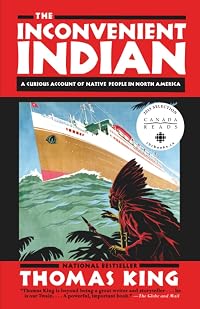
The Inconvenient Indian: A Curious Account of Native People in North America
by Thomas King
On This Page
Description
In this book, the author offers a deeply knowing, darkly funny, unabashedly opinionated, and utterly unconventional account of Indian-White relations in North America since initial contact. In the process, he refashions old stories about historical events and figures. Ranging freely across the centuries and the Canada-U.S. border, he debunks fabricated stories of Indian savagery and White heroism, takes an oblique look at Indians (and cowboys) in film and popular culture, wrestles with the show more history of Native American resistance and his own experiences as a Native rights activist, and articulates a profound, revolutionary understanding of the cumulative effects of ever-shifting laws and treaties on Native peoples and lands. At once a "history" and the complete subversion of a history, this is a critical and personal meditation that the author has conducted over the past 50 years about what it means to be "Indian" in North America. This book distills the insights gleaned from that meditation, weaving the curiously circular tale of the relationship between non-Natives and Natives in the centuries since the two first encountered each other. show lessTags
Recommendations



















Member Recommendations
Member Reviews
Thomas King does a remarkable thing here, not just in content but in the tone he creates: he's an average guy just sharing a beer with you, talking about stuff, and the topic wanders over into his indigenous background. Then he starts telling you the most incredible stuff from his perspective that sheds a bright light on every illusion about the topic, in between making your laugh. It's an exercise for the reader to determine which illusions are their own and figure out what to make of the pieces after they've been shattered. Happily I could deny being prey to a few of them, but others struck home. In my edition there's an appendix where King outlines why he incorporated humor - to keep people reading, to offer respite, or to highlight show more the tragedy. He missed one more benefit, its aid to memory. My favourite line was his insistence there's nothing up his sleeve, which causes me to remember the erosion of status.
What do today's indigenous people really think about their history, about their representation in movies and advertising, about traditional garb and the image it conveys? This provides an excellent portal into speaking about indigenous history and the wrongs of the past. Some of the issues he raises are very complex, but when he could have become lost in the weeds (and his readers with him) he uses fun metaphors and sarcasm to make his key points explicit. Comparing the First Nations with furniture especially hit home with me: like being moved about a house whenever they're in the way, never mind that the house was theirs to begin with.
King has an enormous consciousness of not just the indigenous perspective but the non-indigenous perspective as well, which makes his arguments accessible to any audience. His humour often cuts both ways, so you understand the joke and why it's not a joke at the same time. He does a fabulous job of tearing down the biggest objection: why do we rehash the past like this, it wasn't our generation that did these things. Why not just let it all go? True, we may not be shooting at one another over the issue anymore, but the attitudes that were behind it prevail and are still part of our present. The issues are still with us today, impacting indigenous lives. We can't even say that it's at least more civil or there's less violence: look at the missing women, the starlight tours, the persisting stereotypes. Like anyone else indigenous people just want to be left alone, on their land, doing with it as they see fit. Until they are being seen and treated as equals, by society and by the law - which includes reconciliation and some long-overdue reparations - the past will remain North America's present. show less
What do today's indigenous people really think about their history, about their representation in movies and advertising, about traditional garb and the image it conveys? This provides an excellent portal into speaking about indigenous history and the wrongs of the past. Some of the issues he raises are very complex, but when he could have become lost in the weeds (and his readers with him) he uses fun metaphors and sarcasm to make his key points explicit. Comparing the First Nations with furniture especially hit home with me: like being moved about a house whenever they're in the way, never mind that the house was theirs to begin with.
King has an enormous consciousness of not just the indigenous perspective but the non-indigenous perspective as well, which makes his arguments accessible to any audience. His humour often cuts both ways, so you understand the joke and why it's not a joke at the same time. He does a fabulous job of tearing down the biggest objection: why do we rehash the past like this, it wasn't our generation that did these things. Why not just let it all go? True, we may not be shooting at one another over the issue anymore, but the attitudes that were behind it prevail and are still part of our present. The issues are still with us today, impacting indigenous lives. We can't even say that it's at least more civil or there's less violence: look at the missing women, the starlight tours, the persisting stereotypes. Like anyone else indigenous people just want to be left alone, on their land, doing with it as they see fit. Until they are being seen and treated as equals, by society and by the law - which includes reconciliation and some long-overdue reparations - the past will remain North America's present. show less
If you’re looking for a blunt collection of thoughts on the course of the history of North American Indians, then look no further than Thomas King’s The Inconvenient Indian. King, a member of the Cherokee Nation, tackles the history of the American Indian from the point of view of a novelist, and so this isn’t as stringent a history book as one might hope for. But that doesn’t prevent him from presenting a chronicle of how Native Indian history and North American history have intertwined. It’s interesting and insightful but clearly opinionated. In any case, however, King’s prose is fun, witty, and also challenging to hear.
This history includes perspectives from both American and Canadian tribes, and learning more about the show more native peoples of Canada was very refreshing. We so often hear the plight of Native Americans that we forget about those who were living elsewhere on the continent. The only thing that this book lacks is adequate source documentation or footnotes for his information. King gladly states that he isn’t out to write a scholarly or complete history, but a few citations wouldn’t hurt his cause. A pleasant but slightly biased read. show less
This history includes perspectives from both American and Canadian tribes, and learning more about the show more native peoples of Canada was very refreshing. We so often hear the plight of Native Americans that we forget about those who were living elsewhere on the continent. The only thing that this book lacks is adequate source documentation or footnotes for his information. King gladly states that he isn’t out to write a scholarly or complete history, but a few citations wouldn’t hurt his cause. A pleasant but slightly biased read. show less
This book is one of the five finalists in the CBC Canada Reads competition for 2015. The theme of this year's competition is "One book to break barriers". I must confess that the only other book in this year's competition that I have read is Ru by Kim Thuy which is about the experiences of a young Vietnamese woman who immigrates to Canada. The other nominated books are And the Birds Rained Down by Jocelyne Saucier (a novel about two boys living in the woods on their own), Intolerable by Kamal Al-Solaylee (a memoir about an Islamic man coming out as gay) and When Everything Feels like the Movies by Raziel Reid (a YA novel about a transgendered boy). To me The Inconvenient Indian is the best book to break barriers.
Thomas King presents the show more history of native and white interactions in North America from the first but this is not a dry, dull history text. Instead King brings his humour and satire to bear on the subject so that I snorted with laughter often while I was reading it. Of course, at other times I tsked and shook my head at the things I read.
King says that it took him 6 years to write this book "and probably most of [his] lifetime for the rest of the stuff." (quoted from an interview with Shelagh Rogers on The Next Chapter) He is uniquely qualified to discuss this subject. He lives in Guelph Ontario now but he grew up in California and studied in Utah. He is a Cherokee and he counts people from many other tribes among his friends. He has travelled widely in North America (and outside of it; he tried to become a citizen of New Zealand when he was young).
If you want to distill all relations between natives and non-natives down to one thing King says that one thing would be land. He posits that non-natives view land as a commodity but natives have a spiritual connection to the land. That has made natives defenders of ecosystems but it frustrates whites who want to use the land for material wealth. King is scathing about the Tar Sands development and I can't say I blame him. That sort of rape and pillage of the land will shock future generations (if there are future generations).
I will be interested to see how this book fares in the Canada Reads competition. Even if it doesn't win I hope it will get enough publicity to make Canadians think about our future with "Inconvenient Indians". show less
Thomas King presents the show more history of native and white interactions in North America from the first but this is not a dry, dull history text. Instead King brings his humour and satire to bear on the subject so that I snorted with laughter often while I was reading it. Of course, at other times I tsked and shook my head at the things I read.
King says that it took him 6 years to write this book "and probably most of [his] lifetime for the rest of the stuff." (quoted from an interview with Shelagh Rogers on The Next Chapter) He is uniquely qualified to discuss this subject. He lives in Guelph Ontario now but he grew up in California and studied in Utah. He is a Cherokee and he counts people from many other tribes among his friends. He has travelled widely in North America (and outside of it; he tried to become a citizen of New Zealand when he was young).
If you want to distill all relations between natives and non-natives down to one thing King says that one thing would be land. He posits that non-natives view land as a commodity but natives have a spiritual connection to the land. That has made natives defenders of ecosystems but it frustrates whites who want to use the land for material wealth. King is scathing about the Tar Sands development and I can't say I blame him. That sort of rape and pillage of the land will shock future generations (if there are future generations).
I will be interested to see how this book fares in the Canada Reads competition. Even if it doesn't win I hope it will get enough publicity to make Canadians think about our future with "Inconvenient Indians". show less
This book is a must-read for everyone in North America. Thomas King, who is of Cherokee descent, illustrates, through his own experience and the stories of the past, how Native Americans and Canadian Indigenous people have continually been marginalized, treated as second-class citizens, and discriminated against into the present day. He deftly illustrates how history is just the story that we tell ourselves about the past, talks about the portrayal of Native Americans in popular culture, and how it is simply not possible to move forward while ignoring the past. King writes crisply, clearly, and with plenty of deadpan wit. This wit is demonstrated, among other places, in his introduction, where he explains how the title of the book came show more about and his thought processes while putting it all together. Throughout the book, he plays with the traditional sort of “historical non-fiction” book format by including commentary from his wife and his son about what he’s writing. It’s delightfully meta and works really well, and is a special treat for those of us who’ve enjoyed his books such as Green Grass, Running Water, where he also plays with storytelling and narrative. But this book is not a trifle: in addition to being deadpan witty, it is powerful and angry, sorrowful and disappointed, cynical but at the same time hopeful. I highly recommend this book. show less
Another excellent book by Thomas King. This one is a history of indigenous peoples in North America told from the point of view of indigenous peoples. There is history in here of which I was unaware. Even though some of the history is painful to read in terms of the institutional and personal racism that was leveled against indigenous peoples in the guise of nation building, King brings his sharp wit to bear that makes digestion of this history more manageable. I greatly enjoyed this book while simultaneously filling in the gaps in my Canadian education. I highly recommend this book to anyone of settler descent.
In this latest book by author Thomas King, he points out that history is really 'stories we tell about the past'. But these stories aren't chosen by chance and Dr King has a problem with the ones which have been chosen previously. So, in this book, he chooses which stories to tell. And what a story teller he is!
This is not your normal history. That Dr King is, first and foremost, a novelist is very apparent in the book. This is not a comment on the validity of the history but on its readability. This is no dry chronological account nor does King pretend to a lack of bias. As he once said in an interview, this is more an argument he has been having with himself for a very long time rather than a conventional history. He writes with show more passion and anger and not a little humour about the attitudes of the European conquerors towards the First Nations people in both Canada and the United States. It seems like it might have been simpler to write about one country or the other but as King points out Indians don't perceive borders in the same way that whites do and, by juxtaposing the policies of the two countries, it is fascinating to see how similar they have been. Canada has usually been a few years behind the US but we always seem to catch up where the native people are concerned whether it's been the forcible removal of Natives from what was supposed to be their lands by Treaty when the land could be more 'profitable' in other, shall we say, whiter hands or in the rise of residential schools in the hopes of 'killing the Indian to save the man'. And massacres were never as popular in Canada as in the US but our treatment has been just as heinous in many other ways. When Dr King tells of the three young native men who were driven by the police to the outskirts of Saskatoon and left to freeze to death, a story I was previously unaware of, I was saddened but not surprised. The murders of First nations people have rarely raised much hue and cry in Canada.
KIng doesn't completely let Natives off the hook for some of their problems. He questions the rise of casinos as a source of wealth for many of the bands, especially in the US. However, as much as he questions this, he points out that it has been better than some of the other ventures which Natives have entered into with outside corporations, for example allowing some of their land to be used as waste dumps resulting in ecological disasters for the bands. And, at least, the casinos have had positive results in that many of the tribes have used the money to buy up more land ironically in some cases land that was originally theirs before it was taken back by the government for some other purpose.
And, as King makes clear, for the First Nations, it's always about the land, a fact that many people just can't understand. To the European settlers right up to the present, land is just another commodity to be measured not by our connection to it but by its value on the market. In this day and age of climate change versus pipelines and tar sands, this is an important distinction.
Dr King who, by the way, is Cherokee, points out that, although we tend to lump all Natives together, there are, in fact, several hundred distinct tribes with distinct customs and traditions. There are also many distinctions made by the governments of our two countries - legal Indians, Status Indians, non-status, etc and all of these distinctions mean different treatment for the people in each classification. And then there is popular culture which tends to divide Indians between Dead Indians and Live Indians. We tend to love Dead Indians AKA the Noble Savage with their great costumes and headdresses and Pow Wows but live Indians not so much.
I have no doubt this book will cause some controversy. History, or so we like to pretend, is supposed to be unbiased so where are the footnotes, the bibliographies, where is the list of sources. But reality is all history has a bias no matter how dry or source laden. With The Inconvenient Indian, Dr King has just made his history more accessible than most, more fascinating, more readable. In this book, he tells us a side of history too long ignored. Best of all, it's written in such a way that its damn near unputdownable. Definitely a book everyone should read. show less
This is not your normal history. That Dr King is, first and foremost, a novelist is very apparent in the book. This is not a comment on the validity of the history but on its readability. This is no dry chronological account nor does King pretend to a lack of bias. As he once said in an interview, this is more an argument he has been having with himself for a very long time rather than a conventional history. He writes with show more passion and anger and not a little humour about the attitudes of the European conquerors towards the First Nations people in both Canada and the United States. It seems like it might have been simpler to write about one country or the other but as King points out Indians don't perceive borders in the same way that whites do and, by juxtaposing the policies of the two countries, it is fascinating to see how similar they have been. Canada has usually been a few years behind the US but we always seem to catch up where the native people are concerned whether it's been the forcible removal of Natives from what was supposed to be their lands by Treaty when the land could be more 'profitable' in other, shall we say, whiter hands or in the rise of residential schools in the hopes of 'killing the Indian to save the man'. And massacres were never as popular in Canada as in the US but our treatment has been just as heinous in many other ways. When Dr King tells of the three young native men who were driven by the police to the outskirts of Saskatoon and left to freeze to death, a story I was previously unaware of, I was saddened but not surprised. The murders of First nations people have rarely raised much hue and cry in Canada.
KIng doesn't completely let Natives off the hook for some of their problems. He questions the rise of casinos as a source of wealth for many of the bands, especially in the US. However, as much as he questions this, he points out that it has been better than some of the other ventures which Natives have entered into with outside corporations, for example allowing some of their land to be used as waste dumps resulting in ecological disasters for the bands. And, at least, the casinos have had positive results in that many of the tribes have used the money to buy up more land ironically in some cases land that was originally theirs before it was taken back by the government for some other purpose.
And, as King makes clear, for the First Nations, it's always about the land, a fact that many people just can't understand. To the European settlers right up to the present, land is just another commodity to be measured not by our connection to it but by its value on the market. In this day and age of climate change versus pipelines and tar sands, this is an important distinction.
Dr King who, by the way, is Cherokee, points out that, although we tend to lump all Natives together, there are, in fact, several hundred distinct tribes with distinct customs and traditions. There are also many distinctions made by the governments of our two countries - legal Indians, Status Indians, non-status, etc and all of these distinctions mean different treatment for the people in each classification. And then there is popular culture which tends to divide Indians between Dead Indians and Live Indians. We tend to love Dead Indians AKA the Noble Savage with their great costumes and headdresses and Pow Wows but live Indians not so much.
I have no doubt this book will cause some controversy. History, or so we like to pretend, is supposed to be unbiased so where are the footnotes, the bibliographies, where is the list of sources. But reality is all history has a bias no matter how dry or source laden. With The Inconvenient Indian, Dr King has just made his history more accessible than most, more fascinating, more readable. In this book, he tells us a side of history too long ignored. Best of all, it's written in such a way that its damn near unputdownable. Definitely a book everyone should read. show less
This is a scathing history of how Indians have been treated in their own land for the past few hundred years, told in the rambling style of an old man sitting by the campfire, with a heaping dose of gallows humor. The humor only barely softens the totally justifiable bitterness King has about how his people have been the victims of sustained and systemic genocide for 500 years.
The book is more or less a history, but King rebels against his colonizer's mode of doing history - the book is not in chronological order and doesn't really cite sources (although he talks about some of his sources enough that it would be easy to track them down) and blends personal anecdotes and humor with historical facts. It is very much told in his voice, and show more feels like he's sitting right there telling you about his history. It feels very personal. That makes it easy to feel the personal pain that King feels about centuries of broken treaties and blatantly racist policies.
Despite the conversational style and wry humor, this is not an easy read. It will make you angry and sad. It probably ought to be required reading for all white Americans and Canadians. show less
The book is more or less a history, but King rebels against his colonizer's mode of doing history - the book is not in chronological order and doesn't really cite sources (although he talks about some of his sources enough that it would be easy to track them down) and blends personal anecdotes and humor with historical facts. It is very much told in his voice, and show more feels like he's sitting right there telling you about his history. It feels very personal. That makes it easy to feel the personal pain that King feels about centuries of broken treaties and blatantly racist policies.
Despite the conversational style and wry humor, this is not an easy read. It will make you angry and sad. It probably ought to be required reading for all white Americans and Canadians. show less
Members
- Recently Added By
Published Reviews
ThingScore 90
The book Canadians are snapping up hardly paints them in a flattering light. King’s tone is breezy and light, full of funny stories and self-deprecating jokes, but just below that geniality lies a deep reservoir of bitterness over the treatment of Indians in Canada and the United States that continues on to this day. White North Americans, he argues, prefer their Indians noble, primitive, show more and safely extinct, and actual, live Indians who stubbornly insist on their rights as an independent people they regard as at best a troublesome nuisance. show less
added by Nickelini
It’s a mistake to expect a scholarly history of Native Americans—though Thomas King certainly has he chops to write it—but what we get instead is something only King could do: an historical and cultural memoir, packed with facts and using narrative as it is best used. ... A bit lighter in tone than Vine Deloria Jr.’s Custer Died for Your Sins, The Inconvenient Indian is also fully show more rooted in the 21st century, with discussion of contemporary Native American practices and culture. show less
added by KelMunger
The Inconvenient Indian is less an indictment than a reassurance that we can create equality and harmony. A powerful, important book.
added by Nickelini
Lists

Native American / Indigenous Literature
172 works; 100 members

CBC's 100 True Stories
100 works; 6 members

Globe and Mail | Canadian Non-Fiction: Oct. 9, 2021
10 works; 1 member

2014 Evergreen Nominees
10 works; 1 member

CBC's Great Canadian Reading List
149 works; 5 members

Canada Reads Winners and Nominees
129 works; 9 members

Canada
42 works; 3 members

Books Read in 2024
4,623 works; 126 members

Evergreen Award™ Winners and Nominees 2005–2024
200 works; 3 members

Canadian Historical Fiction 🇨🇦
157 works; 8 members

Top Five Books of 2025
954 works; 303 members
Author Information

Some Editions
Awards and Honors
Awards
Notable Lists
Common Knowledge
- Original publication date
- 2012
- Important places
- Canada; USA
- Epigraph
- I am the Indian.
And the burden
Lies yet with me.
Rita Joe, "Poems of Rita Joe" - Dedication
- For the grandchildren I will not see.
- First words
- About fifteen years back, a bunch of us got together to form a drum group.
- Quotations
- A great many people in North America believe that Canada and the United States, in a moment of inexplicable generosity, gave treaty rights to Native people as a gift. Of course, anyone familiar with the history of Indians in ... (show all)North America knows that Native people paid for every treaty right, and in some cases, paid more than once. The idea that either country gave First Nations something for free is horseshit.
Sorry. I should have been more polite and said "anyone familiar with Native history knows this is in error," or "knows that this is untrue," but, frankly, I'm tired of correcting people. I could have said "bullshit," which is a more standard North American expletive, but, as Sherman Alexie (Spokane-Coeur d'Alene) reminds us in his poem "How to Write the Great American Indian Novel," "real" Indians come from a horse culture. (70) - Last words
- (Click to show. Warning: May contain spoilers.)Now you know it, too.
- Blurbers
- Brand, Dionne; Boyden, Joseph; Davis, Wade
- Original language
- English
Classifications
Statistics
- Members
- 1,293
- Popularity
- 18,821
- Reviews
- 54
- Rating
- (4.14)
- Languages
- English, French
- Media
- Paper, Audiobook, Ebook
- ISBNs
- 19
- ASINs
- 12