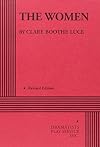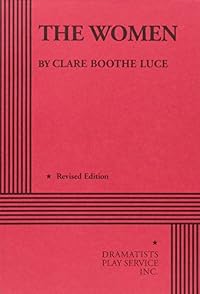
The Women
by Clare Boothe Luce
On This Page
Description
"The play involves the efforts of a group of women to play their respective roles in an artificial society that consists of vain show, comedy, tragedy, hope and disappointment."--Back coverTags
Recommendations
























Member Reviews
I'm trying to keep in mind when this play was written and all, but holy jeebus I was really annoyed with pretty much every character, even when they were being hilarious.
I'm sure I'm missing some higher point here but with plays, where the dialogue is everything, I find it hard to accommodate talk over why one character's cook brings out such drab meals or why the Princess is trading on her title in the department store dressing room. Men - even the presumed best of them - are resigned to being shallow cheaters and still somehow fought over by the women.
Class divisions and gender divisions are very actively drawn here, even as the women themselves seem to find multiple methods by which to be mean to each other. As they say, 'When you show more have friends like these...' While it seems clear that Luce is commenting on the shallowness of rich women (to a certain degree anyway), I find it hard to read a play where the characters are for the most part wholly unsympathetic. show less
I'm sure I'm missing some higher point here but with plays, where the dialogue is everything, I find it hard to accommodate talk over why one character's cook brings out such drab meals or why the Princess is trading on her title in the department store dressing room. Men - even the presumed best of them - are resigned to being shallow cheaters and still somehow fought over by the women.
Class divisions and gender divisions are very actively drawn here, even as the women themselves seem to find multiple methods by which to be mean to each other. As they say, 'When you show more have friends like these...' While it seems clear that Luce is commenting on the shallowness of rich women (to a certain degree anyway), I find it hard to read a play where the characters are for the most part wholly unsympathetic. show less
Mrs. Luce's second play, a three-act bitchfest that ran for 657 performances on Broadway and was subsequently adapted into a somewhat Production Code-sanitized but still plenty snappy MGM film by screenwriters Anita Loos and Jane Murfin (with an uncredited contribution by F. Scott Fitzgerald!) and director George Cukor, and, much later, became the basis of a pointless Meg Ryan/Annette Bening vehicle. Although it was a hit, the play was not well-reviewed, and in her Foreword to this published text, the author presents an amusing but pointed rebuttal to critics, in the course of which she presents 'a partial list of the descriptive nouns and adjectives applied by the Gentlemen of the Press to the Ladies of the Ensemble.' 78 examples are show more presented (among them 'odious harpies,' 'zoological freaks,' 'a smelly lot' and 'adder-fanged'), and at the end of the list she drolly notes that these are 'in the aggregate much harsher language than the dialogue [of the play itself].' show less
The play The Women by Clare Booth Luce is a drama which examines marriage and it's impact on a small group of wealthy socialites in the 1960's. The first scene presents a revelation that sets a domino effect of events that is basically comprised by affairs, gossip and divorce. It paints a pretty grim and hopefully inaccurate picture of women and their "friendships."
This isn't a timeless drama...thankfully. It wasn't all that entertaining or realistic either. Luce's views on men and marriage may have been shocking and groudbreaking at the time, but in 2009 it reads as cliched and uninspired.
This isn't a timeless drama...thankfully. It wasn't all that entertaining or realistic either. Luce's views on men and marriage may have been shocking and groudbreaking at the time, but in 2009 it reads as cliched and uninspired.
This was an amusing read, it reminded me how much I miss watching those old Hollywood classics.
adult drama; women/divorce in the 1960s. As mentioned in one of the special features on Mad Men. Kind of interesting as a historical perspective, but kind of unremarkable otherwise.
Ratings
Members
- Recently Added By
Lists

My Play Collection
769 works; 3 members
Author Information

12+ Works 337 Members
Clare Boothe Luce was born on March 10, 1903, in New York City. She was the wife of Henry Luce, publisher of Time, Life, and Fortune. She was twice elected to the House of Representatives from 1943 to 1947 and served as an ambassador to Italy from 1953 to 1956. President Reagan awarded her the Presidential Medal of Freedom in 1983. She was the show more first female member of Congress to receive this award. Luce began her career in writing with Vogue magazine and later worked her way up to managing editor of Vanity Fair. Luce's 1936 play, The Women, was an instant smash on Broadway. She also authored Europe in the Spring, a non-fiction book. Clare Boothe Luce died of brain cancer on October 9, 1987, at age 84, at her Watergate apartment in Washington, D.C. She is buried at Mepkin Abbey, South Carolina, a plantation that she and Henry Luce had once owned and given to a community of Trappist monks. (Bowker Author Biography) show less
Work Relationships
Common Knowledge
Classifications
Statistics
- Members
- 155
- Popularity
- 210,381
- Reviews
- 5
- Rating
- (3.93)
- Languages
- English
- Media
- Paper
- ISBNs
- 1
- ASINs
- 4