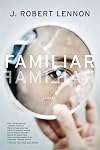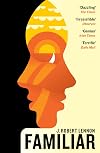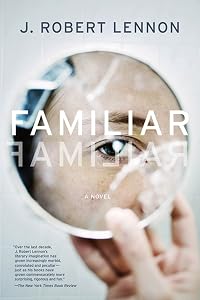
Familiar
by J. Robert Lennon
On This Page
Description
Elisa Brown is on the long drive home after visiting her son's grave when the crack in her windshield vanishes. She notices other changes too. Her body is curvier; her clothes and car are different. Back home, she has a new job, a sturdier marriage, and disturbingly altered sons. Has she had a psychotic break? Or entered a parallel universe? Her quest for answers hinges on seeing herself as she really is--something that might be impossible for Elisa, or for anyone.Tags
Recommendations







Member Recommendations
Member Reviews
Imagine driving along the highway, when the familiar crack in the windshield of your car suddenly disappears. You refocus on the road only to realize everything is different. Everything. Your car, your clothes, even you. Beside you is a folder from a conference you don't remember attending.
Elisa's day is not going well. She decides she has no choice but to follow the road home. Her husband, Derek, is still listed in her phone.
"The mailbox is the same and the driveway she pulls into is the same. But the house is not.
"It is white, for one thing. It's supposed to be a pale yellow-gray. It had been white when they bought it, but they changed it. The rhododendrons are gone, replaced by a row of sculpted yews. Or rather the yews they tore out show more a few years ago are still there. The grass, to which she had always been indifferent, is healthy and trim, and the pink dogwood, the one that had seemed certain to die but then rallied and came back to life, that dogwood is gone and in its place stands a Japanese maple."
This is Elisa's story. But it is not just a story of alternative universes. It is a poignant look at a dysfunctional family, a marriage on the rocks. And the funny thing is that the author never intended to go there!
"The crazy thing is, I didn't want to write about parenthood. At all.... I'd envisioned Familiar as an oblique, rather detached, bit of literary sci-fi, something spare and enigmatic....It wasn't until draft three that I fully accepted that I was writing a novel about the psychological effects of parenthood....Elisa Brown is given a second chance, and her reaction, at least at first, is to long, terribly, for the tragic life she left behind. We are invested in our illusions--I wanted to explore what might happen if this particular one were stripped away."
Loved this book! show less
Elisa's day is not going well. She decides she has no choice but to follow the road home. Her husband, Derek, is still listed in her phone.
"The mailbox is the same and the driveway she pulls into is the same. But the house is not.
"It is white, for one thing. It's supposed to be a pale yellow-gray. It had been white when they bought it, but they changed it. The rhododendrons are gone, replaced by a row of sculpted yews. Or rather the yews they tore out show more a few years ago are still there. The grass, to which she had always been indifferent, is healthy and trim, and the pink dogwood, the one that had seemed certain to die but then rallied and came back to life, that dogwood is gone and in its place stands a Japanese maple."
This is Elisa's story. But it is not just a story of alternative universes. It is a poignant look at a dysfunctional family, a marriage on the rocks. And the funny thing is that the author never intended to go there!
"The crazy thing is, I didn't want to write about parenthood. At all.... I'd envisioned Familiar as an oblique, rather detached, bit of literary sci-fi, something spare and enigmatic....It wasn't until draft three that I fully accepted that I was writing a novel about the psychological effects of parenthood....Elisa Brown is given a second chance, and her reaction, at least at first, is to long, terribly, for the tragic life she left behind. We are invested in our illusions--I wanted to explore what might happen if this particular one were stripped away."
Loved this book! show less
Judging by just two novels read, Lennon has turned himself into a pretty serious genre writer. What means that? Well, someone who uses the elements of genre fiction as a vehicle for (intelligent) explorations of "universal human themes." Themes like: parenthood, personality, power, the struggle for individuality, trust and betrayal . . . And it isn't about sugar-coating the serious stuff with fantasy, horror or SF elements. It's about using those elements to get a novel, fruitful angle on the theme. You get books that aren't more-or-less re-presentations of your own everyday life (Yay!), but which *do* bear upon it in interesting and sometimes enlightening ways.
This is the story of a woman on the fringes of the world of science, on the show more fringes of a faltering marriage and struggling to fully engage with her flawed children. Not being a woman, I can't vouch for how genuine the experiences and reactions of his protagonist might be, but from an outsider's perspective it certainly rings true. Elisa is a flawed but very sympathetic character, who by having a go at life in two quite similar, but crucially different versions, shows us a little something about some of those big issues above. Where Castle is hurt by the shallowness and predictability of it's male protagonist's past, Elisa's complicated and (except for one big thing) quotidian life really enriches this one.
As often seems to happen with novels that have a great concept & great initial execution (I'm thinking of PKD), resolution is difficult or impossible, so the ending seems abrupt and arbitrary, but I don't think resolution is really possible here. Perhaps a more elegant means to drop the curtain could have been found, but that's a small matter in a really fine book.
Speaking of PKD, while a lot of folks really groove on Dick as *weird!/trippy!*, I've always liked his take on normality--his satiric takes on the grind of workaday life, marketing & advertising; his regular Joe characters; his bizarre version of everyday speech, like dialogue that has been going to therapy for 10 years . . . The weird and the trippy, for me, is what gives him the distance, the defamiliarized perspective that allows him to better lay out the familiar for us.
Lennon indulges himself in the stage props far less than Dick, but I think he can be looked at as a sort of PKD with the opportunity to do a lot more character & theme development with far fewer plot elements. For those who enjoy Dick for the very phastasmagoria of plot devices he employs, the similarity I'm talking about won't be at all obvious. For those who enjoy Dick for a lot else aside from that, I think you will enjoy Lennon as a kind of drier, more disciplined and perhaps more fulfilling author working some of the same veins as PKD. show less
This is the story of a woman on the fringes of the world of science, on the show more fringes of a faltering marriage and struggling to fully engage with her flawed children. Not being a woman, I can't vouch for how genuine the experiences and reactions of his protagonist might be, but from an outsider's perspective it certainly rings true. Elisa is a flawed but very sympathetic character, who by having a go at life in two quite similar, but crucially different versions, shows us a little something about some of those big issues above. Where Castle is hurt by the shallowness and predictability of it's male protagonist's past, Elisa's complicated and (except for one big thing) quotidian life really enriches this one.
As often seems to happen with novels that have a great concept & great initial execution (I'm thinking of PKD), resolution is difficult or impossible, so the ending seems abrupt and arbitrary, but I don't think resolution is really possible here. Perhaps a more elegant means to drop the curtain could have been found, but that's a small matter in a really fine book.
Speaking of PKD, while a lot of folks really groove on Dick as *weird!/trippy!*, I've always liked his take on normality--his satiric takes on the grind of workaday life, marketing & advertising; his regular Joe characters; his bizarre version of everyday speech, like dialogue that has been going to therapy for 10 years . . . The weird and the trippy, for me, is what gives him the distance, the defamiliarized perspective that allows him to better lay out the familiar for us.
Lennon indulges himself in the stage props far less than Dick, but I think he can be looked at as a sort of PKD with the opportunity to do a lot more character & theme development with far fewer plot elements. For those who enjoy Dick for the very phastasmagoria of plot devices he employs, the similarity I'm talking about won't be at all obvious. For those who enjoy Dick for a lot else aside from that, I think you will enjoy Lennon as a kind of drier, more disciplined and perhaps more fulfilling author working some of the same veins as PKD. show less
Familiar stunned me. Though I'm not one for speculative fiction, I followed Lisa's story through questions about parallel universes and into nervous breakdowns. Though I'm a skimmer--easily bored--I read and savored every single word of this book--for the wisdom and beauty in the writing. The story takes on big ideas--regret, responsibility, marriage and family--and leaves you with both the humor and tragedy of life. Don't miss this. It's genius.
A naturalistically written book that plays with the true strangeness of memory, character, and perception. About halfway through I started to worry that the author was heading off toward some cheap alternate universe story cliches but Familiar is a much more thoughtful novel than that. It is genuinely disturbing in the ways it subtly questions the comfort of our memories and our settled evaluations of our life events. As the story progresses, it is decreasingly clear what of the protagonist's problems are external or internal, but by the end it does seem that no matter what has "really" happened, it's herself she has to deal with.
I think this is one of my top four books read this year. It beat out The Marriage Plot by a mile. It makes show more a good double feature with Julian Barnes' Sense of An Ending, but I felt let down at the end by the Barnes novel (much as I love some of his work). Familiar told me less at the finish, and said more. show less
I think this is one of my top four books read this year. It beat out The Marriage Plot by a mile. It makes show more a good double feature with Julian Barnes' Sense of An Ending, but I felt let down at the end by the Barnes novel (much as I love some of his work). Familiar told me less at the finish, and said more. show less
Strange but oddly mesmerizing. Intense, 40-something Elisa is driving home from visiting her son's grave six hours away, when she realizes the crack in her windshield has vanished, she's driving a whole different car, and seems to have gained a bit of weight and is wearing office clothes. When she gets home she finds that the past is different in her memory than it is for others. Has she slipped into a parallel universe, or suffered some sort of psychotic breakdown? The novel examines a marriage and a woman under stress, and what might happen to someone given a second chance in this way. It's rather unsettling.
While driving home to New York from Wisconsin where she just visited the grave of her younger son, Silas, killed in a car accident nearly 10 years earlier, Eliza suddenly notices that the world around her has changed: the crack in the windshield is gone -- in fact, she's driving a totally different vehicle; she weighs more; her clothes are different... and when she arrives home she discovers that the marriage she returns to seems to be healthier than the one she left and both of her sons are alive, well and living in California.
So, what happened? Did Elisa slip into a parallel universe? Suffer a psychotic break? As she tries to determine the answer to this question for hersefl this short novel also explores relationships and the show more terrible ups and downs of parenting and makes us seriously wonder about the errors we may be making in our own lives. Recommended. show less
So, what happened? Did Elisa slip into a parallel universe? Suffer a psychotic break? As she tries to determine the answer to this question for hersefl this short novel also explores relationships and the show more terrible ups and downs of parenting and makes us seriously wonder about the errors we may be making in our own lives. Recommended. show less
A strange book that I expected to like more than I did, because it was sort of about the nature of reality: a woman whose son has died suddenly finds herself plopped into a different world, where her son hasn't died, she has a different job, she's not having an affair, etc. etc. My problem was that I found all the characters, including her, rather despicable. Her new family was so dysfunctional, and no one seemed to have the capacity or wisdom to pull themselves out of it. And the ending didn't really pull the whole thing together.
Members
- Recently Added By
Published Reviews
ThingScore 75
It runs deep in life, the feeling that we have wandered down some corridor just alongside the one where we truly belong. An inattentive step or two and already we have traveled too far. The door has disappeared. Our place in the world has become irrecoverable. The past half-decade of American letters has seen the translation or publication of a little pack of kindred novels intended to show more reproduce this sensation, nearly all of them fascinating. Call it the literature of the ontological wrong turn. Some of its representatives have been issued to great gales of attention, like “1Q84,” by Haruki Murakami, or “Remainder,” by Tom McCarthy, others to the keen enthusiasm of a few lucky explorers, like “Metropole,” by Ferenc Karinthy, or (by my lights the secret masterpiece of the field) “The Other City,” by Michal Ajvaz. To that beguiling list add J. Robert Lennon’s allusive and mysterious new novel, “Familiar,” his ninth book and one of his finest. show less
added by Dogberryjr
Lists

Powell's Indiespensable
79 works; 6 members

Powell's Indiespensable
15 works; 1 member
Author Information

29+ Works 1,935 Members
J. Robert Lennon is the author of "The Light of Falling Stars" & "The Funnies". He lives with his wife & children in Ithaca, NY. (Bowker Author Biography)
Common Knowledge
- Canonical title
- Familiar
- Original publication date
- 2012
- People/Characters
- Elisa Brown
- Epigraph
- After the death of his mother, he had spent five years in the house of his brother. It was not from what he said but the way he said it that his enormous animosity toward the domineering, cold, and unfriendly nature of his br... (show all)other became evident.
Then, in short, not very pregnant sentences, he related that he had a friend now who very much loved and admired him. Following this communication, there was a prolonged silence. A few days later he reported a dream: he saw himself in a strange city with his friend, except that the face of his friend was different.
—Wilhelm Reich, Character Analysis - First words
- She's driving.
- Last words
- (Click to show. Warning: May contain spoilers.)And so she bears down, telling herself it will work, that in the end it's actually possible to believe in your dream so completely that you can drag the rest of the world into it with you.
- Original language
- English
Classifications
Statistics
- Members
- 206
- Popularity
- 159,405
- Reviews
- 9
- Rating
- (3.41)
- Languages
- English
- Media
- Paper, Ebook
- ISBNs
- 7
- ASINs
- 4