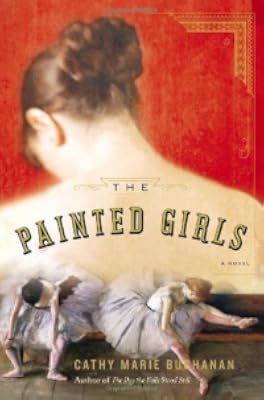
The Painted Girls
by Cathy Marie Buchanan 
On This Page
Description
In belle époque Paris, the Van Goethem sisters struggle for survival after the sudden death of their father, a situation that prompts young Marie's ballet training and her introduction to a genius painter.Tags
Recommendations
















Member Reviews
A visit to Paris 1878. The Painted Girls gives us a glimpse of the grey foggy world of the ballet corps, the absinthe filled days of a mother who has lost her husband and must send out her daughters to become petit-rats at the ballet to bring home the money needed to pay their debts or be cast off into the streets. The true cost is of their innocence. Marie is chosen to be a model at the studio of Edgar Degas and is taken on in the ballet to begin her career while her older sister, Antoinette falls from the ballet to work in the theatre as an extra and worse looking for love in all the wrong places.
This is not the glamorous side of Paris but the truer vision of the working class, one step away from despair and one step away from being show more discovered. Beautifully written if not achingly sad, The Painted Girls will haunt your thoughts well after the last page is read. show less
This is not the glamorous side of Paris but the truer vision of the working class, one step away from despair and one step away from being show more discovered. Beautifully written if not achingly sad, The Painted Girls will haunt your thoughts well after the last page is read. show less
"What was it made that girl want so much? She craved the stage. But why? And was there something lacking in me that I was over it in a week........?" This was a well crafted, poignant story about young girls who had very limited possibilities to lift themselves from the poverty and despair of Paris in the later part of the nineteenth century. While providing historically accurate facts about the principal characters the story affords the reader room for extrapolation and reflection.
I requested this book as an Early Reviewer because I read the author's first book, The Day the Falls Stood Still, a few years ago and loved it. The Painted Girls did not disappoint!
This well-researched historical fiction novel takes place in Paris 1878. It follows the van Goethem sisters as they struggle to survive after their father dies. Luckily the oldest sister, Antoinette, once trained in ballet for the Paris Opera and uses her mischievous ways to get auditions for her little sisters. Little did I know, but they used to pay girls to train for the ballet.
Every other chapter is told from the middle sister, Marie's, point of view, although the story mainly centers around her. She wants nothing more than stability for her family. Marie show more is a hard worker who loves music and her family, which makes her accessible to almost all of us. One way she makes extra money is by posing for Edgar Degas. He has a smaller role in this story but is still well developed as a character.
This is an excellent sister story, but I also felt the author was making a commentary on our roles in the world. Can you truly pull yourself up by your bootstraps or were you born to your lot in life? This underlying theme provides us with some uncomfortable and thoughtful moments.
Read this book and you will be magicked away to a time and place very different from our own. Fortunately the characters will make you feel at home. show less
This well-researched historical fiction novel takes place in Paris 1878. It follows the van Goethem sisters as they struggle to survive after their father dies. Luckily the oldest sister, Antoinette, once trained in ballet for the Paris Opera and uses her mischievous ways to get auditions for her little sisters. Little did I know, but they used to pay girls to train for the ballet.
Every other chapter is told from the middle sister, Marie's, point of view, although the story mainly centers around her. She wants nothing more than stability for her family. Marie show more is a hard worker who loves music and her family, which makes her accessible to almost all of us. One way she makes extra money is by posing for Edgar Degas. He has a smaller role in this story but is still well developed as a character.
This is an excellent sister story, but I also felt the author was making a commentary on our roles in the world. Can you truly pull yourself up by your bootstraps or were you born to your lot in life? This underlying theme provides us with some uncomfortable and thoughtful moments.
Read this book and you will be magicked away to a time and place very different from our own. Fortunately the characters will make you feel at home. show less
 This review was written for LibraryThing Early Reviewers.
Who hasn't seen at least a reproduction of Degas's artwork of ballerinas? He painted other scenes but he frequented the Paris Opera and sketched and painted the young ballerinas at practise, on stage and at rest. One of his most famous works is not a painting however; the statuette of Little Dancer Age 14 was done in wax and clothed. The model for that work, Marie Van Goethem, is one of the principal characters in this book. Like The Girl With the Pearl Earring by Tracy Chevalier it is fascinating to learn the story behind famous works of art.
When the father of Antoinette, Marie and Charlotte Van Goethem dies suddenly poverty hits the family and the three girls have to find ways to earn money. Antoinette, the oldest, is already a dancer show more at the Paris Opera and she takes Marie and Charlotte there to be accepted as students. Even though they are studying they will be paid a small salary. Antoinette soon finds a part in a stage production of Emile Zola's L'Assommoir which pays more than she could expect to make at the Opera. Antoinette is courted by a young man who is also in the play and she is completely besotted by him. Marie catches the attention of Edgar Degas who asks her to come model for him in his studio which will earn some extra money for the household. Charlotte is still young and naive but shows promise as a dancer. When Antoinette's young man is arrested for murder Antoinette believes he is innocent but Marie is convinced he is guilty. This drives a wedge between the sisters which almost undoes their relationship. The girls face many trials but I don't think I am giving too much away to say there is a happy ending.
There were three narrators for this audiobook. Cassandra Campbell and Julia Whelan did Antoinette and Marie (or perhaps vice versa) and Danny Campbell read excerpts from Le Figaro between the major sections. It is an interesting way to structure a spoken work which revolves between the two sisters. One of the readers had a somewhat juvenile inflection but perhaps that is the way the book was written. Of the two I certainly preferred the narrator who did Marie's portion. show less
When the father of Antoinette, Marie and Charlotte Van Goethem dies suddenly poverty hits the family and the three girls have to find ways to earn money. Antoinette, the oldest, is already a dancer show more at the Paris Opera and she takes Marie and Charlotte there to be accepted as students. Even though they are studying they will be paid a small salary. Antoinette soon finds a part in a stage production of Emile Zola's L'Assommoir which pays more than she could expect to make at the Opera. Antoinette is courted by a young man who is also in the play and she is completely besotted by him. Marie catches the attention of Edgar Degas who asks her to come model for him in his studio which will earn some extra money for the household. Charlotte is still young and naive but shows promise as a dancer. When Antoinette's young man is arrested for murder Antoinette believes he is innocent but Marie is convinced he is guilty. This drives a wedge between the sisters which almost undoes their relationship. The girls face many trials but I don't think I am giving too much away to say there is a happy ending.
There were three narrators for this audiobook. Cassandra Campbell and Julia Whelan did Antoinette and Marie (or perhaps vice versa) and Danny Campbell read excerpts from Le Figaro between the major sections. It is an interesting way to structure a spoken work which revolves between the two sisters. One of the readers had a somewhat juvenile inflection but perhaps that is the way the book was written. Of the two I certainly preferred the narrator who did Marie's portion. show less
From Linus's Blanket Cathy Marie Buchanan captivated me with her first novel, The Day The Falls Stood Still, so I had high expectations for herThe Painted Girls by Cathy Marie Buchanan 215x323 Readings: Marmee and Louisa by Eve LaPlante & The Painted Girls by Cathy Marie Buchanan follow-up novel The Painted Girls. I wasn’t disappointed. She chooses a fascinating angle for her novel of two sisters growing up in the desperate poverty of 19th century Paris.
There are three Van Goethem sisters, but Buchanan’s narrative alternates between the perspectives of the book smart Marie, who after being pulled from school after the death of their debt-ridden father, dutifully applies herself to the arduous training of a ballet dancer as a way to show more contribute to the family’s meager earnings, and Antoinette, the eldest of the girls. Antoinette does her best to protect her sisters from life’s harsh realities even as her own troubled romance and unrelenting deprivation force her to contemplate thievery and prostitution. Marie eventually gets a position posing for Degas, a rising artist of the time, and Antoinette finds work in the cast of a popular Zola adaptation. Both artist and writer are exploring the role of criminality and society through their works and are heavily influenced by Italian criminologist Cesare Lombroso, a man who posits that destiny is determined by facial structure, and heavy animal like features are indicative of criminality and vice – features Marie fretfully worries over in her own face.
Buchanan is a skilled weaver of history into the realities of everyday life and she outdoes herself here. Paris, that famed City of Light, comes to life vividly through the smells on the streets, the meanness of its people, the filth of their clothes and the desperation of their toil. It is clear that girls have it worse, and the Van Goethem sisters embody how few the choices and opportunities available to women who would try to better their circumstances or to merely escape their poverty – the cost often being their innocence and respectability. Buchanan excels at showcasing the girl’s distinctive personalities, voice, and approach to life. Each of their narratives are both compelling and heartbreaking and as close as if either of them was whispering her story in your ear. The Painted Girl has elements of mystery – a rash of gruesome murders has been committed, and the unease of the city is palpable – but mostly it is an exquisitely rendered love story between these sisters, and the sacrifices they make to ease each others burdens while striving to better their lives in a world where the odds are highly stacked against them. Highly Recommended. show less
There are three Van Goethem sisters, but Buchanan’s narrative alternates between the perspectives of the book smart Marie, who after being pulled from school after the death of their debt-ridden father, dutifully applies herself to the arduous training of a ballet dancer as a way to show more contribute to the family’s meager earnings, and Antoinette, the eldest of the girls. Antoinette does her best to protect her sisters from life’s harsh realities even as her own troubled romance and unrelenting deprivation force her to contemplate thievery and prostitution. Marie eventually gets a position posing for Degas, a rising artist of the time, and Antoinette finds work in the cast of a popular Zola adaptation. Both artist and writer are exploring the role of criminality and society through their works and are heavily influenced by Italian criminologist Cesare Lombroso, a man who posits that destiny is determined by facial structure, and heavy animal like features are indicative of criminality and vice – features Marie fretfully worries over in her own face.
Buchanan is a skilled weaver of history into the realities of everyday life and she outdoes herself here. Paris, that famed City of Light, comes to life vividly through the smells on the streets, the meanness of its people, the filth of their clothes and the desperation of their toil. It is clear that girls have it worse, and the Van Goethem sisters embody how few the choices and opportunities available to women who would try to better their circumstances or to merely escape their poverty – the cost often being their innocence and respectability. Buchanan excels at showcasing the girl’s distinctive personalities, voice, and approach to life. Each of their narratives are both compelling and heartbreaking and as close as if either of them was whispering her story in your ear. The Painted Girl has elements of mystery – a rash of gruesome murders has been committed, and the unease of the city is palpable – but mostly it is an exquisitely rendered love story between these sisters, and the sacrifices they make to ease each others burdens while striving to better their lives in a world where the odds are highly stacked against them. Highly Recommended. show less
Edgar Degas created a statuette entitled “Little Dancer Aged Fourteen” and in the pages of The Painted Girls, author Cathy Marie Buchanan tells the story of not only the young model, Marie van Goethem but also that of her sisters, Antoinette and Charlotte. Living in the slums of Montmartre with an alcoholic mother the three girls, needing a steady income for survival, plan to be dancers at the Paris Opera. To become a dancer is a way for them to avoid the pitfalls of life on the streets, they start as Petit Rats with long hours of practice, learning to leap with grace and balance en pointe. Doing this they can earn enough to keep from starvation, but always there is the chance that their talent will advance them with the benefits of show more more money and a much better lifestyle.
As the story starts, 17 year old Antoinette has been dismissed from the Opera for rudeness and being wilful. Marie and Charlotte are just beginning as Petit Rats. Marie works hard and appears to be starting her climb, she catches the eye of the artist Degas and works on the side as his model. Charlotte at 7 is the baby of the family and is much more self-absorbed. A pretty but selfish child, she appears to be the natural dancer of the three.
The story unfolds by alternating the viewpoint between Antoinette and Marie, and there is a lot to take in. This appears to be not only the story of these sisters, but also of Paris in 1878. This is a gritty tale of the ballet, the brothels, the taverns, and the prisons of Paris. These girls have choices but hanging over their heads at all times is the need to survive.
This was a fascinating story, but personally I always felt a step or so removed from the characters. So while I appreciated this tale of fate and destiny and loved the setting, The Painted Girls did not captivate me to the point of becoming totally absorbed. In fact I felt so disengaged that I found myself frequently checking to see how many more pages were left in the book. I love to love or hate my characters, but indifference just leaves me cold. show less
As the story starts, 17 year old Antoinette has been dismissed from the Opera for rudeness and being wilful. Marie and Charlotte are just beginning as Petit Rats. Marie works hard and appears to be starting her climb, she catches the eye of the artist Degas and works on the side as his model. Charlotte at 7 is the baby of the family and is much more self-absorbed. A pretty but selfish child, she appears to be the natural dancer of the three.
The story unfolds by alternating the viewpoint between Antoinette and Marie, and there is a lot to take in. This appears to be not only the story of these sisters, but also of Paris in 1878. This is a gritty tale of the ballet, the brothels, the taverns, and the prisons of Paris. These girls have choices but hanging over their heads at all times is the need to survive.
This was a fascinating story, but personally I always felt a step or so removed from the characters. So while I appreciated this tale of fate and destiny and loved the setting, The Painted Girls did not captivate me to the point of becoming totally absorbed. In fact I felt so disengaged that I found myself frequently checking to see how many more pages were left in the book. I love to love or hate my characters, but indifference just leaves me cold. show less
See this and other reviews on my blog: Written Permission
Every so often a novel comes along that makes you sit back and realize the author really cares about their craft. For me, The Painted Girls was that novel. It was a bonus that it was a historical fiction novel, which is hard to do well. And an even bigger bonus is that Cathy Marie Buchanan is a fellow Canadian. Three for three, The Painted Girls.
I am, by no means, an expert on Belle Époque Paris, but I feel like Buchanan really took pride in her writing. She didn't make outlandish claims for her characters, and the Author's Note at the end details where the few liberties were taken, something I really appreciated.
Buchanan's writing is sublime. She flits effortlessly through the show more lives of Marie and her sister Antoinette. While some of the secondary characters are lacking in depth and polish, I found the main characters really made up for it. While Marie is thirteen at the start of the book, she never descends too deeply into the teenage angst that seems to steep books featuring a younger protagonist. Yet, we get a true sense of her age. I never thought she was anything other than a girl just coming into her own. The same can definitely be said for Antoinette.
While The Painted Girls has a light plot, in the sense that it isn't driven to some great climactic moment where everything comes to a head and then all is well with the world, the story itself is far from light. Buchanan treads the waters of poverty, love, loss, and desperation very well. She toes the line, never going over it, but always describing just enough to convey what life was like for these girls. There is drama, there is laughter. I felt emotionally invested in everything that was happening.
The one thing I didn't like about The Painted Girls seems small in comparison to all the things I loved. The timeline jumps around a lot. There were times when it was hard to determine how much time had passed between the end of one chapter and the start of another. It was disorienting, and sometimes disconnected me from the story.
Bottom Line: Superbly written character-driven historical fiction. show less
Every so often a novel comes along that makes you sit back and realize the author really cares about their craft. For me, The Painted Girls was that novel. It was a bonus that it was a historical fiction novel, which is hard to do well. And an even bigger bonus is that Cathy Marie Buchanan is a fellow Canadian. Three for three, The Painted Girls.
I am, by no means, an expert on Belle Époque Paris, but I feel like Buchanan really took pride in her writing. She didn't make outlandish claims for her characters, and the Author's Note at the end details where the few liberties were taken, something I really appreciated.
Buchanan's writing is sublime. She flits effortlessly through the show more lives of Marie and her sister Antoinette. While some of the secondary characters are lacking in depth and polish, I found the main characters really made up for it. While Marie is thirteen at the start of the book, she never descends too deeply into the teenage angst that seems to steep books featuring a younger protagonist. Yet, we get a true sense of her age. I never thought she was anything other than a girl just coming into her own. The same can definitely be said for Antoinette.
While The Painted Girls has a light plot, in the sense that it isn't driven to some great climactic moment where everything comes to a head and then all is well with the world, the story itself is far from light. Buchanan treads the waters of poverty, love, loss, and desperation very well. She toes the line, never going over it, but always describing just enough to convey what life was like for these girls. There is drama, there is laughter. I felt emotionally invested in everything that was happening.
The one thing I didn't like about The Painted Girls seems small in comparison to all the things I loved. The timeline jumps around a lot. There were times when it was hard to determine how much time had passed between the end of one chapter and the start of another. It was disorienting, and sometimes disconnected me from the story.
Bottom Line: Superbly written character-driven historical fiction. show less
Members
- Recently Added By
Published Reviews
ThingScore 75
The Painted Girls is a quick and cinematic read that is hard to put down, destined to be hotly debated book-club fodder across the country...Buchanan’s complete immersion in the time period and setting is obvious, and the reader is quickly present in the city, with its glamour, grit, hardships and peculiarities. An author’s note at the end of the book details exactly what is taken from show more historical record and what was created or embellished for the story.... It was a drag that this part of the narrative didn’t veer from the obvious, but it’s a small thing. For the overall story is a tremendous achievement, and the book is fast-paced leap around Paris at a unique time in its history. show less
added by vancouverdeb
The reader is completely absorbed in the struggle of Marie to rise above her circumstances. It has been said that the great engine of fiction is desire, the terrible urgent want of characters for what they do not have. This is vividly clear in the case of the van Goethem sisters, and that want makes for a strong, suspenseful narrative. The narrative drive is somewhat muted by the author’s show more prose style, however — her sentences have a tendency to carry just a smidgen too much detail. “Monsieur Degas’s lips press tight, and then his eyebrows pull together, the ends closest to his nose lifting up,” runs a characteristic sentence. Metaphors can also be laboured, as when the “harsh tang of fear” is compared to the “skin of a walnut.” The effect is sometimes of a clotted prose.....The question remains: can Buchanan’s characters defy that milieu and defy the laws of Zola? It is a question left in doubt until almost the last page of this convincing, heartfelt story. show less
added by vancouverdeb
Reminiscent of Tracy Chevalier’s novel Girl with a Pearl Earring, Cathy Marie Buchanan’s second novel tells the fascinating story of the young 19th-century Parisian ballerina who posed for Edgar Degas’ famous sculpture Little Dancer, Aged Fourteen. But while Chevalier’s novel (about the inspiration for the eponymous painting) is entirely imaginative, Buchanan’s meticulously show more researched book is based largely on historical record. show less
added by vancouverdeb
Lists

Top Five Books of 2013
1,562 works; 715 members

Top Five Books of 2017
757 works; 230 members

Books Read in 2015
3,299 works; 126 members

2014 Evergreen Nominees
10 works; 1 member
Dance!
41 works; 1 member

Evergreen Award™ Winners and Nominees 2005–2024
200 works; 3 members
Author Information

4 Works 2,430 Members
Cathy Marie Buchanan is a LibraryThing Author, an author who lists their personal library on LibraryThing.
Awards and Honors
Awards
Notable Lists
Common Knowledge
- Canonical title
- The Painted Girls
- Original publication date
- 2013-01-10
- People/Characters
- Edgar Degas; Marie van Goethem; Antoinette van Goethem; Charlotte van Goethem; Émile Abadie; Michel Knobloch (show all 8); Pierre Gille; Monsieur Lefebvre
- Important places
- Paris, France; Paris Opera, Paris, France; Palais Garnier, Paris, France
- Dedication
- For Larry, always
- First words
- Monsieur LeBlanc leans against the doorframe, his arms folded over a belly grown round on pork crackling.
- Last words
- (Click to show. Warning: May contain spoilers.)She gives it the little nudge that makes Geneviève understand, and she reaches for the feather, those wispy tendrils of love offered by her sister as a gift.
- Blurbers
- Clayton, Meg Waite; Benjamin, Melanie; Durrow, Heidi; Greene, Amy; Alcott, Kate; Gowda, Shilpi Somaya
Classifications
Statistics
- Members
- 1,352
- Popularity
- 17,786
- Reviews
- 96
- Rating
- (3.65)
- Languages
- English, French, Polish
- Media
- Paper, Audiobook, Ebook
- ISBNs
- 22
- ASINs
- 6
