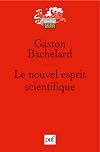
The New Scientific Spirit
by Gaston Bachelard
On This Page
Description
In this book, Bachelard draws upon both his scientific training and his interest in the nonrational - which ultimately drew him toward the study of poetics - to explore the deeper meanings of the new physics. In Bachelard's view, the unpredictable behaviour of subatomic particles belies the seemingly neat, ordered, and mechanistic universe that the practical and empirical scientists of the nineteenth century thought they saw.Tags
Recommendations

















Member Reviews
Read only the first and last chapter, and its simply amazing in terms of insights into the modern epistemology of science and how it shifted from the classical Cartesian one.
Gaston Bachelard gives fruitful insights into the developpement of the natural sciences in the 19th century and the beginning of the 20th century up to the 30ies. His main interest seems to be of methodological nature and he clearly states, how the natural sciences were slowly drifting beyond substantialist concepts with the rise of microphysics, finally leading to the abondonnement of the Newtonian concept of "force" by relativity theory. This is a recommendable book for everyone interested in the philosophy of sciences.
Gastón Bachelard me mostró el cambio en la psicología de la ciencia en el siglo XX a través de una reformación de la visión del mundo por parte de los científicos.
""
Sep 2, 2015French
Ratings
Members
- Recently Added By
Author Information

66+ Works 5,860 Members
Born in Bar-sur-Aube, France, in 1884, Gaston Bachelard received his doctorate in 1927. He became professor of philosophy at the University of Dijon in 1930, and held the chair in the history and philosophy of science at the University of Paris from 1940 to 1954. In epistemology and the philosophy of science, Bachelard espoused a dialectical show more rationalism, or dialogue between reason and experience. He rejected the Cartesian conception of scientific truths as immutable; he insisted on experiment as well as mathematics in the development of science. Bachelard described the cooperation between the two as a philosophy of saying no, of being ever ready to revise or abandon the established framework of scientific theory to express the new discoveries. In addition to his contributions to the epistemological foundations of science, Bachelard explored the role of reverie and emotion in the expressions of both science and more imaginative thinking. His psychological explanations of the four elements-earth, air, fire, water-illustrate this almost poetic aspect of his philosophy. (Bowker Author Biography) show less
Series
Belongs to Publisher Series
Filozofické odkazy (Pravda). Rad B: Súčasná nemarxistická filozofia (1981, 2436. publikácia)
Common Knowledge
- Canonical title
- The New Scientific Spirit
- Original title
- Le nouvel esprit scientifique
- Original publication date
- 1934
Classifications
Statistics
- Members
- 164
- Popularity
- 200,148
- Reviews
- 4
- Rating
- (3.90)
- Languages
- 8 — English, French, German, Italian, Japanese, Portuguese, Spanish, Turkish
- Media
- Paper
- ISBNs
- 18
- ASINs
- 4