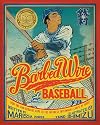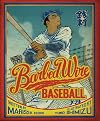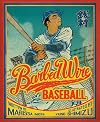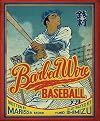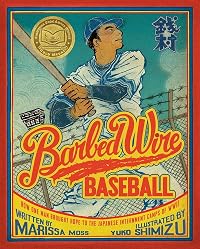
Barbed Wire Baseball
by Marissa Moss 
On This Page
Description
Traces the childhood dream of Japanese-American baseball pioneer Kenichi Zenimura of playing professionally and his family's struggles in a World War II internment camp where he introduces baseball to raise hope.Tags
Recommendations





Member Reviews
Author Marissa Moss and illustrator Yuko Shimizu tell the story of Kenichi "Zeni" Zenimura, a Japanese-American baseball player and team manager in this poignant and inspirational picture-book biography. Having loved the sport since he was an eight-year-old boy, when he saw his first game, Zeni grew up to play the sport, becoming a champion in California's Japanese-American leagues during the 1920s and 30s. He played with Lou Gehrig and Babe Ruth in exhibition games, and took the latter on a baseball exhibition tour of Japan. But when the Japanese bombed Pearl Harbor in 1941, everything changed. Zeni was sent, along with his family and more than 100,000 other Americans of Japanese descent, to an internment camp for the duration of World show more War II. Here, at Gila River War Relocation Center, he spearheaded a movement to build a baseball diamond, organizing the camp inmates into teams, and starting a camp league. Taking part in "America's Pastime" helped these wrongfully imprisoned citizens to feel free, even if only for a short time, and made them feel like they belonged in their own country. The book concludes with a detailed afterword about Zenimura, with an author's note, illustrator's note, bibliography and index...
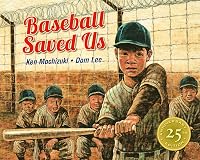
I initially sought out Barbed Wire Baseball (which gained the sub-title "How One Man Brought Hope to the Japanese Internment Camps of WWII" in its paperback edition) after reading and enjoying The Cat Man of Aleppo, a title chosen earlier this year (2021) as a Caldecott Honor book. I was impressed to learn that The Cat Man of Aleppo was only expatriate Japanese illustrator Yuko Shimizu's second picture-book, and, finding the artwork in it so striking and appealing, decided to track down this first book she illustrated. I'm so glad I did, as I found both story and artwork here immensely appealing. The true story of Zenimura's actions, in building and managing a baseball league inside the internment camp, reminded me of the similar but fictional narrative in Ken Mochizuki's Baseball Saved Us, which I read years ago. Apparently there is a documentary about Zenimura, "Diamonds in the Rough: Zeni and the Legacy of Japanese-American Baseball," that includes the testimony of actor Pat Morita (of Karate Kid fame), who was also an internee at Gila River. I will have to see if I can track that down and watch it. In any case, I highly recommend this one to picture-book readers looking for baseball stories, stories of the internment of Japanese-Americans during WWII, or tales of inspirational people who, no matter how terrible the circumstance, never give up. show less
I initially sought out Barbed Wire Baseball (which gained the sub-title "How One Man Brought Hope to the Japanese Internment Camps of WWII" in its paperback edition) after reading and enjoying The Cat Man of Aleppo, a title chosen earlier this year (2021) as a Caldecott Honor book. I was impressed to learn that The Cat Man of Aleppo was only expatriate Japanese illustrator Yuko Shimizu's second picture-book, and, finding the artwork in it so striking and appealing, decided to track down this first book she illustrated. I'm so glad I did, as I found both story and artwork here immensely appealing. The true story of Zenimura's actions, in building and managing a baseball league inside the internment camp, reminded me of the similar but fictional narrative in Ken Mochizuki's Baseball Saved Us, which I read years ago. Apparently there is a documentary about Zenimura, "Diamonds in the Rough: Zeni and the Legacy of Japanese-American Baseball," that includes the testimony of actor Pat Morita (of Karate Kid fame), who was also an internee at Gila River. I will have to see if I can track that down and watch it. In any case, I highly recommend this one to picture-book readers looking for baseball stories, stories of the internment of Japanese-Americans during WWII, or tales of inspirational people who, no matter how terrible the circumstance, never give up. show less
This book does a wonderful job of showing how the love of a sport can bring together a community, despite what's going on around them. This book would be great for kids in the 3rd-5th grade, as there is a good number of words on each page, and the topic may not be harder to explain to kids any younger. This could be read either individually or in a group setting; it is still a good story if it were read to a slightly younger group of kids, as the illustrations are very engaging.
Barbed Wire Baseball: How One Man Brought Hope to the Japanese Internment Camps of WWII by Marissa Moss is the non-fiction story of Kenichi “Zeni” Zenimura. Zeni was a small Japanese American who was an unlikely baseball player who successfully played with the greats like Babe Ruth and Lou Gehrig. After the Japanese attacked Pearl Harbor, Zeni and his family were sent to an internment camp. Instead of allowing this injustice to crush his spirit, he brought his love and passion for baseball to the camp and brought joy to many by creating a field and sharing the game he loved. This is another powerful example of how people in the internment camps were determined to stay positive and help others in what could have been a joyless show more existence. Inspirational! show less
As a boy, Kenichi “Zeni” Zenimura dreams of playing professional baseball, but everyone tells him he is too small. Yet he grows up to be a successful player, playing with Babe Ruth and Lou Gehrig! When the Japanese attack Pearl Harbor in 1941, Zeni and his family are sent to one of ten internment camps where more than 110,000 people of Japanese ancestry are imprisoned without trials. Zeni brings the game of baseball to the camp, along with a sense of hope.
This true story, set in a Japanese internment camp during World War II, introduces children to a little-discussed part of American history through Marissa Moss’s rich text and Yuko Shimizu’s beautiful illustrations. The book includes author and illustrator notes, archival show more photographs, and a bibliography. show less
This true story, set in a Japanese internment camp during World War II, introduces children to a little-discussed part of American history through Marissa Moss’s rich text and Yuko Shimizu’s beautiful illustrations. The book includes author and illustrator notes, archival show more photographs, and a bibliography. show less
Barbed Wire Baseball tells the true story of Kenichi Zenimura. Zenimura is not only known as the “Dean of the Diamond” but also as the father of Japanese American baseball. Zenimura played baseball before the attack on Pearl Harbor, even playing against baseball greats Babe Ruth and Lou Gehrig. Barbed Wire Baseball explores Zenimura’s life; focusing on Zenimura’s decision to build a baseball field while at the Gila River War Relocation Center.
I think this book would be best suited for intermediate readers and above because of the historical context.
This book tells the story of Zeni, and Japanese American boy who loved baseball. He went on to play and manage professionally until the attack of Pearl Harbor sent people of this descent to internment camps. He made the best out of his situation and brought hope to himself, his family, and everyone else in the camp by bringing baseball to them.
This story could be used when teaching about its historical context. It could also be kept in a classroom because of its story of cultural identity and experiences.
This book tells the story of Zeni, and Japanese American boy who loved baseball. He went on to play and manage professionally until the attack of Pearl Harbor sent people of this descent to internment camps. He made the best out of his situation and brought hope to himself, his family, and everyone else in the camp by bringing baseball to them.
This story could be used when teaching about its historical context. It could also be kept in a classroom because of its story of cultural identity and experiences.
A young Japanese-American boy sees a baseball game and falls in love. Throughout his life he pursues baseball, making it up to even be able to play in exhibition games with the New York Yankees. But then Pearl Harbor is bombed and he and his family are put in an internment camp. While there, he feels he can't live without baseball, so he puts in the hard work to create a baseball field in the camp.
Members
- Recently Added By
Author Information

95+ Works 9,819 Members
Marissa Moss began as an illustrator of children's books. She is the author and illustrator of the Amelia series. She has written and illustrated more than 20 children's books including Amelia's Notebook, which was named a 1997 American Booksellers Association Pick of the Lists book. Her other books include Regina's Big Mistake and Knick Knack show more Paddywack. My Notebook (with Help from Amelia) also won the 2000 Parent Council Outstanding Award Informational and Oh Boy, Amelia! won the 2001 Parent's Guide to Children's Media Award and the 2002 Children's Choice Award. (Bowker Author Biography) show less
Marissa Moss is a LibraryThing Author, an author who lists their personal library on LibraryThing.
All Editions
Awards and Honors
Awards
Distinctions
Common Knowledge
- Canonical title
- Barbed Wire Baseball
- Important events
- Japanese-American Internment
Classifications
Statistics
- Members
- 260
- Popularity
- 124,500
- Reviews
- 21
- Rating
- (4.26)
- Languages
- English
- Media
- Paper, Ebook
- ISBNs
- 8
- ASINs
- 2