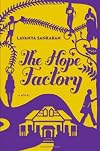
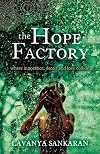
The Hope Factory
by Lavanya Sankaran
On This Page
Description
Anand, the proud owner of a small factory, finds his future uncertain when it collides with urban forces out of his control and a woman named Kamala who is determined to make a better life for her son.Tags
Recommendations













































Member Recommendations
ashmolean1 These both compare and contrast the lives of the employer and employee in India in well written highly readable styles.
Member Reviews
Anand is a successful Bangalore factory-owner, with thoughts on expanding his business. He is also the head of a picture-perfect family. A trendy and attractive wife and two smart, well-behaved teenagers. When he begins to make the move on buying some additional land, he finds himself tangled up with some shady characters and ruthless competitors. He could suddenly lose everything.
Kamala is Anand’s family maid. A single, hard-working mother, struggling day to day, to keep her head above water and keep her teenage son educated and out of trouble. When she is given an eviction notice, with no where else to live, her situation begins to spiral out of control.
This engaging first novel, tells the story of both these individuals, dealing show more with life issues in modern India. The upper-middle class and the poor. It’s a Bolly Upstairs/Downstairs, told in clear, tight prose, with vivid characterizations. Recommended. show less
Kamala is Anand’s family maid. A single, hard-working mother, struggling day to day, to keep her head above water and keep her teenage son educated and out of trouble. When she is given an eviction notice, with no where else to live, her situation begins to spiral out of control.
This engaging first novel, tells the story of both these individuals, dealing show more with life issues in modern India. The upper-middle class and the poor. It’s a Bolly Upstairs/Downstairs, told in clear, tight prose, with vivid characterizations. Recommended. show less
 This review was written for LibraryThing Early Reviewers.
Finally! A book about India that doesn't have to do with getting married or coming of age, or American-born-of Indian-heritage going back to India/dealing with being in the west/whatever. (That's a generalization, I know, but so many of the books I've come across run on that theme, usually with brightly colored saris or spices on the cover.)
The Hope Factory is a gently told novel that takes the time to craft characters, settings, and situations, all grounded in reality and believability. Two interwoven tales: the first is that of Anand, who simply wishes to expand his business, by expanding his factory. The second story centers on Kamala, one of the servants of Anand’s family, a single mother, subsisting on a small income, trying to show more carve out a world for herself and her teenage son, who seems to be running with a bad crowd.
Unfortunately for each, life can become complex and difficult. In Anand's case, politics and conflicting loyalties move in to muck up the land sale. (Having experienced India politics through family who lives there, I can attest to the good job done in the depiction.) For Kamala, the precarious balance of her world and economics is threatened by changes in her rent, and in the needs of her son.
This is a story of real people, with real needs, worries, hopes, and concerns. The characters come across as such. I found the second half of the novel moved more quickly, but that the first half needed the pace it did to set the stage and create the world. The end was a bit abrupt, but true to life. We rarely wrap episodes of our existence up into neat little packages, but they tend to slide, with hope, into the next day, the next challenge, the next phase of life. And sometimes, the next adventure.
I received this book via the Early Reviewers program of LibraryThing. Many thanks to LT and to the publishers for letting me into the Bangalore of Anand and Kamala. show less
The Hope Factory is a gently told novel that takes the time to craft characters, settings, and situations, all grounded in reality and believability. Two interwoven tales: the first is that of Anand, who simply wishes to expand his business, by expanding his factory. The second story centers on Kamala, one of the servants of Anand’s family, a single mother, subsisting on a small income, trying to show more carve out a world for herself and her teenage son, who seems to be running with a bad crowd.
Unfortunately for each, life can become complex and difficult. In Anand's case, politics and conflicting loyalties move in to muck up the land sale. (Having experienced India politics through family who lives there, I can attest to the good job done in the depiction.) For Kamala, the precarious balance of her world and economics is threatened by changes in her rent, and in the needs of her son.
This is a story of real people, with real needs, worries, hopes, and concerns. The characters come across as such. I found the second half of the novel moved more quickly, but that the first half needed the pace it did to set the stage and create the world. The end was a bit abrupt, but true to life. We rarely wrap episodes of our existence up into neat little packages, but they tend to slide, with hope, into the next day, the next challenge, the next phase of life. And sometimes, the next adventure.
I received this book via the Early Reviewers program of LibraryThing. Many thanks to LT and to the publishers for letting me into the Bangalore of Anand and Kamala. show less
This review was written for LibraryThing Early Reviewers.The Hope Factory chronicles the lives of Anand, a wealthy factory owner and Kamala, a poor maid who works in Anand’s household. The difference between the classes in Bangalore is striking. Kamala lives in a one room building without electricity or running water. She thinks that the fact that American housekeepers live in multiple room houses and even have cars is a myth. She desperately wants her son Narayan to stay in school and off the streets so he can have a better life than her.
I love books about India and Indian culture. This book was a reality check about the wide income disparity and heartbreaking poverty that exists in the country. The lives of both main characters were not romanticized. The characters had depth and even show more though they all had flaws I was able to empathize with most of them. The situations they were in had my stomach in knots – especially Anand trying to get more land to expand his factory. It’s a sign of great writing when it evokes such an emotional response in me. Even if you’re not as intrigued by all things Indian like me I think you will enjoy this book. show less
I love books about India and Indian culture. This book was a reality check about the wide income disparity and heartbreaking poverty that exists in the country. The lives of both main characters were not romanticized. The characters had depth and even show more though they all had flaws I was able to empathize with most of them. The situations they were in had my stomach in knots – especially Anand trying to get more land to expand his factory. It’s a sign of great writing when it evokes such an emotional response in me. Even if you’re not as intrigued by all things Indian like me I think you will enjoy this book. show less
This review was written for LibraryThing Early Reviewers.April 16, 2013: This is the evenly paced and well-told story of two citizens of the rapidly growing city of Bangalore, India: Anand, a prosperous businessman, and Kamala, his relatively impoverished housekeeper. What they both have in common is the desire to see their children be healthy and successful and the drive and willingness to sacrifice to make that happen.
Although the story was a tad slow to get started, once it took off I was thoroughly engrossed in the lives of these and other minor and major characters in the book. Although, in truth, I know little about modern-day India, this felt very authentic and realistic and I would imagine it's closer to the truth than some of the more dramatic tales being told. But this is not an show more "Indian" story per se as it could have taken place in nearly any city in the world with nearly any two parents. It's a story for all of us and well worth reading.
Addendum, 5 June 2013: I loaned this book to a co-worker who immigrated to the u.s. about a dozen years ago. She asked me if I understood the book and I replied that I thought I did but if she was asking that question, maybe I didn't! So we talked about how on-point and "Indianish" this book was than anything else she's read in English since she moved here.
So, if you wonder about the cultural accuracy, I quess there's an answer for you! show less
Although the story was a tad slow to get started, once it took off I was thoroughly engrossed in the lives of these and other minor and major characters in the book. Although, in truth, I know little about modern-day India, this felt very authentic and realistic and I would imagine it's closer to the truth than some of the more dramatic tales being told. But this is not an show more "Indian" story per se as it could have taken place in nearly any city in the world with nearly any two parents. It's a story for all of us and well worth reading.
Addendum, 5 June 2013: I loaned this book to a co-worker who immigrated to the u.s. about a dozen years ago. She asked me if I understood the book and I replied that I thought I did but if she was asking that question, maybe I didn't! So we talked about how on-point and "Indianish" this book was than anything else she's read in English since she moved here.
So, if you wonder about the cultural accuracy, I quess there's an answer for you! show less
This review was written for LibraryThing Early Reviewers.I'm smitten with tales set in India. I'm besotted by convincing characters. I'm crazy about skillful prose. The Hope Factory contains everything on my literary wish list.
This is the tale of two families. Anand and his family seem to have it all. Kamala and her son live on the very edge of poverty. In reality both families are dealing with matters that could send them over the brink to ruin.
This novel is populated with corrupt politicians, shady coworkers, and unseemly friends. Anand and Kamala even have to be cautious of their own family members who don't have their best interests at heart.
At the core of The Hope Factory is the desire that Anand and Kamala have to be good parents. I was especially struck by the struggle that Kamala show more goes through to make sure that her son is educated and able to rise above their current station.
The desire for a better and secure future is something we can all understand. Lavanya Sankaran uses that theme to write an outstanding story. show less
This is the tale of two families. Anand and his family seem to have it all. Kamala and her son live on the very edge of poverty. In reality both families are dealing with matters that could send them over the brink to ruin.
This novel is populated with corrupt politicians, shady coworkers, and unseemly friends. Anand and Kamala even have to be cautious of their own family members who don't have their best interests at heart.
At the core of The Hope Factory is the desire that Anand and Kamala have to be good parents. I was especially struck by the struggle that Kamala show more goes through to make sure that her son is educated and able to rise above their current station.
The desire for a better and secure future is something we can all understand. Lavanya Sankaran uses that theme to write an outstanding story. show less
The two main characters of The Hope Factory, Anand and Kamala, occupy two different versions of the same ordinary world. Anand has overcome great obstacles to become the prosperous owner of a factory. He has built a large house for his wife and children as a symbol of all he has achieved. Meanwhile, Kamala works in this grand house for Anand’s wife, but she lives in a small hut. She struggles to make ends meet, always hoping for a brighter future for her son. Despite their differences - one affluent and one poor - these two characters are more similar than first impressions would assume.
At the heart of this novel is the importance of family - specifically children. Both Anand and Kamala would do anything to keep themselves afloat to show more protect their children from ever having to know the same hardships they both overcame. It is a simple story, two individuals, shunned by their families, have to cope, have to survive, not only to prove themselves but to create a future for their children. And when these two characters cross paths, it is achingly poignant just how far they are willing to go.
Sankaran has written about a very specific, truly small world that easily transcends its own boundaries. What starts out as a story of a small town becoming a city in India quickly becomes so much more as Sankaran weaves her characters intricately together in The Hope Factory. show less
At the heart of this novel is the importance of family - specifically children. Both Anand and Kamala would do anything to keep themselves afloat to show more protect their children from ever having to know the same hardships they both overcame. It is a simple story, two individuals, shunned by their families, have to cope, have to survive, not only to prove themselves but to create a future for their children. And when these two characters cross paths, it is achingly poignant just how far they are willing to go.
Sankaran has written about a very specific, truly small world that easily transcends its own boundaries. What starts out as a story of a small town becoming a city in India quickly becomes so much more as Sankaran weaves her characters intricately together in The Hope Factory. show less
This review was written for LibraryThing Early Reviewers.Anand and Kamala are as united as a wealthy landowner and a servant may be: each dreams of creating a big and beautiful life with their families center stage in both their dreams and their downfall. Anand's frivolous wife and her interfering father are not easily impressed with Anand's hard earned success but they are reluctant to assist when his desires for the future don't fit their own. Kamal works to present her only son with the brighter future he may be able to glimpse only from a perspective beyond hers. Sankaran handles each with care, to the relief of this reader who was willing to endure tragedy and hardship, but not devastation, to these very engaging persons.
This review was written for LibraryThing Early Reviewers.Members
- Recently Added By
Lists

Global Reads: Books Set in South Asia
30 works; 3 members
Author Information

3 Works 264 Members
Common Knowledge
- Canonical title
- The Hope Factory
Classifications
Statistics
- Members
- 101
- Popularity
- 317,131
- Reviews
- 20
- Rating
- (3.85)
- Languages
- English, German
- Media
- Paper, Ebook
- ISBNs
- 10
- ASINs
- 1