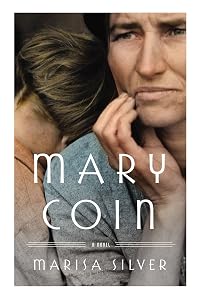
Mary Coin
by Marisa Silver
On This Page
Description
In 1936, a young mother resting by the side of a road in central California is spontaneously photographed by a woman documenting the migrant laborers who have taken to America's farms in search of work. Little personal information is exchanged, and neither woman has any way of knowing that they have produced what will become the most iconic image of the Great Depression. - from cover p.[2].Tags
Recommendations
















Member Reviews
I love the old saying, “A picture is worth a thousand words.” In Silver’s case, a picture is an opportunity to tell the story behind the iconic “Migrant Mother” photograph of subject Florence Owens Thompson, taken by photographer Dorothea Lange and published in 1936. Bringing to life the Dust Bowl Depression of the 1930’s, the story Silver weaves is told from the point of view of three fictionalized narrators: Depression-era migrant worker Mary Coin, photographer Vera Dare and in the modern day, social historian Walker Dodge. Written more like a series of connected stories and using biographical details as a starting point, this is squarely a work of speculative fiction. The thoughts, feelings and emotions of the characters show more are all creations by Silver. The portrayal of the era is stark and powerful. Silver does not try to sugar coat what was a very difficult time for so many people. Relying on broad themes of identity and survival, each of the three narrators face their own unique struggles. Under Silver’s hand, Mary and Vera are rigid, almost unyielding and it is only later in the story where we get to see glimpses of the compassion and uncertainty that lies beneath the surface. Favorite quote:
“Because answers are inert things that stop inquiry. They make you think you have finished looking. But you are never finished. There are always discoveries that will turn everything you think you know on its head and that will make you ask all over again: Who are we?”Through Mary Coin, Silver attempts to follow this line of reasoning. Does she succeed? I think she does, as this story has opened my eyes to more closely scrutinize and ask questions about the images I encounter. show less
I loved this book. The premise was fascinating and so believable that I had to keep reminding myself it was fiction. Nearly everyone has seen the photo Migrant Mother taken by photographer Dorothea Lange in the 1930's. In this novel author Marisa Silver imagines a story around these two women, their lives and their hopes, and how they came to intersect on the side of the road - resulting in this iconic photo. Adding a present day male historian who is also connected to Mary Coin (the woman in the photo) brings another level of depth to the novel.
In addition to the plot, the personalities, and a family secret, the author realistically recreates the life and lifestyle of the migrant worker during America's Great Depression. Juxtaposing show more this gritty, hardscrabble realism with the philosophical question asking "What is a photograph and what does it actually capture?" is one of the special qualities at the heart of this novel. show less
In addition to the plot, the personalities, and a family secret, the author realistically recreates the life and lifestyle of the migrant worker during America's Great Depression. Juxtaposing show more this gritty, hardscrabble realism with the philosophical question asking "What is a photograph and what does it actually capture?" is one of the special qualities at the heart of this novel. show less
You've probably seen the iconic Dorothea Lange "Migrant Mother" photograph that graces the cover of Mary Coin. This stark portrait is one of the most recognizable images of the Great Depression. And yet because it has come to convey so much, very few people stop to think about the woman and children captured here in their poverty and hardship. And yet they were very real people who lived lives well beyond the photograph. Marisa Silver has created a fictional story about the woman in the picture, the woman behind the camera, and a modern day historian whose connection to this photograph and the woman in it will slowly be revealed over the course of the novel and in so doing has created a striking and original read.
Told in a triple show more stranded narrative, the novel spans almost 90 years from before the taking of the photograph to the repercussions long afterwards. Opening in the present day with Walter Dodge returning to his childhood home as his silent and failing father is taken out of that home for the last time, the novel moves into the history professor's life, his unhappiness, his fraught relationship with his children, and the gaps in his family history that he will be exploring as he clears out his father's home and the accumulation of decades. And then the novel moves even further back than Walter's past into the stories, lives, and challenges of Mary Coin, the subject of the photograph, and Vera Dare, the photographer. Both of the women's lives are fully examined and their histories presented separately.
Mary Coin's childhood on a scratch existence farm, from her marriage to the always sickly but kind Toby Coin and their ever growing family, to what drove them off of their own land and into the migrant life that would prove so harrowing are all meticulously covered. Each of the events of her life which molded her into the woman in the photograph, beaten down and yet unyielding, is captured in straight, unforgiving prose. Photographer Vera Dare's life is also laid bare with the same honest and unflinching eye, her lack of self-esteem, her inability to leave her philandering husband, her ambivalence towards motherhood, and her drive to document what she saw, to grow professionally if not personally. These two women's paths would cross for only a few brief minutes and yet together they would come to define an era. How the puzzle piece of modern day Walter fits into all of this lies within the photograph itself, exposed for all the world to see if they would just look.
This is beautifully written and thought-provoking. Silver's imagined story of the iconic photograph and the women connected to it is fascinating in its potential. That she not only created a story for the photo itself but also fully convincing histories for both Mary Coin and Vera Dare and allowed the truth of George Dodge's story to come out through Walker without it ever actually being confirmed, just as so much in life, makes this masterful. Motherhood and survival, what is right, and the lives available to women and to mothers, with or without men, plus the idea of the artifacts, photographs and documents and the ephemera of everyday, that tell us the truth of history all wind through the plot. History is made up of the personal but growing outward, growing larger; its concentric circles touching more and more people and offering understanding on both the national level of the Depression and on the very private level of family secrets and truths. The storylines of the two women are more compelling than that of Walter so the novel is a little bit unbalanced but overall, Silver's novel is ultimately a well-crafted, quiet, and considered examination of Depression-era life and of the people who struggled through it. show less
Told in a triple show more stranded narrative, the novel spans almost 90 years from before the taking of the photograph to the repercussions long afterwards. Opening in the present day with Walter Dodge returning to his childhood home as his silent and failing father is taken out of that home for the last time, the novel moves into the history professor's life, his unhappiness, his fraught relationship with his children, and the gaps in his family history that he will be exploring as he clears out his father's home and the accumulation of decades. And then the novel moves even further back than Walter's past into the stories, lives, and challenges of Mary Coin, the subject of the photograph, and Vera Dare, the photographer. Both of the women's lives are fully examined and their histories presented separately.
Mary Coin's childhood on a scratch existence farm, from her marriage to the always sickly but kind Toby Coin and their ever growing family, to what drove them off of their own land and into the migrant life that would prove so harrowing are all meticulously covered. Each of the events of her life which molded her into the woman in the photograph, beaten down and yet unyielding, is captured in straight, unforgiving prose. Photographer Vera Dare's life is also laid bare with the same honest and unflinching eye, her lack of self-esteem, her inability to leave her philandering husband, her ambivalence towards motherhood, and her drive to document what she saw, to grow professionally if not personally. These two women's paths would cross for only a few brief minutes and yet together they would come to define an era. How the puzzle piece of modern day Walter fits into all of this lies within the photograph itself, exposed for all the world to see if they would just look.
This is beautifully written and thought-provoking. Silver's imagined story of the iconic photograph and the women connected to it is fascinating in its potential. That she not only created a story for the photo itself but also fully convincing histories for both Mary Coin and Vera Dare and allowed the truth of George Dodge's story to come out through Walker without it ever actually being confirmed, just as so much in life, makes this masterful. Motherhood and survival, what is right, and the lives available to women and to mothers, with or without men, plus the idea of the artifacts, photographs and documents and the ephemera of everyday, that tell us the truth of history all wind through the plot. History is made up of the personal but growing outward, growing larger; its concentric circles touching more and more people and offering understanding on both the national level of the Depression and on the very private level of family secrets and truths. The storylines of the two women are more compelling than that of Walter so the novel is a little bit unbalanced but overall, Silver's novel is ultimately a well-crafted, quiet, and considered examination of Depression-era life and of the people who struggled through it. show less
I devoured this in one 3-hour sitting.
Not since Timothy Egan's The Worst Hard Time have I read such a moving and vivid account of families struggling through the Depression. Silver's use of small period details, as well as her "bookend" use of the present tense when telling the contemporary part of her tale, lends an immediacy to the story that made this reader feel as though she was hearing it straight from the memories of a beloved great-aunt. Truly a must-read for anyone fascinated by the lives and hardships of migrant life during the Depression, as well as those readers who recognized that -- far from being two-dimensional photographs -- our great-grandparents had loves and lives and secrets every bit as vital as ours today.
Not since Timothy Egan's The Worst Hard Time have I read such a moving and vivid account of families struggling through the Depression. Silver's use of small period details, as well as her "bookend" use of the present tense when telling the contemporary part of her tale, lends an immediacy to the story that made this reader feel as though she was hearing it straight from the memories of a beloved great-aunt. Truly a must-read for anyone fascinated by the lives and hardships of migrant life during the Depression, as well as those readers who recognized that -- far from being two-dimensional photographs -- our great-grandparents had loves and lives and secrets every bit as vital as ours today.
Novelist Marisa Silver had an idea for a book that was really quite clever: she took the iconic photograph, Migrant Mother, and created a narrative around it. The mother, Florence Owens Thompson, became the eponymous Mary Coin. The photographer, the immensely talented and respected Dorothea Lange, became Vera Dare. And through flashbacks the author recreated their lives and that one moment in time that brought them together in 1936 on the side of the road when Vera worked as a photographer for the U.S. government’s Farm Security Administration, documenting the plight of migrant workers in California during the Great Depression and Mary was sitting in a make-shift tent with her six children.
As these two threads are brilliantly advanced show more in luminous prose I found myself easily drawn into the two lives that had more in common than an outsider might think. Two mothers, working hard for their children’s sake, without a husband, or with one who is often absent because in the end, this was a book about child-rearing. Mary’s children and Vera’s children are as much a part of the story as are Mary’s mother and Vera’s father. Mary and Vera would not have been the people they were had it not been for the parents they had. And without that they may never have met on that California road. Vera muses:
So with all that going for it, what made this book fall a bit flat for me? Well it was that third thread that the author felt she needed to include. The thread that dealt with Walker Dodge in 2010 who is investigating his own family history, which comes fairly easy for him as his occupation is as a university professor who teaches students how to investigate historical artifacts. What he finds was just too contrived to me and had me wondering why the author would feel the need to include this when her story about the two women was so powerful. And the convenient coincidences that Walker uncovers were just too coincidental. What could have been an amazing story turned out to be, instead, a good story. show less
As these two threads are brilliantly advanced show more in luminous prose I found myself easily drawn into the two lives that had more in common than an outsider might think. Two mothers, working hard for their children’s sake, without a husband, or with one who is often absent because in the end, this was a book about child-rearing. Mary’s children and Vera’s children are as much a part of the story as are Mary’s mother and Vera’s father. Mary and Vera would not have been the people they were had it not been for the parents they had. And without that they may never have met on that California road. Vera muses:
What right did she have to take photographs of strangers? But she knew these faces. Even if she had never seen a single one of these people before, something deep inside her recognized them. These people had been made to feel inadequate, abnormal. Their lives were disfigured by circumstances. She had to take their pictures because what she saw, what shesaw, marked her as much as a limp or the fact that she was the only gentile in a school filled with Jews or that her father did not love her enough to stay.” (Page 140)
So with all that going for it, what made this book fall a bit flat for me? Well it was that third thread that the author felt she needed to include. The thread that dealt with Walker Dodge in 2010 who is investigating his own family history, which comes fairly easy for him as his occupation is as a university professor who teaches students how to investigate historical artifacts. What he finds was just too contrived to me and had me wondering why the author would feel the need to include this when her story about the two women was so powerful. And the convenient coincidences that Walker uncovers were just too coincidental. What could have been an amazing story turned out to be, instead, a good story. show less
I read an article on Marisa Silver in the LA Times and ran out to buy this book. Earlier this year I read Eight Girls Taking Pictures, based on the lives of lesser-known woman photographers, but Dorothea Lange and her photo Migrant Mother have always intrigued me. This beautifully-written book offers a fictional exploration of the lives of two women that touch very briefly but with consequences for both women. The third main character, history professor Walker Dodge, is completely fictional and more tangential to the book, but also important to the overall narrative.
Silver does a masterful job of interweaving the stories of the three main character, beginning with Walker in 2010, then moving to 1920 with Mary Coin (Florence Owens show more Thompson) and Vera Dare (Dorothea Lange). The book focuses on Mary and Vera from 1920 to 1936, when the photo Migrant Mother was shot by the side of the road in central California. The encounter lasted less than 10 minutes. Silver handles Mary's story with sensitivity. She had seven children by the time she was 32 and one might ask, "Why not stop having children?," but the book makes it clear why and how this has happened. Vera is also a mother, with a failed marriage and re-marriage to a man who works alongside her documenting the hardships of life on the margins during the Great Depression. Lest anyone think that financial disaster bears any resemblance to the recent Great Recession should read this book. I also just saw a documentary on hunger in the U.S. called A Place at the Table and although it's a travesty that children still go to bed hungry in the U.S. in 2013, Mary and her children were literally starving.
I'll let you find out for yourself the connection between Walker Dodge and Mary Coin. This is a wonderful book that sent me to the library for more books by Marisa Silver and a biography of Dorothea Lange. show less
Silver does a masterful job of interweaving the stories of the three main character, beginning with Walker in 2010, then moving to 1920 with Mary Coin (Florence Owens show more Thompson) and Vera Dare (Dorothea Lange). The book focuses on Mary and Vera from 1920 to 1936, when the photo Migrant Mother was shot by the side of the road in central California. The encounter lasted less than 10 minutes. Silver handles Mary's story with sensitivity. She had seven children by the time she was 32 and one might ask, "Why not stop having children?," but the book makes it clear why and how this has happened. Vera is also a mother, with a failed marriage and re-marriage to a man who works alongside her documenting the hardships of life on the margins during the Great Depression. Lest anyone think that financial disaster bears any resemblance to the recent Great Recession should read this book. I also just saw a documentary on hunger in the U.S. called A Place at the Table and although it's a travesty that children still go to bed hungry in the U.S. in 2013, Mary and her children were literally starving.
I'll let you find out for yourself the connection between Walker Dodge and Mary Coin. This is a wonderful book that sent me to the library for more books by Marisa Silver and a biography of Dorothea Lange. show less
In the depths of the Great Depression photographer Dorothea Lange was hired to capture the toll on American citizens. Her many photos were sent to Washington in the hopes that politicians would take action to help. Amid all the images of bread lines and field workers, one stood out; Migrant Mother showed a woman holding her baby, two other children clinging to her. That woman wasn’t named but she was Florence Owens Thompson. The power of the image was evident; within weeks of its publication money began to flow to the migrant camps to help the destitute workers. Marisa Silver has taken that iconic photo and reimagined the lives of the woman and her children, as well as the photographer.
In this work of fiction, Silver has named the show more migrant mother Mary Coin, and the photographer is now called Vera Dare. But a little research will show that much of the story told in the novel closely parallels that of the real women involved. Still, Silver embellishes and adds another dimension with an imagined descendant of the owner of a farm at which Mary Coin toiled; Walker Dodge is a professor of cultural history who digs into his family’s history after finding some papers in his late father’s desk.
The focus of the work, however, is on the two women. Mary is portrayed as a woman with an inner strength and determination to care for her children. She expects little from life, and frequently gets less, but she is never broken. Like Mary, Vera must deal with the loss of her father at a young age, and the toll that takes on her own mother. Her own early bout with polio has left her with a pronounced limp and she is determined to overcome the disability – both real and perceived. Both women suffer from having been “left” by their fathers early in life, and this loss contributes to the decisions they make concerning their own children when they become mothers.
The prose is beautifully simple, the images powerful, and the story poignant and haunting. So why four stars instead of five? I couldn’t get over the fact that Silver borrowed so completely from the lives of these two very real women, yet changed their names and called it fiction. Yes, I understand that she could not have possibly been privy to their inner thoughts, and for that reason alone had to craft this as a novel rather than a biography. There are plenty of works of historical fiction based on real people that use the real names. So why change their names? Why put that iconic photo on the cover and still hide the real women behind different identities? Also, I did not think Walker Dodge’s story was sufficiently explored. He starts the book, and then disappears for most of the rest, returning in the last quarter to tie up some loose ends. His contribution to the total story is important; he deserved an expanded role. show less
In this work of fiction, Silver has named the show more migrant mother Mary Coin, and the photographer is now called Vera Dare. But a little research will show that much of the story told in the novel closely parallels that of the real women involved. Still, Silver embellishes and adds another dimension with an imagined descendant of the owner of a farm at which Mary Coin toiled; Walker Dodge is a professor of cultural history who digs into his family’s history after finding some papers in his late father’s desk.
The focus of the work, however, is on the two women. Mary is portrayed as a woman with an inner strength and determination to care for her children. She expects little from life, and frequently gets less, but she is never broken. Like Mary, Vera must deal with the loss of her father at a young age, and the toll that takes on her own mother. Her own early bout with polio has left her with a pronounced limp and she is determined to overcome the disability – both real and perceived. Both women suffer from having been “left” by their fathers early in life, and this loss contributes to the decisions they make concerning their own children when they become mothers.
The prose is beautifully simple, the images powerful, and the story poignant and haunting. So why four stars instead of five? I couldn’t get over the fact that Silver borrowed so completely from the lives of these two very real women, yet changed their names and called it fiction. Yes, I understand that she could not have possibly been privy to their inner thoughts, and for that reason alone had to craft this as a novel rather than a biography. There are plenty of works of historical fiction based on real people that use the real names. So why change their names? Why put that iconic photo on the cover and still hide the real women behind different identities? Also, I did not think Walker Dodge’s story was sufficiently explored. He starts the book, and then disappears for most of the rest, returning in the last quarter to tie up some loose ends. His contribution to the total story is important; he deserved an expanded role. show less
Members
- Recently Added By
Lists

Fiction: Historical
288 works; 3 members
Author Information

12+ Works 1,163 Members
Marisa Silver made her fictional debut in "The New Yorker". She has previously worked as a feature film director & lives in Los Angeles. (Bowker Author Biography)
Awards and Honors
Common Knowledge
- Canonical title
- Mary Coin
- Original publication date
- 2013
- People/Characters
- Mary Coin; Vera Dare; Walker Dodge
- Important places
- California, USA
- Important events
- Great Depression
- Epigraph
- If you stand right fronting and face to face to a fact, you will see the sun glimmer on both its surfaces, as if it were a cimeter, and feel its sweet edge dividing you through the heart and marrow, and so you will happily co... (show all)nclude your mortal career. Be it life or death, we crave only reality.
- - Henry David Thoreau - Dedication
- For Henry and Oliver
- First words
- There is something gripping to Walker about a town in decline. As he drives down the streets of his youth, he feels as if he were looking at faded and brittle photographs of a place lost to time. The gap between what exists a... (show all)nd what once was creates a sensation of yearning that feels nearly like love. -Chapter 1, Porter, California, 2010
- Quotations
- Everyone wants to be known. Perhaps the ones who conceal themselves most of all. The question is: Who is foolhardy enough to go in search of them?
- Canonical DDC/MDS
- 813.6
- Canonical LCC
- PS3619.I55
Classifications
Statistics
- Members
- 530
- Popularity
- 56,168
- Reviews
- 33
- Rating
- (3.93)
- Languages
- English
- Media
- Paper, Audiobook, Ebook
- ISBNs
- 8
- ASINs
- 4