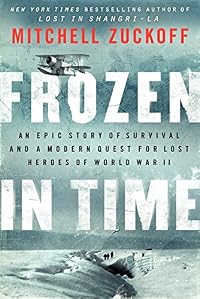
Frozen in Time: An Epic Story of Survival and a Modern Quest for Lost Heroes of World War II
by Mitchell Zuckoff
On This Page
Description
In Nov. 1942 a U.S. cargo plane crashed into the Greenland ice cap, the B-17 sent on the search-and-rescue mission got caught in a storm and also crashed, miraculously all nine men aboard survived. A second rescue operation was launched, but the plane, the Grumman Duck, flew into a storm and vanished. The survivors of the B-17 spent 148 days fighting to stay alive while waiting for rescue by famed explorer Bernt Balchen. Then in 2012 the U.S. Coast Guard and North South Polar mount an show more expedition to solve the mystery of the vanished plane and recover the remains of the lost plane's crew. show lessTags
Recommendations



















Member Recommendations

srdr A gripping mountaineering story about survival in snow and ice.
Member Reviews
Summary: An account of rescue efforts in 1942-43 and a retrieval effort in 2012 to recover several lost heroes, all occurring on the Greenland icecap.
In November of 1942, a C-53 cargo plane took off from Iceland to an airfield on the west side of Greenland. For unknown reasons it crashed inland from the eastern coast of Greenland. A B-17 diverted from transport to England joined the search with a crew of nine, captained by Armand Monteverde. Unsuccessful, they ran into a bad snowstorm that was like “flying in milk.” They also crashed, the plane splitting into two pieces. All nine survived the crash and much of the narrative in this book describes their efforts to survive in subzero temperatures, avoiding life-ending crevasses and show more fighting frostbite and keeping up hope as months went by with little more contact than overflights by another B-17, piloted by “Pappy” Turner, dropping supplies and communicating with the survivors.
Part of the 1942-43 story concerned the efforts to rescue these men either by plane or motor- or dogsled. Sadly, rescuers, both by plane and motorsled died, as did one of the B-17 crash survivors. Three of those who died were on a Coast Guard plane called “The Flying Duck” piloted by John Pritchard and Benjamin Bottoms. They rescued two crash survivors, one who was most severely affected by frostbite. Coming back, they picked up another survivor. Loren Howarth, who had repaired a radio on the crashed B-17. They, too, encountered a fast approaching storm and went down with no survivors.
Here enters the other part of this story. Lou Sapienza, who had participated in previous recovery missions learned the story about the lost men from the Flying Duck. On a preliminary survey in 2010, they identified possible crash sites. Now, he wants to go back. He needs the help of the Coast Guard and a lot of money the Pentagon doesn’t have. He enlists the author to chronicle (and help bankroll) the effort. Offsetting a reluctant bureaucracy is Coast Guard Commander Jim Blow, whose passion is not to leave those missing in action behind. Somehow, they come up with enough for a week on the Greenland ice cap.
So much of what sustains interest in this narrative, which goes back and forth between the rescue and recovery missions, is the uncertainty that they will find a way to rescue the B-17 survivors or recover the Flying Duck and her crew. The big challenge is Greenland itself. There are so many ways it can kill you from crevasses to polar bears to cold. For the surviving crew, the challenge was crash injuries, advancing frostbite, and morale. One is impressed in all the ways this crew improvised shelter, jury-rigged radios, and used what they had on hand. The recovery mission led by Jim and Lou had its own challenges. Faulty GPS coordinates, moving heavy equipment across crevasses, and conflict within the expedition pose challenges, even as they scramble to locate the Flying Duck as another of Greenland’s storms approach, necessitating evacuation.
Zuckoff’s eyewitness narrative coupled with careful historical research makes for a riveting account of the effort to “bring them home” that is a heartbeat of the services. The efforts to survive, to rescue, and to recover are all heroic. In a day when so many public figures disappoint, a narrative about heroes, who have their own struggles, but transcend and work and risk for noble ends, is a welcome gift. show less
In November of 1942, a C-53 cargo plane took off from Iceland to an airfield on the west side of Greenland. For unknown reasons it crashed inland from the eastern coast of Greenland. A B-17 diverted from transport to England joined the search with a crew of nine, captained by Armand Monteverde. Unsuccessful, they ran into a bad snowstorm that was like “flying in milk.” They also crashed, the plane splitting into two pieces. All nine survived the crash and much of the narrative in this book describes their efforts to survive in subzero temperatures, avoiding life-ending crevasses and show more fighting frostbite and keeping up hope as months went by with little more contact than overflights by another B-17, piloted by “Pappy” Turner, dropping supplies and communicating with the survivors.
Part of the 1942-43 story concerned the efforts to rescue these men either by plane or motor- or dogsled. Sadly, rescuers, both by plane and motorsled died, as did one of the B-17 crash survivors. Three of those who died were on a Coast Guard plane called “The Flying Duck” piloted by John Pritchard and Benjamin Bottoms. They rescued two crash survivors, one who was most severely affected by frostbite. Coming back, they picked up another survivor. Loren Howarth, who had repaired a radio on the crashed B-17. They, too, encountered a fast approaching storm and went down with no survivors.
Here enters the other part of this story. Lou Sapienza, who had participated in previous recovery missions learned the story about the lost men from the Flying Duck. On a preliminary survey in 2010, they identified possible crash sites. Now, he wants to go back. He needs the help of the Coast Guard and a lot of money the Pentagon doesn’t have. He enlists the author to chronicle (and help bankroll) the effort. Offsetting a reluctant bureaucracy is Coast Guard Commander Jim Blow, whose passion is not to leave those missing in action behind. Somehow, they come up with enough for a week on the Greenland ice cap.
So much of what sustains interest in this narrative, which goes back and forth between the rescue and recovery missions, is the uncertainty that they will find a way to rescue the B-17 survivors or recover the Flying Duck and her crew. The big challenge is Greenland itself. There are so many ways it can kill you from crevasses to polar bears to cold. For the surviving crew, the challenge was crash injuries, advancing frostbite, and morale. One is impressed in all the ways this crew improvised shelter, jury-rigged radios, and used what they had on hand. The recovery mission led by Jim and Lou had its own challenges. Faulty GPS coordinates, moving heavy equipment across crevasses, and conflict within the expedition pose challenges, even as they scramble to locate the Flying Duck as another of Greenland’s storms approach, necessitating evacuation.
Zuckoff’s eyewitness narrative coupled with careful historical research makes for a riveting account of the effort to “bring them home” that is a heartbeat of the services. The efforts to survive, to rescue, and to recover are all heroic. In a day when so many public figures disappoint, a narrative about heroes, who have their own struggles, but transcend and work and risk for noble ends, is a welcome gift. show less
Frozen in Time: An Epic Story of Survival and a Modern Quest for Lost Heroes of World War II by Mitchell Zuckoff. This was an excellent read! In 1942 a cargo plane slammed into the Greenland icecap and 3 successive rescue attempts were made with 3 more crashes. Why was Greenland important in 1942? German Nazi submarines. The real life saga centers around the many rescue attempts, most of which were unsuccessful. The history and the survival stories are mixed with the modern day attempt to uncover the "Duck" and repatriate the bodies. Although this is a non-fiction it read like a thriller novel and kept me on the edge of my seat. 391 pages 5 stars
Mitchell Zuckoff’s Frozen in Time is quite intense for being a nonfiction account of survival and discovery. Told in two perspectives, a reader gets a first-hand account of both the fight for survival experienced by the crew of the B-17 as well as eyewitness testimony to the present-day recovery mission. There are no real surprises, as one knows how both stories are going to end before ever starting the book, but that does not prevent Mr. Zuckoff from using the natural suspense created by such stories to his advantage. He writes each story in such a way that makes a reader doubt the story’s historically documented ending, capturing and holding a reader’s interest. As a result, this six-hour audiobook feels so much shorter because show more it is the type of story that deters being stopped or set aside for a few hours.
Frozen in Time may be non-fiction, but it reads like a novel. Mr. Zuckoff’s writing style is perfect for engaging a reader. He capitalizes on the built-in tension of the crash and fight for survival, as well as the innate need for humans to solve puzzles, to hide the drier portions of the story, those elements of research or history necessary for readers to understand the context of the real-life drama. He balances the need for detailed descriptions and explanations with the intense and personal stories of suffering and heroism without going overboard on either element. Under his pen, true World War II heroes get their due, and modern-day heroes shine. Better yet, he does not gloss over nor embellish the more disturbing elements of the story to improve his narrative. He presents both stories as is, using letters, journal entries, and other first-hand accounts to let the survivors and discoverers speak for themselves and bundles it all up in an easy-to-read-and-enjoy format.
Even though author-narrators can be a hit-or-miss experience, Mr. Zuckoff’s unique perspective as not only the researcher behind the main story of the lost Grumman Duck but also his participation in its rediscovery make him best suited to narrate his tale. His pride at being included among the Coast Guard’s and North South Polar, Inc.’s joint efforts and his own direct contributions to the solution to the mystery is palpable, and he has every right to be proud. His experiences lend his research a more personal nature, making the story of the survivors come to life in a manner that might not exist with a third-party narrator. His voice is pleasant as well, creating an enjoyable listening experience with a narrative that feels more like a fictional novel than a real life-or-death survival situation.
Frozen in Time confirms the moniker of the Greatest Generation, as the survivors of the B-17 so many decades ago not only did what they had to do to survive, they did not think that their exploits were all that outstanding. Their determination to help one another, and their refusal to give up speaks volumes about their commitment to their duty and to each other. The Coast Guard and North South Polar joint expedition honors that mindset by their own determination to succeed against the odds. Mr. Zuckoff brings both stories together into one well-written and enticing book that makes readers run the full gamut of emotional involvement. With its historical context and modern-day search-and-recovery mission as well as its quick pacing and easy-going narrative, Frozen in Time appeals to a wide audience and would make a great gift to share with others. show less
Frozen in Time may be non-fiction, but it reads like a novel. Mr. Zuckoff’s writing style is perfect for engaging a reader. He capitalizes on the built-in tension of the crash and fight for survival, as well as the innate need for humans to solve puzzles, to hide the drier portions of the story, those elements of research or history necessary for readers to understand the context of the real-life drama. He balances the need for detailed descriptions and explanations with the intense and personal stories of suffering and heroism without going overboard on either element. Under his pen, true World War II heroes get their due, and modern-day heroes shine. Better yet, he does not gloss over nor embellish the more disturbing elements of the story to improve his narrative. He presents both stories as is, using letters, journal entries, and other first-hand accounts to let the survivors and discoverers speak for themselves and bundles it all up in an easy-to-read-and-enjoy format.
Even though author-narrators can be a hit-or-miss experience, Mr. Zuckoff’s unique perspective as not only the researcher behind the main story of the lost Grumman Duck but also his participation in its rediscovery make him best suited to narrate his tale. His pride at being included among the Coast Guard’s and North South Polar, Inc.’s joint efforts and his own direct contributions to the solution to the mystery is palpable, and he has every right to be proud. His experiences lend his research a more personal nature, making the story of the survivors come to life in a manner that might not exist with a third-party narrator. His voice is pleasant as well, creating an enjoyable listening experience with a narrative that feels more like a fictional novel than a real life-or-death survival situation.
Frozen in Time confirms the moniker of the Greatest Generation, as the survivors of the B-17 so many decades ago not only did what they had to do to survive, they did not think that their exploits were all that outstanding. Their determination to help one another, and their refusal to give up speaks volumes about their commitment to their duty and to each other. The Coast Guard and North South Polar joint expedition honors that mindset by their own determination to succeed against the odds. Mr. Zuckoff brings both stories together into one well-written and enticing book that makes readers run the full gamut of emotional involvement. With its historical context and modern-day search-and-recovery mission as well as its quick pacing and easy-going narrative, Frozen in Time appeals to a wide audience and would make a great gift to share with others. show less
In November 1942, an American military plane crashed in Greenland. In a search and rescue effort, two other planes crashed. The end result was nine men stranded in extreme cold in a remote location, attempting to survive in intermittent blizzards with limited food. Mitchell Zuckoff tells the story of the multiple crashes and the heroic rescue attempts. He weaves in an account of a 2012 expedition (in which he played a key role) to locate and recover one of the missing planes.
This narrative non-fiction is filled people facing dangerous conditions. It includes planes landing on ice, planes flying in “milk” (white-out), dog sled teams traveling across unstable glaciers, isolated crash survivors facing frostbite, hypothermia, and show more psychological trauma. It serves to highlight one of the lesser known stories of WWII. It is well-researched and told with dramatic flair. Just when we think conditions cannot get worse, they do.
As in most dual storylines, one of the two is more riveting than the other. The modern quest for lost heroes is perhaps a bit oversold. I listened to the audiobook, competently read by the author. Unlike some authors reading their own books, Zuckoff has a pleasant voice and conveys the intensity of the situation. It is a gripping story that will appeal to those interested in WWII history, aviation, geology, and accounts of survival in harsh conditions. show less
This narrative non-fiction is filled people facing dangerous conditions. It includes planes landing on ice, planes flying in “milk” (white-out), dog sled teams traveling across unstable glaciers, isolated crash survivors facing frostbite, hypothermia, and show more psychological trauma. It serves to highlight one of the lesser known stories of WWII. It is well-researched and told with dramatic flair. Just when we think conditions cannot get worse, they do.
As in most dual storylines, one of the two is more riveting than the other. The modern quest for lost heroes is perhaps a bit oversold. I listened to the audiobook, competently read by the author. Unlike some authors reading their own books, Zuckoff has a pleasant voice and conveys the intensity of the situation. It is a gripping story that will appeal to those interested in WWII history, aviation, geology, and accounts of survival in harsh conditions. show less
Mitchell Zuckoff writes fascinating true adventure stories. I first discovered him though his book Lost in Shangri-La about a WWII plane that crashed into a remote and nearly inaccessible valley in Dutch New Guinea, what the survivors endured, and the daring rescue to pull them out. He brings the same story-telling skills and ability to take the reader into the moment in his newest work of non-fiction about another rescue mission, Frozen in Time.
Greenland, that misnamed island of glaciers, snow, and ice, perpetually white and forbidding, might have been far from the fighting in WWII but it was deemed a strategic outpost to the Allied war effort. By planting bases on it, there was a place to re-fuel planes on their way from the US to show more Europe and it gave the powers that be some meteorological insight into the weather that was soon to swirl its way into Europe and onto the soldiers on the ground. But the massive island's variable weather, unpredictable blizzards, and harsh climate made it incredibly treacherous to fly over and throughout the course of the war, quite a number of planes crashed onto its glacial interior. One plane, a C-53, carrying five US military personnel made a forced landing on Greenland and the crew miraculously survived the crash. But their radio contact with base didn't last long enough for their location to be fixed and so the rescue missions that were mounted to discover them not only had to contend with the frustrations of terrible weather grounding planes for days at a time but also with finding one relatively small plane in a vast, blank land. But looking for a needle in a haystack was just the first of the problems about to beset the rescue mission.
A B-17 bomber, diverted from delivery in Europe, was pressed into service looking for the downed C-53 and its crew. But it too flew into disorienting conditions pilots called "flying in milk" and crashed onto the island in the midst of a crevasse-riddled glacier. Amazingly, the nine men on board the B-17 also survived. But now there were two separate crews of 14 men stranded on the ice in one of the most inhospitable places on the planet and fighting for their survival. Zuckoff captures the immediacy of the danger that the men on the ice faced, from their lack of provisions and cold weather survival gear to the danger of frostbite and exposure. He captures the frustration of command at the inability to find a way to safely remove these would be rescuers now in peril themselves. And he follows the planning and determination of a pilot and his navigator on a Coast Guard cutter patrolling the seas off of Greenland as they prepare to risk their own lives to save the men in the B-17 by flying their small Grumman Duck, an amphibious biplane, to the crash site to pluck the men two by two off the ice.
Alternating with the historical chapters of the increasingly frantic determination to rescue the weakened and suffering men from the B-17, Zuckoff weaves in current day chapters about the quest to locate the Grumman Duck, also tragically lost on the unforgiving glaciers of Greenland with her crew of two fearless men and one of the B-17 survivors. He captures the larger than life, forever optimistic personalities who spearheaded the years of research into the fate and location of the little amphibious biplane and her passengers, lobbied government agencies for their support, and by hook or crook and on a showstring managed to assemble the people and the money to make the trek to Greenland to try and physically locate the final resting place of the Duck.
Zuckoff has written a completely gripping, compelling tale. He's captured the terror and helplessness of the downed men and those valiantly searching for them. He's drawn visceral pictures of the aching cold and desperation they felt as the days mounted without their discovery and that they continued to feel even after their discovery as more time passed while the powers that be tried to figure out a way to pluck them from the ice without endangering more lives. The reader truly feels the ways in which they were at the complete mercy of nature and their own psyches. Pulled from journals, declassified documents, interviews with survivors' families, maps, and interviews, Zuckoff stays true to the story as reproduced publically, honoring the survivors' and participants' versions of events, never speculating on what cannot be known. The story of the men and the several attempts to rescue them is compelling. The modern day narrative about the expedition to find the Duck and her three missing men is interesting and provides closure to the sixty year old tale but isn't quite as enthralling as the historic events. This is a tale of heroes and determination, an overwhelming perseverence in the face of danger, and the unthinkable but constant threat of failure. World War II buffs will certainly appreciate it but other armchair travelers will also find themselves captivated by the hellish Greenland winter, the dire circumstances of the men, and the terrible or wonderful consequences that befell every man who dared to go out to try and save his fellows even in the face of overwhelming risk. show less
Greenland, that misnamed island of glaciers, snow, and ice, perpetually white and forbidding, might have been far from the fighting in WWII but it was deemed a strategic outpost to the Allied war effort. By planting bases on it, there was a place to re-fuel planes on their way from the US to show more Europe and it gave the powers that be some meteorological insight into the weather that was soon to swirl its way into Europe and onto the soldiers on the ground. But the massive island's variable weather, unpredictable blizzards, and harsh climate made it incredibly treacherous to fly over and throughout the course of the war, quite a number of planes crashed onto its glacial interior. One plane, a C-53, carrying five US military personnel made a forced landing on Greenland and the crew miraculously survived the crash. But their radio contact with base didn't last long enough for their location to be fixed and so the rescue missions that were mounted to discover them not only had to contend with the frustrations of terrible weather grounding planes for days at a time but also with finding one relatively small plane in a vast, blank land. But looking for a needle in a haystack was just the first of the problems about to beset the rescue mission.
A B-17 bomber, diverted from delivery in Europe, was pressed into service looking for the downed C-53 and its crew. But it too flew into disorienting conditions pilots called "flying in milk" and crashed onto the island in the midst of a crevasse-riddled glacier. Amazingly, the nine men on board the B-17 also survived. But now there were two separate crews of 14 men stranded on the ice in one of the most inhospitable places on the planet and fighting for their survival. Zuckoff captures the immediacy of the danger that the men on the ice faced, from their lack of provisions and cold weather survival gear to the danger of frostbite and exposure. He captures the frustration of command at the inability to find a way to safely remove these would be rescuers now in peril themselves. And he follows the planning and determination of a pilot and his navigator on a Coast Guard cutter patrolling the seas off of Greenland as they prepare to risk their own lives to save the men in the B-17 by flying their small Grumman Duck, an amphibious biplane, to the crash site to pluck the men two by two off the ice.
Alternating with the historical chapters of the increasingly frantic determination to rescue the weakened and suffering men from the B-17, Zuckoff weaves in current day chapters about the quest to locate the Grumman Duck, also tragically lost on the unforgiving glaciers of Greenland with her crew of two fearless men and one of the B-17 survivors. He captures the larger than life, forever optimistic personalities who spearheaded the years of research into the fate and location of the little amphibious biplane and her passengers, lobbied government agencies for their support, and by hook or crook and on a showstring managed to assemble the people and the money to make the trek to Greenland to try and physically locate the final resting place of the Duck.
Zuckoff has written a completely gripping, compelling tale. He's captured the terror and helplessness of the downed men and those valiantly searching for them. He's drawn visceral pictures of the aching cold and desperation they felt as the days mounted without their discovery and that they continued to feel even after their discovery as more time passed while the powers that be tried to figure out a way to pluck them from the ice without endangering more lives. The reader truly feels the ways in which they were at the complete mercy of nature and their own psyches. Pulled from journals, declassified documents, interviews with survivors' families, maps, and interviews, Zuckoff stays true to the story as reproduced publically, honoring the survivors' and participants' versions of events, never speculating on what cannot be known. The story of the men and the several attempts to rescue them is compelling. The modern day narrative about the expedition to find the Duck and her three missing men is interesting and provides closure to the sixty year old tale but isn't quite as enthralling as the historic events. This is a tale of heroes and determination, an overwhelming perseverence in the face of danger, and the unthinkable but constant threat of failure. World War II buffs will certainly appreciate it but other armchair travelers will also find themselves captivated by the hellish Greenland winter, the dire circumstances of the men, and the terrible or wonderful consequences that befell every man who dared to go out to try and save his fellows even in the face of overwhelming risk. show less
In November 1942, an American military plane crashed in Greenland. In a search and rescue effort, two other planes crashed. The end result was nine men stranded in extreme cold in a remote location, attempting to survive in intermittent blizzards with limited food. Mitchell Zuckoff tells the story of the multiple crashes and the heroic rescue attempts. He weaves in an account of a 2012 expedition (in which he played a key role) to locate and recover one of the missing planes.
This narrative non-fiction is filled people facing dangerous conditions. It includes planes landing on ice, planes flying in “milk” (white-out), dog sled teams traveling across unstable glaciers, isolated crash survivors facing frostbite, hypothermia, and show more psychological trauma. It serves to highlight one of the lesser known stories of WWII. It is well-researched and told with dramatic flair. Just when we think conditions cannot get worse, they do.
As in most dual storylines, one of the two is more riveting than the other. The modern quest for lost heroes is perhaps a bit oversold. I listened to the audiobook, competently read by the author. Unlike some authors reading their own books, Zuckoff has a pleasant voice and conveys the intensity of the situation. It is a gripping story that will appeal to those interested in WWII history, aviation, geology, and accounts of survival in harsh conditions. show less
This narrative non-fiction is filled people facing dangerous conditions. It includes planes landing on ice, planes flying in “milk” (white-out), dog sled teams traveling across unstable glaciers, isolated crash survivors facing frostbite, hypothermia, and show more psychological trauma. It serves to highlight one of the lesser known stories of WWII. It is well-researched and told with dramatic flair. Just when we think conditions cannot get worse, they do.
As in most dual storylines, one of the two is more riveting than the other. The modern quest for lost heroes is perhaps a bit oversold. I listened to the audiobook, competently read by the author. Unlike some authors reading their own books, Zuckoff has a pleasant voice and conveys the intensity of the situation. It is a gripping story that will appeal to those interested in WWII history, aviation, geology, and accounts of survival in harsh conditions. show less
Well written search and rescue plus aviation archaeology story. In November 1942 a C-53 went down over Greenland. Search planes were sent out; one of those, a B-17 with nine crew on board, also crashed. A Grumman Duck floatplane from the coastguard cutter Northland found the B-17, landed on the ice, picked up two crewmen, brought them back to the Northland, then set out again to pick up some more but went down on the return trip with two Coast Guardsmen and a B-17 crewman. An overland sledge party from an Army base set out, reached the B-17, and started back with some of the crewmen; one of the B-17 crew and one of the Army sledgers were lost in crevasses and the surviving sledgers set up camp and waited rather than risk more crevasses. show more Finally a Navy PBY landed on the ice, picked everybody up, and made it back. Final score – All five C-53 crewman lost (that crash site was never located), two Coast Guardsmen lost (the crash site was seen from the air but no attempt was made to recover anybody as it was assumed the crash was not survivable); two B-17 crew lost (one in the Duck crash and one in a crevasse) and one Army sledger lost in a crevasse. One of the B-17 survivors lost both legs at the knee from frostbite. The stories of the various survivors and rescuers are as inspiring as they come; ordinary people in extraordinary circumstance. The most surprising thing here – and author Mitchell Zuckoff doesn’t stress it – is how poorly prepared the AAF was to face Greenland conditions. The B-17 crew had no cold weather gear, no sleeping bags, no extra rations, no arctic weather training, yet were sent out on repeated search flights.
The story alternates the various Army, Coast Guard, and Navy exploits in 1942 and 1943 with the 2012 efforts of an American adventurer, Lou Sapienza, to recover the remains of the Duck. Sapienza had some previous experience in recovering aircraft lost in the Arctic; he got one of a whole flight of P-38s out from under the ice. The Coast Guard had an interest; there were three WWII Coastguardsmen missing in action; one had died in a Japanese POW camp and was deemed unrecoverable; the other two were John Pritchard Jr. and Benjamin Bottoms, the pilot and radioman of the Duck. The Coast Guard was therefore persuaded to loan Sapienza a C-130 to transport him and his crew to Greenland when he claimed he could locate and recover the Duck and the remains of the crew and passenger. Sapienza and his team (which included author Zuckoff) unfortunately come off just as poorly prepared as the WWII AAF. Their clothing was adequate, but their search and recovery equipment – or, rather, their use of it – was not. In particular, they had a set of state-of-the-art GPS receivers, but nobody knew how to use them, and a magnetometer, but nobody knew how to use that either. Their search was based on Coast Guard personal GPS equipment, a team member’s tentative understanding of the magnetometer, and a ground-penetrating radar (at least the operator of that was familiar with the equipment). Their plan was to use 1940’s hand drawn maps of the Duck crash site (which was now assumed to be under many feet of ice), get a signal from the ground-penetrating radar and/or magnetometer, melt down to the wreck with a steam gun, confirm identification with a downhole camera, and come back next year to actually recover it. As is typical of these sorts of stories, on their last day on the ice they got a promising signal, melted down, and photographed something that they and the Coast Guard agreed was part of the Duck. That’s where this book ends in 2012.
Alas, it hasn’t come off. It’s hard to tell exactly what happened from the web, but apparently the Duck’s location was lost after the 2012 mission and another group is trying to locate the wreck again.
A quick and exciting read; the alternating time line keeps things interesting and Zuckoff manages to keep things exciting even though everybody knows what happened. Photographs of participants and scenery from both 1942 and 2012. Could use one modern map; there are historic maps but nothing that shows the 2012 expedition’s location (although perhaps that’s deliberate; Sapienza’s group might have worried about another team jumping their claim and the Coast Guard had already expressed concerns about relic hunters). show less
The story alternates the various Army, Coast Guard, and Navy exploits in 1942 and 1943 with the 2012 efforts of an American adventurer, Lou Sapienza, to recover the remains of the Duck. Sapienza had some previous experience in recovering aircraft lost in the Arctic; he got one of a whole flight of P-38s out from under the ice. The Coast Guard had an interest; there were three WWII Coastguardsmen missing in action; one had died in a Japanese POW camp and was deemed unrecoverable; the other two were John Pritchard Jr. and Benjamin Bottoms, the pilot and radioman of the Duck. The Coast Guard was therefore persuaded to loan Sapienza a C-130 to transport him and his crew to Greenland when he claimed he could locate and recover the Duck and the remains of the crew and passenger. Sapienza and his team (which included author Zuckoff) unfortunately come off just as poorly prepared as the WWII AAF. Their clothing was adequate, but their search and recovery equipment – or, rather, their use of it – was not. In particular, they had a set of state-of-the-art GPS receivers, but nobody knew how to use them, and a magnetometer, but nobody knew how to use that either. Their search was based on Coast Guard personal GPS equipment, a team member’s tentative understanding of the magnetometer, and a ground-penetrating radar (at least the operator of that was familiar with the equipment). Their plan was to use 1940’s hand drawn maps of the Duck crash site (which was now assumed to be under many feet of ice), get a signal from the ground-penetrating radar and/or magnetometer, melt down to the wreck with a steam gun, confirm identification with a downhole camera, and come back next year to actually recover it. As is typical of these sorts of stories, on their last day on the ice they got a promising signal, melted down, and photographed something that they and the Coast Guard agreed was part of the Duck. That’s where this book ends in 2012.
Alas, it hasn’t come off. It’s hard to tell exactly what happened from the web, but apparently the Duck’s location was lost after the 2012 mission and another group is trying to locate the wreck again.
A quick and exciting read; the alternating time line keeps things interesting and Zuckoff manages to keep things exciting even though everybody knows what happened. Photographs of participants and scenery from both 1942 and 2012. Could use one modern map; there are historic maps but nothing that shows the 2012 expedition’s location (although perhaps that’s deliberate; Sapienza’s group might have worried about another team jumping their claim and the Coast Guard had already expressed concerns about relic hunters). show less
Members
- Recently Added By
Author Information

15+ Works 4,642 Members
Mitchell Zuckoff received a master's degree from the University of Missouri and was a Batten Fellow at the Darden School of Business Administration at the University of Virginia. He is currently a professor of journalism at Boston University. He has written several books including Frozen in Time: An Epic Story of Survival and a Modern Quest for show more Lost Heroes of World War II; Lost in Shangri-La: A True Story of Survival, Adventure and the Most Incredible Rescue Mission of World War II; Robert Altman: The Oral Biography; Ponzi's Scheme: The True Story of a Financial Legend; Judgment Ridge: The True Story Behind the Dartmouth Murders written with Dick Lehr; and 13 Hours: The Inside Account of What Really Happened in Benghazi. His work Choosing Naia: A Family's Journey received the Christopher Award. He was a reporter for twenty years, mostly as an investigative reporter and roving national correspondent for The Boston Globe. His articles have appeared in several publications including The New Yorker and Fortune. He received the Distinguished Writing Award from the American Society of Newspaper Editors, the Livingston Award for International Reporting, the Heywood Broun Award, and the Associated Press Managing Editors' Public Service Award. (Bowker Author Biography) show less
Awards and Honors
Awards
Distinctions
Common Knowledge
- Canonical title*
- Frozen. Avventura sopravvivenza mistero
- Original publication date
- 2013-04-23
- Important places
- Greenland
- Important events
- World War II (1939 | 1945)
- Dedication
- For Suzanne, Isabel, and Eve
- First words
- On Thanksgiving Day 1942, at a secret UlS. Army base on the ice-covered island of Greenland, a telegraph receiver clattered to life: "Situation grave."
- Last words
- (Click to show. Warning: May contain spoilers.)"I hope I'm still here to see John brought home." I hope so, too.
- Publisher's editor
- Ottewell, Miranda
- Original language
- English
*Some information comes from Common Knowledge in other languages. Click "Edit" for more information.
Classifications
Statistics
- Members
- 750
- Popularity
- 37,320
- Reviews
- 41
- Rating
- (3.93)
- Languages
- Danish, English, Italian
- Media
- Paper, Audiobook, Ebook
- ISBNs
- 14
- UPCs
- 1
- ASINs
- 8