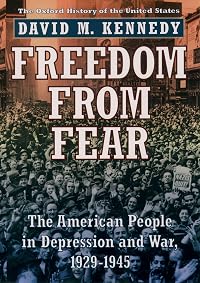
Freedom from Fear: The American People in Depression and War, 1929-1945
by David M. Kennedy
Oxford History of the United States (9)
On This Page
Description
Between 1929 and 1945, two great travails were visited upon the American people: the Great Depression and World War II. In a single volume the author tells how America endured, and eventually prevailed, in the face of those unprecedented calamities. He demonstrates that the economic crisis of the 1930s was more than a reaction to the excesses of the 1920s. For more than a century before the Crash, America's unbridled industrial revolution had gyrated through repeated boom and bust cycles, show more consuming capital and inflicting misery on city and countryside alike. Nor was the alleged prosperity of the 1920s as uniformly shared as legend portrays. Countless Americans eked out threadbare lives on the margins of national life. Roosevelt's New Deal wrenched opportunity from the trauma of the 1930s and created a lasting legacy of economic and social reform, but it was afflicted with shortcomings and contradictions as well. The author details the New Deal's problems and defeats, as well as its achievements. Yet, even as the New Deal was coping with the Depression, a new menace was developing abroad. Exploiting Germany's own economic burdens, Hitler reached out the disaffected, turning their aimless discontent into loyal support for the Nazi Party. In Asia, Japan harbored imperial ambitions of its own. The same generation of Americans who battled the Depression eventually had to shoulder arms in another conflict that wreaked worldwide destruction, ushered in the nuclear age, and forever changed their way of life and their country's relationship to the rest of the world. In the second installment of the chronicle, the author explains how the nation agonized over its role in the conflict, how it fought the war, and why the U.S. emerged victorious, and why the consequences of victory were sometimes sweet, sometimes ironic. The author analyses the determinants of American strategy, the painful choices faced by commanders and statesmen, and the agonies inflicted on the millions of ordinary Americans who were compelled to swallow their fears and face battle as best they could. show lessTags
Recommendations






Member Recommendations


Member Reviews
This book, covering the years 1930-1945, is a worthy entry in the splendid Oxford History of the United States (of which Mr. Kennedy is the current editor). This book is magisterial in scope, and is as balanced as is possible, in a volume covering so many issues that are still highly contentious today. This is not a quick read -- it is an overview of the history of the period, approaching that period from a variety of viewpoints; political, historical, social, and cultural. That adds up to an enormous amount of material, but Mr. Kennedy's vivid prose style and gift for storytelling makes it far more enjoyable that the phrase "historical survey" usually suggests. As to balance, Mr. Kennedy presents his major characters as rounded show more individuals with good and bad character traits, who made both good and bad choices. I had not realized, for example, that Herbert Hoover's policies in so many ways foreshadowed FDR's, nor had I realized just how scatter-shot the New Deal really was. For those who want to learn more about this period, during which so many of our current political issues find their roots, this book is very strongly recommended. show less
Another Oxford History of the US entry, this one covers the Great Depression and World War 2. Those are the decades that fundamentally changed America in a way that will probably never happen again - we have grown too big, too complacent, and though reading through the section on the start of the Depression will have you punching walls in frustration at how little people seem to have learned, it seems like against all odds maybe we have retained a tiny bit about the value of a safety net and the dangers that can result from corruption and poor policy. I wouldn't say that the part about World War 2 is definitive in the same way that McPherson's volume on the Civil War is definitive, but it certainly tries to cover as much as it show more reasonably can. show less
This is a magnificent work of history and I can't recommend it highly enough! It combines politics, economics, military strategy, social issues, and insights into character into a highly readable, occasionally stunningly written, nearly 900 pages. I learned a tremendous amount I didn't know before from it, and found it particularly interesting to find out how some people whose names became well known got their start and what they really did, as well as to gain greater understanding of how the origins of the cold war lay in World War II. Do not be daunted by its length!
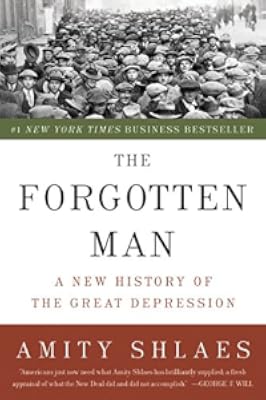
Freedom from Fear won the 2000 Pulitzer Prize in history. It is a 900 page tome that is essentially two books, The Depression and The War. I decided to read it as a comparison to Amity Schlaes' The Forgotten Man (my review).
As far as The Depression goes, Schlaes' treatment is much deeper and more detailed, including the 1920s context and the personal histories and travels to the USSR of FDR's "braintrust." Kennedy skips or glosses over certain crucial details of the New Deal that Schlae's emphasizes, like the critical Schechter case. However, Kennedy does a good job explaining how the New Deal had to be mostly undone to fight World War II. He also does a better job integrating the important of international events on FDR's show more decision-making in the later 30's.
Overall, I don't find many contradictions to Schlaes' treatment of FDR and the New Deal, which is remarkable given how much the Left has poo-poohed Schlaes' account. FDR comes across as inexperienced, contradictory, weak in negotiations, and not very literate ("None of his advisers ever knew him to read a book) in both accounts-- quite different from the adoration he receives today. The New Deal was more about more fair redistribution than economic stimulation, which is why the restrictions it put on free enterprise had to be let go to allow businesses to produce the war machine.
FDR's decision to take the U.S. off the gold standard was the greatest economic boost. His sudden determination to raise taxes and reduce the deficit helped cause the 1938 recession for which he almost faced a tough re-election.
Kennedy does a good job giving a play-by-play overview of World War II, including many details revealed by recent research; that's quite laudable. FDR's ill health and failings at Yalta are detailed. Kennedy does a decent job giving some home-front industrial policy and statistics throughout the book, including WWII, but I think fails to capture the sociology of the American people during the War years. He does look at certain aspects, such as internment camps, and the role of women (and their eagerness to get back to homemaking according to multiple surveys-- something that is forgotten about the 1940s by many modern talking heads).
In all, I give this book 4 stars out of 5. It's not great as a detailed account of both periods, but is a very good overview of both. show less
As far as The Depression goes, Schlaes' treatment is much deeper and more detailed, including the 1920s context and the personal histories and travels to the USSR of FDR's "braintrust." Kennedy skips or glosses over certain crucial details of the New Deal that Schlae's emphasizes, like the critical Schechter case. However, Kennedy does a good job explaining how the New Deal had to be mostly undone to fight World War II. He also does a better job integrating the important of international events on FDR's show more decision-making in the later 30's.
Overall, I don't find many contradictions to Schlaes' treatment of FDR and the New Deal, which is remarkable given how much the Left has poo-poohed Schlaes' account. FDR comes across as inexperienced, contradictory, weak in negotiations, and not very literate ("None of his advisers ever knew him to read a book) in both accounts-- quite different from the adoration he receives today. The New Deal was more about more fair redistribution than economic stimulation, which is why the restrictions it put on free enterprise had to be let go to allow businesses to produce the war machine.
FDR's decision to take the U.S. off the gold standard was the greatest economic boost. His sudden determination to raise taxes and reduce the deficit helped cause the 1938 recession for which he almost faced a tough re-election.
Kennedy does a good job giving a play-by-play overview of World War II, including many details revealed by recent research; that's quite laudable. FDR's ill health and failings at Yalta are detailed. Kennedy does a decent job giving some home-front industrial policy and statistics throughout the book, including WWII, but I think fails to capture the sociology of the American people during the War years. He does look at certain aspects, such as internment camps, and the role of women (and their eagerness to get back to homemaking according to multiple surveys-- something that is forgotten about the 1940s by many modern talking heads).
In all, I give this book 4 stars out of 5. It's not great as a detailed account of both periods, but is a very good overview of both. show less
There are two things you should know before reading this book. The first is that it is a very thorough history of the period, and as such, a fairly long book that requires a serious commitment. The second is, as other reviewers have noted, there is very little about the people beyond statistics and a few anecdotes. Rather, this is a comprehensive textbook of American history from the Great Depression to the end of World War II, and as such, FDR gets a lot of air time.
That said, it is an excellent history that can serve both as a reference work and a debate-sparker. Certain passages are simply outstanding, such as the Japanese resettlement; a few are boring, such as the two barrages of economic statistics that appear in the early and show more late parts of the book. Much of the story has been told in many other works; still, Kennedy has to be given credit for writing some of the events in a way that makes them seem fresh and interesting (Pearl Harbor, for instance). There are of course new facts from the research, but what makes the book special is Kennedy's ability to synthesize fact, event and human impulse into valid interpretations of truth.
So, if you are entirely unschooled in the period, this is a must-read. If you have read a great deal of American history, you may find yourself wanting to skip certain passages that reveal little anything you do not already know. I fall into the latter category, but I still enjoyed the book as a masterpiece of a fine historian. show less
That said, it is an excellent history that can serve both as a reference work and a debate-sparker. Certain passages are simply outstanding, such as the Japanese resettlement; a few are boring, such as the two barrages of economic statistics that appear in the early and show more late parts of the book. Much of the story has been told in many other works; still, Kennedy has to be given credit for writing some of the events in a way that makes them seem fresh and interesting (Pearl Harbor, for instance). There are of course new facts from the research, but what makes the book special is Kennedy's ability to synthesize fact, event and human impulse into valid interpretations of truth.
So, if you are entirely unschooled in the period, this is a must-read. If you have read a great deal of American history, you may find yourself wanting to skip certain passages that reveal little anything you do not already know. I fall into the latter category, but I still enjoyed the book as a masterpiece of a fine historian. show less
A captivating history of the Great Depression and WWII from the United States' perspective. Insightful comments on many of the most controversial aspects of the period.
This volume of the Oxford History of the United States won a Pulitzer Prize in 2000 helping to build the reputation of the series. I have read a number of the volumes in print and I would agree that they are generally high quality history writing. Strangely enough one volume, The Market Revolution: Jacksonian America, 1815-1846 was published by Oxford but replaced in the series by What Hath God Wrought: The Transformation of America, 1815-1848.
This book is a good in-depth survey history of an era that saw great changes in the United States. The author varies narrative history with a cogent analysis of events. 1929 was the end of the roaring twenties. The author gives a short introduction and then begins the book with the crash. America, show more at the time of the crash, was a country of small towns which had retreated from a brief fling as a major power in World War I. On October 29, the market crashed for good and the American economy went into reverse. By 1930 American unemployment was over 10% and was at that figure when the industrial boom of World War II began. At the end of 1945 America had exploded the atomic bomb and had the biggest industrial economy on the planet amidst a bombed out Europe and Asia. After World War II America displaced the European powers on the world stage, eventually fighting and losing an anti-colonial war in Vietnam. It should be noted that the country quit the military never lost.
The author's portrayal of Herbert Hoover is refreshingly balanced. Herbert Hoover was an intelligent man who made a reputation running the programs that fed Europe after WWI. FDR expanded many of the programs that Hoover started and got the credit for being innovative. Unfortunately both of Hoover's parents were dead by the time he was ten and he was raised in a rural Quaker environment. Hoover didn't have one-tenth the charm and warmth that were some of Roosevelt's greatest attributes. Plus he was poorly served at times. General MacArthur ran the Bonus Army families out of their tent camp with tear gas and Hoover got the blame.
In 1932 Franklin Delano Roosevelt was elected president and the New Deal began. Something was wrong in America and the government was going to fix it. There were several agencies and programs that were a flash in the pan and there were long term programs such as Social Security and the TVA that changed the American way of life. The WPA was made the government the employer of last resort for a period of time and the NRA gave rise to the slogan" The little chicken that killed the blue eagle". That was an often used expression describing the Schecter case where the NRA, a huge economic bureaucracy that set prices, wages and standards was declared unconstitutional. This and other cases like it led to FDR's court-packing plan. He wanted to appoint one Justice to the Supreme Court for every one who was over 70. The failure of that plan in 1937 showed that FDR did have limits to his political power.
World War II in Europe began September 1, 1939 and after the British were driven off the shores of Dunkirk losing all of their equipment Roosevelt began to push the country to the aid of England. The battle between Roosevelt and the isolationists ended on December 7, 1941 and when Germany and Italy declared war on the U. S. on December 11. America fought a tough war in the Pacific while the Russians inflicted 70% of the German casualties. The diplomatic side largely consisted of the relationship between Roosevelt and Churchill. The portrayal of Churchill has little depth. He is primarily portrayed as someone who was a zealous advocate for his country's interest. In describing the Big Three conferences Stalin comes across as a formidable adversary. He was intelligent, knew what he wanted and expected to get it. At the last conference in Teheran FDR was very ill. Stalin agreed to go to war against Japan but insisted on a sphere of interest in Eastern Europe as his price. The Russian military occupation of the area created a fait accompli. In April of 1945 FDR died at Warm Springs, Georgia. He was with his mistress. 24 years before he had promised Eleanor he would leave her. At the end of the book there is some emphasis put on the lack of discussion about the decision to use the atomic bomb. The incendiary bombing of Tokyo killed 90,000 people in 12 to 18 hours. The U.S. had spent billions and worked incredibly hard to produce the atomic bomb as a super weapon to end the war without any further American casualties. In retrospect the horror of the atomic bomb is it's lasting legacy. Sherman said "War is Hell" and this was another action that proved him right.
There is much that I liked about this book. It had a great deal of information and was well written. The index is very useful and the author going against the tide put his notes at the bottom of the page. Unfortunately I did not enjoy the book as much as I would have liked. I felt the author had an elitist approach in deciding who and what was important. The book was more about Roosevelt than the American people. I have grown to like history that makes use of diaries and letters to present the moments of the past in the words of the people who lived them. This author chose to use a different approach. Obviously the Pulitzer Committee agreed with his approach. I do recommend the book. The author gave me some new insights into this era and I will keep it on the shelf for reference. show less
This book is a good in-depth survey history of an era that saw great changes in the United States. The author varies narrative history with a cogent analysis of events. 1929 was the end of the roaring twenties. The author gives a short introduction and then begins the book with the crash. America, show more at the time of the crash, was a country of small towns which had retreated from a brief fling as a major power in World War I. On October 29, the market crashed for good and the American economy went into reverse. By 1930 American unemployment was over 10% and was at that figure when the industrial boom of World War II began. At the end of 1945 America had exploded the atomic bomb and had the biggest industrial economy on the planet amidst a bombed out Europe and Asia. After World War II America displaced the European powers on the world stage, eventually fighting and losing an anti-colonial war in Vietnam. It should be noted that the country quit the military never lost.
The author's portrayal of Herbert Hoover is refreshingly balanced. Herbert Hoover was an intelligent man who made a reputation running the programs that fed Europe after WWI. FDR expanded many of the programs that Hoover started and got the credit for being innovative. Unfortunately both of Hoover's parents were dead by the time he was ten and he was raised in a rural Quaker environment. Hoover didn't have one-tenth the charm and warmth that were some of Roosevelt's greatest attributes. Plus he was poorly served at times. General MacArthur ran the Bonus Army families out of their tent camp with tear gas and Hoover got the blame.
In 1932 Franklin Delano Roosevelt was elected president and the New Deal began. Something was wrong in America and the government was going to fix it. There were several agencies and programs that were a flash in the pan and there were long term programs such as Social Security and the TVA that changed the American way of life. The WPA was made the government the employer of last resort for a period of time and the NRA gave rise to the slogan" The little chicken that killed the blue eagle". That was an often used expression describing the Schecter case where the NRA, a huge economic bureaucracy that set prices, wages and standards was declared unconstitutional. This and other cases like it led to FDR's court-packing plan. He wanted to appoint one Justice to the Supreme Court for every one who was over 70. The failure of that plan in 1937 showed that FDR did have limits to his political power.
World War II in Europe began September 1, 1939 and after the British were driven off the shores of Dunkirk losing all of their equipment Roosevelt began to push the country to the aid of England. The battle between Roosevelt and the isolationists ended on December 7, 1941 and when Germany and Italy declared war on the U. S. on December 11. America fought a tough war in the Pacific while the Russians inflicted 70% of the German casualties. The diplomatic side largely consisted of the relationship between Roosevelt and Churchill. The portrayal of Churchill has little depth. He is primarily portrayed as someone who was a zealous advocate for his country's interest. In describing the Big Three conferences Stalin comes across as a formidable adversary. He was intelligent, knew what he wanted and expected to get it. At the last conference in Teheran FDR was very ill. Stalin agreed to go to war against Japan but insisted on a sphere of interest in Eastern Europe as his price. The Russian military occupation of the area created a fait accompli. In April of 1945 FDR died at Warm Springs, Georgia. He was with his mistress. 24 years before he had promised Eleanor he would leave her. At the end of the book there is some emphasis put on the lack of discussion about the decision to use the atomic bomb. The incendiary bombing of Tokyo killed 90,000 people in 12 to 18 hours. The U.S. had spent billions and worked incredibly hard to produce the atomic bomb as a super weapon to end the war without any further American casualties. In retrospect the horror of the atomic bomb is it's lasting legacy. Sherman said "War is Hell" and this was another action that proved him right.
There is much that I liked about this book. It had a great deal of information and was well written. The index is very useful and the author going against the tide put his notes at the bottom of the page. Unfortunately I did not enjoy the book as much as I would have liked. I felt the author had an elitist approach in deciding who and what was important. The book was more about Roosevelt than the American people. I have grown to like history that makes use of diaries and letters to present the moments of the past in the words of the people who lived them. This author chose to use a different approach. Obviously the Pulitzer Committee agreed with his approach. I do recommend the book. The author gave me some new insights into this era and I will keep it on the shelf for reference. show less
Members
- Recently Added By
Lists

Pulitzer Prize for History
16 works; 2 members

r/AskHistorians' Recommended Books
1,068 works; 19 members

Works Cited in The History of White People by Nell Irvin Painter
321 works; 2 members
Author Information

21+ Works 2,649 Members
David M. Kennedy is the Donald J. McLachlan Professor of History Emeritus at Stanford University and the Director Emeritus of the Bill Lane Center for the American West, He won the Bancroft Prize for Birth Control in America: The Career of Margaret Sanger and won the Pulitzer Prize for History for Freedom from Fear: The American People in show more Depression and War, 1929-1945. He is also the editor of the renowned Oxford History of the United States. show less
All Editions
Awards and Honors
Series

Work Relationships
Common Knowledge
- Canonical title
- Freedom from Fear: The American People in Depression and War, 1929-1945
- Original publication date
- 1999
- People/Characters
- Herbert Hoover; Winston Churchill; Adolf Hitler; Joseph Stalin; Franklin Delano Roosevelt
- Important events
- Great Depression; World War II (1939 | 1945); Battle of the Bulge (1944 | 1945)
- Dedication
- This book is for Ben, Bess, and Tom qui laetificant vitam meam.
- First words
- (Prologue) The Great War ended on November 11, 1918.
Like an earthquake, the stock market crash of October 1929 cracked startlingly across the United States, the herald of a crisis that was to shake the American way of life to its foundations. - Last words
- (Click to show. Warning: May contain spoilers.)"The killing was all going to be over," one of them reflected. "We were going to grow to adulthood after all."
(Click to show. Warning: May contain spoilers.)(Epilogue) Like all worlds, it held its share of peril as well as promise. - Blurbers
- Patterson, James T; Dallek, Robert; Blum, John Morton; Galbraith, John Kenneth; Beatty, Jack; Cohen, Lizabeth
- Original language
- English
Classifications
Statistics
- Members
- 1,703
- Popularity
- 13,056
- Reviews
- 15
- Rating
- (4.25)
- Languages
- English, Spanish
- Media
- Paper, Audiobook, Ebook
- ISBNs
- 14
- ASINs
- 12