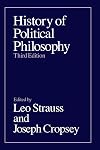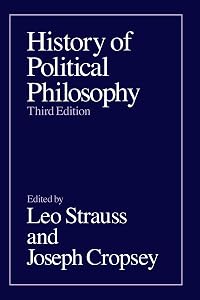
History of Political Philosophy
by Leo Strauss (Editor), Joseph Cropsey (Editor)
On This Page
Description
This volume provides an unequaled introduction to the thought of chief contributors to the Western tradition of political philosophy from classical Greek antiquity to the twentieth century. Written by specialists on the various philosophers, this third edition has been expanded significantly to include both new and revised essays.Tags
Recommendations








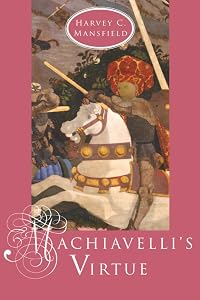
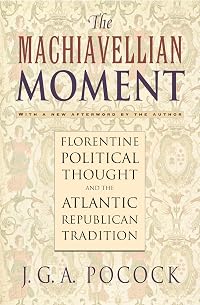
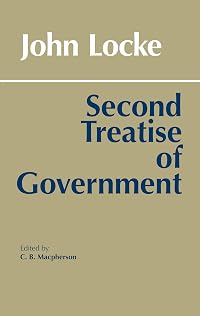
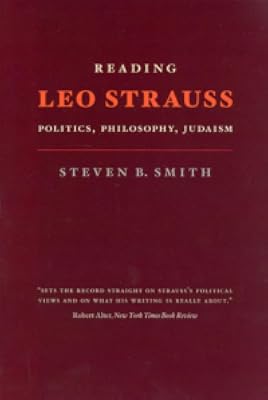



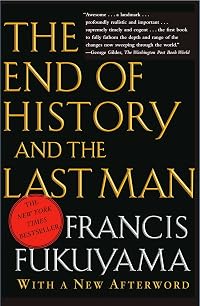
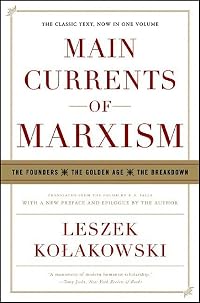

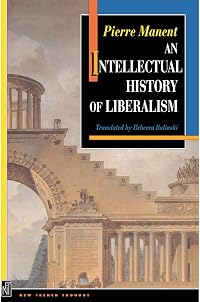
Member Reviews
An important work on the subject of political theory. It is a paradox that the Straussians, who are conservatives, have been open to non-Western thought.
Ratings
Members
- Recently Added By
Author Information

Leo Strauss (1899-1973) was one of the preeminent political philosophers of the twentieth century. From 1949 to 1968 he was professor of political science at the University of Chicago. He is the author of many books, among them The Political Philosophy of Hobbes, Natural Right and History, and Spinoza's Critique of Religion, all published by the show more University of Chicago Press. Catherine H. Zuciert is the Nancy R. Dreux Professor of Political Science Emeritus at the University of Notre Dame. show less
All Editions
Common Knowledge
- Original publication date
- 1963
- People/Characters*
- Thucydides; Plato; Xenophon; Aristotle, 384-322; Marcus Tullius Cicero; St. Augustine (show all 39); Alfarabi; Moses Maimonides; St. Thomas Aquinas; Marsilius of Padua; Niccolo Machiavelli; Martin Luther; John Calvin; Richard Hooker; Francis Bacon; Hugo Grotius; Thomas Hobbes; Rene Descartes; John Milton; Benedict Spinoza; John Locke; Montesquieu; David Hume; Jean-Jacques Rousseau; Immanuel Kant; William Blackstone; Adam Smith; Thomas Paine; Edmund Burke; Jeremy Bentham; James Mill; Georg Wilhelm Friedrich Hegel; Alexis de Tocqueville; John Stuart Mill; Karl Marx; Friedrich Nietzsche; John Dewey; Edmund Husserl; Martin Heidegger
- First words
- Preface to the First Edition -- This book is intended primarily to introduce to undergraduate students of political science to political philosophy. The authors and editors have done their best to take political philosophy se... (show all)riously, assuming throughout that the teachings of the great political philosophers are important not only historically, as phenomena about which we must learn if we wish to understand societies of the present and the past, but also as phenomena from which we must learn if we wish to understand those societies. We believe that the questions raised by the political philosophers of the past are alive in our own society, if only in the way that questions can be alive which, in the main, are tacitly or unwittingly answered. We have written, further, in the belief that in order to understand any society, to analyze it with any depth, the analyst must himself be exposed to these enduring questions and be swayed by them.
- Last words
- (Click to show. Warning: May contain spoilers.)By becoming aware of the dignity of the mind, we realize the true ground of the dignity of man and therewith the goodness of the world, whether we understand it as created or as uncreated, which is the home of man because it is the home of the human mind.
*Some information comes from Common Knowledge in other languages. Click "Edit" for more information.
Classifications
- Genres
- Philosophy, Politics and Government, Nonfiction, General Nonfiction, History, Religion & Spirituality
- DDC/MDS
- 320.01 — Society, government, & culture Political science Types of Government Political Science Philosophy and Theory
- LCC
- JA81 .H58 — Political Science Political science (General) Political science (General) History
- BISAC
Statistics
- Members
- 809
- Popularity
- 34,201
- Reviews
- 1
- Rating
- (4.22)
- Languages
- English, French, Polish, Spanish
- Media
- Paper, Ebook
- ISBNs
- 11
- ASINs
- 5