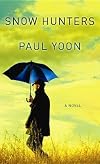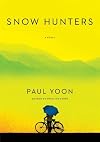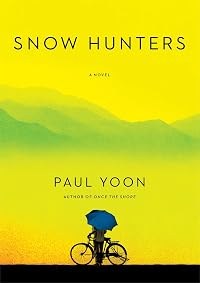
Snow Hunters
by Paul Yoon
On This Page
Description
"A highly anticipated debut novel from 5 Under 35 National Book Foundation honoree featuring a Korean War refugee who emigrates to Brazil to become a tailor's apprentice and confronts the wreckage of his past"--Tags
Recommendations





Member Reviews
I am in awe of Paul Yoon's ability in this, his first novel, to write a nearly 200-page book in mostly stream of consciousness and not bore me to tears.
That's a back ass-wards way of saying that Snow Hunters and Yoon's talent as a writer are not to be missed.
While reading Yoon, I ask myself how is it that he can take prose and make it sing like poetry? How is it he can take a scene and bring out the colours an artist uses in a fine, dappled landscape? How is it with little or no dialogue he can tell a reader so much? How is it the writer knows what I've thought from time to time..."that people aged, second by second, leaving themselves behind."
In this novel, the main character Yohan, is so dislocated, so isolated that the people he show more thinks of as friends he doesn't often see and, [XBR] when he does, few words pass between them. It's not until the final few pages that Yohan has finally found enough words to make a connection.
"Stay this time," he says. And "...he watched the shape of her there, rising. She lifted her arms for balance. Then she made her way toward him, across the length of the canoe, as lights appeared and the evening started." show less
That's a back ass-wards way of saying that Snow Hunters and Yoon's talent as a writer are not to be missed.
While reading Yoon, I ask myself how is it that he can take prose and make it sing like poetry? How is it he can take a scene and bring out the colours an artist uses in a fine, dappled landscape? How is it with little or no dialogue he can tell a reader so much? How is it the writer knows what I've thought from time to time..."that people aged, second by second, leaving themselves behind."
In this novel, the main character Yohan, is so dislocated, so isolated that the people he show more thinks of as friends he doesn't often see and, [XBR] when he does, few words pass between them. It's not until the final few pages that Yohan has finally found enough words to make a connection.
"Stay this time," he says. And "...he watched the shape of her there, rising. She lifted her arms for balance. Then she made her way toward him, across the length of the canoe, as lights appeared and the evening started." show less
As a teenager I heard an interview with filmmaker Abbas Kiarostami about what he likes in films that resonated so intensely with me, I later transcribed it from a home VHS tape. Ever since I have thought to myself on occasion, "this is a film Kiarostami would like." So: this is a book I think Kiarostami would like. It is subtle and poetic, equally simple and complex, and somehow manages to convey quiet through language, in a beautifully active, present, and haunting way. I don't know that it's for everyone, but it's very much for some of us.
Snow Hunters opens with North Korean twenty-five year old Yohan arriving in Brazil via a cargo ship shortly after the end of the Korean War with a business card of a Japanese tailor in hand. Thus begins the introspective telling of Yohan’s journey. It is a testimony to the sparse elegant prose that so effectively conveys the quietness and solitary soul of Yohan with a gentleness of a whisper.
I was not quite sure what to expect from this story but was intrigued by the blurb of learning of a migration and war we do not often hear about, and was rewarded with a fascinating yet melancholy read. As Yohan’s figures out the world around him based on his past and present – it is with an open eyed innocence with an eye for simplicity yet show more fullness of spirit as he needs to figure out which of his memories he will be able to keep, what new memories will replace the ones, and once he is gone who will have a memory of him.
But, time and time again it was the beauty of the language that just so much with a perfect phrasing of a sentence. I recommend this book to readers who enjoy lyrically told stories with a freshness of storytelling style. show less
I was not quite sure what to expect from this story but was intrigued by the blurb of learning of a migration and war we do not often hear about, and was rewarded with a fascinating yet melancholy read. As Yohan’s figures out the world around him based on his past and present – it is with an open eyed innocence with an eye for simplicity yet show more fullness of spirit as he needs to figure out which of his memories he will be able to keep, what new memories will replace the ones, and once he is gone who will have a memory of him.
But, time and time again it was the beauty of the language that just so much with a perfect phrasing of a sentence. I recommend this book to readers who enjoy lyrically told stories with a freshness of storytelling style. show less
Poignant story about a man who relocates from Korea to Brazil after being captured and spending over a year in a prison camp. There are only a handful of characters. Yohan is taken in by a tailor and becomes his apprentice. He meets a pair of orphaned children. He makes a friend of the groundskeeper at the local church.
This is a sparse poetic story of a man trying to find his way back from the trauma he experienced during the Korean War to form a life in a new country. He has trouble connecting with people, we assume due to suffering from PTSD (though this is not stated). It is beautifully and atmospherically written. We learn Yohan’s backstory via (minimal) flashbacks.
Yoon’s writing appeals to me. It is elegant and expressive. In show more only a few words, he can draw scenes that become vivid in the mind’s eye: “But there were also times when he was unable to move, unable to look at her, afraid he had been imagining this and that she wouldn’t be there. It seemed possible. And when he considered this an emptiness overwhelmed him, as if he were no longer here, that there was just his shell of a body bent over a table. And even as he continued to hear her behind him he felt a sadness, though for what he could not say.”
It is a quiet, meditative story. This book is not for anyone looking for plot or action. It is a delicately drawn character study. I found it a well-crafted piece of writing that packs a great deal of emotional content into relatively few pages.
“In this way the days passed. Those days became years. Those years a life.” show less
This is a sparse poetic story of a man trying to find his way back from the trauma he experienced during the Korean War to form a life in a new country. He has trouble connecting with people, we assume due to suffering from PTSD (though this is not stated). It is beautifully and atmospherically written. We learn Yohan’s backstory via (minimal) flashbacks.
Yoon’s writing appeals to me. It is elegant and expressive. In show more only a few words, he can draw scenes that become vivid in the mind’s eye: “But there were also times when he was unable to move, unable to look at her, afraid he had been imagining this and that she wouldn’t be there. It seemed possible. And when he considered this an emptiness overwhelmed him, as if he were no longer here, that there was just his shell of a body bent over a table. And even as he continued to hear her behind him he felt a sadness, though for what he could not say.”
It is a quiet, meditative story. This book is not for anyone looking for plot or action. It is a delicately drawn character study. I found it a well-crafted piece of writing that packs a great deal of emotional content into relatively few pages.
“In this way the days passed. Those days became years. Those years a life.” show less
Yohan, a Korean soldier from the north—a POW in the south—remains behind as his fellow soldiers are re-patriated north at the end of the war. He is offered, and takes, an opportunity to immigrate to Brazilian coast and work for a tailor, a Japanese WWII emigre there. This is where the reader begins, but the story seems more expansive than this less-than 200 page novel can contain, and yet it does. I've said it in two other reviews, but there is something about Yoon's prose that holds one captive; his empathy-infused storytelling is not far from poetry. It is clearly addictive for some of us.
Here is an excerpt where Yohan, in Brazil, is out walking….
"Nearby, shanties stood in rows. They were short and squat with steel roofs that show more reflected the evening light. Some of them were without windows. Others had the space for a door but there was none, the entrances covered in heavy blankets.
A path had been made among them and in the moonlight he watched a man on a mule pace through the settlement. Two women carried baskets into a shanty. At one entrance a pair of gray dogs lay side by side with the heads on their paws. A group of old men, with their hats hooked over their knees, smoked cigarettes.
There was also a large tree in the field. Clothes of various colors hung on its branches, left to dry. Bia was standing under it. She was wearing a hat pulled low over her eyes. She unfurled a shirt and threw it over a branch.
He climbed over the stone wall. Water hit the hulls of the small boats lined up along the shore. He could hear himself breathing, hear the beats of his heart starting to speed and then slow as he moved away from the beach and entered the settlement. It was as though someone, somewhere, were dreaming this and he had crossed into it without permission. Everything both familiar and foreign. "
----------------------
According to the author interview at the end of this paperback, Yoon is intrigued by the form of the short novel, and he wanted to write “the biggest I could in the most concise way possible.” He also is interested in, what Colum McCann described as "writing about 'the other' ". Yoon says Brazil just after the Korean War is his "other." show less
Here is an excerpt where Yohan, in Brazil, is out walking….
"Nearby, shanties stood in rows. They were short and squat with steel roofs that show more reflected the evening light. Some of them were without windows. Others had the space for a door but there was none, the entrances covered in heavy blankets.
A path had been made among them and in the moonlight he watched a man on a mule pace through the settlement. Two women carried baskets into a shanty. At one entrance a pair of gray dogs lay side by side with the heads on their paws. A group of old men, with their hats hooked over their knees, smoked cigarettes.
There was also a large tree in the field. Clothes of various colors hung on its branches, left to dry. Bia was standing under it. She was wearing a hat pulled low over her eyes. She unfurled a shirt and threw it over a branch.
He climbed over the stone wall. Water hit the hulls of the small boats lined up along the shore. He could hear himself breathing, hear the beats of his heart starting to speed and then slow as he moved away from the beach and entered the settlement. It was as though someone, somewhere, were dreaming this and he had crossed into it without permission. Everything both familiar and foreign. "
----------------------
According to the author interview at the end of this paperback, Yoon is intrigued by the form of the short novel, and he wanted to write “the biggest I could in the most concise way possible.” He also is interested in, what Colum McCann described as "writing about 'the other' ". Yoon says Brazil just after the Korean War is his "other." show less
Yohan is arriving by sea to Brazil, choosing not to repatriate to North Korea after living a couple years in a South Korean POW camp during the Korean War. Yohan is a gentle soul, surprising for anyone who has had to live through anything traumatic. The trauma is implied here. There are only hints to Yohan's life before Brazil, as a child in North Korea or fighting in the war, choosing to focus on how to live after the horribleness that the universe sometimes presents. After all, a life should not be defined by the worst experiences. The blurbs on the book mention that the story was edited down from 500 pages to a sparse 200 pages. I might have liked to read more about Yohan's past, but the writer wanted to leave more to the show more imagination. Yoon's writing is best when it focuses on tiny poetical details. I can only imagine that those who have survived the worst traumas have a knack for appreciating the smaller beauties in life, what others might call insignificant. Paul Yoon is a writer to watch! show less
Snow Hunters by Paul Yoon is a beautiful little book. It seemed almost fairytale like or seeing a life of a person through a light fog. The story alternates between different times in the life of a Korean expatriate. When he was a boy brought up with kindness but without emotion or conversation by his father. He ran away from North Korea after the war. He had been imprisoned for two years with a casual friend of his childhood.
After Yohan gets off the boat to Brazil, he heads for an address on a card. He doesn't know Portuguese, anything about Brazil or the climate. He finds the address of a Japanese tailor. The whole first half of the book has so sparse conversation that is seemed uniquely peaceful and beautiful. It is almost like the show more author is painting a picture instead of writing a story. Yohan sews and helps the tailor in other ways and they form a relationship that doesn't require many words. Yohan’s world includes a boy and a girl that come in and out of his life when they want to.
This little book has so much beauty in it. You can feel the heat and when it becomes cold, smell the cooking of the town women and admire the art in their lives and in nature. Yohan is very appreciative of art, the little windows in the building where he made deliveries and the article that he found in the alleys. You realize that you have to own things to enjoy their beauty. The silence was beautiful
Later in the book I wanted more details, more depth but this book will always linger in my memory.
I recommend this book as an adventure in reading. It is not what I expected but I was deeply satisfied.
I received this book as a win from FirstReads but that did not influence my thoughts in this review. show less
After Yohan gets off the boat to Brazil, he heads for an address on a card. He doesn't know Portuguese, anything about Brazil or the climate. He finds the address of a Japanese tailor. The whole first half of the book has so sparse conversation that is seemed uniquely peaceful and beautiful. It is almost like the show more author is painting a picture instead of writing a story. Yohan sews and helps the tailor in other ways and they form a relationship that doesn't require many words. Yohan’s world includes a boy and a girl that come in and out of his life when they want to.
This little book has so much beauty in it. You can feel the heat and when it becomes cold, smell the cooking of the town women and admire the art in their lives and in nature. Yohan is very appreciative of art, the little windows in the building where he made deliveries and the article that he found in the alleys. You realize that you have to own things to enjoy their beauty. The silence was beautiful
Later in the book I wanted more details, more depth but this book will always linger in my memory.
I recommend this book as an adventure in reading. It is not what I expected but I was deeply satisfied.
I received this book as a win from FirstReads but that did not influence my thoughts in this review. show less
Members
- Recently Added By
Lists

Books That Deserve A Wider Audience
36 works; 1 member
Author Information

10+ Works 912 Members
Awards and Honors
Common Knowledge
- Canonical title
- Snow Hunters
- Important places
- Korea; Brazil
- Epigraph
- I saw a tree inside a tree
rise kaleidoscopically as if the leaves had livelier ghosts - Christian Wiman
Children in the trees, one falling into the grip of another. - Michael Ondaatje - Dedication
- for Laura, my coast
- First words
- That winter, during a rainfall, he arrived in Brazil.
- Blurbers
- Patchett, Ann; Groff, Lauren; Ratner, Vaddey; Soli, Tatjana; Gay, Roxane
Classifications
Statistics
- Members
- 295
- Popularity
- 108,963
- Reviews
- 28
- Rating
- (3.94)
- Languages
- English, French, Italian
- Media
- Paper, Audiobook, Ebook
- ISBNs
- 12
- ASINs
- 4