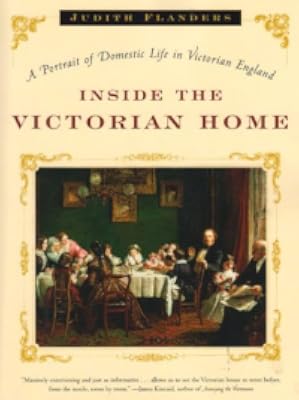
The Victorian House: Domestic Life from Childbirth to Deathbed
by Judith Flanders 
On This Page
Description
Publisher's description: The Victorian age is much closer to us in time than we might believe. Yet at that time, in the most technologically advanced nation in the world, people buried meat in fresh earth to prevent mold forming and wrung sheets out in boiling water with their bare hands. Such household drudgery was routinely performed by the grandparents of people still living, but the knowledge of it has passed as if it had never been. Judith Flanders's book is laid out like a Victorian show more house, taking you through the story of daily life from room to room. In each space she depicts the home's furnishings and decoration: from childbirth in the master bedroom, through the scullery and kitchen, the separate male and female domains of the drawing room and the parlor, and ending in the sickroom. A rich selection from diaries, letters, advice books, magazines, and paintings fills the rooms with the people and personalities of the age. show lessTags
Recommendations









Member Recommendations
Member Reviews
If you’re in the mood to spend a little time in the bedrooms ... and drawing rooms, and washrooms, and kitchens ... of (mostly) middle class Victorians, this book will satisfy every curiosity, right down to the smalls. Your smalls, by the way, would have been white if you were a real lady, because only women of loose morals would have worn colourful underclothes. This is the sort of delightful trivia you will find in this very engaging book — a cultural dalliance within a very rustic era. Despite the charm inherent in having a little visit with Dickens and Eliot, with Emily and Charlotte, with Browning and Tennyson, there is no charm at all in suffering from chilblains in cold and drafty houses. Like Lou Rawls, you would have to get show more fully dressed before going to bed, if you didn't want to suffer frostbite in the night.
Flanders is enchanting as a tour guide, revealing all the minutiae one longs to know ... about table manners, and kitchen practices; about food preparation and laundry days; about social functions and bodily functions ... it’s all covered, within the whole range of the alphabet. What makes this particularly appealing to me is that examples are pulled from the books and lives of writers, so it’s great fun to revisit many of one’s favourite fictional characters, and to study them under the microscope of socio-cultural history; or to meet Henry James at his own table, for instance, or writing desk, and to peek in on his life as he goes about this business of writing. A number of very interesting Victorians are presented, along with their interesting neuroses and illnesses. Both Charles Darwin and Florence Nightingale emerge as very unusual case studies, in situ.
While Flanders’ story flows like the proverbial cultural river, it is also respectably hefty with footnotes and bibliography, providing solid basis for her pronouncements, as well as fodder for further reading.
This is one to own, and dip into at leisure, if you’re at all fond of, or intrigued by, the Victorians. show less
Flanders is enchanting as a tour guide, revealing all the minutiae one longs to know ... about table manners, and kitchen practices; about food preparation and laundry days; about social functions and bodily functions ... it’s all covered, within the whole range of the alphabet. What makes this particularly appealing to me is that examples are pulled from the books and lives of writers, so it’s great fun to revisit many of one’s favourite fictional characters, and to study them under the microscope of socio-cultural history; or to meet Henry James at his own table, for instance, or writing desk, and to peek in on his life as he goes about this business of writing. A number of very interesting Victorians are presented, along with their interesting neuroses and illnesses. Both Charles Darwin and Florence Nightingale emerge as very unusual case studies, in situ.
While Flanders’ story flows like the proverbial cultural river, it is also respectably hefty with footnotes and bibliography, providing solid basis for her pronouncements, as well as fodder for further reading.
This is one to own, and dip into at leisure, if you’re at all fond of, or intrigued by, the Victorians. show less
A masterful survey of the details of day to day life in Victorian England, with particular focus on London and the middle class. The author draws on medical texts, advertisements, diaries, letters, and even fiction to describe the quotidian drudgery, dirt, and mentality of that time and place. The past really does seem to be a different country--the assumptions (that wearing something because you liked it was strange and antisocial, that children needed bland food and few vegetables, that liking or even knowing one another before engagement was not expected or desired, that the classes were intrinsically physically and mentally different) are so alien that despite years of reading Victorian novels I still found myself goggling at the show more page. But at the same time, it's fascinating to divine the origins of many oddities of the modern era to their origins in Victorian England.
Flanders organizes this history through the different rooms of the home. After first describing the furniture and decorations of the parlor, for instance, she then goes on to talk about women's social role, and from thence to wedding trends. It flows naturally and easily, told in lucid language and sprinkled with contemporary quotes. Flanders exhibits a dry wit and an enjoyment of absurdity that makes her history and sociology all the easier to read. She ends with this:
Flanders organizes this history through the different rooms of the home. After first describing the furniture and decorations of the parlor, for instance, she then goes on to talk about women's social role, and from thence to wedding trends. It flows naturally and easily, told in lucid language and sprinkled with contemporary quotes. Flanders exhibits a dry wit and an enjoyment of absurdity that makes her history and sociology all the easier to read. She ends with this:
"It is too easy for us to think of the Victorian era--or any part of the past--as 'romantic.' For some it was an endless succession of cold, dirt, and dark, of black bombazine and narrow stairs. For others, though, it was fuchsine and peacock blue, as well as celadon skies.show less
To emphasize either viewpoint at the expense of the other is to give only a partial picture. We may be able to do no more than peer through the windows of the past--but at least we can choose to do so through windows that have the curtains open and the rooms inside brightly lit."
A very enjoyable survey of domestic life in Victorian England. The book is logically organized "by room," going into a great deal of detail as to how domestic arrangements were set up in the 1840-1900 period. At one point, things do threaten to run off the rails into gender studies, but Flanders luckily has the discipline to rein this in. Many of the editorial comments in the footnotes are sharp and witty, and there's a plethora of choice illustrations. One interesting point she develops is how much of Victorian status was subtly signalled in the works of authors like Dickens or Trollope, which does put a certain spin on those books that might be a bit lost today. All told, a good read.
It's easy to attribute everything to sex, especially when you're dealing with the past, and a hyper-sexualized viewpoint on the Victorians is a cliché. Those billowing gowns; those smothering draperies. Tight corsets, euphemisms, and fainting spells. Oh, my! So Flanders side-steps the issue entirely, via footnote. She just won't talk about it. There's an easy parallel here between her refusal to talk about sex and the Victorians' refusal to talk about sex. Call it ironic ...
Omitting such a huge part of life is more than just sloppy; it's deceptive. Sex is now a fundamental cultural narrative. How to do it; how to want it; how to show it or cover it up. There simply isn't any way to omit it & be comprehensive.
So. Caveat neatly in show more place ...
Flanders attempts to neatly explain the Victorians through characteristic furniture/rooms. Sometimes it works. Sometimes it doesn't. The rooms that I was especially interested in - the bedroom (sex!) and the bathroom (poop!) were informative in minutia, but not in substance. Bedclothes, bedcurtains, bedside tables, but not a word about what happens between the sheets. Pages & pages devoted to bathing and plumbing, but no hint of what the Victorian attitude was to these necessary bodily functions. Did it change as indoor plumbing became standard? Did euphemisms become less prominent or more common?
Some rooms - the sickroom, the nursery - had me reading lines aloud to my patient roommate (who just wanted to be left alone to watch The Simpsons, ferchrissake).
me: "No WONDER infant mortality was so high - the recommended baby food was a gruel of flour and water. Holy crap!"
she: "Mmmm."
Mostly, though, it was engaging and interesting. Flanders has a dry wit (snarky footnotes) that I thought was fun, usually, but she sometimes gave in to presumptive leaps of logic, which ... I can't go into more detail about, since I didn't write that down in my notes. Oops. show less
Omitting such a huge part of life is more than just sloppy; it's deceptive. Sex is now a fundamental cultural narrative. How to do it; how to want it; how to show it or cover it up. There simply isn't any way to omit it & be comprehensive.
So. Caveat neatly in show more place ...
Flanders attempts to neatly explain the Victorians through characteristic furniture/rooms. Sometimes it works. Sometimes it doesn't. The rooms that I was especially interested in - the bedroom (sex!) and the bathroom (poop!) were informative in minutia, but not in substance. Bedclothes, bedcurtains, bedside tables, but not a word about what happens between the sheets. Pages & pages devoted to bathing and plumbing, but no hint of what the Victorian attitude was to these necessary bodily functions. Did it change as indoor plumbing became standard? Did euphemisms become less prominent or more common?
Some rooms - the sickroom, the nursery - had me reading lines aloud to my patient roommate (who just wanted to be left alone to watch The Simpsons, ferchrissake).
me: "No WONDER infant mortality was so high - the recommended baby food was a gruel of flour and water. Holy crap!"
she: "Mmmm."
Mostly, though, it was engaging and interesting. Flanders has a dry wit (snarky footnotes) that I thought was fun, usually, but she sometimes gave in to presumptive leaps of logic, which ... I can't go into more detail about, since I didn't write that down in my notes. Oops. show less
Travel abroad and you might sample one or two travel guides before you go - "Lonely Planet", or one the "Rough Guide" series, perhaps.
But what's your source for information when you travel in time? Where do you go first for information about, say, Edwardian London, Imperial Russia or Pre-Revolutionary Mexico?
Well, you could try any number of reference-points suggested by your favourite, fireside search-engine, or you could rely on personal recommendation.
And here's my recommendation for you: if you're planning to read or research anything set in Victorian England, then read "The Victorian House" by Judith Flanders first.
Don't imagine that this is in any way a book about architecture. It's not. It's a treasure-trove of well-researched show more information about the morals, customs and habits of the people of the Victorian era, divided for convenience by use of the rooming-name convention of the houses of the day: bedroom, nursery, kitchen, scullery, drawing room, parlour, dining room, morning room, bathroom & lavatory and sickroom. For good measure, a chapter on "the street" is also included.
There is such a lot here to inform and entertain that it is difficult to pick out only one or two examples. My own favourites were the change in the way meals were served from "a la francaise" to "a la russe" and why the serving of "courses" was first introduced and has persisted to this day, and why the extreme restrictions placed on women's and men's fashions were supported, by both women and men, for so long.
This is a comprehensive and enlightening book, including appendices on mourning clothes for women, a quick guide to books and authors of the Victorian period, a guide to currency, extensive chapter notes, a select bibliography and, last but not least, a good index.
Judith Flanders' book is in the best tradition of travel writing. It is your guide to that most intriguing foreign country of all : the past. show less
But what's your source for information when you travel in time? Where do you go first for information about, say, Edwardian London, Imperial Russia or Pre-Revolutionary Mexico?
Well, you could try any number of reference-points suggested by your favourite, fireside search-engine, or you could rely on personal recommendation.
And here's my recommendation for you: if you're planning to read or research anything set in Victorian England, then read "The Victorian House" by Judith Flanders first.
Don't imagine that this is in any way a book about architecture. It's not. It's a treasure-trove of well-researched show more information about the morals, customs and habits of the people of the Victorian era, divided for convenience by use of the rooming-name convention of the houses of the day: bedroom, nursery, kitchen, scullery, drawing room, parlour, dining room, morning room, bathroom & lavatory and sickroom. For good measure, a chapter on "the street" is also included.
There is such a lot here to inform and entertain that it is difficult to pick out only one or two examples. My own favourites were the change in the way meals were served from "a la francaise" to "a la russe" and why the serving of "courses" was first introduced and has persisted to this day, and why the extreme restrictions placed on women's and men's fashions were supported, by both women and men, for so long.
This is a comprehensive and enlightening book, including appendices on mourning clothes for women, a quick guide to books and authors of the Victorian period, a guide to currency, extensive chapter notes, a select bibliography and, last but not least, a good index.
Judith Flanders' book is in the best tradition of travel writing. It is your guide to that most intriguing foreign country of all : the past. show less
Although the fifty page intro was a bit sluggish, it fortunately did not represent the rest of the book. Flanders devotes a chapter to each room in the stereotypical Victorian house, plus one for The Street. Her research gives new meaning to the word "depth". She has mined non fiction, letters, fiction,and just about anything that could possibly add insight to life in that very rigid time. The result is a wealth of analysis, as well as wonderful trivia (People did not want newfangled toilets in their bathrooms because bathrooms were clean!). From the weight of women's clothing (37 pounds), to the ways households detected adulteration in their food, and the number of mail deliveries per day (10-12), The Victorian House is a treasure show more trove of information. The three sections of colour plates add visual evidence to Flanders' text, and the whole thing is remarkably focused trip through this world. show less
This book was excellent.
This is not a book for people who are already knowledgeable on the topic of domestic daily life during the Victorian age in England. Flanders does, however, manage to combine an informative overview with a considerable degree of entertainment value - especially if you read the footnotes, were most of the humour is.
This is a particularly useful book for anyone hoping to write about the period, since Flanders does not get bogged down in detail, but she does manage to get the 'feel' of the period very well indeed. One thing that particularly struck me is the sheer filthiness of the cities (particularly London, as the largest city) - Flanders does not just say "it was filthy" but demonstrates by discussing little show more adjustments people had to make, like not putting out a white tablecloth until a short time before the meal, or it would go grey. This level of atmospheric pollution is something that we just don't have to deal with in the UK any more, so it's hard to imagine without the examples Flanders gives.
Another interesting area is the illustration of how limited many middle-class women's lives were - again, something that we find it difficult to appreciate from our twenty-first century standpoint. We might intellectually know that the Victorian period was probably the one in English history where women's rights and status in society reached their lowest ebb, but Flanders provides illustrative facts, including that since women were supposed to spend their lives catering to their families (particularly the men), pretty much the only way for a woman to get some time to herself was to be ill - which provided a cast-iron excuse for retiring to one's bedroom and closing the door. It provides an interesting alternative viewpoint on the fragile Victorian lady - women's health was generally poorer than men's because of their poorer diet and lack of fresh air and exercise, but being a professional invalid definitely had its attractions for any woman who wanted to escape the endless round of service to others.
This is a book I shall probably refer to again, and I recommend it to anyone who is interested in the domestic life of the period. show less
This is not a book for people who are already knowledgeable on the topic of domestic daily life during the Victorian age in England. Flanders does, however, manage to combine an informative overview with a considerable degree of entertainment value - especially if you read the footnotes, were most of the humour is.
This is a particularly useful book for anyone hoping to write about the period, since Flanders does not get bogged down in detail, but she does manage to get the 'feel' of the period very well indeed. One thing that particularly struck me is the sheer filthiness of the cities (particularly London, as the largest city) - Flanders does not just say "it was filthy" but demonstrates by discussing little show more adjustments people had to make, like not putting out a white tablecloth until a short time before the meal, or it would go grey. This level of atmospheric pollution is something that we just don't have to deal with in the UK any more, so it's hard to imagine without the examples Flanders gives.
Another interesting area is the illustration of how limited many middle-class women's lives were - again, something that we find it difficult to appreciate from our twenty-first century standpoint. We might intellectually know that the Victorian period was probably the one in English history where women's rights and status in society reached their lowest ebb, but Flanders provides illustrative facts, including that since women were supposed to spend their lives catering to their families (particularly the men), pretty much the only way for a woman to get some time to herself was to be ill - which provided a cast-iron excuse for retiring to one's bedroom and closing the door. It provides an interesting alternative viewpoint on the fragile Victorian lady - women's health was generally poorer than men's because of their poorer diet and lack of fresh air and exercise, but being a professional invalid definitely had its attractions for any woman who wanted to escape the endless round of service to others.
This is a book I shall probably refer to again, and I recommend it to anyone who is interested in the domestic life of the period. show less
Members
- Recently Added By
Lists

Non-Fiction Worth Reading
1,015 works; 261 members

Recommend the 20 best books you've read in the last five years
2,168 works; 606 members

Books Read in 2018
4,360 works; 110 members

Club Read's Recommended Nonfiction Written by Women
618 works; 30 members
Author Information

15+ Works 5,560 Members
Judith Flanders is a social historian. Her works include the best-selling The Invention of Murder, and Inside the Victorian Home. She is senior research fellow at the University of Buckingham.
Judith Flanders is a LibraryThing Author, an author who lists their personal library on LibraryThing.
Common Knowledge
- Canonical title
- The Victorian House: Domestic Life from Childbirth to Deathbed
- Alternate titles
- Inside the Victorian Home: A Portrait of Domestic Life in Victorian England
- Original publication date
- 2003
- Important places
- England, UK
- Dedication
- For my mother, Kappy Flanders
- First words
- In 1909 H. G. Wells wrote, in a passage from his novel Tono-Bungay, of Edward Ponderevo, a purveyor of patent medicines and terror of eminent historians. (Introduction)
In the segregation that permeated the Victorian house, the reception rooms were always considered the main rooms—they presented the public face of the family, defining it, clarifying its status. (Chapter I, The Bedroom) - Last words
- (Click to show. Warning: May contain spoilers.)We may be able to do no more than peer through windows of the past, but at least we can choose to do so through windows that have the curtains open and the rooms inside brightly lit.
- Blurbers
- Mantel, Hilary
- Disambiguation notice
- Published in the US in 2004 as: Inside the Victorian home : a portrait of domestic life in Victorian England.
Classifications
- Genres
- History, Nonfiction, General Nonfiction
- DDC/MDS
- 306.0942 — Society, government, & culture Social sciences, sociology & anthropology Social Behavior - Dating, Marriage, Divorce Social history Europe England And Wales
- LCC
- HQ615 .F58 — Social sciences The family. Marriage, Women and Sexuality The Family. Marriage. Women The family. Marriage. Home
- BISAC
Statistics
- Members
- 1,300
- Popularity
- 18,654
- Reviews
- 22
- Rating
- (4.17)
- Languages
- English
- Media
- Paper, Ebook
- ISBNs
- 6
- ASINs
- 5