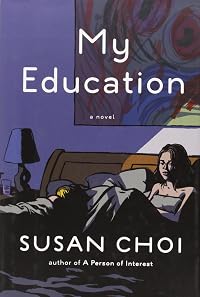
My Education
by Susan Choi
On This Page
Description
Regina Gottlieb had been warned about Professor Nicholas Brodeur long before arriving as a graduate student at his prestigious university high on a pastoral hill. He's said to lie in the dark in his office while undergraduate women read couplets to him. He's condemned on the walls of the women's restroom and enjoys films by Roman Polanski. But no one warned Regina about his exceptional physical beauty--or his charismatic, volatile wife. My Education is the story of Regina's mistakes, which show more begin in the bedroom and end--if they do--fifteen years in the future and thousands of miles away. By turns erotic and completely catastrophic, Regina's misadventures demonstrate what can happen when the chasm between desire and duty is too wide to bridge. show lessTags
Recommendations















Member Reviews
Schadenfreude is a wonderful thing: we can watch empires fall and wonder why they didn’t have better homeowners’ insurance or more canned goods, whatever satisfies that secret need for smugness that we all need to indulge once in a while. A novel entitled My Education promises something along those lines too. We’re going to see someone learn something! Someone else, who’s not us. It suggests a spectacle, and for most of Susan Choi’s tale of impulsive love, it is—although not, ultimately, in the way you might imagine.
The educatee in question is Regina Gottlieb, a graduate student in an unnamed literary discipline at an unnamed upstate university (you can call it Cornell if you want). The education she has in mind, though, is show more something a bit less academic. Choi doesn’t mess around; in the book’s opening sentence she throws us right up against the object of Regina’s intentions, the notoriously caddish professor Nicholas Brodeur. The fact that he’s got a terrible reputation and stands accused of numerous instances of moral turpitude, coupled with a case of extreme attractiveness, render Regina basically powerless not to pursue him. (Motives don’t figure heavily in this story, nor do they need to.) And pursue him she does until, at a marvelously uncomfortable dinner party at his home, she meets, makes out with, and promptly initiates an affair with Brodeur’s wife, Martha.
It’s a hot affair, to be sure. It sizzles off the page. Choi knows how to write a sex scene, but it’s her bracketing—the lead-up, the dénouement—that reverberates. Consider Regina, after her first marathon roll with Martha:
"I felt the peculiar gratification of having been made a taxidermy of myself, disassembled and rebuilt with some sort of narcotic-soaked gauze densely stuffed in my cavities—I was that deeply satisfied, down to my marrow; all the bones in my pelvis seemed loosened and bobbling around."
Just in case you didn’t catch it the first time around, this is good sex. But Regina is 21 and ripe for experience, whereas Martha is in her mid-30s, married with a new baby, and has no intention—no potential—to give herself over completely. Regina is passionate and obsessive, Martha is passionate and withholding, and not even the best sex in the world is going to remedy the imbalance of power between them. And herein lies the titular lesson: that youth and beauty, though excellent currency, are still no match for… well, anything, really. Regina exists in that classic American late adolescence where being a grownup is still a rumor, and all its trappings—the baby, the good car, the dinner party—dwell in some fabled shadowland. And while there are plenty of people out there who trudge dutifully in that general direction, from their teens through their 20s, until they reach it, there are plenty of us who needed to get there—if indeed we have gotten there—the hard way. I was half hoping in some selfish corner of my brain that My Education would bring back that visceral thrill of infatuation and lust, the joys of throwing caution to the wind, but the real elusive turn-on here turns out to be adulthood. As Regina puts it,
"I’d like to say I defied gravity just as often as feeling its snare, but my efforts were more likely spent clinging on with white knuckles to not be dislodged. Still, that was my heroism—my tenacious fidelity to her, though it was based on a grave misperception. I thought desire was duty. No trial could not be endured nor impediment smashed in desire’s holy service, or so I believed, with naïve righteousness. I didn’t grasp that desire and duty could rival each other, least of all that they most often do."
And so we get to watch her crash and burn in the name of love, and because Choi is a fine writer it’s a pleasure—she does extreme drunkenness as well as she does sex, for one thing. Also because, if the reader pays any attention to names, she will know from the start that a protagonist named Regina (“Queen”) Gottlieb (“God’s love”) will surely survive. Ironically, this is where youth comes in handy: it may lead you to hit bottom, but chances are you’ll bounce. She bounces almost too conveniently well, in fact—eventually, after getting fired from a literary agency job, writing a purposefully lowbrow “young-girl-in-the-city rehash” that goes on to become an unexpected bestseller; marrying wisely, if not passionately; and being unexpectedly blindsided by the grownup version of hot passion, motherlove. But that’s OK. We’re rooting for her by the novel’s end, even if she is a bit of a pain in the ass.
This is not Flaubert’s Sentimental Education, and Choi sidesteps any pointed sociological context. The fact that the grand love affair here involves two women is less a political point, or an effort to ground the story in a particular time, it seems, than a leveling of the playing field. The asymmetry between Regina and Martha has everything to do with their ages, stations in life, and motivations; gender is not part of this equation. My Education does end up being sentimental, though, almost unsettlingly so, and by the time Regina has made her version of amends for the various relationships she’s torn through, it’s tempting to miss the rest of the book’s damp messiness.
But she has wanted adulthood so badly. She has lusted after Martha’s competence almost as much as her touch, yearned for capability and ripeness, which is what has made the book more than a fable of neediness thwarted. When Martha helps her furnish her first solo apartment, Regina gets a glimpse of what it is she really wants:
"Along with all these things of hers into my rooms had come a smell, encyclopedic and subtle, like a threadbare tapestry on some epic subject: her former lovers and gardens and meals and travels and sails and wounds and orgasms and perhaps even failures, a dusty and vegetal, floral and heat-baked and cool-moist and unnameable smell. The smell of her past, her past self, here where my self was seeking its future."
In the end, it feels almost uncharitable to begrudge her the book’s smooth closure. It’s to Choi’s credit that Regina is more sweet than sour, and that My Education invokes more compassion than schadenfreude. It’s a complicated book, but a good one, and it’s not a terrible thing to be reminded of those days when the prospect of becoming a real live adult was still exhilarating. show less
The educatee in question is Regina Gottlieb, a graduate student in an unnamed literary discipline at an unnamed upstate university (you can call it Cornell if you want). The education she has in mind, though, is show more something a bit less academic. Choi doesn’t mess around; in the book’s opening sentence she throws us right up against the object of Regina’s intentions, the notoriously caddish professor Nicholas Brodeur. The fact that he’s got a terrible reputation and stands accused of numerous instances of moral turpitude, coupled with a case of extreme attractiveness, render Regina basically powerless not to pursue him. (Motives don’t figure heavily in this story, nor do they need to.) And pursue him she does until, at a marvelously uncomfortable dinner party at his home, she meets, makes out with, and promptly initiates an affair with Brodeur’s wife, Martha.
It’s a hot affair, to be sure. It sizzles off the page. Choi knows how to write a sex scene, but it’s her bracketing—the lead-up, the dénouement—that reverberates. Consider Regina, after her first marathon roll with Martha:
"I felt the peculiar gratification of having been made a taxidermy of myself, disassembled and rebuilt with some sort of narcotic-soaked gauze densely stuffed in my cavities—I was that deeply satisfied, down to my marrow; all the bones in my pelvis seemed loosened and bobbling around."
Just in case you didn’t catch it the first time around, this is good sex. But Regina is 21 and ripe for experience, whereas Martha is in her mid-30s, married with a new baby, and has no intention—no potential—to give herself over completely. Regina is passionate and obsessive, Martha is passionate and withholding, and not even the best sex in the world is going to remedy the imbalance of power between them. And herein lies the titular lesson: that youth and beauty, though excellent currency, are still no match for… well, anything, really. Regina exists in that classic American late adolescence where being a grownup is still a rumor, and all its trappings—the baby, the good car, the dinner party—dwell in some fabled shadowland. And while there are plenty of people out there who trudge dutifully in that general direction, from their teens through their 20s, until they reach it, there are plenty of us who needed to get there—if indeed we have gotten there—the hard way. I was half hoping in some selfish corner of my brain that My Education would bring back that visceral thrill of infatuation and lust, the joys of throwing caution to the wind, but the real elusive turn-on here turns out to be adulthood. As Regina puts it,
"I’d like to say I defied gravity just as often as feeling its snare, but my efforts were more likely spent clinging on with white knuckles to not be dislodged. Still, that was my heroism—my tenacious fidelity to her, though it was based on a grave misperception. I thought desire was duty. No trial could not be endured nor impediment smashed in desire’s holy service, or so I believed, with naïve righteousness. I didn’t grasp that desire and duty could rival each other, least of all that they most often do."
And so we get to watch her crash and burn in the name of love, and because Choi is a fine writer it’s a pleasure—she does extreme drunkenness as well as she does sex, for one thing. Also because, if the reader pays any attention to names, she will know from the start that a protagonist named Regina (“Queen”) Gottlieb (“God’s love”) will surely survive. Ironically, this is where youth comes in handy: it may lead you to hit bottom, but chances are you’ll bounce. She bounces almost too conveniently well, in fact—eventually, after getting fired from a literary agency job, writing a purposefully lowbrow “young-girl-in-the-city rehash” that goes on to become an unexpected bestseller; marrying wisely, if not passionately; and being unexpectedly blindsided by the grownup version of hot passion, motherlove. But that’s OK. We’re rooting for her by the novel’s end, even if she is a bit of a pain in the ass.
This is not Flaubert’s Sentimental Education, and Choi sidesteps any pointed sociological context. The fact that the grand love affair here involves two women is less a political point, or an effort to ground the story in a particular time, it seems, than a leveling of the playing field. The asymmetry between Regina and Martha has everything to do with their ages, stations in life, and motivations; gender is not part of this equation. My Education does end up being sentimental, though, almost unsettlingly so, and by the time Regina has made her version of amends for the various relationships she’s torn through, it’s tempting to miss the rest of the book’s damp messiness.
But she has wanted adulthood so badly. She has lusted after Martha’s competence almost as much as her touch, yearned for capability and ripeness, which is what has made the book more than a fable of neediness thwarted. When Martha helps her furnish her first solo apartment, Regina gets a glimpse of what it is she really wants:
"Along with all these things of hers into my rooms had come a smell, encyclopedic and subtle, like a threadbare tapestry on some epic subject: her former lovers and gardens and meals and travels and sails and wounds and orgasms and perhaps even failures, a dusty and vegetal, floral and heat-baked and cool-moist and unnameable smell. The smell of her past, her past self, here where my self was seeking its future."
In the end, it feels almost uncharitable to begrudge her the book’s smooth closure. It’s to Choi’s credit that Regina is more sweet than sour, and that My Education invokes more compassion than schadenfreude. It’s a complicated book, but a good one, and it’s not a terrible thing to be reminded of those days when the prospect of becoming a real live adult was still exhilarating. show less
I really enjoyed this one. The first two-thirds takes place in the early 1990s in an East Coast college town, and the last third takes place in the present. Regina, a first year literature graduate student when the action begins, narrates from an older/wiser place of reminiscence. She tells the story of how she became romantically involved with her mentor's wife (a literature professor in her 30s), while the marriage (between the mentor and his wife) was in the process of disintegration. Choi does a wonderful job of depicting an obsessive, chaotic, and passionate romance and the lasting effect it had on all three lives, without making any of the parties (all of whom are imperfect and good at making rather bad decisions) into villains or show more angels. The characters are well-drawn and complex (with a great cast of supporting characters), the attraction is very believable, and it captures that early-20s-end-of-the-world-love thing so well. What a page-turner!
This novel seems to get very mixed reviews and the only explanation I can come up with is that it's an odd combination of literary fiction and mild erotica, so maybe you have fans of both genres reading it, and then perhaps one audience ends up offended and the other bored. That's my theory anyway. Oh, well. I liked it a lot. show less
This novel seems to get very mixed reviews and the only explanation I can come up with is that it's an odd combination of literary fiction and mild erotica, so maybe you have fans of both genres reading it, and then perhaps one audience ends up offended and the other bored. That's my theory anyway. Oh, well. I liked it a lot. show less
In Choi’s My Education, bright Regina is a graduate student studying literature at a Northeastern university. She’s been warned about the lecherous professor Nicholas Brodeur, but is immediately stunned by both his intellect and his beauty, and tentatively moves into his circle of influence. The book takes a sharp turn when, instead of letting herself be seduced by Brodeur, she seduces his wife, Martha, starting a passionate affair that is doomed from the very beginning.
Choi’s characters are absolutely believable in their many charms and flaws and cruelties, and she has a fantastic grasp on the early-‘90s academic scene. But the real reason to recommend My Education is the writing itself. Choi’s brilliant sentences , even the show more ones that aren’t describing sex, are as sinuous and sexy as any I’ve read. show less
Choi’s characters are absolutely believable in their many charms and flaws and cruelties, and she has a fantastic grasp on the early-‘90s academic scene. But the real reason to recommend My Education is the writing itself. Choi’s brilliant sentences , even the show more ones that aren’t describing sex, are as sinuous and sexy as any I’ve read. show less
Wonderful almost Jamesian novel about innocence and experience, age and youth. Incredible writing about sex as well. The latter third of the book - where everything is brought up to the present - felt tacked on to me and not necessary. If ever a story could live with an untidy ending, it was this one.
Did I mention the sex scenes were great? Yibetty.
Did I mention the sex scenes were great? Yibetty.
i am really unsure how i feel about this book.
parts of it went by so quickly, and parts took me forever to get through. the writing is in some parts so very good, and in others (purposefully, i think) awkward and cumbersome. the story sometimes drew me in, and other times didn't seem to matter to me at all. for me, this book is a collection of opposing critiques. i'm not sure where the balance lies.
i really liked this book for the first third or so, although it took me a little while to get used to her writing. she sometimes structures her sentences in a way that made me need to read passages two or three times to know what she was saying. just with her syntax. (ex: "The trio accompanied him that since long before he and I met had show more established themselves as the owners of the other three seats in his car.") i liked her writing better when the sentences were shorter and the writing was crisp; this she does very well. but anyway, the first third or so of the book kept me quite interested - and surprised, as there is a good deal of graphic lesbian sex (although not detailed) and i didn't expect this from a mainstream publisher, and i especially wasn't looking for it so early on in the story - but i found the plot stagnating for a large portion of this book. halfway through the book i had no idea what it was about, and it didn't seem to be going anywhere, and the characters seemed as stuck as the plot was. it took far too long for my liking for things to move at all.
it didn't help that i found the characters to be generally unlikable (until the older joachim, finally!) and wanted them to move through some arc so i would be made to care more about what happened to them. but that's not something that usually bothers me (not liking the characters, that is, not the lack of character arc), so don't think it's what bothers me about this book.
i did like the ending (not how it unfolded or even necessarily what happened, but i found myself finally caring at the end) so i'm also left with a conflicting feeling of actually starting to like it more just when it ended but holding on to a more negative feeling about the rest.
as i'm thinking through this, it seems to me that i want to like this, that i like some of her writing quite a bit, but that overall i just didn't really like the book. because she can write, i'd read something else by her again, i think that something about this one just didn't work for me, although i'm not entirely sure what it was that didn't work. likely the lack of depth to the character development.it's not that she ends up with a man, or that she pushes dutra (who i did kind of like throughout) to be with martha, because i felt like they were both so clearly bisexual the entire time, although i'm sure people in my lesbian book group will be disappointed with this outcome.
"Nicholas Brodeur was a predator - not to mention a sexist! - whose continuing presence on campus proved the sorry truth of everything we'd learned in women's studies (and so was gratifying, though most of us wouldn't admit it)."
"Returning she gave me her deep, searching kiss, as a promise or a bribe, if these aren't the same thing."
"This was so simple it went without saying, but unsaid, one could try to forget it." show less
parts of it went by so quickly, and parts took me forever to get through. the writing is in some parts so very good, and in others (purposefully, i think) awkward and cumbersome. the story sometimes drew me in, and other times didn't seem to matter to me at all. for me, this book is a collection of opposing critiques. i'm not sure where the balance lies.
i really liked this book for the first third or so, although it took me a little while to get used to her writing. she sometimes structures her sentences in a way that made me need to read passages two or three times to know what she was saying. just with her syntax. (ex: "The trio accompanied him that since long before he and I met had show more established themselves as the owners of the other three seats in his car.") i liked her writing better when the sentences were shorter and the writing was crisp; this she does very well. but anyway, the first third or so of the book kept me quite interested - and surprised, as there is a good deal of graphic lesbian sex (although not detailed) and i didn't expect this from a mainstream publisher, and i especially wasn't looking for it so early on in the story - but i found the plot stagnating for a large portion of this book. halfway through the book i had no idea what it was about, and it didn't seem to be going anywhere, and the characters seemed as stuck as the plot was. it took far too long for my liking for things to move at all.
it didn't help that i found the characters to be generally unlikable (until the older joachim, finally!) and wanted them to move through some arc so i would be made to care more about what happened to them. but that's not something that usually bothers me (not liking the characters, that is, not the lack of character arc), so don't think it's what bothers me about this book.
i did like the ending (not how it unfolded or even necessarily what happened, but i found myself finally caring at the end) so i'm also left with a conflicting feeling of actually starting to like it more just when it ended but holding on to a more negative feeling about the rest.
as i'm thinking through this, it seems to me that i want to like this, that i like some of her writing quite a bit, but that overall i just didn't really like the book. because she can write, i'd read something else by her again, i think that something about this one just didn't work for me, although i'm not entirely sure what it was that didn't work. likely the lack of depth to the character development.
"Nicholas Brodeur was a predator - not to mention a sexist! - whose continuing presence on campus proved the sorry truth of everything we'd learned in women's studies (and so was gratifying, though most of us wouldn't admit it)."
"Returning she gave me her deep, searching kiss, as a promise or a bribe, if these aren't the same thing."
"This was so simple it went without saying, but unsaid, one could try to forget it." show less
The basics: When Regina Gottlieb begins a graduate program in English at a prestigious upstate New York university, she was familiar with the rumors about Professor Nicholas Brodeur. When she accepts a job as his teaching assistant, the novel takes off.
Note: This review references some minor spoilers. All spoilers discussed are mentioned in the publisher's summary, which means some may not consider them spoilers, but as I reader, I did.
My thoughts: I have somewhat complicated thoughts about My Education. I adore novels about higher education, and this one started off thoroughly enmeshed in the culture of both the university and a town that sound very much like Cornell and Ithaca, New York to me. Regina is a fascinating enough character, show more and as Choi makes her intentions clear, my interest was certainly piqued. As a reader, I was surprised the first twist of sorts was soon followed by my own disengagement with the characters.
The middle of My Education was at times tough-going for me. I was certainly interested enough to see what would happen, but my interest stemmed from my curiosity of what Choi would make these characters do--I never felt the characters were real enough to drive the momentum of the story. Her writing was excellent, and the commentary on academic culture was close to perfect. Perhaps the strength of those elements also over-shadowed the characters somewhat. Because I read with a critical eye to construction rather than one of plot and character engagement, this middle section lagged for me. The summary of the book references a time jump, and largely because of this knowledge, I expected it to come much earlier. (Once again, I call for a rule that summaries mention nothing that is not revealed in the first half of the book, and I'd personally prefer nothing after the first quarter, but I know that's unlikely.)
Once the time jump happens, however, I was enchanted. For the first time, I realized I had no inkling where Choi was taking these characters. How much of them would be the same and how much would not? Regina goes from being realistically childlike to an adult, and I was eager to see how many of her annoying traits she managed to grow out of. This last section of the book was thoroughly enjoyable, but as I turned the last page, I still found myself questioning the pace of this novel. Perhaps it's a case of my fascination with life now, in my thirties, that I would have been satisfied with less emphasis on the past as it was and more emphasis on the past as it is remembered.
Favorite passage: "At that moment, I think we each genuinely believed ourselves to be the protagonist, and the other a naive and pardonable walk-on whose role might even have a tragic end."
The verdict: Although the pacing and emphasis on certain times seemed off to me, Choi's writing and observations were astute and thought-provoking throughout. While I didn't completely adore this novel, it did make me a fan of Choi, and I'm eager to explore her backlist while I wait for her next novel. show less
Note: This review references some minor spoilers. All spoilers discussed are mentioned in the publisher's summary, which means some may not consider them spoilers, but as I reader, I did.
My thoughts: I have somewhat complicated thoughts about My Education. I adore novels about higher education, and this one started off thoroughly enmeshed in the culture of both the university and a town that sound very much like Cornell and Ithaca, New York to me. Regina is a fascinating enough character, show more and as Choi makes her intentions clear, my interest was certainly piqued. As a reader, I was surprised the first twist of sorts was soon followed by my own disengagement with the characters.
The middle of My Education was at times tough-going for me. I was certainly interested enough to see what would happen, but my interest stemmed from my curiosity of what Choi would make these characters do--I never felt the characters were real enough to drive the momentum of the story. Her writing was excellent, and the commentary on academic culture was close to perfect. Perhaps the strength of those elements also over-shadowed the characters somewhat. Because I read with a critical eye to construction rather than one of plot and character engagement, this middle section lagged for me. The summary of the book references a time jump, and largely because of this knowledge, I expected it to come much earlier. (Once again, I call for a rule that summaries mention nothing that is not revealed in the first half of the book, and I'd personally prefer nothing after the first quarter, but I know that's unlikely.)
Once the time jump happens, however, I was enchanted. For the first time, I realized I had no inkling where Choi was taking these characters. How much of them would be the same and how much would not? Regina goes from being realistically childlike to an adult, and I was eager to see how many of her annoying traits she managed to grow out of. This last section of the book was thoroughly enjoyable, but as I turned the last page, I still found myself questioning the pace of this novel. Perhaps it's a case of my fascination with life now, in my thirties, that I would have been satisfied with less emphasis on the past as it was and more emphasis on the past as it is remembered.
Favorite passage: "At that moment, I think we each genuinely believed ourselves to be the protagonist, and the other a naive and pardonable walk-on whose role might even have a tragic end."
The verdict: Although the pacing and emphasis on certain times seemed off to me, Choi's writing and observations were astute and thought-provoking throughout. While I didn't completely adore this novel, it did make me a fan of Choi, and I'm eager to explore her backlist while I wait for her next novel. show less
Beautiful writing for certain. The plot had some amazing "holes" that left the reader wondering... I think I could have read the last section "2007" and enjoyed it just fine! The author's understanding of aging in this last section was very well-expressed. I guess the intense relationship details at the beginning of the novel were evidence of the strong emotions of a young love...Nevertheless, it was hard to square the character's changes...How did she end up marrying Matt? Susan Choi is clearly a talented author...
Members
- Recently Added By
Published Reviews
ThingScore 100
"Choi has taken seriously the sexual love between two women who see themselves as straight. This choice of subject matter is an exciting one, for if a number of the great novels of the past century have been stories of gay love, no really adequate literature of bisexuality exists."
added by LiteraryFiction
Lists

The Hermenautic Bookshelf
111 works; 7 members

Books Read in 2026
1,942 works; 66 members
Author Information

9+ Works 4,031 Members
Some Editions
Awards and Honors
Awards
Distinctions
Series
Belongs to Publisher Series
Contemporánea [Alba] (16)
Common Knowledge
- Original publication date
- 2013
- People/Characters
- Regina Gottlieb; Nicholas Brodeur; Martha Hallett; Laurence Pumbleton; Daniel Francis Dutra
- First words
- 1992 Since arriving the previous week I'd kept hearing about a notorious person, and now as I entered the packed lecture hall my gaze caught on a highly conspicuous man.
- Last words
- (Click to show. Warning: May contain spoilers.)I lingered a moment to watch their glad faces, as they caught sight of him.
- Blurbers
- Egan, Jennifer; Cunningham, Michael
- Canonical DDC/MDS
- 813.54
- Canonical LCC
- PS3553.H584
Classifications
Statistics
- Members
- 372
- Popularity
- 84,336
- Reviews
- 19
- Rating
- (3.46)
- Languages
- English
- Media
- Paper, Audiobook, Ebook
- ISBNs
- 13
- ASINs
- 3