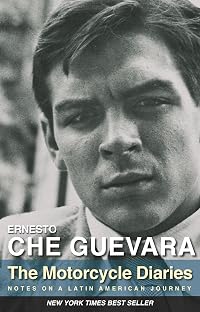
The Motorcycle Diaries
by Che Guevara
On This Page
Description
In January 1952, two young men from Buenos Aires set out to explore South America on "La Poderosa", the Powerful One: a 500cc Norton. One of them was the 23-year-old Che Guevara. Written eight years before the Cuban Revolution, these are Che's diaries - full of disasters and discoveries, high drama, low comedy and laddish improvisations. During his travels through Argentina, Chile, Peru and Venezuela, Che's main concerns are where the next drink is coming from, where the next bed is to be show more found, and who might be around to share it. Che becomes a stowaway, a fireman and a football coach; he sometimes falls in love and frequently falls off the motorbike. Within a decade the whole world would know his name. His trip might have been an adventure of a lifetime - had his lifetime not turned into a much greater adventure. show lessTags
Recommendations













Member Recommendations
Member Reviews
THE MOTORCYCLE DIARIES: NOTES ON A LATIN AMERICAN JOURNEY, by Ernesto "Che" Guevara.
Guevara's journal of his "off to see the world" trip with his older pal, Alberto Granado, was fairly interesting, if not compelling, reading. I have only the usual vague knowledge of Guevara, Castro's important compadre in overthrowing the Batista regime in Cuba's 1959 revolution. Several years ago I read Chuck Pfarrer's excellent novel, KILLING CHE (2008), a fictional look at Che's final months in the jungles of Bolivia, where his life ended under shrouded circumstances, after his capture by government troops in 1967.
This book is vastly different. It's in Guevara's own words, the words of a very young man (he turned 24 in these pages, in 1952) "off to show more see the world" with a pal, Alberto Granado. His friend was already a doctor who specialized in leprosy, but Che was taking a break from his last years of med school to make this trip. He had not yet become the "revolutionary." He was just a young guy off on an adventure. And they had plenty, enduring multiple wipeouts and mechanical problems on the rough roads of South America. Granado's old Norton cycle, reduced to a badly broken machine held together with odd bits of wire, tires and inner tubes with multiple improvised patches, was finally abandoned before the trip was half over. The pair's status as "motorized bums" then entered a new stage as "bums without wheels." They were also plagued by various illnesses, mosquitoes and road injuries, and Guevara himself suffered numerous attacks of asthma, a chronic condition that stayed with him throughout his life.
They made numerous stops in cities, towns and villages as their trip took them from Argentina through Chile, Peru, Colombia, Venezuela, Brazil and beyond. They visited a leper colony along the way, as well as tiny villages with primitive native inhabitants where clothing was sometimes optional, a feature our young narrator appreciated. In one visit to a tribe of "Yaguas, the Indians of the red straw," he commented, "The women had abandoned traditional costume for ordinary clothes, so you couldn't admire their jugs." And later, during their stay in Caracas, he makes this comment about blacks and white Portuguese workers -
"Discrimination and poverty unite them in the daily fight for survival, but their different ways of approaching life separate them completely: the black is indolent and a dreamer; spending his meager wage on frivolity or drink; the European has a tradition of work and saving ..."
Not exactly politically correct, but these are the observations of a still-young man, not the legendary revolutionary that Guevara would later become. THE MOTORCYCLE DIARIES is a pretty detailed look at the early opinions of the young Guevara who is often moved by the social inequities and abject poverty he sees on his journey. The book also contains a detailed introduction by Cintio Vitier placing the narrative in historical context, as well as timelines of both the journey and Guevara's life. I would recommend this book to anyone interested in learning more about Latin America, its history and revolutions. Oh, and P.S. - I learned that "Che" is simply an Argentinian interjection that can mean simply "hey," or is a conversational 'filler' word. It was a nickname given him by his Cuban compatriots because of the way he used the word constantly in his conversation, an oddity to the Cubans. In our own language, it might manifest itself as the ubiquitous "like" or maybe, "dude." And no, it's not in this book. I had to look it up. show less
Guevara's journal of his "off to see the world" trip with his older pal, Alberto Granado, was fairly interesting, if not compelling, reading. I have only the usual vague knowledge of Guevara, Castro's important compadre in overthrowing the Batista regime in Cuba's 1959 revolution. Several years ago I read Chuck Pfarrer's excellent novel, KILLING CHE (2008), a fictional look at Che's final months in the jungles of Bolivia, where his life ended under shrouded circumstances, after his capture by government troops in 1967.
This book is vastly different. It's in Guevara's own words, the words of a very young man (he turned 24 in these pages, in 1952) "off to show more see the world" with a pal, Alberto Granado. His friend was already a doctor who specialized in leprosy, but Che was taking a break from his last years of med school to make this trip. He had not yet become the "revolutionary." He was just a young guy off on an adventure. And they had plenty, enduring multiple wipeouts and mechanical problems on the rough roads of South America. Granado's old Norton cycle, reduced to a badly broken machine held together with odd bits of wire, tires and inner tubes with multiple improvised patches, was finally abandoned before the trip was half over. The pair's status as "motorized bums" then entered a new stage as "bums without wheels." They were also plagued by various illnesses, mosquitoes and road injuries, and Guevara himself suffered numerous attacks of asthma, a chronic condition that stayed with him throughout his life.
They made numerous stops in cities, towns and villages as their trip took them from Argentina through Chile, Peru, Colombia, Venezuela, Brazil and beyond. They visited a leper colony along the way, as well as tiny villages with primitive native inhabitants where clothing was sometimes optional, a feature our young narrator appreciated. In one visit to a tribe of "Yaguas, the Indians of the red straw," he commented, "The women had abandoned traditional costume for ordinary clothes, so you couldn't admire their jugs." And later, during their stay in Caracas, he makes this comment about blacks and white Portuguese workers -
"Discrimination and poverty unite them in the daily fight for survival, but their different ways of approaching life separate them completely: the black is indolent and a dreamer; spending his meager wage on frivolity or drink; the European has a tradition of work and saving ..."
Not exactly politically correct, but these are the observations of a still-young man, not the legendary revolutionary that Guevara would later become. THE MOTORCYCLE DIARIES is a pretty detailed look at the early opinions of the young Guevara who is often moved by the social inequities and abject poverty he sees on his journey. The book also contains a detailed introduction by Cintio Vitier placing the narrative in historical context, as well as timelines of both the journey and Guevara's life. I would recommend this book to anyone interested in learning more about Latin America, its history and revolutions. Oh, and P.S. - I learned that "Che" is simply an Argentinian interjection that can mean simply "hey," or is a conversational 'filler' word. It was a nickname given him by his Cuban compatriots because of the way he used the word constantly in his conversation, an oddity to the Cubans. In our own language, it might manifest itself as the ubiquitous "like" or maybe, "dude." And no, it's not in this book. I had to look it up. show less
“ This is not a story of heroic feats, or merely the narrative of a cynic. It is a glimpse of two lives running parallel for a time, with similar hopes and convergent dreams.
Nine months. On the motorbike La Poderosa II - The Mighty One, with Alberto Granado. Until it breaks down, and then “…just two hitchhikers with backpacks, and with all the grime of the road stuck to our overalls, shadows of our former aristocratic selves.” Subsisting mostly on bread, cheese, and mate. Two hungry doctors, on the road!
Learning more about leprosy. Ernesto’s asthma. That river dolphin story! Those poor peaches under the window! Begging for money, food and lodging. It's a good travel story, and I learned a great deal, flipping back to the map show more many a time to orient myself as to their whereabouts. The pictures in the middle are pretty dang good too! The book made me want to follow their journey, and see what they saw. I'm sure plenty has changed, but the plight of the people, especially the indigenous people, is almost assuredly the same. Easy to see why a revolutionary was born!
"The future belongs to the people, and gradually, or in one strike, they will take power. here and in every country. The terrible thing is the people need to be educated, and this they cannot do before taking power, only after." show less
Nine months. On the motorbike La Poderosa II - The Mighty One, with Alberto Granado. Until it breaks down, and then “…just two hitchhikers with backpacks, and with all the grime of the road stuck to our overalls, shadows of our former aristocratic selves.” Subsisting mostly on bread, cheese, and mate. Two hungry doctors, on the road!
Learning more about leprosy. Ernesto’s asthma. That river dolphin story! Those poor peaches under the window! Begging for money, food and lodging. It's a good travel story, and I learned a great deal, flipping back to the map show more many a time to orient myself as to their whereabouts. The pictures in the middle are pretty dang good too! The book made me want to follow their journey, and see what they saw. I'm sure plenty has changed, but the plight of the people, especially the indigenous people, is almost assuredly the same. Easy to see why a revolutionary was born!
"The future belongs to the people, and gradually, or in one strike, they will take power. here and in every country. The terrible thing is the people need to be educated, and this they cannot do before taking power, only after." show less
If you attempt ANY kind of political comments, the exit is THAT way. It's that simple. Don't provoke me, it won't end well.
“This is not a story of heroic feats, or merely the narrative of a cynic; at least I do not mean it to be. It is a glimpse of two lives running parallel for a time, with similar hopes and convergent dreams.”
Two young men set off for the journey of a lifetime. Their chariot, a motorcycle. Their initial purpose, to know and understand the fascinating world of South America. As they travel deeper and deeper, they come across lands and communities struck by poverty, abandonment, isolation, exploitation, violence, torment, sickness, death. And the two youngsters of our story acquire a new purpose. To help the ones show more in need with whatever meagre (sic?) means they have.
Their quest takes them from the north across the Andes, to Chile, the Atacama Desert, Peru and Venezuela. Facing the whims of a demanding nature, encountering people who have been abused and ostracised because of their beliefs, experiencing the sacred impact of Machu Pichu, one of the marvels of human ingenuity, the two young men leave the crazy, alluring, care-free attitude of youth behind towards a new vision. Che’s writings, thoughts and experiences in the San Pablo leper colony in Peru are heartbreaking, his determination to aid the ones who suffer by an absurd divide due to false ‘’ medical’’ convictions is touching and eye-opening.
The young men’s names? Alberto Granado. Ernesto ‘’Che’’ Guevara.
P.S. Do I really need to mention the marvellous 2004 adaptation starring Gael García Bernal and Rodrigo de la Serna, directed by Walter Salles? If you haven’t watched it, do so. You won’t regret it.
“Some give the impression they go on living only because it's a habit they cannot shake”
“Perhaps one day tired of circling the world I'll return to Argentina and settle in the Andean lakes if not indefinitely then at least for a pause while I shift from one understanding of the world to another.”
My reviews can also be found on https://theopinionatedreaderblog.wordpress.com/ show less
“This is not a story of heroic feats, or merely the narrative of a cynic; at least I do not mean it to be. It is a glimpse of two lives running parallel for a time, with similar hopes and convergent dreams.”
Two young men set off for the journey of a lifetime. Their chariot, a motorcycle. Their initial purpose, to know and understand the fascinating world of South America. As they travel deeper and deeper, they come across lands and communities struck by poverty, abandonment, isolation, exploitation, violence, torment, sickness, death. And the two youngsters of our story acquire a new purpose. To help the ones show more in need with whatever meagre (sic?) means they have.
Their quest takes them from the north across the Andes, to Chile, the Atacama Desert, Peru and Venezuela. Facing the whims of a demanding nature, encountering people who have been abused and ostracised because of their beliefs, experiencing the sacred impact of Machu Pichu, one of the marvels of human ingenuity, the two young men leave the crazy, alluring, care-free attitude of youth behind towards a new vision. Che’s writings, thoughts and experiences in the San Pablo leper colony in Peru are heartbreaking, his determination to aid the ones who suffer by an absurd divide due to false ‘’ medical’’ convictions is touching and eye-opening.
The young men’s names? Alberto Granado. Ernesto ‘’Che’’ Guevara.
P.S. Do I really need to mention the marvellous 2004 adaptation starring Gael García Bernal and Rodrigo de la Serna, directed by Walter Salles? If you haven’t watched it, do so. You won’t regret it.
“Some give the impression they go on living only because it's a habit they cannot shake”
“Perhaps one day tired of circling the world I'll return to Argentina and settle in the Andean lakes if not indefinitely then at least for a pause while I shift from one understanding of the world to another.”
My reviews can also be found on https://theopinionatedreaderblog.wordpress.com/ show less
This book taken at face value does not amount to much. It is the status of the mythical figure behind the text that gives the book its appeal. On the pages of these notes we observe the transformation of a bored middle class kid looking for an adventure into a person ready to sacrifice himself in a fight for dignity of those least fortunate. It is not surprising that the strongest passages in the book are devoted to the descriptions of terrible living and working conditions at the Chuquicamata mines, the constant humiliation of the indigenous people of Peru, the suffering of patients in leprosy colonies. The notes do not have significant literary value but you get a glimpse of a real person behind that iconic image - "the most famous show more photograph in the world". show less
I liked the travelogue parts much more than the revolutionary class consciousness parts, and there were less of those than one might expect.
Che comes off as a bit of a jerk. He scams rides, food, drinks, skips out on hotel bills, and generally behaves like a frat boy on a road trip. I was surprised by that and has expected more communism and hagiography and less humanity. I was also surprised by Che’s interest in leprosy. I knew he was a medical student, but hadn’t known he worked with leper’s or that they were of particular interest to him.
It did make me want to take a long motorcycle trip.
Che comes off as a bit of a jerk. He scams rides, food, drinks, skips out on hotel bills, and generally behaves like a frat boy on a road trip. I was surprised by that and has expected more communism and hagiography and less humanity. I was also surprised by Che’s interest in leprosy. I knew he was a medical student, but hadn’t known he worked with leper’s or that they were of particular interest to him.
It did make me want to take a long motorcycle trip.
It is inevitable that anyone who reads this book would have vivid images of Che Guevra intruding into his or her mind. Who doesn't remember the stunning photo image of Guevra, said to be the most copied image in the world? Then the image of Guevra fighting through the marshes to capture Cuba, and then when Castro and the others set about rebuilding the country, taking his gun again to fight his lonely battles for liberation in other countries. And the last flashing image, a tired, defeated Guevra tied down in a shack in the jungles of Bolivia, shouting his famous last words to the drunk captain sent to shoot him and who lost his nerve in his presence, "Shoot, you fool, you are only shooting a man!"
But it is not Guevra as a revolutionary show more who wrote this book. Instead, it is a young Guevra, a loveable, fun guy who sets out to discover his homeland, losing his motorcycle into page 30 but continuing his travels, bluffing, scamming, working, stowing away, and doing whatever it takes to go on his way. He and his friend come across as two delightful guys with their humor, pranks and various adventures. We see the young Guevra without any false ego or pride, curious and sympathetic to his fellow men, moved by their sufferings, amused at the vanity of others who should have been more sympathetic, and yet always preserving his own humility and ability to laugh at himself.
It is said that when you love a book, you want to be friends with the author. After reading this book you are sure to want Che to have been your friend, to have taken you along for the ride... show less
But it is not Guevra as a revolutionary show more who wrote this book. Instead, it is a young Guevra, a loveable, fun guy who sets out to discover his homeland, losing his motorcycle into page 30 but continuing his travels, bluffing, scamming, working, stowing away, and doing whatever it takes to go on his way. He and his friend come across as two delightful guys with their humor, pranks and various adventures. We see the young Guevra without any false ego or pride, curious and sympathetic to his fellow men, moved by their sufferings, amused at the vanity of others who should have been more sympathetic, and yet always preserving his own humility and ability to laugh at himself.
It is said that when you love a book, you want to be friends with the author. After reading this book you are sure to want Che to have been your friend, to have taken you along for the ride... show less
God damn LibraryThing just swallowed my last review so have to start over again...
This is a cool book. I've always been reluctant to jump on the whole Che Guevara as a "anti-establishment poster-boy" bandwagon (does anyone else see the irony in Che merchandise?). Read this book though - it explains the man behind the icon. This was written when he was still a kid really (in a way it's a rite of passage diary) and describes a road trip through the american continent starting in Argentina then up the Andes through Chile and Peru to North America (miami). I like this because it's very human. You can see the evolution of Guevara's politics in his observations (he is very articulate about the way indigenous americans are treated by the latin show more americans and the social divide between them). Think George Orwell's best non-fiction (Down and Out..., Homage to Catalonia etc.) - this tells the experiences that shaped Guevara's thinking. It's actually really well written as well. In addition to being a medical doctor, commander of guerillas and international politician, Guevara had a bit of knack with the written word. It's funny too. It's not often that a book makes me laugh out loud but an anecdote about a stay with some Germans, an open first floor window, a bout of the squits and an unfortunately placed tray of drying peaches had me (I read this on a plane - if you ever want to make Easy Jet cabin crew nervous try sitting on your own at the back and laughing. Maybe that's why I got stopped at customs, or am I being paranoid...hmmm).
Anyway - highly recomend this and I'll be looking for Guevara's notes from the Cuban revolution. 5 stars! show less
This is a cool book. I've always been reluctant to jump on the whole Che Guevara as a "anti-establishment poster-boy" bandwagon (does anyone else see the irony in Che merchandise?). Read this book though - it explains the man behind the icon. This was written when he was still a kid really (in a way it's a rite of passage diary) and describes a road trip through the american continent starting in Argentina then up the Andes through Chile and Peru to North America (miami). I like this because it's very human. You can see the evolution of Guevara's politics in his observations (he is very articulate about the way indigenous americans are treated by the latin show more americans and the social divide between them). Think George Orwell's best non-fiction (Down and Out..., Homage to Catalonia etc.) - this tells the experiences that shaped Guevara's thinking. It's actually really well written as well. In addition to being a medical doctor, commander of guerillas and international politician, Guevara had a bit of knack with the written word. It's funny too. It's not often that a book makes me laugh out loud but an anecdote about a stay with some Germans, an open first floor window, a bout of the squits and an unfortunately placed tray of drying peaches had me (I read this on a plane - if you ever want to make Easy Jet cabin crew nervous try sitting on your own at the back and laughing. Maybe that's why I got stopped at customs, or am I being paranoid...hmmm).
Anyway - highly recomend this and I'll be looking for Guevara's notes from the Cuban revolution. 5 stars! show less
Members
- Recently Added By
Lists

Best Autobiographies and Memoirs
370 works; 67 members
100 Biographies and Memoirs to Read in a (Single) Lifetime
98 works; 12 members

Books Read in 2015
3,299 works; 129 members

Allie's Wishlist
217 works; 2 members

My E-Book Collection - Opinions Welcome
92 works; 10 members

Revolutions
72 works; 5 members

r/History Recommended Reading List
603 works; 12 members

BitLife
212 works; 4 members

Hakim's Marxist Book List
46 works; 3 members

Reading LIst
648 works; 1 member

Cuba
6 works; 1 member
Author Information

269+ Works 8,505 Members
Ernesto "Che" Guevara was born in Rosario, Argentina on June 14, 1928, to an aristocratic family of Spanish-Irish descent. He was known from an early age for his dynamic personality and radical points of view. Guevara graduated from the University of Buenos Aires with a degree of doctor of medicine and surgery in 1953. He witnessed the 1954 show more CIA-backed coup in Guatemala that ended the regime of socialist Jacobo Arbenz. As a direct result, Guevara became convinced that the United States would never support leftist governments and that violent revolution was the only way to end poverty in Latin America. He joined Fidel Castro's 26th of July Movement in 1956, and following the Cuban Revolution held several influential posts in the new socialist government, including Minister of Industries. In 1965, Che left Cuba for the ex-Belgian Congo to support the Marxist Simba movement, which was ultimately unsuccessful. Following his time in Africa, Guevara traveled to Bolivia to teach guerrilla warfare to native Communists preparing for revolution. He was captured during a military operation by army forces supported by the United States and executed on October 9, 1967. Guevara's remains were discovered in 1997 and relocated to a mausoleum in Cuba. Guevara had a daughter with Hilda Gadea, whom he married in 1955 and divorced in 1959, and four children with his second wife, Aleida March, a Cuban-born member of the 26th of July movement. He also had a son with Lilia Rosa López. After his death Guevara became a global icon of martyrdom and a symbol of rebellion, particularly during the worldwide student protests of the late 1960s. Among his most noted written works, which include texts on guerilla warfare, socialism, and political economy, are "The Motorcycle Diaries," "Bolivian Diary," and "Reminiscences of the Cuban Revolutionary War." (Bowker Author Biography) show less
Some Editions
Awards and Honors
Work Relationships
Has the adaptation
Is abridged in
Common Knowledge
- Canonical title
- The Motorcycle Diaries
- Original title
- Notas de viaje
- Original publication date
- 1993
- People/Characters
- Ernesto ''Che'' Guevara; Alberto Granado; Che Guevara
- Important places
- Argentina; Chile; Peru; Colombia
- Related movies
- Diarios de motocicleta (2004 | IMDb)
- First words
- This is not a story of incredible heroism, or merely the narrative of a cynic; at least I do not mean it to be.
Preface: When I read these notes for the first time, they were not yet in book form and I did not know the person who had written them. - Last words
- (Click to show. Warning: May contain spoilers.)I feel my nostrils dilate, savoring the acrid smell of gunpowder and blood, of the enemy's death; I steel my body, ready to do battle, and prepare myself to be a sacred space within which the bestial howl of the triumphant proletariat can resound with new energy and new hope.
- Blurbers
- Salles, Walter; Galeano, Eduardo
- Original language
- Spanish
Classifications
Statistics
- Members
- 3,909
- Popularity
- 4,043
- Reviews
- 48
- Rating
- (3.67)
- Languages
- 23 — Chinese, Czech, Danish, Dutch, English, Estonian, Finnish, French, German, Greek, Hungarian, Italian, Japanese, Lithuanian, Malayalam, Norwegian (Bokmål), Norwegian, Polish, Portuguese, Slovenian, Spanish, Swedish, Turkish
- Media
- Paper, Audiobook, Ebook
- ISBNs
- 77
- ASINs
- 29