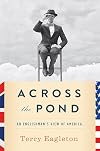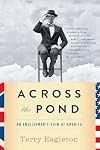
Across the Pond: An Englishman's View of America
by Terry Eagleton
On This Page
Description
A native Briton describes America and its citizens through his English eyes, humorously questioning their choices in bumper stickers, use of adjectives and superlatives, and their overall lack of appreciation for the teapot.Tags
Recommendations




























Member Recommendations

Member Reviews
Another European intellectual explains America! Eagleton doesn’t quite have his usual postmodern Marxist hat on for this book, he seems to be channeling Dickens, Henry James and de Tocqueville and trying to imagine how they would react to the transatlantic divide in its Obama-era incarnation. There is a lot of shameless generalisation and stereotyping of course, as there has to be in such a book — Eagleton insists on his right to do this.
In the end it seems to come down to Eagleton’s analysis of the strengths and weaknesses of the American idea that we can achieve anything if we really want to. Of course most of us can’t, but this approach conveniently means that anyone whose life doesn’t work out well can fairly be blamed show more for their own problems.
An entertaining read on the whole, with a few interesting insights, but nothing that will really change your prejudices, whether you’re a European who distrusts American self-promotion or an American fed up with European intellectuals parachuting in to make fun of your culture. show less
In the end it seems to come down to Eagleton’s analysis of the strengths and weaknesses of the American idea that we can achieve anything if we really want to. Of course most of us can’t, but this approach conveniently means that anyone whose life doesn’t work out well can fairly be blamed show more for their own problems.
An entertaining read on the whole, with a few interesting insights, but nothing that will really change your prejudices, whether you’re a European who distrusts American self-promotion or an American fed up with European intellectuals parachuting in to make fun of your culture. show less
For a European intellectual, writing a non-fiction book about the United States is traditionally about as wise a career move as writing a satirical novel about Islam. You can be absolutely sure that your European colleagues will condemn you in the LRB or the TLS for having spent so much time in America that you failed to appreciate the true monstrosity of Evil Uncle Sam, whilst readers in the USA will be mortally offended, issue fatwas calling for your immediate decapitation, and strike your name off their list of visiting speakers for next year. If your name is Terry Eagleton and your last few books have included an efficient hatchet job on postmodernism and a spirited defence of the works of Karl Marx, you presumably enjoy this kind show more of attention. And you may even be cheered by the thought that anyone wishing to burn your book will have to hand over hard cash for a paper copy first.
Having said that, this is an enjoyably ironic and idiosyncratic account of the differences in national characteristics and attitudes between Britain, Ireland and the United States, which really oughtn't to give offence to anyone. Eagleton spends a lot of time analysing how it is that there are such things as national characteristics, and draws heavily on some of his more illustrious predecessors in the field, especially Alexis de Tocqueville, Charles Dickens and Henry James. He finds Americans ignorant of the use of the teapot, lacking in their use (but not necessarily appreciation) of irony, excessively positive, too focussed on the will at the expense of physical reality - in particular he dislikes the American repugnance for the human body and its frailties. But in every case he points out that the British and/or the Irish have a complementary weakness (too negative, too focussed on tragedy and failure, obsessed with mortality, etc.). So it's not a one-sided condemnation of American culture. But there is probably a bit more for British readers to laugh at than there is for Americans. show less
Having said that, this is an enjoyably ironic and idiosyncratic account of the differences in national characteristics and attitudes between Britain, Ireland and the United States, which really oughtn't to give offence to anyone. Eagleton spends a lot of time analysing how it is that there are such things as national characteristics, and draws heavily on some of his more illustrious predecessors in the field, especially Alexis de Tocqueville, Charles Dickens and Henry James. He finds Americans ignorant of the use of the teapot, lacking in their use (but not necessarily appreciation) of irony, excessively positive, too focussed on the will at the expense of physical reality - in particular he dislikes the American repugnance for the human body and its frailties. But in every case he points out that the British and/or the Irish have a complementary weakness (too negative, too focussed on tragedy and failure, obsessed with mortality, etc.). So it's not a one-sided condemnation of American culture. But there is probably a bit more for British readers to laugh at than there is for Americans. show less
Terry Eagleton considers America, what characterizes it as a nation, and how it differs from Great Britain and Ireland. He's not talking about individual Americans here, of course -- we no doubt differ just as widely as people anywhere else -- but about the culture in which Americans live. His ruminations on the subject range from flippant and frivolous comments to some fairly deep analysis of American thought patterns and how they have evolved from the country's puritan roots. There's also quite a lot of space in the middle where it's not always possible to tell just how serious he's intending to be -- a characteristic he would insist is extremely British, or at least very not-American.
It's an interesting and provocative little book. I show more found my reactions to it ranging all over the place: "That might be a little bit offensive" would quickly be followed by, "But that is funny because it's true," and "True or not, that's freaking hilarious." "That is a good and relevant observation" alternated a lot with "I'm not entirely sure how I feel about this, but it's certainly thought-provoking" and occasionaly "What on earth is he on about now?"
I'm not sure it's possible to give a sense of this book without quoting a bit of Eagleton's writing, so here's a sample:
"Because of the all-powerful will, Americans are great believers in the fraudulent doctrine that you can do anything you want if you try hard enough. In no other country on earth does one hear this consoling lie chanted so often. If you want to fly to Rio and there is no airport to hand, simply want it as hard as you can and feathers will sprout spontaneously from your biceps. When the United States finally killed Osama bin Laden, Barack Obama declared with mathematical predictability that it was an example of how the country could do anything it set its mind to. He did not mention that ten years is a rather long time for the omnipotent will to creak into action. One wonders why the nation does not put its mind to abolishing poverty, if all of its mental strivings are guaranteed to succeed. The United States has a larger proportion of its population in prison, higher levels of mental illness, greater rates of teenage pregnancy, a lower level of child well-being, and higher levels of poverty and social exclusion than most other developed nations. Perhaps this is because its people have not been exercising their wills in concert. Perhaps a date and time should be appointed for, say, the willing away of criminal gangs, when great hordes of people can emerge civic-mindedly on the streets and bend their collective mental efforts to this end."
I should point out that by no means is all of it that negative. But I think that paragraph right there is probably enough to tell you whether or not this is a book you'll appreciate.
Rating: 4/5, not because I agree with everything in it, but because it's interesting and frequently very funny, and because it's always good to get an outsider's perspective. show less
It's an interesting and provocative little book. I show more found my reactions to it ranging all over the place: "That might be a little bit offensive" would quickly be followed by, "But that is funny because it's true," and "True or not, that's freaking hilarious." "That is a good and relevant observation" alternated a lot with "I'm not entirely sure how I feel about this, but it's certainly thought-provoking" and occasionaly "What on earth is he on about now?"
I'm not sure it's possible to give a sense of this book without quoting a bit of Eagleton's writing, so here's a sample:
"Because of the all-powerful will, Americans are great believers in the fraudulent doctrine that you can do anything you want if you try hard enough. In no other country on earth does one hear this consoling lie chanted so often. If you want to fly to Rio and there is no airport to hand, simply want it as hard as you can and feathers will sprout spontaneously from your biceps. When the United States finally killed Osama bin Laden, Barack Obama declared with mathematical predictability that it was an example of how the country could do anything it set its mind to. He did not mention that ten years is a rather long time for the omnipotent will to creak into action. One wonders why the nation does not put its mind to abolishing poverty, if all of its mental strivings are guaranteed to succeed. The United States has a larger proportion of its population in prison, higher levels of mental illness, greater rates of teenage pregnancy, a lower level of child well-being, and higher levels of poverty and social exclusion than most other developed nations. Perhaps this is because its people have not been exercising their wills in concert. Perhaps a date and time should be appointed for, say, the willing away of criminal gangs, when great hordes of people can emerge civic-mindedly on the streets and bend their collective mental efforts to this end."
I should point out that by no means is all of it that negative. But I think that paragraph right there is probably enough to tell you whether or not this is a book you'll appreciate.
Rating: 4/5, not because I agree with everything in it, but because it's interesting and frequently very funny, and because it's always good to get an outsider's perspective. show less
Authors from Alexis de Tocqueville and Charles Dickens to Alistair Cooke and Bill Bryson have, over the years, made “America, seen through foreign eyes” an evergreen literary subgenre. Literature scholar Terry Eagleton, a Briton who has lived and taught for years in the United States, joins their ranks with Across the Pond.
Eagleton’s subject here is not America but Americans, and (by extension) the English and the Irish rather than their respective homelands. He’s interested in people rather than places, and specifically in the shared habits of belief, thought, and action that makes one clump of people collectively different than other another. Done badly, this kind of thing can degenerate into crude stereotyping, but Eagleton show more does it well. His observations are sharp, his conclusions insightful, and his ability to weave them into a coherent picture considerable. Better yet, all this comes wrapped in humorous prose that, at its best, attains a level of comic surrealism reminiscent of Hitchhiker’s Guide to the Galaxy. Here, for example, is Eagleton on (seemingly) the most mundane of cultural differences, pronunciation: “I once rang an American colleague and reached his voicemail, which announced: ‘This is Mike and Marie. We do not reply to silly questions.’ Perhaps they had been besieged by callers asking to know how many triangular pink objects they had in the house, or how much it cost to rent a lawnmower in Kuala Lumpur. Later I realized he had said ‘survey questions.’”
The artistry with which Eagleton blends serious (if impressionistic) anthropological observation and humor becomes fully apparent in Chapter 3, which discusses Americans’ physical bodies, and attitudes toward them. There, and only there, he turns (almost) completely serious without announcing or, seemingly, realizing it. The observations are still as sharp, and the insights just as unexpected, but the absence of humor transforms the experience of reading them. Had the book been written entirely in that style, I would still have read it and counted the couple of hours invested in it as time well spent. I’m very glad, however, that I got to read this version instead. show less
Eagleton’s subject here is not America but Americans, and (by extension) the English and the Irish rather than their respective homelands. He’s interested in people rather than places, and specifically in the shared habits of belief, thought, and action that makes one clump of people collectively different than other another. Done badly, this kind of thing can degenerate into crude stereotyping, but Eagleton show more does it well. His observations are sharp, his conclusions insightful, and his ability to weave them into a coherent picture considerable. Better yet, all this comes wrapped in humorous prose that, at its best, attains a level of comic surrealism reminiscent of Hitchhiker’s Guide to the Galaxy. Here, for example, is Eagleton on (seemingly) the most mundane of cultural differences, pronunciation: “I once rang an American colleague and reached his voicemail, which announced: ‘This is Mike and Marie. We do not reply to silly questions.’ Perhaps they had been besieged by callers asking to know how many triangular pink objects they had in the house, or how much it cost to rent a lawnmower in Kuala Lumpur. Later I realized he had said ‘survey questions.’”
The artistry with which Eagleton blends serious (if impressionistic) anthropological observation and humor becomes fully apparent in Chapter 3, which discusses Americans’ physical bodies, and attitudes toward them. There, and only there, he turns (almost) completely serious without announcing or, seemingly, realizing it. The observations are still as sharp, and the insights just as unexpected, but the absence of humor transforms the experience of reading them. Had the book been written entirely in that style, I would still have read it and counted the couple of hours invested in it as time well spent. I’m very glad, however, that I got to read this version instead. show less
Can you sum up a whole nation of people in even a long book let alone a short one? Of course not but Eagleton has fun trying and is fairly even handed in his dispensations. Please don't take it seriously.
Delightful reading. Incisive biting wit from cover to cover.
Nothing too insightful or funny, but I've always liked outsider looking in sort of books, so I think it's a decent read nonetheless.
Members
- Recently Added By
Published Reviews
ThingScore 25
Across the Pond rises to a secondary virtue unmentioned by Wood: acerbic echo chamber of all the truisms we’ve encountered forever about America.
added by thorold
Lists

Top Five Books of 2014
1,064 works; 398 members
Author Information

111+ Works 12,036 Members
Terry Eagleton received a Ph.D from Cambridge University. He is a literary critic and a writer. He has written about 50 books including Shakespeare and Society, Criticism and Ideology, The Ideology of the Aesthetic, Literary Theory, The Illusions of Postmodernism, Why Marx Was Right, The Event of Literature, and Across the Pond: An Englishman's show more View of America. He wrote a novel entitled Saints and Scholars, several plays including Saint Oscar, and a memoir entitled The Gatekeeper. He is also the chair in English literature in Lancaster University's department of English and creative writing. (Bowker Author Biography) show less
Some Editions
Common Knowledge
- Original publication date
- 2013
- People/Characters
- Terry Eagleton
- Important places
- USA; Ireland; United Kingdom
- Dedication
- For
Maude Ellmann
and
Annie Janowitz - Publisher's editor
- Glusman, John; Leventhal, Tori
- Blurbers
- Hitchings, Henry
Classifications
- Genres
- Nonfiction, General Nonfiction, Biography & Memoir
- DDC/MDS
- 306.0973 — Society, government, & culture Social sciences, sociology & anthropology Social Behavior - Dating, Marriage, Divorce Social history North America United States
- LCC
- E169 .Z83 .E24 — History of the United States United States General
- BISAC
Statistics
- Members
- 121
- Popularity
- 269,599
- Reviews
- 8
- Rating
- (3.26)
- Languages
- English
- Media
- Paper, Audiobook, Ebook
- ISBNs
- 4
- ASINs
- 3