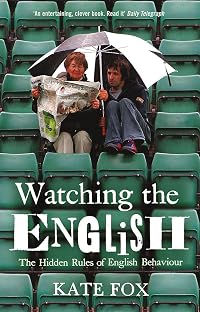
Watching the English: The Hidden Rules of English Behaviour
by Kate Fox
On This Page
Description
Anthropologist Kate Fox takes a revealing look at the quirks, habits and foibles of the English people. She puts the English national character under her anthropological microscope, and finds a strange and fascinating culture, governed by complex sets of unspoken rules and byzantine codes of behaviour.Tags
Recommendations




































Member Recommendations





Member Reviews
As a sarcastic American Expat who has fled to England and is attempting to blend in with the foliage, my take on this book is: accurate.
Witty, humorous, relatable, charming. Will keep on hand for any visiting family members who wish to know the unspoken rules (why it's not OK to be friendly to strangers on public transport)
Witty, humorous, relatable, charming. Will keep on hand for any visiting family members who wish to know the unspoken rules (why it's not OK to be friendly to strangers on public transport)
I approached this book with a mixture of curiosity and trepidation. Having spent four years living in England, I was interested in this analysis of "Englishness," but also somewhat afraid I would discover several cultural norms that I had inadvertently violated during my stay there. Fortunately, Watching the English simply reinforced the blunders I already knew about. It also provided amusing insight into a culture and way of life that I truly enjoyed being part of.
Kate Fox is a social scientist, and her book is written very much in layman's terms, a kind of "pop anthropology." She describes the central core'of Englishness as a "social dis-ease," a "congenital disorder, bordering on a sort of sub-clinical combination of autism and show more agoraphobia" that manifests itself in a sense of extreme discomfort in most social situations. This is exhibited in many ways, several of which struck me as fundamental differences from American culture:
- "The Denial Rule," in which strangers are completely ignored. This occurs in a variety of situations from public transportation, to school functions, to village gatherings. The denial rule made it difficult for us to assimilate into village life. Reading this book, I greatly appreciated one couple who went against cultural norms and initiated contact with us right away. They were the only people to do this in four years!
- "Negative Politeness," which is primarily concerned with people's need not to be intruded or imposed upon. Underlying this is the importance of privacy. While I also value privacy, American cultural norms promote "positive politeness," which is concerned with inclusion and approval.
- Inability to complain effectively, coupled with an intense dislike of "making a scene," results in a quiet acceptance of poor service, delays, and equipment malfunctions. This was the principal source of my own cultural faux pas, since when presented with poor service or repairmen who didn't show up, my first reaction was to become assertive and demanding. This was highly ineffectual in the English culture.
Throughout this book, Fox also highlights the importance of humor, particularly self-deprecating humor. Humor is often used as a form of modesty, to cover up success or, in a backward way, to highiight success without being seen as boasting. Humor is an essential element of every type of interaction, with funerals the sole exception. While some aspects of English culture can be frustrating to those from other countries, for me the pervasive nature of humor made up for those frustrating aspects and left me with lasting fond memories of the English people.
Recommended reading for Anglophiles. show less
Kate Fox is a social scientist, and her book is written very much in layman's terms, a kind of "pop anthropology." She describes the central core'of Englishness as a "social dis-ease," a "congenital disorder, bordering on a sort of sub-clinical combination of autism and show more agoraphobia" that manifests itself in a sense of extreme discomfort in most social situations. This is exhibited in many ways, several of which struck me as fundamental differences from American culture:
- "The Denial Rule," in which strangers are completely ignored. This occurs in a variety of situations from public transportation, to school functions, to village gatherings. The denial rule made it difficult for us to assimilate into village life. Reading this book, I greatly appreciated one couple who went against cultural norms and initiated contact with us right away. They were the only people to do this in four years!
- "Negative Politeness," which is primarily concerned with people's need not to be intruded or imposed upon. Underlying this is the importance of privacy. While I also value privacy, American cultural norms promote "positive politeness," which is concerned with inclusion and approval.
- Inability to complain effectively, coupled with an intense dislike of "making a scene," results in a quiet acceptance of poor service, delays, and equipment malfunctions. This was the principal source of my own cultural faux pas, since when presented with poor service or repairmen who didn't show up, my first reaction was to become assertive and demanding. This was highly ineffectual in the English culture.
Throughout this book, Fox also highlights the importance of humor, particularly self-deprecating humor. Humor is often used as a form of modesty, to cover up success or, in a backward way, to highiight success without being seen as boasting. Humor is an essential element of every type of interaction, with funerals the sole exception. While some aspects of English culture can be frustrating to those from other countries, for me the pervasive nature of humor made up for those frustrating aspects and left me with lasting fond memories of the English people.
Recommended reading for Anglophiles. show less
This confirms that I’m very English, although I identify as a European Brit. It’s social anthropology that explores the “grammar” of English (not British) conversation and behaviour codes. English readers enjoy recognition:
“To have our instinctive 'knowledge'... properly measured and confirmed by objective research.”
Others may understand us a little better.
It’s structured like a text book: each chapter has an introduction, headings, subheadings, a summary, and maybe a few footnotes (in addition to the detailed index). However, the writing is chatty and informal, with self-deprecating humour. Just as well, because modesty (sometimes false modesty) and humour as a default are two of the defining characteristics of show more Englishness that she identifies. The same themes recur in different contexts, culminating in this simple diagram that summarises the whole book:
Image: Englishness-at-a-glance: everything stems from our social dis-ease.
All the expected subjects are carefully dissected: class, weather talk, pubs, class, queueing, food, class, amateurism in sport, dress codes, class, gardens, DIY, class… Plus some others.
Note: Back in 2004, "grooming talk" was nothing dodgy. It refers to innocuous niceties that might now be described as social glue or oiling the wheels.
Slow change
This was published in 2004, but it’s mostly as true as when I first read it, with three main exceptions.
Mobile phones
A short chapter on the emerging etiquette of mobile phones assumes they’re only for voice calls and texts. Fox saw them as the new garden fence or village green and welcomed liberation from landlines:
“The space technology of mobile phones has allowed us to return to the more natural patterns of pre-industrial society, when we lived in small, stable communities and enjoyed frequent ‘grooming talk’ with a tightly integrated social network.”
Image: Dom Jolly of Trigger Happy TV in an iconic role (Source)
Diversity - and not
It repeatedly extrapolates from narrow assumptions about the differences between men and women. They’re stereotypes because they’re broadly true, but a social anthropologist should try to separate the cause and effect of nature and nurture. It’s worst in the chapter on sex and courtship: it's rife with generalisations in the absence of data, and there's no mention of LGBTQ+.
Englishness broadly equates with whiteness, but it is increasingly affected and enriched by English people of more diverse heritage, so race should be mentioned more than it is.
Nationalism
“Can there be any other nation so resolutely unpatriotic?”
“The English do not like extremism in politics.”
I read this four years after the Brexit referendum, just before the end of the transition period for trading with the EU. In that time, nationalism, xenophobia, and outright racism have become far more visible.
"The English are undeniably good at spoof and satire... it's what we do instead of getting angry and having revolutions."
Was the long absence of Spitting Image responsible for Brexit?!
Image: Original Spitting Image figures, including Thatcher, GH Bush, Gorbachev, and Reagan (Source)
In fact, Rory Bremner, one of the voices of Spitting Image, phoned Eurosceptic Tory MPs in 1993, pretending to be PM John Major, and asking for their support. They believed him and abandoned their revolt! Clearly, we need satire and humour. (News story here.)
Mind your language
My favourite section last time and this. It explains the nuances that were drummed into me throughout my childhood, by parents and schools who wanted me to be further up the social scale than I was, let alone am or want to be. But one's mother tongue/dialect is always that. I try not to judge others' usage, but nor do I change mine.
The conundrum of what to call meals at different times of the day always requires clarification when making arrangements with friends and in-laws: tea, dinner, and supper, especially. However, Fox doesn't mention how the regional axis intersects with the class axis for them - far more than for other class-based language.
Seven major class marker words are discussed individually. Generally, upper-middles will quietly look down on anyone using them; upper class people won't use them, will notice those who do, but won't care as much either way:
• pardon (worse than fuck in some circles)
• toilet (and euphemistic alternatives)
• serviette
• dinner (when used for the “wrong” meal)
• settee
• lounge (as a room or an activity)
• sweet (instead of pudding)
Some of these are the same as Nancy Mitford's 1950s list of U (upper) and non-U words: here.
Quotes
• "Taste is often judged... not by the deed but by the doer." (But there's an "eccentricity clause".)
• “The upper classes do not care what... [people] think of them.” (It’s the upper-middles who have social class anxiety.)
• “In England, money will buy you a lot of things… but it will not buy you any respect…
In no other country is social class so completely independent of material wealth.”
Related reading
Fox often quotes George Mikes’ How to Be an Alien, which I reviewed a few months ago, HERE. It’s affectionate mockery of middle and upper class London life, observed by a Hungarian immigrant, published in 1946. It’s surprising how little has changed!
Back when jolly tongue-in-cheek jingoism could be fun, there was Flanders and Swann’s Song of Patriotic Prejudice (chorus “The English, the English, the English are best / I wouldn't give tuppence for all of the rest”), which I reviewed with others of theirs HERE
John Betjeman’s How To Get on in Society, HERE. It’s a short comic poem that deliberately breaks numerous upper middle class vocabulary taboos.
“Phone for the fish-knives, Norman...” show less
“To have our instinctive 'knowledge'... properly measured and confirmed by objective research.”
Others may understand us a little better.
It’s structured like a text book: each chapter has an introduction, headings, subheadings, a summary, and maybe a few footnotes (in addition to the detailed index). However, the writing is chatty and informal, with self-deprecating humour. Just as well, because modesty (sometimes false modesty) and humour as a default are two of the defining characteristics of show more Englishness that she identifies. The same themes recur in different contexts, culminating in this simple diagram that summarises the whole book:
Image: Englishness-at-a-glance: everything stems from our social dis-ease.
All the expected subjects are carefully dissected: class, weather talk, pubs, class, queueing, food, class, amateurism in sport, dress codes, class, gardens, DIY, class… Plus some others.
Note: Back in 2004, "grooming talk" was nothing dodgy. It refers to innocuous niceties that might now be described as social glue or oiling the wheels.
Slow change
This was published in 2004, but it’s mostly as true as when I first read it, with three main exceptions.
Mobile phones
A short chapter on the emerging etiquette of mobile phones assumes they’re only for voice calls and texts. Fox saw them as the new garden fence or village green and welcomed liberation from landlines:
“The space technology of mobile phones has allowed us to return to the more natural patterns of pre-industrial society, when we lived in small, stable communities and enjoyed frequent ‘grooming talk’ with a tightly integrated social network.”
Image: Dom Jolly of Trigger Happy TV in an iconic role (Source)
Diversity - and not
It repeatedly extrapolates from narrow assumptions about the differences between men and women. They’re stereotypes because they’re broadly true, but a social anthropologist should try to separate the cause and effect of nature and nurture. It’s worst in the chapter on sex and courtship: it's rife with generalisations in the absence of data, and there's no mention of LGBTQ+.
Englishness broadly equates with whiteness, but it is increasingly affected and enriched by English people of more diverse heritage, so race should be mentioned more than it is.
Nationalism
“Can there be any other nation so resolutely unpatriotic?”
“The English do not like extremism in politics.”
I read this four years after the Brexit referendum, just before the end of the transition period for trading with the EU. In that time, nationalism, xenophobia, and outright racism have become far more visible.
"The English are undeniably good at spoof and satire... it's what we do instead of getting angry and having revolutions."
Was the long absence of Spitting Image responsible for Brexit?!
Image: Original Spitting Image figures, including Thatcher, GH Bush, Gorbachev, and Reagan (Source)
In fact, Rory Bremner, one of the voices of Spitting Image, phoned Eurosceptic Tory MPs in 1993, pretending to be PM John Major, and asking for their support. They believed him and abandoned their revolt! Clearly, we need satire and humour. (News story here.)
Mind your language
My favourite section last time and this. It explains the nuances that were drummed into me throughout my childhood, by parents and schools who wanted me to be further up the social scale than I was, let alone am or want to be. But one's mother tongue/dialect is always that. I try not to judge others' usage, but nor do I change mine.
The conundrum of what to call meals at different times of the day always requires clarification when making arrangements with friends and in-laws: tea, dinner, and supper, especially. However, Fox doesn't mention how the regional axis intersects with the class axis for them - far more than for other class-based language.
Seven major class marker words are discussed individually. Generally, upper-middles will quietly look down on anyone using them; upper class people won't use them, will notice those who do, but won't care as much either way:
• pardon (worse than fuck in some circles)
• toilet (and euphemistic alternatives)
• serviette
• dinner (when used for the “wrong” meal)
• settee
• lounge (as a room or an activity)
• sweet (instead of pudding)
Some of these are the same as Nancy Mitford's 1950s list of U (upper) and non-U words: here.
Quotes
• "Taste is often judged... not by the deed but by the doer." (But there's an "eccentricity clause".)
• “The upper classes do not care what... [people] think of them.” (It’s the upper-middles who have social class anxiety.)
• “In England, money will buy you a lot of things… but it will not buy you any respect…
In no other country is social class so completely independent of material wealth.”
Related reading
Fox often quotes George Mikes’ How to Be an Alien, which I reviewed a few months ago, HERE. It’s affectionate mockery of middle and upper class London life, observed by a Hungarian immigrant, published in 1946. It’s surprising how little has changed!
Back when jolly tongue-in-cheek jingoism could be fun, there was Flanders and Swann’s Song of Patriotic Prejudice (chorus “The English, the English, the English are best / I wouldn't give tuppence for all of the rest”), which I reviewed with others of theirs HERE
John Betjeman’s How To Get on in Society, HERE. It’s a short comic poem that deliberately breaks numerous upper middle class vocabulary taboos.
“Phone for the fish-knives, Norman...” show less
A wonderful book, given to me by my older son a couple of years ago. It's an anthropologists's research about English culture - specifically English rather than British in general. The author herself is English, and writes with self-deprecating humour, one of the hallmarks, as she discovers, of English people.
I dipped into the book several times before sitting down to read it in its entirety, and it took me more than a year to do so, in irregular sittings. It's the kind of book that can be enjoyed all the more over a lengthy period, reading and pondering a chapter and then putting it aside for a while.
In a nutshell, the author concludes that we tend to suffer from what she calls social dis-ease, which manifests itself in humour ('the show more importance of Not Being Earnest'), general moderation, a strange hypocrisy, class-consciousness (while denying that we care about such things), and an Eeyorish outlook. We do have a few positive traits: we particularly value fairness, politeness and modesty.
Topics covered in individual chapters include work, leisure, food, dress codes, rites of passage... and much more. I recognised myself and my English friends and family regularly in this book, and couldn't find myself disagreeing with any of it. I would recommend it highly - if I can do so in a moderate kind of way - to anyone seeking to understand better how we English function. show less
I dipped into the book several times before sitting down to read it in its entirety, and it took me more than a year to do so, in irregular sittings. It's the kind of book that can be enjoyed all the more over a lengthy period, reading and pondering a chapter and then putting it aside for a while.
In a nutshell, the author concludes that we tend to suffer from what she calls social dis-ease, which manifests itself in humour ('the show more importance of Not Being Earnest'), general moderation, a strange hypocrisy, class-consciousness (while denying that we care about such things), and an Eeyorish outlook. We do have a few positive traits: we particularly value fairness, politeness and modesty.
Topics covered in individual chapters include work, leisure, food, dress codes, rites of passage... and much more. I recognised myself and my English friends and family regularly in this book, and couldn't find myself disagreeing with any of it. I would recommend it highly - if I can do so in a moderate kind of way - to anyone seeking to understand better how we English function. show less
https://nwhyte.livejournal.com/2962509.html
Fox wittily dissects the behaviour of the English in 400 pages of anthropology, concluding that it all comes down to social dis-ease, with reflexes of humour, moderation, and hypocrisy, an outlook based on empiricism, Eeyorishness and class-consciousness, and values including fair play, courtesy and modesty. She enlarges on her concept of social dis-ease:
"It is our lack of ease, discomfort and incompetence in the field (minefield) of social interaction; our embarrassment, insularity, awkwardness, perverse obliqueness, emotional constipation, fear of intimacy and general inability to engage in a normal and straightforward fashion with other human beings."
Since the author herself is English, the show more book falls firmly into the acceptable discourse of being self-deprecatingly funny. The most enjoyable chapters are perhaps those on pets and hobbies - I now begin to understand DIY. She is even self-deprecating about her own discipline: "social science can sometimes almost be as insightful as good stand-up comedy."
Of course, I am not English myself, but I am not unfamiliar with them (having married one), and as a close observer for several decades, I think Fox has nailed a number of characteristic behaviours beautifully. show less
Fox wittily dissects the behaviour of the English in 400 pages of anthropology, concluding that it all comes down to social dis-ease, with reflexes of humour, moderation, and hypocrisy, an outlook based on empiricism, Eeyorishness and class-consciousness, and values including fair play, courtesy and modesty. She enlarges on her concept of social dis-ease:
"It is our lack of ease, discomfort and incompetence in the field (minefield) of social interaction; our embarrassment, insularity, awkwardness, perverse obliqueness, emotional constipation, fear of intimacy and general inability to engage in a normal and straightforward fashion with other human beings."
Since the author herself is English, the show more book falls firmly into the acceptable discourse of being self-deprecatingly funny. The most enjoyable chapters are perhaps those on pets and hobbies - I now begin to understand DIY. She is even self-deprecating about her own discipline: "social science can sometimes almost be as insightful as good stand-up comedy."
Of course, I am not English myself, but I am not unfamiliar with them (having married one), and as a close observer for several decades, I think Fox has nailed a number of characteristic behaviours beautifully. show less
This is an amazingly entertaining book for such a scholarly topic. Every page is filled with fascinating observations and insights, almost always delivered with a wry humour. More often than not, the humour is directed against the author herself. The writer sees herself as one of her most typical 'subjects' and is generous in exposing her own foibles to provide examples.
My only issue with the writing is that it is somewhat repetitive. The writer tells us what she is going to tell us, then tells us and then tells us what she told us. This would be fine if it was very different at each stage but mostly the conclusions from one chapter are reinforcements of the conclusions from the previous chapter. This is standard for an academic show more approach and is only a minor quibble.
I very much enjoyed and learned a lot from this book - especially being Irish. show less
My only issue with the writing is that it is somewhat repetitive. The writer tells us what she is going to tell us, then tells us and then tells us what she told us. This would be fine if it was very different at each stage but mostly the conclusions from one chapter are reinforcements of the conclusions from the previous chapter. This is standard for an academic show more approach and is only a minor quibble.
I very much enjoyed and learned a lot from this book - especially being Irish. show less
Not terrible, but not as good as the hype (from years ago) it is already very out of date, and even this revised version has already lost any currency. References to the internet and smartphones as new and emerging technologies jar badly. However it's worst sin is the ridiculous focus on labelling behaviours as based on class attitudes and thoughts. Class is utterly irrelevant to anyone I know. I'm sure when asked by nosy authors people can and will divide and point out anything and everything based on their understandings of class, and I'm sure as anthropologists it's a very useful system for grouping cohorts. But it is not a concept that makes sense of actually living in england.
Many other topics were missing and over or show more under-studied, but then the book would have been even more excessively long than it already was. The Masons are never mentioned, yet remain a substantial influence. She goes to some pains to try and understand hobbies and sports, but fails to note just how passionate and committed people are to them - again subjective as she often mentions - but actually a notable difference.
And of course while it's difficult, the most glaring lack is enough contrast with other countries and cultures, and it's only that which would allow her stated aim of understanding the english cf any other humans. show less
Many other topics were missing and over or show more under-studied, but then the book would have been even more excessively long than it already was. The Masons are never mentioned, yet remain a substantial influence. She goes to some pains to try and understand hobbies and sports, but fails to note just how passionate and committed people are to them - again subjective as she often mentions - but actually a notable difference.
And of course while it's difficult, the most glaring lack is enough contrast with other countries and cultures, and it's only that which would allow her stated aim of understanding the english cf any other humans. show less
Members
- Recently Added By
Published Reviews
"Social dis-ease", she decides, is the "central core of Englishness". She holds this congenital awkwardness responsible for everything from our "obsession with privacy" to our celebrated courtesy, famous reserve and infinite capacity for embarrassment. "We do everything in moderation," she believes. Fox's curiosity about English behaviour, which she attempts to reduce, in this prodigously long show more investigation, into key constituent parts, is matched only by her regret that we are not a more free and easy nationality. show less
added by John_Vaughan
Author Information

4 Works 2,576 Members
Kate Fox is Co-Director of the Social Issues Research Centre in Oxford and a Fellow of the Institute for Cultural Research.
Awards and Honors
Distinctions
Common Knowledge
- Original publication date
- 2004
- Important places
- United Kingdom; England, UK
- Dedication
- To Henry, William, Sarah and Katharine
- First words
- I am sitting in a pub near Paddington station, clutching a small brandy.
- Quotations
- There are of course other theories of language evolution, the most appealing of which is Geoffrey Miller's proposition that language evolved as a courtship device - to enable us to flirt. (from footnote 15)
the Edwardian rhyme "The Germanys live in Germany; The Romans live in Rome; The Turkeys live in Turkey; But the English live at home. (from footnote 31) - Last words
- (Click to show. Warning: May contain spoilers.)Maybe I could get the next one...
- Blurbers
- Saunders, Jennifer; Perry, Grayson; MacClancy, Jeremy; Mount, Harry; Hart, Keith; Parr, Martin (show all 10); Miller, Daniel; Leinaweaver, Jessaca B.; Dahl, Bianca; Taylor, Erin B.
- Original language
- English UK
Classifications
- Genres
- Anthropology, General Nonfiction, Nonfiction
- DDC/MDS
- 390.0941 — Society, government, & culture Customs, etiquette & folklore Customs, etiquette, folklore Customs; Costumes; Folklore Biography; History by Place Europe British Isles -- Ireland & Scotland
- LCC
- DA566.4 .F67 — History of Europe, Asia, Africa and Oceania Great Britain History of Great Britain England History By period Modern, 1485- 20th century
- BISAC
Statistics
- Members
- 2,567
- Popularity
- 7,440
- Reviews
- 64
- Rating
- (3.82)
- Languages
- 5 — Chinese, English, German, Polish, Russian
- Media
- Paper, Audiobook, Ebook
- ISBNs
- 19
- ASINs
- 6