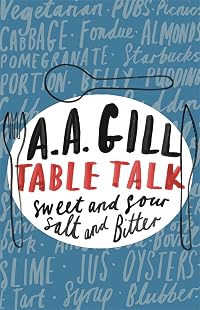
Table Talk
by A. A. Gill
On This Page
Description
The first collection of food writing by Britain's funniest and most feared critic A.A. Gill knows food, and loves food. A meal is never just a meal. It has a past, a history, connotations. It is a metaphor for life. A.A. Gill delights in decoding what lies behind the food on our plates: famously, his reviews are as much ruminations on society at large as they are about the restaurants themselves. So alongside the concepts, customers and cuisines, ten years of writing about restaurants has show more yielded insights on everything from yaks to cowboys, picnics to politics. TABLE TALK is an idiosyncratic selection of A.A. Gill's writing about food, taken from his Sunday Times and Tatler columns. Sometimes inspired by the traditions of a whole country, sometimes by a single ingredient, it is a celebration of what great eating can be, an excoriation of those who get it wrong, and an education about our own appetites. Because it spans a decade, the book focuses on A.A. Gill's general dining experiences rather than individual restaurants - food fads, tipping, chefs, ingredients, eating in town and country and abroad, and the best and worst dining experiences. Fizzing with wit, it is a treat for gourmands, gourmets and anyone who relishes good writing. show lessTags
Recommendations











Member Recommendations
Member Reviews
Sunday Times food critic A.A. Gill is of the mind that restaurants, like food, are best roasted slowly.
And his tongue drips with acid – so much so, I laughed till I cried.
Comments such as these:”What is the point of a menu if you need the Rosetta Stone to translate it?”; or "The amuse-gueule came, as I knew it would: a crab cake the size of a shirt button that collapsed into vapours at the sight of a fork. A man can feel right foolish chasing a crab's toenail round a plate. It tasted fine, in a homeopathic sort of way."; or "The baby back ribs were like eating the evidence in a war-crimes trial. Apparently they'd been buried in a peat bog for a month"; or "The only way to describe this food is 'gay'. Gayissiums. Gayomorphic. show more Spumingly, frothingly queer. It was proudly, poncily, deliciously, lispingly effete." Goodness only knows how he gets away with it. He wouldn’t here – our libel laws would send him (and his paper) broke. Remember Leo Schofield, doyen of food critics in Australia, who lost a $100,000 libel case in 1984 over a restaurant review in which he compared the lobster to an "albino walrus".
Table Talk is Gill at his best. He has naturally chucked out the over-cooked and underwritten bits that appear when you wirte a column (or two) every single week. And these often excoriating reviews do not seem particularly mean, because he has left out the names of the restaurants. I’d love to join him, the Blonde, and his star-studded friends list for just one meal.
More power to his fork. show less
And his tongue drips with acid – so much so, I laughed till I cried.
Comments such as these:”What is the point of a menu if you need the Rosetta Stone to translate it?”; or "The amuse-gueule came, as I knew it would: a crab cake the size of a shirt button that collapsed into vapours at the sight of a fork. A man can feel right foolish chasing a crab's toenail round a plate. It tasted fine, in a homeopathic sort of way."; or "The baby back ribs were like eating the evidence in a war-crimes trial. Apparently they'd been buried in a peat bog for a month"; or "The only way to describe this food is 'gay'. Gayissiums. Gayomorphic. show more Spumingly, frothingly queer. It was proudly, poncily, deliciously, lispingly effete." Goodness only knows how he gets away with it. He wouldn’t here – our libel laws would send him (and his paper) broke. Remember Leo Schofield, doyen of food critics in Australia, who lost a $100,000 libel case in 1984 over a restaurant review in which he compared the lobster to an "albino walrus".
Table Talk is Gill at his best. He has naturally chucked out the over-cooked and underwritten bits that appear when you wirte a column (or two) every single week. And these often excoriating reviews do not seem particularly mean, because he has left out the names of the restaurants. I’d love to join him, the Blonde, and his star-studded friends list for just one meal.
More power to his fork. show less
Gill's patronising, middle class arrogance and his faux belligerence I can forgive. His over-use of similes I cannot.
It's a real shame, as Gill knows his stuff and there are some genuinely interesting and witty articles here. A pity then that his writing becomes increasingly annoying: dishes are as salty as "a fat bloke's cycling shorts" and sauces are "the colour of a stripper's knickers and the consistency of a politician's promise". Describing kedgeree as the colour of "Chinese cowardice" is a cheap shot for the sake of cheap laugh. Worse, it does not tell us what the dish actually looked like (I'm guessing some shade of yellow). Lazy writing.
The kedgeree dish is from a lunch that he shared with Jeremy Clarkson, the only man to outdo show more Gill in his use of contrived and convoluted similes. The appendix references Clarkson on no less than 12 pages throughout the book. Enough said. show less
It's a real shame, as Gill knows his stuff and there are some genuinely interesting and witty articles here. A pity then that his writing becomes increasingly annoying: dishes are as salty as "a fat bloke's cycling shorts" and sauces are "the colour of a stripper's knickers and the consistency of a politician's promise". Describing kedgeree as the colour of "Chinese cowardice" is a cheap shot for the sake of cheap laugh. Worse, it does not tell us what the dish actually looked like (I'm guessing some shade of yellow). Lazy writing.
The kedgeree dish is from a lunch that he shared with Jeremy Clarkson, the only man to outdo show more Gill in his use of contrived and convoluted similes. The appendix references Clarkson on no less than 12 pages throughout the book. Enough said. show less
I opened this book in a shop and read the entry about cabbage. It made me giggle, so I bought it. Quite a lot of the book is snigger inducing, however, I'm not sure I'd recommend reading it in one go - it is a book to dip in and out of. A A Gill can be witty and even laugh-out-loud funny; he can also be rather offensive. In small doses, the former seems more prominent, when I read large chunks of the book at once, I was struck more by the latter.
Ratings
Members
- Recently Added By
Published Reviews
Few jobs attract more envy than that of the food critic: free food, fine wine, and the rest of the day for deliberation and digestion. Trawling various gastrocrats' attempts to capture the personality of a lobster bisque, it's clear that much food writing bears little relation to an everyday function.
A A Gill's Sunday Times column is a worthy exception, taking a refreshingly broad look at show more food. His brash intolerance is bound to alienate, but he goes beyond the forensic dissection of whatever lands on his plate, to consider the meanings show less
A A Gill's Sunday Times column is a worthy exception, taking a refreshingly broad look at show more food. His brash intolerance is bound to alienate, but he goes beyond the forensic dissection of whatever lands on his plate, to consider the meanings show less
added by John_Vaughan
Author Information

21+ Works 1,113 Members
Adrian Anthony Gill was born in Edinburgh, Scotland on June 28, 1954. He studied at Central Saint Martins College of Art and Design in London and at the Slade School, but did not graduate from either. A series of odd jobs followed as he descended into alcoholism. After entering a rehabilitation program in 1984 and joining Alcoholics Anonymous, he show more taught cooking classes. He wrote a short article about his recovery for Tatler's Good Rehab Guide and was hired as a food writer and essayist. In 1993, he was hired by The Sunday Times. He wrote about television, travel, and politics before taking over Table Talk, the newspaper's weekly restaurant column. His travel writing and foreign reporting were collected in A. A. Gill Is Away and A. A. Gill Is Further Away. His other books included Sap Rising, The Ivy: The Restaurant and Its Recipes, Le Caprice, Breakfast at the Wolseley: Recipes from London's Favorite Restaurant, Grand Cafe, The Golden Door: Letters to America, and Table Talk: Sweet and Sour, Salt and Bitter. His autobiography, Pour Me: A Life, was published in 2015. He died from lung cancer on December 10, 2016 at the age of 62. (Bowker Author Biography) show less
Classifications
Statistics
- Members
- 79
- Popularity
- 401,706
- Reviews
- 3
- Rating
- (3.56)
- Languages
- English
- Media
- Paper
- ISBNs
- 2