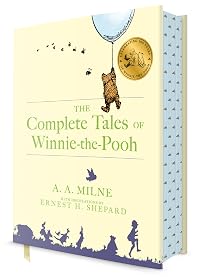
Winnie-the-Pooh • The House at Pooh Corner
by A. A. Milne
Winnie the Pooh (A.A. Milne Original) (Collections and Selections — Omnibus 1-2)
On This Page
Description
The world of Pooh is a world of enchantment. It is a world where Winnie-the-Pooh and his friends Piglet, Eeyor, Tigger, Kanga and the others share unforgettable adventures with Christopher Robin.Tags
Recommendations




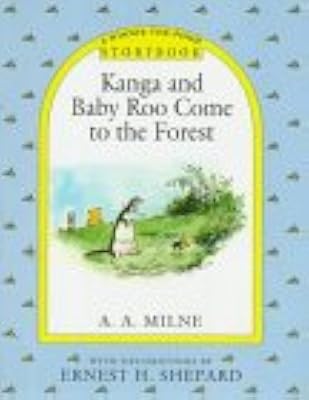


Member Recommendations

Member Reviews
(With original line illustrations by E. H. Shepard)
This book was originally published in 1926, when Christopher Robin, A. A. Milne's son, would have been about 5 or 6. Milne breaks the fourth wall to envelop us, too, in the delightful adventures of Christopher Robin and his companions.
These are the opening paragraphs (after a short Introduction, where we are given a sideways explanation of who Winnie the Bear is - until Piglet interrupts):
(oh, alright, then; just this once. He apparently took his named from a Canadian bear, who - after many adventures in the Great War - came to reside in London Zoo, and was named after Winston Churchill. Winnie. As for 'ther-Pooh', you'll have to ask him yourselves.)
And so we are introduced to Winnie-ther-Pooh (formerly known as Edward Bear), and thus to Christopher Robin. This is the delightful, quirky tone of the book, which is a collection of 10 short stories featuring the denizens of the 100 Aker Wood, some of whose arrivals (Kanga's and Roo's) feature in the collection. They go on expotitions, hunt Woozles and Wizzles and Heffalumps (or are hunted by them), have parties - and of course - eat lots of hunny. Which usually gets our bear into trouble.
I just love the casual, quirky silliness of the way it's written:
This was the bedtime book I read to my children over a few nights. My four year old loved the stories, while my nine year old gets a lot of the humour, though there are some levels that may be reserved for adults (I doubt young children realise that Piglet's sign is part of 'trespassers will be prosecuted', for instance).
And in addition, for me, there is that sense of reminiscence and innocence that is partly peeking into my children's childhood and partly looking back to mine.
This book strikes a special chord with me, as Christopher Robin - as portrayed - is about the same age as my youngest is now (though my child is, necessarily, more worldly-wise).
Thoroughly recommended, especially for a bit of light-hearted, misty-eyed nostalgia.
Five stars. show less
This book was originally published in 1926, when Christopher Robin, A. A. Milne's son, would have been about 5 or 6. Milne breaks the fourth wall to envelop us, too, in the delightful adventures of Christopher Robin and his companions.
These are the opening paragraphs (after a short Introduction, where we are given a sideways explanation of who Winnie the Bear is - until Piglet interrupts):
Here is Edward Bear, coming downstairs now, bump, bump, bump, on the back of his head, behind Cristopher Robin. It is, as far as he knows, the only way of coming downstairs, but sometimes he feels that there really is another way, if only he could stop bumping for a moment and think of it. And then heshow more
feels that perhaps there isn't. Anyhow, here he is at the bottom, and ready to be introduced to you. Winnie-the-Pooh.
When I first heard his name, I said, just as you are going to say, "But I thought he was a boy?"
"So did I," said Christopher Robin.
"Then you can't call him Winnie?"
"I don't."
"But you said --"
"He's Winnie-the-Pooh. Don't you know what 'ther' means?"
"Ah, yes, now I do," I said quickly; and I hope you do too, because it is all the explanation you are going to get.
(oh, alright, then; just this once. He apparently took his named from a Canadian bear, who - after many adventures in the Great War - came to reside in London Zoo, and was named after Winston Churchill. Winnie. As for 'ther-Pooh', you'll have to ask him yourselves.)
And so we are introduced to Winnie-ther-Pooh (formerly known as Edward Bear), and thus to Christopher Robin. This is the delightful, quirky tone of the book, which is a collection of 10 short stories featuring the denizens of the 100 Aker Wood, some of whose arrivals (Kanga's and Roo's) feature in the collection. They go on expotitions, hunt Woozles and Wizzles and Heffalumps (or are hunted by them), have parties - and of course - eat lots of hunny. Which usually gets our bear into trouble.
I just love the casual, quirky silliness of the way it's written:
Christopher Robin said you couldn't be called Trespassers W, and Piglet said yes, you could, because his grandfather was, and it was short for Trespassers Will, which was short for Trespassers William. And his grandfather had had two names in case he lost one - Trespassers after an uncle, and William after Trespassers.
This was the bedtime book I read to my children over a few nights. My four year old loved the stories, while my nine year old gets a lot of the humour, though there are some levels that may be reserved for adults (I doubt young children realise that Piglet's sign is part of 'trespassers will be prosecuted', for instance).
And in addition, for me, there is that sense of reminiscence and innocence that is partly peeking into my children's childhood and partly looking back to mine.
This book strikes a special chord with me, as Christopher Robin - as portrayed - is about the same age as my youngest is now (though my child is, necessarily, more worldly-wise).
Thoroughly recommended, especially for a bit of light-hearted, misty-eyed nostalgia.
Five stars. show less
Another one of those “imbibed with mother's milk” books, like “The Wind in the Willows” and “The Hobbit,” which I am incapable of commenting on with any sort of objectivity. I get a kick out of Pooh's “hums,” and the characters are old friends. My dad's nickname for my mom was “Pooh,” and she introduced him to the Pooh books when they were dating (he was a Jewish boy from Staten Island, and knew all about science and philosophy, but had missed out on most of the children's classics), and lines and characters from the books were part of our family culture. My copy is one I purchased on a long-ago and fondly remembered trip to England with my best childhood friend, so there's that much more sentiment involved. You get show more the picture – I turn to mush when it comes to Pooh. Anyway, this is my last “read this to my mom while she was dying of dementia/cancer” review, because, well, I don't get to read her any more books. But, we got to finish this one. On Tuesday morning, her last day, I read her chapter IX, which is the one where Eeyore finds Owl a new house, only it happens to be Piglet's house, and Piglet does the Noble thing, and then X, “An Enchanted Place.” That last chapter chokes me up in a “normal” reading – when reading to a child. Christopher Robin is leaving his “nursery days,” and he asks Pooh to always remember him. He, Christopher Robin, doesn't want to leave, but it's time and he has to, but a part of him will always remain in this enchanted place with Pooh. Mom was fading away, but she was still aware and registered the illustrations I showed her (I only bothered her with the best ones). She passed away Tuesday night, and I'll miss her terribly, but I think this was a fine book to end with. show less
Have a deep, long look at the image above. That motley crew are undoubtedly the most famous toy animals in existence.
Winnie-the-Pooh, Piglet, Eeyore, Kanga (I cannot see Roo) and (last but not least) Tigger.
A. A. Milne, and established playwright and writer, constructed silly nursery stories and poems for his young son Christopher Robin, built around his beloved toys. He published them. And much to his chagrin, he came to be known as the creator of "Winnie-the-Pooh": all his "serious" works were forgotten!
Read this book, and you will understand why.
True, nothing much happens in the stories. There are no hair-raising escapades, no dashing adventures and no earth-shaking events. What we have here are a bunch of rather silly animals (the show more team mentioned above, along with two imaginary ones, Rabbit and Owl) in Hundred Acre Woods, doing a lot of silly things, talking nonsensically (though pompously) most of the time, and making prize fools of themselves. Yet these stories are magical, for adults and children alike.
Christopher Robin is the acknowledged lord of this idyllic kingdom: the stories start when he comes down the stairs, dragging Pooh-bear behind him ("bump, bump, bump") and ends when he goes up the stairs in the same fashion. The cosy world of the nursery transforms itself into a magic land where you can hunt "heffalumps" or go on "expotitions" to the North Pole. The cast of characters are always the same, and the happenings, similar. Where these stories score are in the way the characters are etched. With true English underplayed humour, Milne has invested these stuffed toys with fascinating personalities.
Pooh, the "Bear of Very Little Brain", but subject to occasional flashes of brilliance and bursts of versification.
Piglet, the smallest and weakest of them all but sometimes capable of doing "Very Grand Things".
The clever Rabbit, many a time too much so for his own good.
The pedantic and pompous Owl, who can't restrain himself from holding forth at the slightest provocation.
The long-suffering Eeyore with his never-ending complaints.
The devoted Kanga and her frisky little son Roo, whom she keeps in her pocket.
Happy-go-lucky Tigger, bouncing all over the woods.
These characters are typically English: in fact, they could have stepped out from a P.G.Wodehouse novel. When a child reads these stories, he/ she will enjoy them at their face value; while the perceptive adult will be fascinated by the subtext.
It is no surprise that these stories endure. As Milne says: "...the Forest will always be there...and anybody who is Friendly with Bears can find it." Christopher Robin will grow up; making way for other kids who will take his place. But this imaginary landscape will endure, because "in that enchanted place on the top of the Forest a little boy and his Bear will always be playing."
Fantastic book!
P.S. The illustrations by E.H.Shepard should also be mentioned. They are so much a part of the story that we cannot imagine the book without the pictures. show less
This is a sterling rendition of these wonderful books. The cast is spectacular, the music delightful and the atmosphere captivating. I never want it to end. I could listen to this again and again. It just makes me feel good all over. I come away humming Pooh's hums and looking for a stream to play Pooh sticks.
This is a 2 part children's book in which chapters somewhat build on each other, but each can be taken as a separate story. The stories are short enough that we always read the whole thing in full (but too long for our bedtime stories). There are many themes such as discovery, friendship, problem solving, appreciating or being open to being nice to others, and growing up that are explored to various degrees.
The characters and adventures are appropriate for young readers. I read the entire book to my four-year-old over a few months (we read a story or two at a time but then may not read it again for a few days). While my child enjoyed the book, he didn't always understand what was going on. I think we'll enjoy this more in a year or two. show more The characters include both stuffed animals and make-believe animals. I thought this was a really interesting concept, particularly that the animals knew this. There are points in the book that are really only understandable for the adult reading. They were stories that both I as a parent, and my child could enjoy.
I liked that there is nothing truly scary; Piglet's fear is the main driver of any "scary" and it is always resolved by the end of the story.
I cried at the end of the last story.
Note that these stories were created for a particular child and that they were his stuffed animals. Therefore, there is only one female character (Kanga, a mother figure), because the child probably only made one of his animals female (I know my son rejects my suggesting that any of the stuffed animals are female). However, all of the animals have unique personalities and show a full range of emotions (between them). So, for those that lament the lack of female characters, remember that there's more diversity within a sex than between which is important for a child to learn too; but if it really annoys you just change the sex of the characters. Too bad English attributes sex because I think the animals could have been without sex/gender but that makes for poor writing. show less
The characters and adventures are appropriate for young readers. I read the entire book to my four-year-old over a few months (we read a story or two at a time but then may not read it again for a few days). While my child enjoyed the book, he didn't always understand what was going on. I think we'll enjoy this more in a year or two. show more The characters include both stuffed animals and make-believe animals. I thought this was a really interesting concept, particularly that the animals knew this. There are points in the book that are really only understandable for the adult reading. They were stories that both I as a parent, and my child could enjoy.
I liked that there is nothing truly scary; Piglet's fear is the main driver of any "scary" and it is always resolved by the end of the story.
I cried at the end of the last story.
Note that these stories were created for a particular child and that they were his stuffed animals. Therefore, there is only one female character (Kanga, a mother figure), because the child probably only made one of his animals female (I know my son rejects my suggesting that any of the stuffed animals are female). However, all of the animals have unique personalities and show a full range of emotions (between them). So, for those that lament the lack of female characters, remember that there's more diversity within a sex than between which is important for a child to learn too; but if it really annoys you just change the sex of the characters. Too bad English attributes sex because I think the animals could have been without sex/gender but that makes for poor writing. show less
I always have been a fan of Winnie the Pooh since I was a kid. However, I haven't actually sat down and read the original stories that were then adapted by Disney. I was delightfully surprised by how familiar the stories felt. All of the characters, while similar to their Disney counterparts, had their own little quirks and personality bits that made them unique to the characters I already knew and loved. Specifically the little bits of sass and quips that are clearly peaks of the authors voice in the characters he created. Very excited to share these stories specifically with my future family.
I read this book as part of a nighttime reading to my eight year old daughter. On the one hand it was a good fit because each chapter was no longer than thirteen pages, a perfect length to read as part of bedtime. And then the characters are already well-known thanks to Disney. I will admit this that this aspect made it a bit challenging because I could never quite get the voices of the characters right when reading them aloud. I was only satisfied with my voice for Eyeore. And I think that I failed miserably on Pooh every time. Another thing that I liked was that Disney did a good job of translating the characters to the screen. The cartoons very much matched the book. In fact, several chapters seemed to be a directly converted into show more the cartoons. It made me feel good that the book was providing a high-quality source and giving me more than what could be found in the cartoons.
Now, on the other hand, the book wasn't totally a great fit to be read aloud to a young-ish child. The stories were originally written in 1926 and 1928 and some of the descriptions use older terms. I had to redescribe items several times. Plus there were many moments of more mature humor that were totally lost on my daughter. Often the characters would misspell words (Owl spelled his name as WOL); something that is lost when read out loud and to a child who doesn't immediately recognize a misspelled word. Plus there were several times when important elements to a chapter were left unsaid. As an adult, I knew what was happening, but a child would not. For example, the final chapter where Christopher Robin is going away. My daughter just thought of that as Christopher Robin going to play elsewhere or with different friends or different toys. But as adults, we can read between the lines and realize that Christopher Robin is growing up and moving away from childhood and into adulthood and leaving his imagination behind in the process. A sad fact regardless but a hard truth to convey to someone who still lives in a world of imagination. Overall, I'm glad that I read the stories but I probably won't read them to my second daughter until she's a bit older than eight. show less
Now, on the other hand, the book wasn't totally a great fit to be read aloud to a young-ish child. The stories were originally written in 1926 and 1928 and some of the descriptions use older terms. I had to redescribe items several times. Plus there were many moments of more mature humor that were totally lost on my daughter. Often the characters would misspell words (Owl spelled his name as WOL); something that is lost when read out loud and to a child who doesn't immediately recognize a misspelled word. Plus there were several times when important elements to a chapter were left unsaid. As an adult, I knew what was happening, but a child would not. For example, the final chapter where Christopher Robin is going away. My daughter just thought of that as Christopher Robin going to play elsewhere or with different friends or different toys. But as adults, we can read between the lines and realize that Christopher Robin is growing up and moving away from childhood and into adulthood and leaving his imagination behind in the process. A sad fact regardless but a hard truth to convey to someone who still lives in a world of imagination. Overall, I'm glad that I read the stories but I probably won't read them to my second daughter until she's a bit older than eight. show less
Members
- Recently Added By
Lists

Favorite Childhood Books
1,646 works; 514 members
1001 Children's Books You Must Read Before You Grow Up
774 works; 101 members

Scholastic 100 Best Read-Aloud Books
100 works; 8 members

501 Must-Read Books
529 works; 72 members
Honey For a Child's Heart
1,152 works; 25 members

LibraryThingers' 1001 Books You Must Read Before You Die
442 works; 30 members

Short Story Collections and Anthologies
261 works; 42 members

Favorite Series
238 works; 94 members

Five star books
1,755 works; 107 members
Our Favorite Comfort Reads
334 works; 200 members

Guilty Pleasures
223 works; 86 members

The Five Books That Represent Us
391 works; 148 members
Author Information

A prolific writer, A. A. Milne published 35 plays, 6 novels, 3 books of verse, 3 collections of short stories, and several works of nonfiction, including sketches for Punch magazine, of which he was the assistant editor. Nevertheless, his fame rests on four books for children: two of whimsical stories about the stuffed animals in his son's bedroom show more (Winnie-the-Pooh and The House at Pooh Corner) and two of verse (When We Were Very Young and Now We Are Six). All are considered classics and have been included among the Children's Literature Association's Touchstone books as the best in children's literature, on the Lewis Carroll Shelf list, and on the Choice magazine list of books for the academic library. He also wrote Toad of Toad Hall, a play based on Grahame's The Wind in the Willows, and Once upon a Time: A Fairy Tale for Grown-ups, both of which are sometimes included in volumes with the four classic works. Milne had a son, Christopher Robin, who served as the model for the little boy in his children's books. (Bowker Author Biography) show less
Some Editions
Awards and Honors
Series

Work Relationships
Common Knowledge
- Canonical title
- Winnie-the-Pooh • The House at Pooh Corner
- Original publication date
- 1958-10-23 (in one volume) (in one volume)
- People/Characters
- Winnie-the-Pooh; Piglet; Owl [in Winnie-the-Pooh]; Kanga; Roo; Tigger (show all 9); Christopher Robin; Rabbit [in Winnie-the-Pooh]; Eeyore
- Important places
- Hundred Acre Wood
- Epigraph
- TO HER
Hand in hand we come
Christopher Robin and I
To lay this book in your lap.
Say you're surprised?
Say you like it?
Say it's just what you wanted?
Because it's yours -
Because we love you. - First words
- Introduction: If you happen to have read another book about Christopher Robin, you may remember that he once had a swan (or the swan had Christopher Robin, I don't know which) and that he used to call this swan Pooh.
- Last words
- (Click to show. Warning: May contain spoilers.)So they went off together. But wherever they go, and whatever happens to them on the way, in that enchanted place on the top of the Forest, a little boy and his Bear will always be playing.
- Original language
- English
- Disambiguation notice
- This work includes both "Winnie-the-Pooh" and "The House at Pooh Corner". Please don't combine with either individual work, or with collections that include "Now We Are Six" and/or "When We Were Very Young."
Classifications
- Genres
- Children's Books, Fiction and Literature
- DDC/MDS
- 823.912 — Literature & rhetoric English & Old English literatures English fiction 1900- 1901-1999 1901-1945
- LCC
- PZ7 .M64 .W — Language and Literature Fiction and juvenile belles lettres Fiction and juvenile belles lettres Juvenile belles lettres
- BISAC
Statistics
- Members
- 7,017
- Popularity
- 1,683
- Reviews
- 50
- Rating
- (4.50)
- Languages
- 18 — Bulgarian, Danish, Dutch, English, Estonian, Finnish, French, German, Hungarian, Japanese, Latvian, Lithuanian, Moldavian, Norwegian, Polish, Russian, Spanish, Swedish
- Media
- Paper, Audiobook, Ebook
- ISBNs
- 99
- UPCs
- 1
- ASINs
- 45