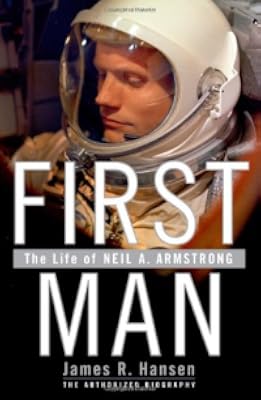
First Man: The Life of Neil A. Armstrong
by James R. Hansen
On This Page
Description
On July 20, 1969, the world stood still to watch 38-year-old American astronaut Neil A. Armstrong become the first person ever to step on the surface of another heavenly body. Upon his return to Earth, Armstrong was celebrated for his monumental achievement. He was also--as NASA historian Hansen reveals in this authorized biography--misunderstood. Armstrong's accomplishments as an engineer, a test pilot, and an astronaut have long been a matter of record, but Hansen's access to private show more documents and unpublished sources and his interviews with more than 125 subjects (including more than fifty hours with Armstrong himself) yield the first in-depth analysis of this elusive, reluctant hero. Hansen recreates Armstrong's flying career, from his combat missions over North Korea to his transatmospheric flights in the rocket-powered X-15 to the first-ever docking in space. For a pilot who cared more about flying to the Moon than he did about walking on it, Hansen asserts, Armstrong's storied vocation exacted a dear personal toll, paid in kind by his wife and children.--From publisher description. show lessTags
Recommendations

















Member Reviews
As the authorized biography of Neil Armstrong, this book has the usual faults and virtues of such an exercise. On one hand, due to access to private materials, significant myths are debunked about the subject. On the other, one can sometimes wonder how forthright the author is about what he is thinking about his subject. In between tracking the choices that led to Armstrong becoming the first man to step onto the Moon, and the technology that was involved, the point that crystallized the book for me came late, when Armstrong admitted that while his flying was not very intuitive, he made up for this with more precision. This admission could describe much of the rest of Armstrong’s life, as he seemed to function best in structured show more environments where problems could be dealt with in isolation. Unfortunately, this was not an approach that served Armstrong well either in his first marriage, where he seems to have given too little back in terms of emotional support and time, or in post-astronaut life in general, where the man’s iconic status (and generally closed personality) seemed to lead to, at best, general awkwardness.
This also offers some insight into the resentment that the community of military test pilots seemed to have for the man (a running topic in this book), in that Armstrong’s desire to keep his own counsel and avoid personal conflict could be seen as arrogance and his flying style might be seen as awkward by men who were more intuitive fliers. This, of course, discounts the Darwinian drive for prestige and advancement between the American military and civilian aerospace efforts, which the civilian side was probably always going to win, with Armstrong probably being the leading civilian test pilot in the NACA/NASA complex (not to mention being a good organization man). Hansen, being a NASA man himself, might not best placed to comment on this issue. I might be unfair in this instance, as Hansen does seem to deal forthrightly with how the crew of Apollo 11 was anything but a band of brothers (which was seen as unusual at the time); possibly a comment on Armstrong's leadership skills. show less
This also offers some insight into the resentment that the community of military test pilots seemed to have for the man (a running topic in this book), in that Armstrong’s desire to keep his own counsel and avoid personal conflict could be seen as arrogance and his flying style might be seen as awkward by men who were more intuitive fliers. This, of course, discounts the Darwinian drive for prestige and advancement between the American military and civilian aerospace efforts, which the civilian side was probably always going to win, with Armstrong probably being the leading civilian test pilot in the NACA/NASA complex (not to mention being a good organization man). Hansen, being a NASA man himself, might not best placed to comment on this issue. I might be unfair in this instance, as Hansen does seem to deal forthrightly with how the crew of Apollo 11 was anything but a band of brothers (which was seen as unusual at the time); possibly a comment on Armstrong's leadership skills. show less
A boy from Ohio fascinated by planes and how they are engineered one day becomes the most famous man on the planet by stepping onto the Moon. First Man: The Life of Neil A. Armstrong is the authorized biography of the Apollo 11 commander by James R. Hansen.
Hansen centers the biography on the Apollo 11 mission, which from the decision to name Neil Armstrong commander to his return home. The first quarter and the final quarter of the biography literally bookends those approximately eight months with the former detailing Armstrong’s childhood passion for flight that led to his career as a test pilot then astronaut and the later detailing how the modest Armstrong adjusted—or did not—to worldwide fame that only lessened in everyday show more life as he grew older. Given the number of pages that Hansen concentrated on Armstrong’s time with NASA, there are a lot of vehicle abbreviations that need to be negotiated when reading but Hansen does a good job in make sure readers learn the terms however if one doesn’t pay attention, you can miss something and get confused. Yet this book is a fantastic read thanks to Hansen’s interviews of Armstrong and his extensive research into the Apollo 11 logs which flesh out those momentous July days for those not alive to experience them.
First Man is a very well written biography that blends NASA archived logs, author interviews of Armstrong, and interviews of fellow Gemini and Apollo astronauts. show less
Hansen centers the biography on the Apollo 11 mission, which from the decision to name Neil Armstrong commander to his return home. The first quarter and the final quarter of the biography literally bookends those approximately eight months with the former detailing Armstrong’s childhood passion for flight that led to his career as a test pilot then astronaut and the later detailing how the modest Armstrong adjusted—or did not—to worldwide fame that only lessened in everyday show more life as he grew older. Given the number of pages that Hansen concentrated on Armstrong’s time with NASA, there are a lot of vehicle abbreviations that need to be negotiated when reading but Hansen does a good job in make sure readers learn the terms however if one doesn’t pay attention, you can miss something and get confused. Yet this book is a fantastic read thanks to Hansen’s interviews of Armstrong and his extensive research into the Apollo 11 logs which flesh out those momentous July days for those not alive to experience them.
First Man is a very well written biography that blends NASA archived logs, author interviews of Armstrong, and interviews of fellow Gemini and Apollo astronauts. show less
This is a biography of the first man to walk on the Moon, which inspired the recent film of the same name (which I watched while reading this, and enjoyed). Armstrong was wary of potential chroniclers of his life, due to negative experiences at the hands of some journalists and other unscrupulous people in the heady immediate post-Apollo XI period, so steered clear of potential interviewers or biographers until James Hansen was able to persuade him to be interviewed extensively for this biography in 2005. Hansen says that Armstrong did not seek to influence his writing or conclusions, thus this is quite a rounded biography of the great astronaut, an authorised biography in the sense that it had access to family details and personal show more accounts from family members, but also maintains some critical distance from his subject.
It is quite a long biography, and also quite dry in a few places for most readers, with many technical details of various aircraft and early spacecraft in which he flew; though Armstrong would have welcomed this as he saw himself primarily as an engineer whose life was about resolving problems in this field. That said, much research has been done on his family background, which has been traced back ten generations to the first Armstrongs to emigrate from Scotland to America in the early 18th century. Neil was born in a small town in Ohio in 1930. He was fascinated by flying from an early age, and is quoted as saying that even in elementary school his intention was to be an aircraft designer. He gained a student pilot's license when he turned 16. He became a naval aviator and was taking part in the Korean War (including nearly parachuting into a minefield) in his very early 20s. He then became a test pilot, testing increasingly sophisticated aircraft that could fly higher and faster than ever before. This was a very dangerous business - far more test pilots died in flight than ever have in the whole history of spaceflight from the 1960s to date.
Neil applied for astronaut selection in 1962, shortly after the tragic death of his two year old daughter Karen from a brain tumour. Before the Apollo programme, he was command pilot in 1966 for Gemini VIII, in which, on the way back from performing the first docking of two spacecraft in orbit, he and co-pilot David Scott, went tumbling away end to end, potentially disastrously, before regaining control. This wasn't the end of Neil's brushes with death; while flying a lunar landing research vehicle in 1968, he had to parachute out seconds before it blew up. The story of Apollo XI is too well known to need recounting in this review, but suffice it to say that Armstrong's personal unflappability and resourcefulness demonstrated why he was absolutely the right person to command this first and successful attempt to land on the moon and return safely to Earth.
(As an aside on the Apollo programme, I have often thought that Apollo 8, that flew at Christmas 1968, should be better known, as its astronauts - including Jim Lovell who later commanded the ill-fated Apollo 13 in 1970 - were the first humans to leave Earth’s gravitational field and actually travel to the moon's vicinity, and orbit it successfully).
After the storming success of Apollo XI, the rest of Armstrong's life was, in a sense, perforce an anti-climax. After a brief period as a NASA administrator, he spent a decade in academia and was headhunted for the boards of many companies. He spread himself too thinly, and in the end this told on his marriage, he and his wife Janet splitting in 1990 after 34 years together. He kept up his support for the space programme, such as it was, and objected, albeit politely and in a restrained manner, to the Obama administration's regrettable decision to cancel NASA's plans to return men to the Moon by 2020. Astronauts, being resilient and in peak physical condition, tend to lead long lives and Armstrong was generally in fine condition until his death from complications after heart surgery in August 2012 (slightly mysteriously, after he had been expecting to make a full recovery). His place as a giant in the history of exploration and engineering is assured, and even those who know nothing about spaceflight would recognise his famous words as he stepped onto the Moon's surface. But he never considered himself an explorer: “What I attended to was the progressive development of flight machinery. My exploration came totally as a by-product of that. I flew to the Moon not so much to go there, but as part of developing the systems that would allow it to happen.” He did that, of course, but so much more. show less
It is quite a long biography, and also quite dry in a few places for most readers, with many technical details of various aircraft and early spacecraft in which he flew; though Armstrong would have welcomed this as he saw himself primarily as an engineer whose life was about resolving problems in this field. That said, much research has been done on his family background, which has been traced back ten generations to the first Armstrongs to emigrate from Scotland to America in the early 18th century. Neil was born in a small town in Ohio in 1930. He was fascinated by flying from an early age, and is quoted as saying that even in elementary school his intention was to be an aircraft designer. He gained a student pilot's license when he turned 16. He became a naval aviator and was taking part in the Korean War (including nearly parachuting into a minefield) in his very early 20s. He then became a test pilot, testing increasingly sophisticated aircraft that could fly higher and faster than ever before. This was a very dangerous business - far more test pilots died in flight than ever have in the whole history of spaceflight from the 1960s to date.
Neil applied for astronaut selection in 1962, shortly after the tragic death of his two year old daughter Karen from a brain tumour. Before the Apollo programme, he was command pilot in 1966 for Gemini VIII, in which, on the way back from performing the first docking of two spacecraft in orbit, he and co-pilot David Scott, went tumbling away end to end, potentially disastrously, before regaining control. This wasn't the end of Neil's brushes with death; while flying a lunar landing research vehicle in 1968, he had to parachute out seconds before it blew up. The story of Apollo XI is too well known to need recounting in this review, but suffice it to say that Armstrong's personal unflappability and resourcefulness demonstrated why he was absolutely the right person to command this first and successful attempt to land on the moon and return safely to Earth.
(As an aside on the Apollo programme, I have often thought that Apollo 8, that flew at Christmas 1968, should be better known, as its astronauts - including Jim Lovell who later commanded the ill-fated Apollo 13 in 1970 - were the first humans to leave Earth’s gravitational field and actually travel to the moon's vicinity, and orbit it successfully).
After the storming success of Apollo XI, the rest of Armstrong's life was, in a sense, perforce an anti-climax. After a brief period as a NASA administrator, he spent a decade in academia and was headhunted for the boards of many companies. He spread himself too thinly, and in the end this told on his marriage, he and his wife Janet splitting in 1990 after 34 years together. He kept up his support for the space programme, such as it was, and objected, albeit politely and in a restrained manner, to the Obama administration's regrettable decision to cancel NASA's plans to return men to the Moon by 2020. Astronauts, being resilient and in peak physical condition, tend to lead long lives and Armstrong was generally in fine condition until his death from complications after heart surgery in August 2012 (slightly mysteriously, after he had been expecting to make a full recovery). His place as a giant in the history of exploration and engineering is assured, and even those who know nothing about spaceflight would recognise his famous words as he stepped onto the Moon's surface. But he never considered himself an explorer: “What I attended to was the progressive development of flight machinery. My exploration came totally as a by-product of that. I flew to the Moon not so much to go there, but as part of developing the systems that would allow it to happen.” He did that, of course, but so much more. show less
I confess, I had this sitting in the queue and was going to get to it eventually, but the debut of the movie made me move this up.
I still haven’t seen the movie.
But what can you say about Neil Armstrong. An American icon and the face of the space program – or specifically, the moon shot.
This is a very good biography that doesn’t seem to pull punches even though it’s authorized. It talks about the controversies, the misgivings, the warts and all.
Or mostly – I’d have to see another biography to judge that.
But it’s all here, from Neil’s childhood to his military service to engineering career to his life as an astronaut. Plus, the tragic loss of his child, and his tangles with other astronauts and Chuck Yeager, and his show more eventual divorce.
One interesting insight is that while they were history-makers, the three astronauts of Apollo 11 were nothing more than cordial strangers. You would think the shared experience would pull them together, but it doesn’t seem to have done so, and partly because of Armstrong’s distance from everyone, all the time.
(By the way, the author pulls from other bios and autobios, and Mike Collins’ quotes makes me want to read his book now).
The book also tells everybody’s side in recounting the controversies, but of course it largely sides with Armstrong.
It was a really good book. Might have been one or two chapters too long, though.
For more of my reviews, go to Ralphsbooks. show less
I still haven’t seen the movie.
But what can you say about Neil Armstrong. An American icon and the face of the space program – or specifically, the moon shot.
This is a very good biography that doesn’t seem to pull punches even though it’s authorized. It talks about the controversies, the misgivings, the warts and all.
Or mostly – I’d have to see another biography to judge that.
But it’s all here, from Neil’s childhood to his military service to engineering career to his life as an astronaut. Plus, the tragic loss of his child, and his tangles with other astronauts and Chuck Yeager, and his show more eventual divorce.
One interesting insight is that while they were history-makers, the three astronauts of Apollo 11 were nothing more than cordial strangers. You would think the shared experience would pull them together, but it doesn’t seem to have done so, and partly because of Armstrong’s distance from everyone, all the time.
(By the way, the author pulls from other bios and autobios, and Mike Collins’ quotes makes me want to read his book now).
The book also tells everybody’s side in recounting the controversies, but of course it largely sides with Armstrong.
It was a really good book. Might have been one or two chapters too long, though.
For more of my reviews, go to Ralphsbooks. show less
A comprehensive biography of the first man to step onto the lunar surface on 20 July 1969. As the authorized biography of Neil Armstrong. First Man is authoritative. Hansen was chosen by Armstrong as his biographer in 2002, and the book quotes the astronaut extensively. The book gives you a good feel for the reluctant hero.
A meticulously well-researched account of an extraordinary life. The amount of incidental detail takes some getting used to but in the end what shines through is the exceptional character of an everyman hero who distinguished himself in all he did. Unexpectedly emotional at the end too with a beautiful sense of Armstrong as an icon of inspiration and his life as a symbol of the aspirational nature of mankind.
An amazing book which if filled with technical detail as well as anecdotes about Neil Armstrong. Most of the excruciating detail could be better served as an appendix, but overall an interesting read, if you can get past the first 150 pages. The book explains some of Mr. Armstrong's "recluse behavior", which I for one never thought he practiced and admired him for not embracing fame, especially at this age of reality TV and other shameful displays of humanity. Several pages of this book are dedicated to misconceptions about the moon landing, especially those circulating in cyber space, which alone is worth the price of the book.
The book moves from excruciating technical details to moving personal stories, all important to help us show more understand the subject at hand. As in any history book / biography the most interesting parts are the small anecdotes we never will hear. show less
The book moves from excruciating technical details to moving personal stories, all important to help us show more understand the subject at hand. As in any history book / biography the most interesting parts are the small anecdotes we never will hear. show less
Members
- Recently Added By
Lists

Science: Astronomy
62 works; 2 members

Simon & Schuster
136 works; 4 members
Author Information

13+ Works 1,263 Members
James R. Hansen is a professor emeritus of history at Auburn University. A former historian for NASA, Hansen is the author of eleven books on the history of aerospace. He lives in Auburn, Alabama.
Awards and Honors
Work Relationships
Common Knowledge
- Original publication date
- 2005-10-01
- People/Characters
- George Abbey; Neil Armstrong; Ira H. Abbot; David Acheson; Dorothy Hutton Adams; Alfred Adler (show all 156); Spiro T. Agnew; John Alcock; Arnold Aldrich; Andrew John Aldrin; Buzz Aldrin; Fay Ann Aldrin; Gene Aldrin; James Michael Aldrin; Janice Rose Aldrin; Joan Archer Aldrin; Madeline Aldrin; Marion Moon Aldrin; Joanne Alford; Joseph S. Algranti; Jack Allavie; H. Julian Allen; John G. Allen, Jr.; Luis W. Alvarez; Stephen E. Ambrose; Bill Anders; Valerie Anders; Merle L. Anderson; Mike Anderson; Bill Andrews; Tom Andrews; Milburn G. Apt; Bernice Armstrong (aunt); Carol Knight Armstrong (second wife); Dean Alan Armstrong (brother); Eric Alan; George Armstrong; Grace Armstrong (aunt); Guy Armstrong (uncle); June Louise Armstrong Huffman (sister); Janet Shearon Armstrong (first wife); Jay Armstrong (nephew); Karen Anne Armstrong (daughter); Laura Mary Louise Koenig Armstrong (grandmother); Marilyn Armstrong (sister-in-law); Mark Stephen Armstrong (son); Mary Barbara Armstrong (aunt); Ray Armstrong (uncle); Stephen Koenig Armstrong (father); Viola Engel Armstrong (mother); Wendy Armstrong (daughter-in-law); Willis Armstrong (grandfather); Jeff Ashby; James J. Ashford; Fred Asselin; Donald Babbitt; D. J. Badger; Clyde Bailey; Philip K. Balch; Steve Bales; Tom B. Ballard; Ruta Bankovis; Wade A. Barfield; Roger Barnicki; Doris Barr; Charles A. Bassett; Jeanie Bassett; Richard Batten; Alan L. Bean; Ernest M. Beauchamp; Marshall Beebe; Elroy E. Beeler; Stephen Beering; R. S. Belcher; Donald Bellman; Howard Benedict; Floyd Bennett; Kenneth Benzing; Georgy T. Beregovoy; A. Scott Berg; Charles E. Berry; Paul Bikle; Ned Binkley; Collins Bird; Billy Bishop; John Blackford; Dottie Blackmun; Frank Borman; Frederick Borman; Susan Bigby Borman; Simon Bourgin; William W. 'Bowers; Della Mae Bowling; Charles Brading, Jr.; Richard Brading; Ross K. Bramwell; Hank Brandli; Guy Briggs; Douglas Brinkley; Heywood Hale Broun; A. W. Brown; David Brown; Bear Bryant; Warren E. Burger; H. R. Burkett; Dave Burrus; Devere Burt; George H. W. Bush; George W. Bush; Stanley P. Butchart; J. J. Buzek; Harry Caicedo; Pera Campbell; Eugene Cargill; John Carlos; Bob Carlton; John Carpenter; M. Scott Carpenter; William R. Carpentier; Jerry Carr; Jimmy Carter; Nicolae Ceausescu; Barbara Cernan; Eugene Cernan; Tracy Cernan; Roger B. Chaffee; William Chairs; Robert A. Champine; Cliff Charlesworth; Jeanette Chase; Kalpana Chawla; Dorothy Cheshire; Leonard R. Cheshire; Paul Christiansen; Sally Christiansen; Laurel Clark; Milton Clauser; Bruce E. Clingan; Patty Cole; Robert Cole; Agnes Collins; J. Lawton Collins; James L. Collins; James L. Collins, Jr.; Michael Collins, astronaut; Patricia Finnegan Collins; Virginia Stewart Collins; William Collins; Harry Combs; Pete Conrad; Christopher Conrad; Jane DuBose Conrad; L. Gordon Cooper, Jr.; Edgar A. Cortright; C. B. Cottingham; Alexey Leonov
- Important places
- Cape Canaveral, Florida, USA; The Moon; Florida, USA; Pensacola, Florida, USA; Ohio, USA; Houston, Texas, USA
- Important events
- Apollo program (1961 | 1975); Apollo 1 fire (1967-01-27); Apollo 7 (1968-10-11 | 1968-10-22); Apollo 8 (1968-12-21 | 1968-12-27); Apollo 9 (1969-03-03 | 1969-03-13); Apollo 10 (1969-05-18 | 1969-05-26) (show all 14); Apollo 11 (1969-07-16 | 1969-07-24); Apollo 11 Moon Landing (1969-07-20); Apollo 12 (1969-11-14 | 1969-11-24); Apollo 13 (1970-04-11 | 1970-04-17); Apollo 14 (1971-01-31 | 1971-02-09); Apollo 15 (1971-07-26 | 1971-08-07); Apollo 16 (1972-04-16 | 1972-04-27); Apollo 17 (1972-12-07 | 1972-12-19)
- Related movies
- First Man (2018 | IMDb)
- Dedication
- For Jennifer and Nathan
- First words
- Two obscure European towns took special meaning from the first human steps on another world.
- Last words
- (Click to show. Warning: May contain spoilers.)Then she stopped, hesitated for a moment, looked at the nice older man like Grandpa who had come to visit her in her house, and said, "Oh! Your name is Neil Armstrong, too, isn't it?"
- Original language
- English
Classifications
- Genres
- Nonfiction, Biography & Memoir, Science & Nature, History
- DDC/MDS
- 629.45 — Applied science & technology Engineering Transportation Vehicles Spacecraft & Vehicles Manned space flight
- LCC
- TL789.85 .A75 .H36 — Technology Motor vehicles. Aeronautics. Astronautics Motor vehicles. Aeronautics. Astronautics Astronautics. Space travel
- BISAC
Statistics
- Members
- 1,051
- Popularity
- 24,565
- Reviews
- 22
- Rating
- (3.92)
- Languages
- 7 — English, French, German, Hungarian, Italian, Spanish, Portuguese (Portugal)
- Media
- Paper, Audiobook, Ebook
- ISBNs
- 45
- ASINs
- 10