On This Page
Description
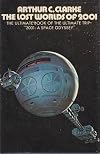
Includes chapters on the making of the film '2001'.Tags
Recommendations














Member Recommendations
Member Reviews
https://nwhyte.livejournal.com/3331396.html
The Lost Worlds of 2001, originally published in 1972, is an interesting exploration of alternate storylines for the novel and the film. Earlier versions of the film had more personalised aliens coming to educate the apemen, and a much longer segment of politicking in Washington DC (where incidentally there are quite a lot of women, even of most of them are defined by their male partners). Clarke frames the out-takes with some explanation of the painful process of film-making. He was 48, Kubrick was 40, and there's a slight sense of generational clash (the Englishman old enough to have fought in the war, the American who wasn't). It's interesting to see which paths were not taken, and in the show more end I have to agree with the judgements made by Kubrick and Clarke to move the narrative as they did; making the aliens too visible would have risked looking silly, and monoliths and music are much more impactful. I like it for the same reason I like the Book of Lost Tales, etc; they throw further light on something I already love. show less
The Lost Worlds of 2001, originally published in 1972, is an interesting exploration of alternate storylines for the novel and the film. Earlier versions of the film had more personalised aliens coming to educate the apemen, and a much longer segment of politicking in Washington DC (where incidentally there are quite a lot of women, even of most of them are defined by their male partners). Clarke frames the out-takes with some explanation of the painful process of film-making. He was 48, Kubrick was 40, and there's a slight sense of generational clash (the Englishman old enough to have fought in the war, the American who wasn't). It's interesting to see which paths were not taken, and in the show more end I have to agree with the judgements made by Kubrick and Clarke to move the narrative as they did; making the aliens too visible would have risked looking silly, and monoliths and music are much more impactful. I like it for the same reason I like the Book of Lost Tales, etc; they throw further light on something I already love. show less
An interesting examination of how one of the great movies of the 60's came together. Interesting to see what was the seed, how it blossomed, and what was pruned.
I read this mainly out of a sense of nostalgia for the movie. But this book wasn't very interesting or informative, and in fact, the various endings Clarke gives the reader are for the most part boring.
Clarke's story of the writing of the book and movie, in contains multiple versions of the original story that are as good as anything he's done.
Very interesting background information on how Clarke and Kubrick ended up with the film version we know of 2001. Also includes the story that inspired it all.
The book is too slow paced for me. And my GK isn't very good. If some historical character is mentioned I feel the author should brush up at least a bit on what that character did in history. Here and there were some words I didnt understand. I started pushing myself to read it.
Finally I read its summary in wiki. Felt the story was too small for such a thick book.
Finally I read its summary in wiki. Felt the story was too small for such a thick book.
Ratings
Members
- Recently Added By
Lists

The Short Story Collections of Arthur C. Clarke
10 works; 1 member

The Non-Fiction Works of Arthur C. Clarke
27 works; 2 members
Author Information

861+ Works 130,263 Members
Arthur C. Clarke was born in Minehead, Somerset, England, on December 16, 1917. During World War II, he served as a radar specialist in the RAF. His first published piece of fiction was Rescue Party and appeared in Astounding Science, May 1946. He graduated from King's College in London with honors in physics and mathematics, and worked in show more scientific research before turning his attention to writing fiction. His first book, Prelude to Space, was published in 1951. He is best known for his book 2001: A Space Odyssey, which was later turned into a highly successful and controversial film under the direction of Stanley Kubrick. His other works include Childhood's End, Rendezvous with Rama, The Garden of Rama, The Snows of Olympus, 2010: A Space Odyssey II, 2062: Odyssey III, and 3001: The Final Odyssey. During his lifetime, he received at least three Hugo Awards and two Nebula Awards. He died of heart failure on March 19, 2008 at the age of 90. (Bowker Author Biography) show less
Some Editions
Series

Belongs to Publisher Series
Work Relationships
Is contained in
Contains
Is a supplement to
Common Knowledge
- Original title
- The Lost Worlds of 2001
- Original publication date
- 1972
- Epigraph
- "Sorry to interrupt the festivities, but we have a problem." (HAL 9000, during Frank Poole's birthday party)
"Houston, we've had a problem" (Jack Swigert, shortly after playing the Zarathustra theme to this TV audience... (show all), aboard Apollo 13 Command Module Odyssey) - Dedication
- To Scott, who conceived this book, and Stanley, who inspired it.
- First words
- View from the year 2000 Between the first and last decades of the twentieth century lay a gulf greater than the wildest imagination could have conceived.
- Last words
- (Click to show. Warning: May contain spoilers.)I do not think we will have to wait for long. Colombo December 31, 1970
Classifications
Statistics
- Members
- 794
- Popularity
- 34,745
- Reviews
- 6
- Rating
- (3.47)
- Languages
- Czech, English, German, Hungarian
- Media
- Paper, Ebook
- ISBNs
- 15
- UPCs
- 1
- ASINs
- 5