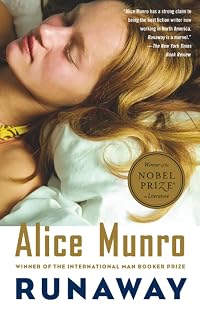
Runaway
by Alice Munro
On This Page
Description
The incomparable Alice Munro's bestselling and rapturously acclaimed Runaway is a book of extraordinary stories about women of all ages and circumstances - and about love and its infinite betrayals and surprises. The runaway of the title story is a young woman who is incapable of leaving her husband. In "Passion," a country girl emerging into the larger world via a job in a resort hotel discovers, in a single moment of insight, the limits and lies of passion. Three stories concern a woman show more named Juliet - in the first, she escapes from teaching at a girls' school into a wild love affair; in the second, she returns with her child to the home of her parents, whose marriage she finally begins to examine; and in the last, her vanished child turns up caught in the grip of a religious cult. In these and other stories, Alice Munro's understanding of the people about whom she writes makes their lives as real as our own. show lessTags
Recommendations







Member Recommendations
Member Reviews
When I'm not reading Alice Munro's stories, I remember that I like her writing, but I forget what it is I like about them. Every time I go back, then, I get a sense of the familiar.
Oh, yeah! I think. This is what I like about her stories!
In Munro's stories are lessons in the commonplace, but mostly her characters ignore these lessons, even when they're practically written in neon for them. If they do learn the lesson, it's too late to really do anything about it other than grow as a person, and what's the point of that? Her characters say things they shouldn't and leave things unsaid that they should say. They're selfish with their love. They use, or try to use, relationships with others to get them out of relationships or situations show more they don't have the courage to get out of themselves. They fear owning up to their mistakes and the qualities they dislike in themselves and, most of all, rejection so much that they don't go searching for people they should search for. They let things slide that shouldn't slide and hold onto things that are better let go. More than anything else, they lie to themselves.
Munro's characters are remarkably human. There are no dramatic gestures here. No one is being swept off their feet, and if it seems like they are, you know there's a catch. Her relationships are profoundly, prosaically sad. And maybe this is why I put so much time between Munro's stories. Although I admire the hell out of her writing, I can only handle so much reality at once. show less
Oh, yeah! I think. This is what I like about her stories!
In Munro's stories are lessons in the commonplace, but mostly her characters ignore these lessons, even when they're practically written in neon for them. If they do learn the lesson, it's too late to really do anything about it other than grow as a person, and what's the point of that? Her characters say things they shouldn't and leave things unsaid that they should say. They're selfish with their love. They use, or try to use, relationships with others to get them out of relationships or situations show more they don't have the courage to get out of themselves. They fear owning up to their mistakes and the qualities they dislike in themselves and, most of all, rejection so much that they don't go searching for people they should search for. They let things slide that shouldn't slide and hold onto things that are better let go. More than anything else, they lie to themselves.
Munro's characters are remarkably human. There are no dramatic gestures here. No one is being swept off their feet, and if it seems like they are, you know there's a catch. Her relationships are profoundly, prosaically sad. And maybe this is why I put so much time between Munro's stories. Although I admire the hell out of her writing, I can only handle so much reality at once. show less
The trouble with Alice Munro is that she is so consistently good at what she does that I want to say almost exactly the same things about this collection as about all the others I've read so far. Every story in the book takes you unmistakably into Alice Munro country, that world in which people are unaccountably drawn to ruin their lives by misreading a situation or failing to grasp an opportunity (more often than not an opportunity three or four decades ago). But each story also does something radical and unique to bend the formula of the short story in a way that you would have sworn before reading it couldn't be done. There ought to be a law against it, but fortunately there isn't...
I don’t think it’s an overreaction to say Alice Munro is one of the greatest short story writers I’ve ever read. Almost every story in this collection ranks among the greatest short stories I’ve ever read (Chance; Soon; Silence; Trespasses; Passion; Tricks; Powers). The only one I didn’t care a whole lot for was the title story, Runaway. Munro is a master of the medium.
The stories in this collection are about the lives and relationships of lower/middle-class Canadian women. The relationships are about lovers, companions, friends, husbands/wives, mentors/mentees, mothers/fathers/children; common themes are independence, fear, loneliness, social/cultural constraints on women, how people change, and how they really don’t show more change at all. They are not very optimistic stories, in general. People fall into the same old self-defeating patterns, people are abandoned, they age, they divorce, they miss opportunities, etc.
Memory and time’s passing are two themes coursing through the best of these stories. Munro likes to build up characters at young ages and then quickly jump forward decades in their lives. We first see them young and vitalized, swept up in dramas of youth (money, marriage, status, possessions). Then, we see them much later, with so many hopes disappointed and dreams unfulfilled. The reader is left with an aching for these characters’ lost potential selves, futures that never arrived, roads once open and now closed off forever. These themes are extremely potent and universal and I’m honestly surprised more writers don’t focus on them. Who among us does not mourn for that which never came about? I know at times I feel really bereaved for the missed potentialities of my life, for the chances at relationships with other people and places that never happened and never will, that now exist only in my memory. It’s a lonely, bitter thing.
I’m totally awed by Munro’s stories: carefully composed, utterly human, always relevant. She’s worth reading, I promise.
A great quote from Powers: “Life is always so full. Getting and spending we lay waste out powers. Why do we let ourselves be so busy and miss doing the things we should have, or would have, liked to do?” show less
The stories in this collection are about the lives and relationships of lower/middle-class Canadian women. The relationships are about lovers, companions, friends, husbands/wives, mentors/mentees, mothers/fathers/children; common themes are independence, fear, loneliness, social/cultural constraints on women, how people change, and how they really don’t show more change at all. They are not very optimistic stories, in general. People fall into the same old self-defeating patterns, people are abandoned, they age, they divorce, they miss opportunities, etc.
Memory and time’s passing are two themes coursing through the best of these stories. Munro likes to build up characters at young ages and then quickly jump forward decades in their lives. We first see them young and vitalized, swept up in dramas of youth (money, marriage, status, possessions). Then, we see them much later, with so many hopes disappointed and dreams unfulfilled. The reader is left with an aching for these characters’ lost potential selves, futures that never arrived, roads once open and now closed off forever. These themes are extremely potent and universal and I’m honestly surprised more writers don’t focus on them. Who among us does not mourn for that which never came about? I know at times I feel really bereaved for the missed potentialities of my life, for the chances at relationships with other people and places that never happened and never will, that now exist only in my memory. It’s a lonely, bitter thing.
I’m totally awed by Munro’s stories: carefully composed, utterly human, always relevant. She’s worth reading, I promise.
A great quote from Powers: “Life is always so full. Getting and spending we lay waste out powers. Why do we let ourselves be so busy and miss doing the things we should have, or would have, liked to do?” show less
I always say I'm not really a fan of short stories but in the hand of a master like Alice Munro I am transformed. I think you have to be a consummate writer to craft a short story that doesn't leave the reader wishing there was more. On the front of this book the New York Times Book Review is quoted "Alice Munro has a strong claim to being the best fiction writer now working in North America." I may not have the breadth of experience that the reviewers of the New York Times have but I do think Munro is a fabulous writer.
All of these stories deal with people who have run away or been abandoned or sometimes run away and then been abandoned. I think it is interesting that these stories are not contemporary; they mostly are set between the show more two world wars or just after the Second World War. I think it was maybe easier then to run away and not be found. Today with the World Wide Web and instant methods of communicating and the need to document all your financial transactions it is much less likely that people could disappear.
My favourite story was the last one, Powers. Two couples are contrasted in this story. On the one hand there is Nancy and Wilf, the couple that stayed in their Ontario town for most of their life where Wilf had a successful doctor's practise. On the other hand are Tessa and Ollie. Ollie is Wilf's cousin who met Tessa when Ollie came to town after spending time in a sanatorium for TB. Tessa has the power to find lost objects as well as some other extrasensory powers. Nancy introduced Ollie and Tessa but was surprised when Tessa went away with Ollie. Years later Nancy is called to a mental institution where Tessa has been for years and Ollie is presumed dead. The institution is being shut down and the authorities are looking for people to take the cases that no longer need to be in an institution. Nancy can't do this because Wilf has dementia and it is all she can do to look after him. Some time later, after Wilf's death, Nancy encounters Ollie on a street in Vancouver. Ollie tells Nancy that Tessa died of leukemia. Nancy doesn't disclose to Ollie that she knows differently. I can't help but ask myself what I would do in the same situation. That's always the mark of a good story for me. show less
All of these stories deal with people who have run away or been abandoned or sometimes run away and then been abandoned. I think it is interesting that these stories are not contemporary; they mostly are set between the show more two world wars or just after the Second World War. I think it was maybe easier then to run away and not be found. Today with the World Wide Web and instant methods of communicating and the need to document all your financial transactions it is much less likely that people could disappear.
My favourite story was the last one, Powers. Two couples are contrasted in this story. On the one hand there is Nancy and Wilf, the couple that stayed in their Ontario town for most of their life where Wilf had a successful doctor's practise. On the other hand are Tessa and Ollie. Ollie is Wilf's cousin who met Tessa when Ollie came to town after spending time in a sanatorium for TB. Tessa has the power to find lost objects as well as some other extrasensory powers. Nancy introduced Ollie and Tessa but was surprised when Tessa went away with Ollie. Years later Nancy is called to a mental institution where Tessa has been for years and Ollie is presumed dead. The institution is being shut down and the authorities are looking for people to take the cases that no longer need to be in an institution. Nancy can't do this because Wilf has dementia and it is all she can do to look after him. Some time later, after Wilf's death, Nancy encounters Ollie on a street in Vancouver. Ollie tells Nancy that Tessa died of leukemia. Nancy doesn't disclose to Ollie that she knows differently. I can't help but ask myself what I would do in the same situation. That's always the mark of a good story for me. show less
Runaway: Noun or Verb?
As a noun, “runaway” conjures a fairly specific character and situation.
Image: Runaway child with backpack
But as a phrasal verb, running away is often much broader and more metaphorical.
Right now, writing this, while sitting at my laptop, I’m running away from planning a conference presentation. In the past, I have run away from physical fear (trying to climb a net); a job I hated so much it was making me ill; and from potential rejection (and thus from possible acceptance).
But more often, consciously or not, I stiffen my British upper lip and focus on surviving immediate difficulties, either by denial or by distracting myself with fripperies, against a background of hopeful detachment.
Living in the present show more can be a coping strategy for those with past trauma or a fearful future. I’m not really in either camp. But maybe as a symptom of enjoying fiction, if times are tricky, I default to imagining alternative situations, rather than face the one I’m actually living.
Image: My life is more interesting inside my head (I can’t find the original artist)
Even doing nothing is a decision of sorts.
“Never put off to tomorrow, what you can put off till next week.”
- said no successful, famous, and content person, ever.
I see the patterns of my behaviour, but not a generalised solution, no way to discern which approach to use when. This is frustrating, because wilful ignorance is an accidentally recurring theme of my recent reading: Ford Madox Ford’s The Good Soldier (see my review HERE) and John Williams’ Nothing But the Night (see my review HERE), and now this.
Reading to Save Ourselves
My edition has an introduction by Jonathan Franzen. I read it in 2018, a year and a half into Trump’s presidency. But in 2004, Franzen wrote:
“Hatred is entertaining. The great insight of media-age extremists. How else to explain the election of so many repellant zealots, the disintegration of political civility, the ascendancy of Fox New?”
He ends up asking if a better kind of fiction can save the world, and concludes that’s unlikely, but it may save your soul.
That is why we read, and why we discuss on GR.
I think there is more worth in that thought than in some of these stories - except they are part of his solution.
A Mixed Bag
Three of the stories are episodes in the life of one character, Juliet, forming a novella. That is preceded and followed by other stories, which are unrelated, except they are all of similar length, have single-word titles, and share the general theme of a Canadian woman running away: from the past, from parents, from partners, from a child, from reality, from religion - and to it.
To quote from REM’s Belong, they want “To breathe at the thought of such freedom… Opened the window, A breath, this song, how long, And knew, knew, belong.”
There’s nothing inherently wrong with a mix of novella and short stories, but in this case, it added to the sense of unevenness in the collection.
The best of the stories were very good (though not superb, like Munro’s The Lives of Girls and Women (see my review HERE)), but the final one was a ridiculous, disjointed, unengaging mess!
THE STORIES
Runaway 3*
Carla ran away to marry Clark.
“She saw him as the architect of the life ahead of them, herself as captive, her submission both proper and exquisite.”
They now run a stables, not very successfully, and are married, not very successfully. Carla is fonder of her pet goat, Flora. You sense casual manipulation and overt put-downs: a “see-saw misery”. Then, a more twisted plan, and a dash of almost magical-realism.
Chance (Juliet’s story, part 1) 4*
As a child in the suburbs, Juliet’s mother had wanted her to be popular, and her father to fit in:
“Her sort of intelligence was often put in the same category as a limp or an extra thumb.”
She’s now a young classics teacher who views and interprets the world and people in it by analogies in Greek mythology. She has a strange experience and a curious encounter on a train. Blood is relevant for two very different reasons. The parallel narratives mean you’re not initially clear how or if they’re connected, and whether one is imaginary.
Soon (Juliet’s story, part 2) 3*
This opens with a description of a strange painting titled, “I and the Village”. Juliet takes her small daughter (Penelope) to visit her aging hippie parents, Sam and Sara, who “lived in a curious but not unhappy isolation”. Atheist Juliet is shocked that her mother has acquired some sort of faith, and angry when a priest friend of her mother’s criticizes her for depriving Penelope of a religious upbringing. It’s poignant, but firmly the middle part; it doesn’t work as well as a standalone story as parts 1 and 3.
Silence (Juliet’s story, part 3) 5*
Penelope is now 20, and has been away at a spiritual retreat for the last six months. Unlike the other stories in the collection, this one focuses on the one left behind, as she tries to join the dots, tormented by thoughts of what she should have done differently. It’s far more painful. Brilliantly so. There can be freedom in being abandoned. But freedom isn’t necessarily happiness.
Passion 4*
The risk of revisiting the past is that it has changed, gone, or is just irrelevant. Grace returns to the lake town where she had worked and fallen in love. Or rather, Maury fell in love with her. She seemed closer (though not in a sexual way) to his mother, who understood her passion for knowledge.
“Mrs Travers would not start any sort of conversation until enough time had passed for Grace’s thoughts to have got loose from whatever book she had been in.”
The title is as much about lack of passion (fear and inexperience made McEwan’s On Chesil Beach come to mind - see my review HERE) as misdirected passion. Two people running away from different things, in different ways, is not necessarily a recipe for a happy ending.
Trespasses 4*
The previous story started with a woman revisiting her past and ended with drama in a car. This separate story starts with four in a car, revisiting the past. The situation is intriguingly vague, as are the connections between the people, and the two timelines - rather like one of the characters:
“She talked about her life without getting it in any kind of order.”
It’s about identity and the sort of insecurities many children have about their place in the world, and especially their family. It looked as if it was going to be unoriginal and thus predictable. It was neither.
“If there was one big thing she hadn’t known about, why could there not be another? This notion was unsettling, but it had a distant charm.”
Tricks 5*
Robin (26) cares for her sickly older sister, Joanne. Her annual treat to herself is a trip to see a Shakespeare play, and his themes are the key to the story: lost and found, mistaken identity, opportunities lost by a sliver of chance, and the transformative effect of a curious and powerful connection.
“Nothing faded for her… Her memories, and the embroidery on her memories, just kept wearing a deeper groove.”
Powers 1*
A first person narration (mostly), starting earlier than the others, in 1927. Nancy has recently left school, but is still rather naive and childish in her extrovert and teasing ways. A male friend wonders why he hangs out with her, when she is:
“Not outstanding in any way, except perhaps in being spoiled, saucy, and egotistical.”
Nancy herself:
“Was truly, naturally reckless and full of some pure conviction that she led a charmed life.”
I didn’t buy it. Her friend Tessa seemed more charmed, living in the woods, doing psychic consultations, mainly to help people find lost things - including bodies.
Anyway, Nancy gets implausibly engaged, and then married, then there’s an epistolary section, and a bit of discussion of parapsychology. Later, the story turns more to Tessa, and the consequences of moderate fame, infamy, and investigation. There are chance meetings that are too convenient. The characters are mostly inconsistent and not credible. There’s mention of people’s need to believe in alternative reality. Very bitty time hops. The ending was odd and confusing.
This story was a mess. I hated it, and most of all, I hated that it was the last one of an otherwise very good collection.
Other Quotes
• “The whole countryside was changing, shaking itself loose” after a long period of endless rain.
• “They [outings] were what people did before they understood the realities of their lives.”
• “He was both a handsome man and a silly-looking man. Tall, lean, well built, but with a slouch that seemed artificial. A contrived, self-conscious air of menace… a vain little moustache, eyes that appeared both hopeful and mocking, a boyish smile perpetually on the verge of a sulk.”
• “It was as if she had a murderous needle somewhere in her lungs, and by breathing carefully, she could avoid feeling it. But every once in a while she had to take a deep breath, and it was still there.”
• “Trim abundance… a few repetitive houses” (suburbs).
• “She can tell by his voice that he is claiming her… He advances on her and she feels herself ransacked from top to bottom, flooded with relief, assaulted by happiness.”
• “The sort of card you send to an acquaintance whose tastes you cannot guess.”
• “The memory of him in the daily and ordinary world was in retreat.”
• “The smell did not make Grace hungry, exactly - it made her remember being hungry in other circumstances.”
• “Her casually provocative outfits.”
• “Everything might still be cheerful but the cheerfulness was hard as knives” (a couple, after drinking).
• “A bachelor’s room, with everything deliberate and necessary proclaiming a certain austere satisfaction.”
• “The conversation of kisses.”
• “Sporadic and secret, but, on the whole, comforting” (someone’s sex life). show less
As a noun, “runaway” conjures a fairly specific character and situation.
Image: Runaway child with backpack
But as a phrasal verb, running away is often much broader and more metaphorical.
Right now, writing this, while sitting at my laptop, I’m running away from planning a conference presentation. In the past, I have run away from physical fear (trying to climb a net); a job I hated so much it was making me ill; and from potential rejection (and thus from possible acceptance).
But more often, consciously or not, I stiffen my British upper lip and focus on surviving immediate difficulties, either by denial or by distracting myself with fripperies, against a background of hopeful detachment.
Living in the present show more can be a coping strategy for those with past trauma or a fearful future. I’m not really in either camp. But maybe as a symptom of enjoying fiction, if times are tricky, I default to imagining alternative situations, rather than face the one I’m actually living.
Image: My life is more interesting inside my head (I can’t find the original artist)
Even doing nothing is a decision of sorts.
“Never put off to tomorrow, what you can put off till next week.”
- said no successful, famous, and content person, ever.
I see the patterns of my behaviour, but not a generalised solution, no way to discern which approach to use when. This is frustrating, because wilful ignorance is an accidentally recurring theme of my recent reading: Ford Madox Ford’s The Good Soldier (see my review HERE) and John Williams’ Nothing But the Night (see my review HERE), and now this.
Reading to Save Ourselves
My edition has an introduction by Jonathan Franzen. I read it in 2018, a year and a half into Trump’s presidency. But in 2004, Franzen wrote:
“Hatred is entertaining. The great insight of media-age extremists. How else to explain the election of so many repellant zealots, the disintegration of political civility, the ascendancy of Fox New?”
He ends up asking if a better kind of fiction can save the world, and concludes that’s unlikely, but it may save your soul.
That is why we read, and why we discuss on GR.
I think there is more worth in that thought than in some of these stories - except they are part of his solution.
A Mixed Bag
Three of the stories are episodes in the life of one character, Juliet, forming a novella. That is preceded and followed by other stories, which are unrelated, except they are all of similar length, have single-word titles, and share the general theme of a Canadian woman running away: from the past, from parents, from partners, from a child, from reality, from religion - and to it.
To quote from REM’s Belong, they want “To breathe at the thought of such freedom… Opened the window, A breath, this song, how long, And knew, knew, belong.”
There’s nothing inherently wrong with a mix of novella and short stories, but in this case, it added to the sense of unevenness in the collection.
The best of the stories were very good (though not superb, like Munro’s The Lives of Girls and Women (see my review HERE)), but the final one was a ridiculous, disjointed, unengaging mess!
THE STORIES
Runaway 3*
Carla ran away to marry Clark.
“She saw him as the architect of the life ahead of them, herself as captive, her submission both proper and exquisite.”
They now run a stables, not very successfully, and are married, not very successfully. Carla is fonder of her pet goat, Flora. You sense casual manipulation and overt put-downs: a “see-saw misery”. Then, a more twisted plan, and a dash of almost magical-realism.
Chance (Juliet’s story, part 1) 4*
As a child in the suburbs, Juliet’s mother had wanted her to be popular, and her father to fit in:
“Her sort of intelligence was often put in the same category as a limp or an extra thumb.”
She’s now a young classics teacher who views and interprets the world and people in it by analogies in Greek mythology. She has a strange experience and a curious encounter on a train. Blood is relevant for two very different reasons. The parallel narratives mean you’re not initially clear how or if they’re connected, and whether one is imaginary.
Soon (Juliet’s story, part 2) 3*
This opens with a description of a strange painting titled, “I and the Village”. Juliet takes her small daughter (Penelope) to visit her aging hippie parents, Sam and Sara, who “lived in a curious but not unhappy isolation”. Atheist Juliet is shocked that her mother has acquired some sort of faith, and angry when a priest friend of her mother’s criticizes her for depriving Penelope of a religious upbringing. It’s poignant, but firmly the middle part; it doesn’t work as well as a standalone story as parts 1 and 3.
Silence (Juliet’s story, part 3) 5*
Penelope is now 20, and has been away at a spiritual retreat for the last six months. Unlike the other stories in the collection, this one focuses on the one left behind, as she tries to join the dots, tormented by thoughts of what she should have done differently. It’s far more painful. Brilliantly so. There can be freedom in being abandoned. But freedom isn’t necessarily happiness.
Passion 4*
The risk of revisiting the past is that it has changed, gone, or is just irrelevant. Grace returns to the lake town where she had worked and fallen in love. Or rather, Maury fell in love with her. She seemed closer (though not in a sexual way) to his mother, who understood her passion for knowledge.
“Mrs Travers would not start any sort of conversation until enough time had passed for Grace’s thoughts to have got loose from whatever book she had been in.”
The title is as much about lack of passion (fear and inexperience made McEwan’s On Chesil Beach come to mind - see my review HERE) as misdirected passion. Two people running away from different things, in different ways, is not necessarily a recipe for a happy ending.
Trespasses 4*
The previous story started with a woman revisiting her past and ended with drama in a car. This separate story starts with four in a car, revisiting the past. The situation is intriguingly vague, as are the connections between the people, and the two timelines - rather like one of the characters:
“She talked about her life without getting it in any kind of order.”
It’s about identity and the sort of insecurities many children have about their place in the world, and especially their family. It looked as if it was going to be unoriginal and thus predictable. It was neither.
“If there was one big thing she hadn’t known about, why could there not be another? This notion was unsettling, but it had a distant charm.”
Tricks 5*
Robin (26) cares for her sickly older sister, Joanne. Her annual treat to herself is a trip to see a Shakespeare play, and his themes are the key to the story: lost and found, mistaken identity, opportunities lost by a sliver of chance, and the transformative effect of a curious and powerful connection.
“Nothing faded for her… Her memories, and the embroidery on her memories, just kept wearing a deeper groove.”
Powers 1*
A first person narration (mostly), starting earlier than the others, in 1927. Nancy has recently left school, but is still rather naive and childish in her extrovert and teasing ways. A male friend wonders why he hangs out with her, when she is:
“Not outstanding in any way, except perhaps in being spoiled, saucy, and egotistical.”
Nancy herself:
“Was truly, naturally reckless and full of some pure conviction that she led a charmed life.”
I didn’t buy it. Her friend Tessa seemed more charmed, living in the woods, doing psychic consultations, mainly to help people find lost things - including bodies.
Anyway, Nancy gets implausibly engaged, and then married, then there’s an epistolary section, and a bit of discussion of parapsychology. Later, the story turns more to Tessa, and the consequences of moderate fame, infamy, and investigation. There are chance meetings that are too convenient. The characters are mostly inconsistent and not credible. There’s mention of people’s need to believe in alternative reality. Very bitty time hops. The ending was odd and confusing.
This story was a mess. I hated it, and most of all, I hated that it was the last one of an otherwise very good collection.
Other Quotes
• “The whole countryside was changing, shaking itself loose” after a long period of endless rain.
• “They [outings] were what people did before they understood the realities of their lives.”
• “He was both a handsome man and a silly-looking man. Tall, lean, well built, but with a slouch that seemed artificial. A contrived, self-conscious air of menace… a vain little moustache, eyes that appeared both hopeful and mocking, a boyish smile perpetually on the verge of a sulk.”
• “It was as if she had a murderous needle somewhere in her lungs, and by breathing carefully, she could avoid feeling it. But every once in a while she had to take a deep breath, and it was still there.”
• “Trim abundance… a few repetitive houses” (suburbs).
• “She can tell by his voice that he is claiming her… He advances on her and she feels herself ransacked from top to bottom, flooded with relief, assaulted by happiness.”
• “The sort of card you send to an acquaintance whose tastes you cannot guess.”
• “The memory of him in the daily and ordinary world was in retreat.”
• “The smell did not make Grace hungry, exactly - it made her remember being hungry in other circumstances.”
• “Her casually provocative outfits.”
• “Everything might still be cheerful but the cheerfulness was hard as knives” (a couple, after drinking).
• “A bachelor’s room, with everything deliberate and necessary proclaiming a certain austere satisfaction.”
• “The conversation of kisses.”
• “Sporadic and secret, but, on the whole, comforting” (someone’s sex life). show less
I need to study this book. It's so beautiful and so compelling! The writing drew me in so subtly and sweetly that I didn't see the emotional precipice until I had fallen into it. Each story made the pain of the fall and landing totally worthwhile. I don't know how Ms. Munro did this, over and over, hence why this very much requires re-reading and study on my part. I have every intention of reading Ms. Munro's entire bibliography.
Sometimes after reading several male authors in succession, I suddenly have a deep longing for the feminine voice, and so was delighted to settle in to this collection of stories that all center around women (even the little white goat, Flora, in Runaway was female!). Munro does a great job of capturing the interior world of women at all ages, the feelings and thoughts so real to us. She also has a special talent for putting into words the quiet revelations life has to give. Here is a passage I particularly enjoyed from Passion, in which the character Grace returns to a lake cabin of her youth some decades later:
In the same poignant way, Munro’s endings never fail to satisfy and leave you feeling that there was only one way this story could have ever concluded, and the author nailed it. That said many stories do not end happily, just as in real life, perhaps because they capture the tragedy of living in an indifferent world so perfectly. But even so the author shows compassion for her characters, and so by the end we forgive them their flaws and can relate personally to their situations.
It was a joy to discover Alice Munro and her Canadian landscape of northern forests, snow-dusted lakes, and icy streams, as well as her varied and unique group of women. Looking forward to reading more from her in the future. show less
“What was Grace really looking for when she had undertaken this expedition? Maybe the worst thing would have been to getshow more
just what she might have thought she was after. Sheltering roof, screened windows, the lake in front, the stand of maple and cedar and balm of Gilead trees behind. Perfect preservation, the past in tact, when nothing of the kind could be said of herself.”
In the same poignant way, Munro’s endings never fail to satisfy and leave you feeling that there was only one way this story could have ever concluded, and the author nailed it. That said many stories do not end happily, just as in real life, perhaps because they capture the tragedy of living in an indifferent world so perfectly. But even so the author shows compassion for her characters, and so by the end we forgive them their flaws and can relate personally to their situations.
It was a joy to discover Alice Munro and her Canadian landscape of northern forests, snow-dusted lakes, and icy streams, as well as her varied and unique group of women. Looking forward to reading more from her in the future. show less
Members
- Recently Added By
Published Reviews
ThingScore 75
Unfortunately, her latest collection of stories, ''Runaway,'' does not represent Ms. Munro's artistry at its height. Three overlapping stories (''Chance,'' ''Soon'' and ''Silence'') provide an affecting portrait of a woman named Juliet and the harrowing trajectory of her life, but most of the entries in this volume are more stilted affairs. Instead of assuming the organic, musical form of real show more life, they feel like self-conscious, overworked tales, relying on awkwardly withheld secrets and O'Henryesque twists to create narrative suspense. show less
added by jlelliott
But suspense and purity, which are a gift to the reader, present problems for the reviewer. Basically, ''Runaway'' is so good that I don't want to talk about it here. Quotation can't do the book justice, and neither can synopsis. The way to do it justice is to read it.
added by jlelliott
Lists

Best 21st Century Books (So Far)
679 works; 86 members

Best Contemporary Literary Fiction (Around the Last 30 Years)
400 works; 124 members
The Best of Canadian Literature
235 works; 33 members

Female Author
1,234 works; 67 members

Short Story Collections and Anthologies
261 works; 42 members

Nobel Price Winners
222 works; 19 members

2000s (the decade, not the century)
184 works; 11 members

Favourite Books
1,820 works; 316 members

Top Five Books of 2014
1,064 works; 398 members

Giller Prize Winners
32 works; 6 members

Books Read in 2014
2,344 works; 89 members

2000s decade
85 works; 7 members

Books Read in 2022
5,226 works; 115 members

Books Read in 2020
4,379 works; 124 members

.
184 works; 1 member
NYT 100 best books of 21st C
100 works; 31 members

le donne raccontano
116 works; 1 member

to get
244 works; 2 members
Ten Novels About Disappearing
10 works; 1 member

Book Recommendations Masterlist
28 works; 1 member

Five star books
1,767 works; 110 members

Unread books
1,063 works; 83 members
Author Information

129+ Works 30,496 Members
Alice Munro was born Alice Laidlaw in Wingham, Ontario on July 10, 1931. She published her first story, The Dimensions of a Shadow, while a student at the University of Western Ontario in 1950. She left the university in 1951 to get married and start a family. In 1972 she became Writer in Residence at the University of Western Ontario. Her first show more collection, Dance of the Happy Shades, was published in 1968 and won the Governor General's Award, Canada's highest literary prize. Her other works include Lives of Girls and Women, The View from Castle Rock, Something I've Been Meaning to Tell You, Too Much Happiness, and Dear Life. She has received several awards including the Governor General's Award for fiction for Who Do You Think You Are? and The Progress of Love, the Giller Prize for Runaway in 2004, the Man Booker International Prize in 2009 for her lifetime body of work, and the 2013 Nobel Prize in Literature. Her stories have appeared in numerous publications including The New Yorker, The Paris Review, and The Atlantic Monthly. Also, in 2013, her title Dear Life: Stories made The New York Times Best Seller List. (Bowker Author Biography) show less
Some Editions
Awards and Honors
Awards
Distinctions
Series
Belongs to Publisher Series
Keltainen kirjasto (364)
Fischer Taschenbuch (16818)
Work Relationships
Is contained in
Contains
Has as a student's study guide
Common Knowledge
- Canonical title
- Runaway
- Original title
- Runaway
- Original publication date
- 2004
- People/Characters
- Sylvia Jamieson; Carla; Clark; Joy Tucker; Leon Jamieson; Juliet Henderson (show all 24); Eric Porteous; Ann Porteous; Christa Lamb; Sam; Sara; Irene Avery; Penelope Henderson-Porteous; Gary Lamb; Grace; Maury Travers; Neil Travers; Robin; Danilo "Daniel" Adzic; Alexander Adzic; Wilf Rubstone; Nancy Rubstone; Tessa Netterby; Ginny Ross
- Important places
- Vancouver, British Columbia, Canada; Whale Bay; Denman Island, British Columbia, Canada; Canada; Ontario, Canada; Stratford, Ontario, Canada (show all 7); Bjelojevici, Montenegro
- Related movies
- Julieta (2016 | IMDb)
- Dedication
- In memory of my friends,
Mary Carey
Jean Livermore
Melda Buchanan - First words
- Carla heard the car coming before it topped the little rise in the road that around here they called a hill.
- Last words
- (Click to show. Warning: May contain spoilers.)But deep in that moment some instability is waiting, that Nancy is determined to ignore. No use. She is aware already of being removed, drawn out of those two people and back into herself. It seems as if some calm and decisive person--could it be Wilf?--has taken on the task of leading her out of that room with its wire hangers and its flowered curtains. Gently, inexorably leading her away from what begins to crumble behind her, to crumble and darken tenderly into something like soot and soft ash.
- Blurbers
- Franzen, Jonathan; Prose, Francine
- Original language
- English
Classifications
Statistics
- Members
- 3,999
- Popularity
- 3,938
- Reviews
- 97
- Rating
- (4.02)
- Languages
- 19 — Chinese, Czech, Danish, Dutch, English, Finnish, French, German, Hebrew, Hungarian, Italian, Korean, Norwegian (Bokmål), Norwegian, Polish, Portuguese, Romanian, Spanish, Swedish
- Media
- Paper, Audiobook, Ebook
- ISBNs
- 73
- UPCs
- 1
- ASINs
- 21