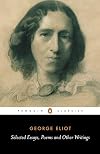
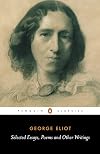
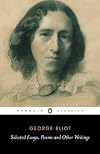
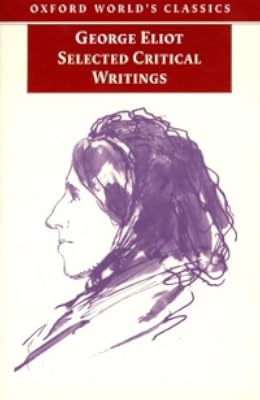
George Eliot: Selected Essays, Poems and Other Writings
by George Eliot
On This Page
Description
The works assembled here introduce George Eliot's incisive views on religion, art, and science, and the nature and purpose of fiction. Essays show her rejecting her earlier religious beliefs, questioning conventional ideas about female virtues and marriage, and setting out theories of idealism and realism that she developed further in her famous novels. Also included are selections from Eliot's translations of works by Strauss and Feuerbach, excerpts from her poems, and reviews of writers show more such as Wollstonecraft, Goethe, and Browning. Wonderfully rich in imagery and observations, these pieces reveal the intellectual development of this most rewarding of writers. show lessTags
Recommendations










Member Reviews
Wit, acumen, imagination, feeling as distinguished from sensation, reason as a subjective faculty, – all these so-called powers of the soul, are powers of humanity, not of man as an individual; they are products of culture, products of human society. [...] To ask a question and to answer, are the first acts of thought. Thought originally demands two. It is not until man has reached an advanced stage of culture that he can double himself, so as to play the part of another within himself. (462)
This volume collects a variety of writing by George Eliot, from across four decades: her journals, reviews of a diverse range of books, letters, poems, and translations. The editors, A. S. Byatt and Nicholas Warren, seem to have a particular show more interest in areas where Eliot expresses her opinions on the importance/function of art, and on the role of women. Eliot was a smart, witty woman, and so of course, her essays make for smart, witty reading. Some of what's collected here, the most famous stuff, I'd already read in Nathan Sheppard's The Essays of "George Eliot", so I skipped over that material, but that still left a lot of good stuff.
Parts of particular interest include her 1866-70 correspondence with Frederic Harrison, which may have inspired Middlemarch (1871-72); he asked her to write about a utopian village run by scientist to demonstrate the power of Positivism, and she replied that "æsthetic teaching is the highest of all teaching because it deals with life in its highest complexity. But if it ceases to be purely æsthetic – if it lapses anywhere from the picture to the diagram – it becomes the most offensive of all teaching" (248). If Middlemarch is anything, it is anti-utopian, but it definitely deals with "life in its highest complexity," as indeed do all of her works-- yet they still all engage in "æsthetic teaching" too.
Review-wise, I particularly got something out of those of R. W. Mackay's The Progress of Intellect (1851),* where she sifts out some of what there is to like about Positivism; of Goethe's Wilhelm Meister (1855), where she argues under what circumstances a book depicting immorality can still promote morality, concluding that in overtly moral novels, "The emotion of satisfaction which a reader feels when the villain of the book dies of some hideous disease, or is crushed by a railway train, is no more essentially moral than the satisfaction which used to be felt in whipping culprits at the cart-tail" (308); of Charles Kingsley's Westward Ho! (1855), where she decries how Kinglsey lets his fiction be taken over by his shoddy moralizing; and of John Ruskin's Modern Painters (1856), where you can see some of her own theory of art emerge, being developed (one presumes) on its way to its fullest statement in Adam Bede (1859).
The translations (I've quoted from her 1854 translation of Ludwig Feuerbach's The Essence of Christianity above) are also worthy inclusions; they come from early in her career, and you can see how they would influence both her theories of art and knowledge and her fiction, especially (as always) Middlemarch.
* All dates given are those of her review, not the reviewed book's publication. show less
This volume collects a variety of writing by George Eliot, from across four decades: her journals, reviews of a diverse range of books, letters, poems, and translations. The editors, A. S. Byatt and Nicholas Warren, seem to have a particular show more interest in areas where Eliot expresses her opinions on the importance/function of art, and on the role of women. Eliot was a smart, witty woman, and so of course, her essays make for smart, witty reading. Some of what's collected here, the most famous stuff, I'd already read in Nathan Sheppard's The Essays of "George Eliot", so I skipped over that material, but that still left a lot of good stuff.
Parts of particular interest include her 1866-70 correspondence with Frederic Harrison, which may have inspired Middlemarch (1871-72); he asked her to write about a utopian village run by scientist to demonstrate the power of Positivism, and she replied that "æsthetic teaching is the highest of all teaching because it deals with life in its highest complexity. But if it ceases to be purely æsthetic – if it lapses anywhere from the picture to the diagram – it becomes the most offensive of all teaching" (248). If Middlemarch is anything, it is anti-utopian, but it definitely deals with "life in its highest complexity," as indeed do all of her works-- yet they still all engage in "æsthetic teaching" too.
Review-wise, I particularly got something out of those of R. W. Mackay's The Progress of Intellect (1851),* where she sifts out some of what there is to like about Positivism; of Goethe's Wilhelm Meister (1855), where she argues under what circumstances a book depicting immorality can still promote morality, concluding that in overtly moral novels, "The emotion of satisfaction which a reader feels when the villain of the book dies of some hideous disease, or is crushed by a railway train, is no more essentially moral than the satisfaction which used to be felt in whipping culprits at the cart-tail" (308); of Charles Kingsley's Westward Ho! (1855), where she decries how Kinglsey lets his fiction be taken over by his shoddy moralizing; and of John Ruskin's Modern Painters (1856), where you can see some of her own theory of art emerge, being developed (one presumes) on its way to its fullest statement in Adam Bede (1859).
The translations (I've quoted from her 1854 translation of Ludwig Feuerbach's The Essence of Christianity above) are also worthy inclusions; they come from early in her career, and you can see how they would influence both her theories of art and knowledge and her fiction, especially (as always) Middlemarch.
* All dates given are those of her review, not the reviewed book's publication. show less
Ratings
Members
- Recently Added By
Author Information

378+ Works 61,899 Members
George Eliot was born Mary Ann Evans on a Warwickshire farm in England, where she spent almost all of her early life. She received a modest local education and was particularly influenced by one of her teachers, an extremely religious woman whom the novelist would later use as a model for various characters. Eliot read extensively, and was show more particularly drawn to the romantic poets and German literature. In 1849, after the death of her father, she went to London and became assistant editor of the Westminster Review, a radical magazine. She soon began publishing sketches of country life in London magazines. At about his time Eliot began her lifelong relationship with George Henry Lewes. A married man, Lewes could not marry Eliot, but they lived together until Lewes's death. Eliot's sketches were well received, and soon after she followed with her first novel, Adam Bede (1859). She took the pen name "George Eliot" because she believed the public would take a male author more seriously. Like all of Eliot's best work, The Mill on the Floss (1860), is based in large part on her own life and her relationship with her brother. In it she begins to explore male-female relations and the way people's personalities determine their relationships with others. She returns to this theme in Silas Mariner (1861), in which she examines the changes brought about in life and personality of a miser through the love of a little girl. In 1863, Eliot published Romola. Set against the political intrigue of Florence, Italy, of the 1490's, the book chronicles the spiritual journey of a passionate young woman. Eliot's greatest achievement is almost certainly Middlemarch (1871). Here she paints her most detailed picture of English country life, and explores most deeply the frustrations of an intelligent woman with no outlet for her aspirations. This novel is now regarded as one of the major works of the Victorian era and one of the greatest works of fiction in English. Eliot's last work was Daniel Deronda. In that work, Daniel, the adopted son of an aristocratic Englishman, gradually becomes interested in Jewish culture and then discovers his own Jewish heritage. He eventually goes to live in Palestine. Because of the way in which she explored character and extended the range of subject matter to include simple country life, Eliot is now considered to be a major figure in the development of the novel. She is buried in Highgate Cemetery, North London, England, next to her common-law husband, George Henry Lewes. (Bowker Author Biography) show less
Some Editions
Series
Belongs to Publisher Series
Work Relationships
Contains
Is an abridged version of
Common Knowledge
- Canonical title
- George Eliot: Selected Essays, Poems and Other Writings
- Original title
- Selected Essays, Poems and Other Writings
- Original publication date
- 1991
- People/Characters
- George Eliot; Madeleine de Souvré, marquise de Sablé; John Cumming; Heinrich Heine; Edward Young; Frederic Harrison (show all 35); Edgar Quinet; Jules Michelet; James Anthony Froude; Robert William Mackay; William Rathbone Greg; Thomas Carlyle; Henry Brougham; Johann Wolfgang von Goethe; Wilhelm Meister; Charles Kingsley; Geraldine Jewsbury; Marc Girardin; Ashford Owen; Shirley Brooks; Margaret Fuller; Mary Wollstonecraft; Robert Browning; Peter von Bohlen; Sophocles; Antigone; John Ruskin; Harriet Beecher Stowe; Charles Reade; Fredrika Bremer; William Edward Hartpole Lecky; Theophrastus Such; David Strauss; Jesus Christ; Ludwig Feuerbach
- Important places
- London, England, UK; England, UK; UK; Germany; France
- Important events
- Victorian Era; 19th century
Classifications
Statistics
- Members
- 168
- Popularity
- 193,379
- Reviews
- 1
- Rating
- (4.43)
- Languages
- English
- Media
- Paper, Ebook
- ISBNs
- 3
- ASINs
- 2