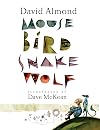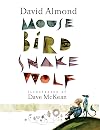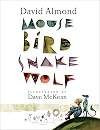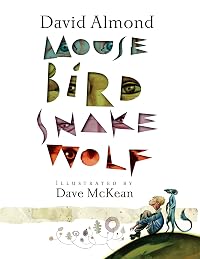
Mouse Bird Snake Wolf
by David Almond
On This Page
Description
Using sticks, leaves, and clay, Little Ben makes a mouse, Sue, a bird, and Harry, a snake, but when they create a terrifying wolf that turns on them, Little Ben must summon the courage to save them.Tags
Recommendations

Member Reviews
Part picture-book, part graphic novel, this lovely little volume from British author/illustrator team David Almond and Dave McKean imagines a world whose creation is incomplete. A lazy pantheon of gods lounges about on the clouds, admiring what they have created, while empty places exist in the world down below. Three children - Harry, Sue and Ben - take a hand at completing their world, each of them creating a new creature: Ben a mouse, Sue a bird, and Harry a snake. Their last creation however - a wolf - proves rather problematic, as he swallows Harry and Sue whole, leaving it to Ben to un-create him. Things are not so simple however, and the narrative concludes with a hint that the wolf won't stay un-created for long...
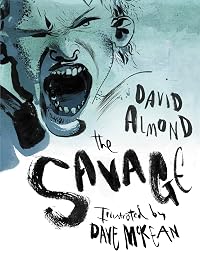
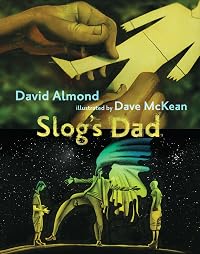
Almond and show more McKean have teamed up on other titles - The Savage, Slog's Dad - but Mouse Bird Snake Wolf is the first of their joint projects I have picked up. I am so glad I did, as I found it quite a thought-provoking little book. The writing is spare but powerful, the artwork intense and compelling, the final product an interesting meditation on the nature of creation. Is it complete? (obviously not in this world). Do we (human beings) have a role to play, in completing it? What is creation? And can things be unmade, once they are made? What is the relationship between the divine and the human? Between the creator and the created? Does the creator become his creation? These are all questions raised by the story here, remaining open-ended, as they should. The only thing here I didn't like, was the use of the figure of the wolf, as these creatures are so often (unjustly) vilified in story, standing in for our fears about the natural world. Of course, one could argue that since the wolf comes from a human figure in the story, its negative connotations are brought to life by humanity, rather than by any innate wolfiness, but again, the narrative here complicates ideas of creator/creation. Recommended to readers looking for more philosophical children's books. show less
Almond and show more McKean have teamed up on other titles - The Savage, Slog's Dad - but Mouse Bird Snake Wolf is the first of their joint projects I have picked up. I am so glad I did, as I found it quite a thought-provoking little book. The writing is spare but powerful, the artwork intense and compelling, the final product an interesting meditation on the nature of creation. Is it complete? (obviously not in this world). Do we (human beings) have a role to play, in completing it? What is creation? And can things be unmade, once they are made? What is the relationship between the divine and the human? Between the creator and the created? Does the creator become his creation? These are all questions raised by the story here, remaining open-ended, as they should. The only thing here I didn't like, was the use of the figure of the wolf, as these creatures are so often (unjustly) vilified in story, standing in for our fears about the natural world. Of course, one could argue that since the wolf comes from a human figure in the story, its negative connotations are brought to life by humanity, rather than by any innate wolfiness, but again, the narrative here complicates ideas of creator/creation. Recommended to readers looking for more philosophical children's books. show less
Almond and McKean seem to always tackle the big picture ideas - death, growing up, family - very successfully, and this book once again falls in suite. This time around their theme is creation and its limits and they play wonderfully with these tropes by giving us the contrast of lazy gods and unruly creations. Their cake and tea eating gods are extremely laughable, but they touch on some poignant literary/philosophical themes by suggesting that the gods don't take care of their creation anymore (similar to Preacher and Lucifer comic series). It is up to three children to create a mousy thing, a chirpy thing, and a slithery thing to fill in some of the gaps. But Almond and McKean go back on this hint that humans should take up the show more reigns when we witness the brutality of the created wolf - who becomes a symbol of humanity correupting the world through their creations and of the inevitable darkness that lies within everyone. show less
In another world not so different from our own, three children proceed to complete the work of the gods while those gods lie idle. The creatures they create are progressively more terrifying, the final one gobbling up two of the three children. That remaining child reaches into the depths of himself to unmake that last terrifying beast and frees his friends. The inattentive gods end the book in rumination of these new creations.
Almond's work here is thought provoking and unique. The scene is set for great wonder and curiosity on the part of the reader. The graphic novel style draws the reader in and tells a wonderful story on it's own. For a story that is so bizarre, you can really connect with the characters and plot.
Almond's work here is thought provoking and unique. The scene is set for great wonder and curiosity on the part of the reader. The graphic novel style draws the reader in and tells a wonderful story on it's own. For a story that is so bizarre, you can really connect with the characters and plot.
Brilliant, original, intense. A fable for all ages... but only for certain readers.
I did not enjoy it. But I admire it exceedingly.
And yes, imo the art is ugly, but it's absolutely apt. I cannot imagine any other artist making Almond's story come alive the way McKean did. If you don't like ugly pictures, see if you can find someone to read just the text to you. The only thing you'll miss is the concept of the creatures coming alive from ideas inside the creators' heads.
I did not enjoy it. But I admire it exceedingly.
And yes, imo the art is ugly, but it's absolutely apt. I cannot imagine any other artist making Almond's story come alive the way McKean did. If you don't like ugly pictures, see if you can find someone to read just the text to you. The only thing you'll miss is the concept of the creatures coming alive from ideas inside the creators' heads.
Mouse Bird Snake Wolf brings together David Almond and Dave McKean again. While The Savage explored the untapped anger of a boy over his father's death, this one looks at the power of human imagination.
This is the story of three children: Harry, Sue and little Ben who live on an unfinished world. The Gods, grown weary from work and smug from their successes, have left gaps in their work — unfinished bits. The children can sense these gaps and begin to imagine things to fill them — starting small with a mouse.
Creativity with uncensored power can lead to danger. I don't know if the gods had created predators yet (beyond mankind, of course). The wolf — the last animal in the title — is more than the children can handle.
I have mixed show more feelings about this book. The positives are certainly McKean's illustrations. I like his raw, untamed wildness — here though, molded into something magical and mythical.
I also love the idea of thoughts being able to transform everyday objects and give life to new ones. It reminds me of the thoughts bandied back and forth between Joshua and Lobsang in The Long Earth (review coming) about human imagination having an influence on the details of the various earths.
But the wolf is just sitting in my craw. I blame, I suppose, my recent reading of Winter Study (review coming) has tainted my ability to blindly accept the wolf as such a dangerous creation. Of course — that leads to the question — what should have been the last creation of the golem animals? show less
This is the story of three children: Harry, Sue and little Ben who live on an unfinished world. The Gods, grown weary from work and smug from their successes, have left gaps in their work — unfinished bits. The children can sense these gaps and begin to imagine things to fill them — starting small with a mouse.
Creativity with uncensored power can lead to danger. I don't know if the gods had created predators yet (beyond mankind, of course). The wolf — the last animal in the title — is more than the children can handle.
I have mixed show more feelings about this book. The positives are certainly McKean's illustrations. I like his raw, untamed wildness — here though, molded into something magical and mythical.
I also love the idea of thoughts being able to transform everyday objects and give life to new ones. It reminds me of the thoughts bandied back and forth between Joshua and Lobsang in The Long Earth (review coming) about human imagination having an influence on the details of the various earths.
But the wolf is just sitting in my craw. I blame, I suppose, my recent reading of Winter Study (review coming) has tainted my ability to blindly accept the wolf as such a dangerous creation. Of course — that leads to the question — what should have been the last creation of the golem animals? show less
The images and writing are equal portions of the story telling here as 3 young inhabitants fill in lacunae left by lazy gods napping and feasting above them. The mouse, bird, and snake are interesting but the wolf takes a different turn. An ambiguous story to present to young or old readers.
This little book is whimsical. It's beautiful, with illustrations that transport and transfix you, but at the last page, I feel largely unchanged. Maybe I just . . . didn't "get it". Maybe it's not a book to be understood--just enjoyed--but I dunno. I wouldn't ever pick it up again.
Members
- Recently Added By
Lists

Red Dot 2014-2015 - Older Readers - Longlist
37 works; 4 members
Author Information

60+ Works 10,765 Members
David Almond was born on May 15, 1951 in the United Kingdom. He writes novels for children and young adults including The Savage, Slog's Dad, My Name Is Mina, The Boy Who Swam with Piranhas, and The Tightrope Walkers. He has received numerous awards including the Carnegie Medal for Skellig, two Whitbread Awards, the Michael L. Printz Award for show more young-adult books for Kit's Wilderness, the Smarties Prize and the Boston Globe Horn Book Award for The Fire-Eaters, the 2015 Guardian Children's Fiction Prize for A Song for Ella Grey, and the Hans Christian Andersen Award. (Bowker Author Biography) show less
All Editions
Awards and Honors
Common Knowledge
- Dedication
- For Dave and Sue
D.A.
For Lexie and Emily
D.M. - First words
- Long ago and far away, in a world rather like this one, and with people in it rather like us, there were three children: Harry, Sue and Ben.
- Last words
- (Click to show. Warning: May contain spoilers.)And the gods listened and were entranced, and they all knew, as they sipped their tea and nibbled their cake, that the new and marvelous beast would soon find its way out again into the world.
- Blurbers
- Gaiman, Neil
Classifications
Statistics
- Members
- 127
- Popularity
- 255,187
- Reviews
- 13
- Rating
- (3.76)
- Languages
- English, Italian
- Media
- Paper, Ebook
- ISBNs
- 7