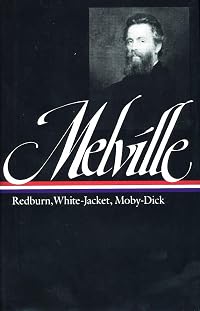
Redburn / White-Jacket / Moby Dick [Library of America]
by Herman Melville 
On This Page
Description
Redburn is the story that relates a young man's initiation into the sailors life; White-Jacket is the story that is a semi-autobiographical account of experiences in the U.S. Navy; Moby-Dick, or the whale is the most famous of Melville's works, and tells the story of Ahab, a ship captain that has become obsessed with the hunt for the whale he has named Moby-Dick.Tags
Recommendations















Member Reviews
Read Redburn, which is a great tale of a sailor from NY across the Atlantic to Liverpool and back. This was Melville's first novel. Young Redburn was very naive and I saw a lot of a young me in him. In one moment, he becomes overwhelmed on a ferry and has a meltdown with a gun. Although no one was hurt, it sounded eerily like something that could happen in our own day with much more disastrous consequences. While Redburn has many serious moments, it also had many humorous or downright funny moments as well. As an historian, I found his comments on race and immigration interesting as a source from the late 1840s as both became issues in the wake of the Mexican War and the Irish Potato Famine.
This is not a "review" of Herman Melville's Moby-Dick. Another one of those wouldn’t do much good. What follows are simply my thoughts and impressions on finally finishing a book that I first attempted, and failed to complete, more than four decades ago. Since that first encounter, I have probably read the first quarter of Melville's classic another ten times without getting any further into the novel. But this time I made it despite setting the book aside for two or three weeks at a time. And I feel like I finally successfully climbed Everest.
Most everyone knows the basic plot of Moby-Dick: nineteenth-century whaler loses his leg to a ghostly white whale and becomes obsessed with revenging his loss by killing the huge creature. show more Nothing less will do. What most people who have not read the classic do not realize is how few pages of the novel are actually devoted to advancing Melville's plot (my own rough estimate is that less than half of the book's more than 600 pages do so). The rest of the book, the portion that most often drives readers to distraction, is Melville's primer on the nuts and bolts of whaling, whaling ships and their crews, and whale anatomy.
Melville, through the voice of his narrator, builds a strong case that those risking their lives providing a product so critical to the nation deserve much more respect and appreciation than they are accorded by the public. He is also determined that his readers get a proper sense of the size of the creatures whalers were, under the harshest of conditions, battling for the benefit of those who took it all for granted. Melville accomplishes both admirably. The risks these men took with their lives on the open sea are astounding, and modern readers cannot help but be impressed by their skill and courage.
Moby-Dick has a Shakespearian quality to it, even to what at times sounds almost like stage direction inserted by the author as an aside. This quality is most apparent in Melville's dialogue and the way he has his characters regularly speak their deepest and most private thoughts aloud. Both the structure and the philosophical nature of the book contribute to its reputation as one of the greatest novels ever written - despite the generally terrible reception the novel received when first published.
Bottom Line: There is so much going on in Moby-Dick that whole books have been written about the novel. It is, I suspect, on many more "To Be Read" lists than it is on "Read" lists, and this is understandable given its length and complexity. Readers, however, should never permanently abandon their effort to read this classic novel. Just the feeling of accomplishment one gets when that final page is turned is reason enough to keep Moby-Dick on the nightstand as long as it takes. show less
Most everyone knows the basic plot of Moby-Dick: nineteenth-century whaler loses his leg to a ghostly white whale and becomes obsessed with revenging his loss by killing the huge creature. show more Nothing less will do. What most people who have not read the classic do not realize is how few pages of the novel are actually devoted to advancing Melville's plot (my own rough estimate is that less than half of the book's more than 600 pages do so). The rest of the book, the portion that most often drives readers to distraction, is Melville's primer on the nuts and bolts of whaling, whaling ships and their crews, and whale anatomy.
Melville, through the voice of his narrator, builds a strong case that those risking their lives providing a product so critical to the nation deserve much more respect and appreciation than they are accorded by the public. He is also determined that his readers get a proper sense of the size of the creatures whalers were, under the harshest of conditions, battling for the benefit of those who took it all for granted. Melville accomplishes both admirably. The risks these men took with their lives on the open sea are astounding, and modern readers cannot help but be impressed by their skill and courage.
Moby-Dick has a Shakespearian quality to it, even to what at times sounds almost like stage direction inserted by the author as an aside. This quality is most apparent in Melville's dialogue and the way he has his characters regularly speak their deepest and most private thoughts aloud. Both the structure and the philosophical nature of the book contribute to its reputation as one of the greatest novels ever written - despite the generally terrible reception the novel received when first published.
Bottom Line: There is so much going on in Moby-Dick that whole books have been written about the novel. It is, I suspect, on many more "To Be Read" lists than it is on "Read" lists, and this is understandable given its length and complexity. Readers, however, should never permanently abandon their effort to read this classic novel. Just the feeling of accomplishment one gets when that final page is turned is reason enough to keep Moby-Dick on the nightstand as long as it takes. show less
Got a whale of a tale to tell ya, lads
A whale of a tale or two
'Bout the flappin' fish and the girls I've loved
I swear by my tattoo
I'm going to go out on a limb and give it neither a love rating nor a hate rating. Learned more about whales than anyone should need to know, and more than I would have ever expected Melville to know. All i have to say is that the whale doesn't show till page 689, baby, and that's a whole lot of anticipation to build up.
A whale of a tale or two
'Bout the flappin' fish and the girls I've loved
I swear by my tattoo
I'm going to go out on a limb and give it neither a love rating nor a hate rating. Learned more about whales than anyone should need to know, and more than I would have ever expected Melville to know. All i have to say is that the whale doesn't show till page 689, baby, and that's a whole lot of anticipation to build up.
I love Melville! Therefore, my objectivity is somewhat lacking.
I read this volume some 30 years ago.
This is an excellent book (i.e., a 5 on a 5 point scale), which is much more than I expect when I buy a book
The first book in this volume is 'Redburn: His First Voyage'.
The second book is 'White-Jacket: or, The World in a Man-of-War'.
The third book is 'Moby Dick: or, The Whale'. The movie differs from the book.
These are seafaring tales, set in the South Seas.
Melville is a good writer with a very good vocabulary. His plot and character developments are very good.
I was involved in all of the stories.
Positives:
This is a Library of America book.
Negatives:
None.
I read this volume some 30 years ago.
This is an excellent book (i.e., a 5 on a 5 point scale), which is much more than I expect when I buy a book
The first book in this volume is 'Redburn: His First Voyage'.
The second book is 'White-Jacket: or, The World in a Man-of-War'.
The third book is 'Moby Dick: or, The Whale'. The movie differs from the book.
These are seafaring tales, set in the South Seas.
Melville is a good writer with a very good vocabulary. His plot and character developments are very good.
I was involved in all of the stories.
Positives:
This is a Library of America book.
Negatives:
None.
Redburn (2008): This is a pretty decent story about a young man of the 1840s who goes to sea for the first time. It starts out like an adventure, then it becomes like a travelogue and , finally, at the end, it becomes a story with characters about whom we begin to care. In the meantime, Melville includes many memorable passages.
Plodding, but worth it, if you stick with it to the end. See the movie with Gregory Peck too!
read White-Jacket only
Members
- Recently Added By
Lists

Books Read in 2023
5,547 works; 145 members
Author Information

657+ Works 78,298 Members
Herman Melville (August 1, 1819 - September 28, 1891) was born into a seemingly secure, prosperous world, a descendant of prominent Dutch and English families long established in New York State. That security vanished when first, the family business failed, and then, two years later, in young Melville's thirteenth year, his father died. Without show more enough money to gain the formal education that professions required, Melville was thrown on his own resources and in 1841 sailed off on a whaling ship bound for the South Seas. His experiences at sea during the next four years were to form in part the basis of his best fiction. Melville's first two books, Typee (1846) and Omoo (1847), were partly romance and partly autobiographical travel books set in the South Seas. Both were popular successes, particularly Typee, which included a stay among cannibals and a romance with a South Sea maiden. During the next several years, Melville published three more romances that drew upon his experiences at sea: Redburn (1849) and White-Jacket (1850), both fairly realistic accounts of the sailor's life and depicting the loss of innocence of central characters; and Mardi (1849), which, like the other two books, began as a romance of adventure but turned into an allegorical critique of contemporary American civilization. Moby Dick (1851) also began as an adventure story, based on Melville's experiences aboard the whaling ship. However, in the writing of it inspired in part by conversations with his friend and neighbor Hawthorne and partly by his own irrepressible imagination and reading of Shakespeare and other Renaissance dramatists Melville turned the book into something so strange that, when it appeared in print, many of his readers and critics were dumbfounded, even outraged. By the mid-1850s, Melville's literary reputation was all but destroyed, and he was obliged to live the rest of his life taking whatever jobs he could find and borrowing money from relatives, who fortunately were always in a position to help him. He continued to write, however, and published some marvelous short fiction pieces Benito Cereno" (1855) and "Bartleby, the Scrivener" (1853) are the best. He also published several volumes of poetry, the most important of which was Battle Pieces and Aspects of the War (1866), poems of occasionally great power that were written in response to the moral challenge of the Civil War. His posthumously published work, Billy Budd (1924), on which he worked up until the time of his death, became Melville's last significant literary work, a brilliant short novel that movingly describes a young sailor's imprisonment and death. Melville's reputation, however, rests most solidly on his great epic romance, Moby Dick. It is a difficult as well as a brilliant book, and many critics have offered interpretations of its complicated ambiguous symbolism. Darrel Abel briefly summed up Moby Dick as "the story of an attempt to search the unsearchable ways of God," although the book has historical, political, and moral implications as well. Melville died at his home in New York City early on the morning of September 28, 1891, at age 72. The doctor listed "cardiac dilation" on the death certificate. He was interred in the Woodlawn Cemetery in The Bronx, New York, along with his wife, Elizabeth Shaw Melville. (Bowker Author Biography) show less
Herman Melville has a Legacy Library. Legacy libraries are the personal libraries of famous readers, entered by LibraryThing members from the Legacy Libraries group.
All Editions
Series
Belongs to Publisher Series
Library of America (009)
Work Relationships
Common Knowledge
- Canonical title
- Redburn / White-Jacket / Moby Dick [Library of America]
- Original publication date
- 1983-04-15
Classifications
Statistics
- Members
- 775
- Popularity
- 36,014
- Reviews
- 9
- Rating
- (4.37)
- Languages
- English
- Media
- Paper, Ebook
- ISBNs
- 6
- ASINs
- 1