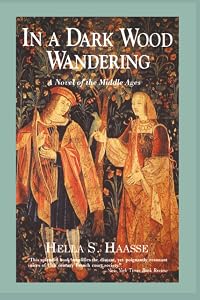
In a Dark Wood Wandering
by Hella S. Haasse
On This Page
Description
In this novel, set in the 15th century during the Hundred Years War between France and England, Hella Haasse brilliantly captures all the drama of one of the great ages of history.Tags
Recommendations















Member Reviews
A novel without a hero.
Reading this book reminded me of a visit to Musée de Cluny in Paris, and seeing “The Lady and the Unicorn” tapestries, and getting lost in the magic of their colours and details. Isn’t the title, “In a Dark Wood Wandering”, glorious?
We follow the life of Charles d’Orléans (1394-1465), from his birth in the prologue, to his death in the last chapter. Haasse’s choice of a protagonist is a curious one – he was part of the royal family, nephew to the mad king Charles VI… yet throughout his life, he remained a passive observer of events, a pawn who spent 25 years in captivity in England. He is not a person destined for “greatness”, he is happy when he can lose himself in books and write poetry. show more ”For poetry contests are the order of the day in the castle of Blois; they are, it is said with amusement, the Duke’s only weakness.”
This made me think about courage. Courage can take many different forms. One of them is quietly persevering during dark times (civil wars, Hundred Year’s War between France and England…), just trying to live with dignity. This novel was published in 1949, so the choice of a protagonist is probably not a curious, but a natural one.
”Doesn’t it seem to you that we have, all of us – the King and I and our good friends – wandered off into the forest of the night, filled with wolves and sly foxes? […] We are lost in the Forest of Long Awaiting, a wilderness without prospect.”
The historical background is fascinating. I loved how this book connected with my other historical reads – "The Last Duel: A True Story of Crime, Scandal, and Trial by Combat in Medieval France", Dunnett’s House of Niccoló books, "The Life and Death of King Richard III" by Anthony Cheetham. I like having yet another piece of the puzzle of 15th century Europe. It’s a funny thing: if you had asked me a couple of months ago what Joan of Arc might mean to the characters of House of Niccoló, I would have said “oh, ancient history”. Then the dates of the events in this book were right in front of me, and I said “oh, my”. *The sound of puzzle pieces clicking firmly into place.*
I think the author’s style might be off-putting to some readers. There are historical exposés that feel dry and are more like non-fiction than a novel. Yet the writing is vivid and precise. The book comes alive in dialogue and interactions between the characters. These things made me sink deeper and deeper into my “medieval tapestries”. Also, the style shifts from concise to poetic when we come to Charles d’Orleans’ POV. It’s really nice!
”It was not so much looking at what could be seen through the windows that he loved, it was rather the standing still, the waiting, which enthralled him – that curious feeling that at any moment a miracle would happen.”
”…sound of the music, clear as raindrops, cool and shimmering like the green river, filled with fragrance and the color of unknown things.”
”He was continually overcome with amazement that a world filled with adventure and beauty could rise from behind the black letters; that within a single page, a life could unfold, that death and heroism could be enclosed in a few strokes on the paper.”
There was a lot of Charles d’Orleans’ poetry in the book. (in the original lovely French, with translation into English). I really appreciated it, and thought I could see the man behind the rhyming lines. And isn’t what reading historical fiction is all about, seeing real people behind the pages of chronicles? show less
Reading this book reminded me of a visit to Musée de Cluny in Paris, and seeing “The Lady and the Unicorn” tapestries, and getting lost in the magic of their colours and details. Isn’t the title, “In a Dark Wood Wandering”, glorious?
We follow the life of Charles d’Orléans (1394-1465), from his birth in the prologue, to his death in the last chapter. Haasse’s choice of a protagonist is a curious one – he was part of the royal family, nephew to the mad king Charles VI… yet throughout his life, he remained a passive observer of events, a pawn who spent 25 years in captivity in England. He is not a person destined for “greatness”, he is happy when he can lose himself in books and write poetry. show more ”For poetry contests are the order of the day in the castle of Blois; they are, it is said with amusement, the Duke’s only weakness.”
This made me think about courage. Courage can take many different forms. One of them is quietly persevering during dark times (civil wars, Hundred Year’s War between France and England…), just trying to live with dignity. This novel was published in 1949, so the choice of a protagonist is probably not a curious, but a natural one.
”Doesn’t it seem to you that we have, all of us – the King and I and our good friends – wandered off into the forest of the night, filled with wolves and sly foxes? […] We are lost in the Forest of Long Awaiting, a wilderness without prospect.”
The historical background is fascinating. I loved how this book connected with my other historical reads – "The Last Duel: A True Story of Crime, Scandal, and Trial by Combat in Medieval France", Dunnett’s House of Niccoló books, "The Life and Death of King Richard III" by Anthony Cheetham. I like having yet another piece of the puzzle of 15th century Europe. It’s a funny thing: if you had asked me a couple of months ago what Joan of Arc might mean to the characters of House of Niccoló, I would have said “oh, ancient history”. Then the dates of the events in this book were right in front of me, and I said “oh, my”. *The sound of puzzle pieces clicking firmly into place.*
I think the author’s style might be off-putting to some readers. There are historical exposés that feel dry and are more like non-fiction than a novel. Yet the writing is vivid and precise. The book comes alive in dialogue and interactions between the characters. These things made me sink deeper and deeper into my “medieval tapestries”. Also, the style shifts from concise to poetic when we come to Charles d’Orleans’ POV. It’s really nice!
”It was not so much looking at what could be seen through the windows that he loved, it was rather the standing still, the waiting, which enthralled him – that curious feeling that at any moment a miracle would happen.”
”…sound of the music, clear as raindrops, cool and shimmering like the green river, filled with fragrance and the color of unknown things.”
”He was continually overcome with amazement that a world filled with adventure and beauty could rise from behind the black letters; that within a single page, a life could unfold, that death and heroism could be enclosed in a few strokes on the paper.”
There was a lot of Charles d’Orleans’ poetry in the book. (in the original lovely French, with translation into English). I really appreciated it, and thought I could see the man behind the rhyming lines. And isn’t what reading historical fiction is all about, seeing real people behind the pages of chronicles? show less
This took me a while to get into, and it took me a while to work out why. I don't read a huge amount of historical fiction, but I do have some favourites: Dorothy Dunnett and Patrick O'Brian. But these are tales of adventure and romance set against vivid historical back-drops, incorporating historical figures and events, but primarily concerned with their own plots and characters. This is historical fiction that reads like non-fiction, more like a work of journalism that recreates scenes and events than a novel. It is a novel, of course, a superb one, and it is fictional, but its primary concern is an historical figure and the historical events he was part of. History may contain plots, but it isn't A plot. History is big, sprawling, show more rambling, unsentimental and only has shape in retrospect. In A Dark Wood Wandering is a rigorous examination of a person and his milieu, and an extraordinary feat of sympathetic imagination.
1494, Charles d'Orleans is christened in Paris. His father, after whom he is named, is brother to the king, and the king is suffering from spells of madness. The elder Charles is being drawn into a divisive conflict with the powerful and influential Duke of Burgundy, who is pursuing his own interests in the north of France, while Orleans tries to guide the king closer to the interest of France. Courtly and political intrigue and maneuver and counter-maneuvre consume the rivals. Lies and rumours drive Orleans' wife from Paris and the conflict slowly turns deadly.
Young Charles grows up blissfully until a terrible act thrusts him into adulthood too soon and lays a heavy burden of vengeance and blood feud on his youthful shoulders. Utterly unsuited to his leadership role, Charles is intelligent and dutiful, but lacks the edge of political and physical ruthlessness he needs to be truly effective. He cannot break free of the powerful personalities that control him and out-maneuver him. His sensitive poet's soul, which he denies, suffers horribly through tragedy and loss and dire efforts to retain his honour and fulfill his duty.
The cost of duty, the merciless demands placed on the powerful, the disintegration of a once-great country and the appalling suffering that ensues. This is far from the playful textual and semiotic literary games of Name Of the Rose. This is a serious, unflinching novel, that gradually accumulates an emotional and intellectual weight until by the final few hundred pages it is nearly impossible to stop reading. show less
1494, Charles d'Orleans is christened in Paris. His father, after whom he is named, is brother to the king, and the king is suffering from spells of madness. The elder Charles is being drawn into a divisive conflict with the powerful and influential Duke of Burgundy, who is pursuing his own interests in the north of France, while Orleans tries to guide the king closer to the interest of France. Courtly and political intrigue and maneuver and counter-maneuvre consume the rivals. Lies and rumours drive Orleans' wife from Paris and the conflict slowly turns deadly.
Young Charles grows up blissfully until a terrible act thrusts him into adulthood too soon and lays a heavy burden of vengeance and blood feud on his youthful shoulders. Utterly unsuited to his leadership role, Charles is intelligent and dutiful, but lacks the edge of political and physical ruthlessness he needs to be truly effective. He cannot break free of the powerful personalities that control him and out-maneuver him. His sensitive poet's soul, which he denies, suffers horribly through tragedy and loss and dire efforts to retain his honour and fulfill his duty.
The cost of duty, the merciless demands placed on the powerful, the disintegration of a once-great country and the appalling suffering that ensues. This is far from the playful textual and semiotic literary games of Name Of the Rose. This is a serious, unflinching novel, that gradually accumulates an emotional and intellectual weight until by the final few hundred pages it is nearly impossible to stop reading. show less
I’ve always been interested in the period of the Hundred Years' War, the battle between France and England that inspired many stellar moments in Literature and Theatre. This book by Hella S.Haasse immediately attracted my attention (partly due to its beautiful cover) and it came highly recommended by esteemed Goodreads friends and many members of our community. Now, upon finishing this opus, I can say that I enjoyed it -at parts- but there were certain issues that prevent me from classifying it among the best Historical Fiction I’ve ever read.
The plethora of characters is certain to astonish you in the most positive way. One of the things that excite me in Historical Fiction is that most of us avid fans of the genre are accustomed show more to lists and lists of family names, dates and facts without being intimidated. When the authors understand this, they do not refrain from offering us a wealth of information. Haasse certainly follows this route. The reader comes across many historical figures that marked the era. Charles VI, le Bien-Aimé, le Fol, one of the most tragic and tormented monarchs in European History. Philip the Bold, Isabeau of Bavaria, Isabella of Valois, Jean the Fearless, and of course Charles d’Orléans, his mother Valentina Visconti and none other than Jeanne d’Arc, La Pucelle d'Orléans. A colourful cast of characters that will please even the most demanding readers.
The writing is rich and well-composed, the dialogue very faithful (presumably) of the era in which the story takes place. The letters, the hymns to the Virgin Mary for the protection of the country and the ballads embellish the narration and give a Chretien de Troyes flair. However, at this point, my main issue with the book is evident. It slowly starts reading as a History lecture rather than Historical Fiction. Now, I am an avid seeker of historical accuracy- sometimes, to the extreme- but I want an inspired kind of historical accuracy, a healthy combination between artistic license and facts. Here, Haasse loses momentum, and in my opinion, the novel becomes much slower and needlessly verbose after the halfway mark. There were instances when I was bored, genuinely bored and tired. I didn't want to skip pages (a personal faux-pas when I’m reading anything History-related) and therefore, my irritation grew. I felt I was reading dry, lifeless sentences. Paragraphs out of a university textbook.There was very little emotion, very little development.
Perhaps, it wasn’t Haasse’s writing, but the focus on Charles d’Orléans who is a rather dull character. Once the spotlight fell on him, I lost interest, plain and simple. I didn’t care how many times he would get married or about his endless interactions while in exile. In my opinion, he was a bad choice for a protagonist. A second issue had to do with the women of the story. I loved the rivalry between Valentine and Isabeau, it reminded me of the first cold interactions between Catelyn Stark and Cersei Lannister. Once this enmity is off the narrative, the remaining female characters are there only to look demurely away and at men or to give birth to heirs. Jeanne d’Arc was a great introduction in the story, but the author didn’t do her justice.
The book was published in 1949 and it shows. The lack of any important function for the majority of the female characters is dated, and I must be more of a child of my times than I thought. I am used to enjoy stories with strong, powerful women in power, not defined on their relationships with men but on their own abilities and, thankfully, there is a plethora of variety in the current Historical Fiction genre. There is a tricky issue when we encounter novels based on well-known historical facts. We all know the closure. Therefore, the journey must be exciting to make you care.In this case, the journey went wrong, although my expectations were high. Most likely, it’s my fault. I shouldn’t have read it after Rutherfurd's masterpiece, the comparison was unavoidable.
I don’t regret having read the novel, not in the least. I learned quite a lot of new facts about this turbulent era in European History and I came to know what seems to be an iconic book of the genre. The research is exhausting, the effort tremendous and beautiful. However, it will not enter my pantheon of Historical Fiction examples, it will not be memorable in my collection. And as I always try to be honest to myself, 3 stars is the most I can give. show less
The plethora of characters is certain to astonish you in the most positive way. One of the things that excite me in Historical Fiction is that most of us avid fans of the genre are accustomed show more to lists and lists of family names, dates and facts without being intimidated. When the authors understand this, they do not refrain from offering us a wealth of information. Haasse certainly follows this route. The reader comes across many historical figures that marked the era. Charles VI, le Bien-Aimé, le Fol, one of the most tragic and tormented monarchs in European History. Philip the Bold, Isabeau of Bavaria, Isabella of Valois, Jean the Fearless, and of course Charles d’Orléans, his mother Valentina Visconti and none other than Jeanne d’Arc, La Pucelle d'Orléans. A colourful cast of characters that will please even the most demanding readers.
The writing is rich and well-composed, the dialogue very faithful (presumably) of the era in which the story takes place. The letters, the hymns to the Virgin Mary for the protection of the country and the ballads embellish the narration and give a Chretien de Troyes flair. However, at this point, my main issue with the book is evident. It slowly starts reading as a History lecture rather than Historical Fiction. Now, I am an avid seeker of historical accuracy- sometimes, to the extreme- but I want an inspired kind of historical accuracy, a healthy combination between artistic license and facts. Here, Haasse loses momentum, and in my opinion, the novel becomes much slower and needlessly verbose after the halfway mark. There were instances when I was bored, genuinely bored and tired. I didn't want to skip pages (a personal faux-pas when I’m reading anything History-related) and therefore, my irritation grew. I felt I was reading dry, lifeless sentences. Paragraphs out of a university textbook.There was very little emotion, very little development.
Perhaps, it wasn’t Haasse’s writing, but the focus on Charles d’Orléans who is a rather dull character. Once the spotlight fell on him, I lost interest, plain and simple. I didn’t care how many times he would get married or about his endless interactions while in exile. In my opinion, he was a bad choice for a protagonist. A second issue had to do with the women of the story. I loved the rivalry between Valentine and Isabeau, it reminded me of the first cold interactions between Catelyn Stark and Cersei Lannister. Once this enmity is off the narrative, the remaining female characters are there only to look demurely away and at men or to give birth to heirs. Jeanne d’Arc was a great introduction in the story, but the author didn’t do her justice.
The book was published in 1949 and it shows. The lack of any important function for the majority of the female characters is dated, and I must be more of a child of my times than I thought. I am used to enjoy stories with strong, powerful women in power, not defined on their relationships with men but on their own abilities and, thankfully, there is a plethora of variety in the current Historical Fiction genre. There is a tricky issue when we encounter novels based on well-known historical facts. We all know the closure. Therefore, the journey must be exciting to make you care.In this case, the journey went wrong, although my expectations were high. Most likely, it’s my fault. I shouldn’t have read it after Rutherfurd's masterpiece, the comparison was unavoidable.
I don’t regret having read the novel, not in the least. I learned quite a lot of new facts about this turbulent era in European History and I came to know what seems to be an iconic book of the genre. The research is exhausting, the effort tremendous and beautiful. However, it will not enter my pantheon of Historical Fiction examples, it will not be memorable in my collection. And as I always try to be honest to myself, 3 stars is the most I can give. show less
This is an absolutely fascinating historical trip through the Hundred Years War between France and England. This is not an easy read (I had to make notes in margins and occasionally refer to a reference), but what a delight. Reading this is like finishing a hard, sweaty, but very fulfilling workout.
The accuracy of this book seems very reliable based on the reference sources that I used in reading it. The characters are historically accurate. At the same time, the author manages to put life into what textbook simply portray as dry historical characters. There are few fictional characters who can be as memorable as the royalty of England and France. Crazy King Charles, his bizarre wife Isabeau, the child brides, the haughty Duke of show more Burgandy, and then throw in Joan of Arc -- what a mixture! One can't make that stuff up. The pain, frustration, anxiety, and fear of those thrown into the path of history based on their birth is so vividly portrayed. It's a world different from ours, but yet human nature remains the same.
Reading this puts our modern day political messes in perspective. For those that believe times have never been worse, haven't lived in the Middle Ages.
For anyone seriously interested in the Middle Ages or otherwise loves good historical fiction. This is it. show less
The accuracy of this book seems very reliable based on the reference sources that I used in reading it. The characters are historically accurate. At the same time, the author manages to put life into what textbook simply portray as dry historical characters. There are few fictional characters who can be as memorable as the royalty of England and France. Crazy King Charles, his bizarre wife Isabeau, the child brides, the haughty Duke of show more Burgandy, and then throw in Joan of Arc -- what a mixture! One can't make that stuff up. The pain, frustration, anxiety, and fear of those thrown into the path of history based on their birth is so vividly portrayed. It's a world different from ours, but yet human nature remains the same.
Reading this puts our modern day political messes in perspective. For those that believe times have never been worse, haven't lived in the Middle Ages.
For anyone seriously interested in the Middle Ages or otherwise loves good historical fiction. This is it. show less
Following Charles d'Orleans's life from birth to death, this novel depicts the life of a man who feels the weight of his family's ambitions and his responsibilities too young and struggles with the instability of France with a king who's ill and with the noble families are each out for what they can get in their attempts to gain control. Then comes exile that takes him away from it for his best years, which might give him some inner calm but means even after its end he'll never have the influence and drive to shape his country to what he'd like it to be. A fascinating novel, even if it was at times hard to keep up.
In a Dark Wood Wandering sat on my shelf for a good 10 years or so before I picked it up for reading. I don't know how I came about it and for the longest time I had no clue what it was even about. After reading that it was about the life of Charles, Duke of Orleans, I still wasn't interested in reading the historical novel. At one point I decided that it must go and sat it on the bottom shelf to be donated. Lucky for me, before making my donations, I decided to take a 50 book challenge and wanted to put all books available to read on the top shelf. I was struggling to find 50 books total and so up to the top shelf it went, saved. Boy am I glad to have moved it back up. I thought for sure that this book would be dry, boring and dragging show more but I found it to be the opposite. I was intrigued by the main character, Charles, who was well developed. I felt a personal attachment to the characters, the historical setting felt like home and the political issues and warfare held me to the edge of my seat as I waited to see how the outcomes would effect Charles and the world in which he lived in. The research on the history of England and France during this time period truly helped in delivering this story in a way which was believable and fascinating. After I finished I wanted to do nothing more then write an historical novel and study the poetry of Charles, Duke of Orleans.
Just as interesting is how this story was once lost, nearly destroyed and was saved. It is hard to believe that this was not Haasse's most acclaimed work. It has made her one of my favorite historical fiction authors. The only thing negative I can say about this book is that throughout the whole piece I asked, "Why the title, In a Dark Wood Wandering?" I would have much preferred the the original translation of The Forest of Long Awaiting. But, that is just a minor deal. Overall, this book is wonderfully written with a great setting, realistic characters and a story line that moves its readers, guiding them from this our world in this time and date to that of the middle ages. show less
Just as interesting is how this story was once lost, nearly destroyed and was saved. It is hard to believe that this was not Haasse's most acclaimed work. It has made her one of my favorite historical fiction authors. The only thing negative I can say about this book is that throughout the whole piece I asked, "Why the title, In a Dark Wood Wandering?" I would have much preferred the the original translation of The Forest of Long Awaiting. But, that is just a minor deal. Overall, this book is wonderfully written with a great setting, realistic characters and a story line that moves its readers, guiding them from this our world in this time and date to that of the middle ages. show less
This is a fictional account of the life of Charles d'Orleans. Very readable prose and a fascinating story. Highlights included - the appearance of mad French king Charles VI, Agincourt, Jeanne d'Arc, politics, poetry and warfare. An interesting mix of topics and I did appreciate the addition of Charles' own poetry as it gave a feel for the real man. I really liked it.
There is an interesting story behind is publication as well. It was first published in 1949 in Dutch and, according to the introduction in my copy, was never out of print but after the death of its first English translator the manuscript wasn't rediscovered for twenty years and the book first appeared in English in 1989.
There is an interesting story behind is publication as well. It was first published in 1949 in Dutch and, according to the introduction in my copy, was never out of print but after the death of its first English translator the manuscript wasn't rediscovered for twenty years and the book first appeared in English in 1989.
Members
- Recently Added By
Lists

Five star books
1,767 works; 110 members

Canon van de Nederlandse letterkunde
125 works; 5 members

covers with paintings / paintings as covers .
37 works; 1 member

Books Read in 2022
5,226 works; 112 members
Favorite Romance Fiction
247 works; 115 members
Author Information

Hella Haasse was born in Batavia, the capital of what was then Dutch East India, now independent Indonesia. It is thus understandable why her first novel, Oeroeg (1948), describes the relationship between a Dutch and an Indonesian youth. As the two young men grow up, they gradually become conscious of their ethnic and cultural differences and, in show more spite of their efforts, nature appears to have destined them to become estranged from each other. Haasse's greatest impact on the Dutch literary scene occurred when her historical novel Het woud der verwachting (In a Dark Wood Wandering) (1948) was published. It was translated into English in 1989. This novel became a classic in its own time. In it the author describes the ever-increasing loneliness of the fifteenth-century Romantic poet--prince Charles d'Orleans, pretender to the crown of France, who wrote most of his poems in British and French prisons. In addition to giving a moving report of the life of a person destined to end his life in utter isolation, Hella Haasse succeeds in presenting her main character in a way which allows the reader to identify with him. Charles's life is interwoven with the lives of all the other people he meets. Haasse's talent for description and narration and her skill with flashbacks allow her to manage the novel's many characters, constructing a microcosm in which each reader feels "at home' and meets people with whom he or she can identify. (Bowker Author Biography) show less
Some Editions
Awards and Honors
Work Relationships
Common Knowledge
- Canonical title
- In a Dark Wood Wandering
- Original title
- Het woud der verwachting : het leven van Charles van Orléans
- Original publication date
- 1949
- People/Characters
- Charles, Duke of Orléans; Charles VI, King of France; Henry V, King of England
- Important places
- Saint-Pol, Paris, France; Blois, Indre-et-Loire, Centre-Val de Loire, France; Tower of London, London, England, UK
- Important events
- Battle of Agincourt (1415)
- Epigraph
- En la forêt de Longue Attente Chevauchant par divers sentiers M'en vais, cette année présente, Au voyage de Desiriers. Devant sont allés mes fourriers Pour appareiller mon logis En la cité de Destinée ; Et pour mon cœu... (show all)r et moi ont pris L'hôtellerie de Pensée..................................................................................................Dedans mon Livre de Pensée, J’ay trouvé écrivant mon cœur La vraie histoire de douleur, De larmes toute enluminée, -------------------------------Charles d'Orléans
In het woud van Lang Verwachten te paard op pad, dolenderwijs, zie ik mijzelf dit jaar bij machte tot Verlangens' verre reis. Mijn knechtstoet is vooruitgegaan om 's nachtverblijf vast te bereiden, vond in Bestemming's Stad g... (show all)ereed voor dit mijn hart, en mij ons beiden, de herberg, die Gedachte heet. .................................................................................................................In 't boek van mijn gepeinzen al vond ik dan, schrijvend, mijn hart; het waar verhaal van bitt're smart verlucht met tranen zonder tal. - Dedication
- In memoriam Chrisje
- First words
- In haar met groene gordijnen omhangen staatsiebed luisterde Valentine, hertogin van Orléans, naar het gebeier der klokken van Saint-Pol
- Last words
- (Click to show. Warning: May contain spoilers.)Daarna boog hij zich voorover en drukte voorzichtig de ogen van de dode toe.
- Original language
- Dutch
Classifications
- Genres
- Fiction and Literature, General Fiction, Historical Fiction
- DDC/MDS
- 839.31364 — Literature & rhetoric German & related literatures Other Germanic literatures Netherlandish literatures Dutch Dutch fiction 20th Century 1945-1999
- LCC
- PT5838 .H45 .W613 — Language and Literature German, Dutch and Scandinavian literatures Dutch literature Individual authors or works 1800-1960
- BISAC
Statistics
- Members
- 1,125
- Popularity
- 22,583
- Reviews
- 20
- Rating
- (4.06)
- Languages
- 6 — Dutch, English, French, German, Italian, Spanish
- Media
- Paper, Audiobook, Ebook
- ISBNs
- 45
- ASINs
- 12