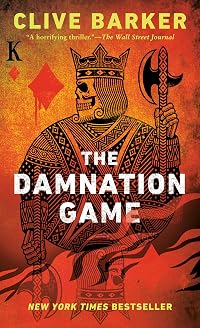
The Damnation Game
by Clive Barker
On This Page
Description
Marty Strauss, a gambling addict recently released from prison, is hired to be the personal bodyguard of Joseph Whitehead, one of the wealthiest men in the world. The job proves more complicated and dangerous than he thought, however, as Marty soon gets caught up in a series of supernatural events involving Whitehead, his daughter (who is a heroin addict), and a devilish man named Mamoulian, with whom Whitehead made a Faustian bargain many years earlier, during World War II.As time passes, show more Mamoulian haunts Whitehead using his supernatural powers (such as the ability to raise the dead), urging him to complete his pact with him. Eventually Whitehead decides to escape his fate after a few encounters with Mamoulian and having his wife, former bodyguard, and now his daughter Carys taken away from him. With hope still left to save Carys, Marty Strauss, although reluctant to get involved in the old man Whiteheads deserved punishment, decides to get involved and attempt to save the innocent gifted addict from being another victim to the damnation game. show lessTags
Recommendations













Member Recommendations
Member Reviews
Barker knows how to write creepy stuff. More importantly, his stories are not just attempts at seeing how high the gore-factor can be pumped; he finds a way to inject some morale truths and enough ambiguity to keep a reader thinking.
Martin Strauss is prisoner released into the care of an eccentric millionaire. His job is to provide for the rich man's needs. Martin is mystified by the electric fencing and high powered lights that surround the mansion he is to serve in but his figures it's the kind of paranoia that comes being being obscenely wealthy. As the story unfolds, and Martin begins to peripherally see more of the dark nature to his new residence, it becomes clear that he's simple inhabiting a prison of a new kind, one with the show more grandest types of punishment and redemption.
With the impending close of Border, I managed to score this copy for less than 2 bucks. Had the story been so-so or even something I couldn't finish, I knew I could consider it "no biggie" because of the cost, but that's not how it went with this tale.
This ones worth whatever price you find it at. show less
Clive Barker's first full novel (1985) is imaginative and very different from most novels of damnation where the devil or demons and a defined external hell are central themes while a Faust-like character trades his soul for something that proves insubstantial in the long run.
A dark fantasy set in a world of addiction, sleaze and failure, it has flawed humans and half-alive corpses in a chess game played against a wealthy sociopath, Whitehead, by Mamoulian whose own petulant negativity gives him no heroic aspect unlike say Rice's 'Memnoch'.
The book cannot be called subtle even though it is creative in the telling. There are few deep meanings but Barker does manage to hint at the evil being closer to the Christian good than many might show more like. In this, he is as subversive as Philip Pullman was to be in children's literature.
Part of the cleverness of the story (because it allows the plot to progress through the will of the living dead) lies in not having the reanimated entirely lose all will and reason independent of the reanimator even if their faculties seem to have rotted down to instinctive base urges.
However, while the author subverts our expectations throughout much of the novel, he also has a tendency not to take a theme or idea and bring it to a satisfying conclusion. One suspects that Barker was still thinking in segmented short story terms at this time.
For example, the first half of the book develops a strong theme of gambling, games-playing and chance. While this is returned to (although almost in passing in favour of other themes) at the end, the imbalance between its importance in one place yet not another is noticeable.
The book is certainly entertaining (assuming you have a taste for evil, decay and putrefaction) but it seems to lack an almost indefinable 'thing' to hold it together as a fully cohesive work. Yet this is a quibble. It is still a book that marks a very original and effective writer in the genre.
As to the evil at the centre, it is powerful and dangerous but also limited. Barker solves a common problem in the horror genre of how evil monsters seem to be so powerful and often fail at the same time by creating a credible monster operating between the human and the supernatural.
Mamoulian is no demon but simply a very lucky (or is it unlucky) man with a void at his centre whose experience has placed him in a position - never fully defined or explained - of power between our world and the world on the other side of death.
He is an unnatural bridge bringing life (as the animating soul) to death and death to life and creating mental terror and illusion by transferring the other world into the perceptions of those who live in this world. This enables subtle play with ideas of soul transmigration.
His extreme transgressive self-animation brings no wisdom. He starts off as a limited low life (rather like Marty, the 'hero', and the billionaire Whitehead) and transforms least over time, in his case, a very long time. He is cunning but his dark arts replace intelligence. He is negation.
The conflict between Mamoulian and Whitehead is the conflict between a sociopath who is limited but has 'powers' and one who does not have such powers but is intelligent. Marty has no powers and is not very bright but is certainly not a sociopath.
If the villain is a nasty bit of work as we would expect, the 'hero' is a not-too-bright petty criminal drawn into a world that becomes truly visceral, one of death and putrefaction in life. He ends up a hero but only because he is a bit dim.
Barker's supernatural is finely honed to become a credible collapse in boundaries rather than a wilful intervention from outside. His hellish other world is something that we slip into with death and should never return from. Mamoulian changes that iron rule of existence and non-existence.
However, Mamoulian cannot change the laws of nature (Barker is quite old-fashioned in seeing a world of souls separate from matter) so what he restores to life freezes or slows down but does not reverse aging or decay. He is not God or a god, nor Devil nor demon.
There is a spoiler problem here because the precise history of the tempter, the complex qualities of a hell that travels alongside us without necessity for God and the insubstantiality of the bargains being made are revealed only slowly. As a result, not much can be said that provides more detail.
The romantic aspect is conventional, matching the horror with some realistic sex, even if the relationship between the dim and the damaged tends to confirm a rather gnostic view of love struggling against materiality. The material world, of course, contains its own future rot within it.
Grand guignol takes over by the end and what starts as a dark thriller with a mystery at its centre transforms by the end into some seriously schlocky horror with no holds barred. This is not cosmic horror but a tale of decay and grubbiness between worlds that reflects on our own.
Overall, Barker writes well. There are few places where one is tempted to speed-read to leap the bounds of convention. The bulk of the book has one fully engaged but it is not a story for those with a sensitive stomach. show less
A dark fantasy set in a world of addiction, sleaze and failure, it has flawed humans and half-alive corpses in a chess game played against a wealthy sociopath, Whitehead, by Mamoulian whose own petulant negativity gives him no heroic aspect unlike say Rice's 'Memnoch'.
The book cannot be called subtle even though it is creative in the telling. There are few deep meanings but Barker does manage to hint at the evil being closer to the Christian good than many might show more like. In this, he is as subversive as Philip Pullman was to be in children's literature.
Part of the cleverness of the story (because it allows the plot to progress through the will of the living dead) lies in not having the reanimated entirely lose all will and reason independent of the reanimator even if their faculties seem to have rotted down to instinctive base urges.
However, while the author subverts our expectations throughout much of the novel, he also has a tendency not to take a theme or idea and bring it to a satisfying conclusion. One suspects that Barker was still thinking in segmented short story terms at this time.
For example, the first half of the book develops a strong theme of gambling, games-playing and chance. While this is returned to (although almost in passing in favour of other themes) at the end, the imbalance between its importance in one place yet not another is noticeable.
The book is certainly entertaining (assuming you have a taste for evil, decay and putrefaction) but it seems to lack an almost indefinable 'thing' to hold it together as a fully cohesive work. Yet this is a quibble. It is still a book that marks a very original and effective writer in the genre.
As to the evil at the centre, it is powerful and dangerous but also limited. Barker solves a common problem in the horror genre of how evil monsters seem to be so powerful and often fail at the same time by creating a credible monster operating between the human and the supernatural.
Mamoulian is no demon but simply a very lucky (or is it unlucky) man with a void at his centre whose experience has placed him in a position - never fully defined or explained - of power between our world and the world on the other side of death.
He is an unnatural bridge bringing life (as the animating soul) to death and death to life and creating mental terror and illusion by transferring the other world into the perceptions of those who live in this world. This enables subtle play with ideas of soul transmigration.
His extreme transgressive self-animation brings no wisdom. He starts off as a limited low life (rather like Marty, the 'hero', and the billionaire Whitehead) and transforms least over time, in his case, a very long time. He is cunning but his dark arts replace intelligence. He is negation.
The conflict between Mamoulian and Whitehead is the conflict between a sociopath who is limited but has 'powers' and one who does not have such powers but is intelligent. Marty has no powers and is not very bright but is certainly not a sociopath.
If the villain is a nasty bit of work as we would expect, the 'hero' is a not-too-bright petty criminal drawn into a world that becomes truly visceral, one of death and putrefaction in life. He ends up a hero but only because he is a bit dim.
Barker's supernatural is finely honed to become a credible collapse in boundaries rather than a wilful intervention from outside. His hellish other world is something that we slip into with death and should never return from. Mamoulian changes that iron rule of existence and non-existence.
However, Mamoulian cannot change the laws of nature (Barker is quite old-fashioned in seeing a world of souls separate from matter) so what he restores to life freezes or slows down but does not reverse aging or decay. He is not God or a god, nor Devil nor demon.
There is a spoiler problem here because the precise history of the tempter, the complex qualities of a hell that travels alongside us without necessity for God and the insubstantiality of the bargains being made are revealed only slowly. As a result, not much can be said that provides more detail.
The romantic aspect is conventional, matching the horror with some realistic sex, even if the relationship between the dim and the damaged tends to confirm a rather gnostic view of love struggling against materiality. The material world, of course, contains its own future rot within it.
Grand guignol takes over by the end and what starts as a dark thriller with a mystery at its centre transforms by the end into some seriously schlocky horror with no holds barred. This is not cosmic horror but a tale of decay and grubbiness between worlds that reflects on our own.
Overall, Barker writes well. There are few places where one is tempted to speed-read to leap the bounds of convention. The bulk of the book has one fully engaged but it is not a story for those with a sensitive stomach. show less
This is dark, horrifying, and smart. For fans of horror or Faustus-related legends and works, this novel is a must-read, but I'd recommend it also to readers who simply enjoy a thought-provoking read and can deal with the darker areas of the imagination. Barker's characters and plots are beautifully crafted, and it's easy to see him engaging with the horror genre and traditions of horror in a way that many writers don't do. Simply put, Barker has thought about the end-goal here, and he's carefully crafted this book in a way that makes it transcend horror literature and genre. Fans of Neil Gaiman will appreciate some of his moves here, but it's worth noting that while the book is an easy read, this book is a heavier read than any of show more Gaiman's texts. If you make yourself take the time to think through the ideas that Barker presents here, the book becomes richer with each page, as well as more horrifying. I don't have any doubt that this will become a classic of horror literature, but it's also an incredibly beautiful and smart read if you can take the rawness of it all. In other words, highly highly recommended. show less
Barker's self contained universes would be split into trilogies by other authors. Sometimes he manages to fill an entire world into the pages of a single book. Sometimes, like here, that universe is only half realized, and in trying to spread its wings beyond being just a horror story, it ultimately sinks the project. It could have been a much tighter written 300 page novel without losing anything at all.
“Hell is reimagined by each generation. Its terrain is surveyed for absurdities and remade and, if necessary, reinvented to suit the current climate of atrocity; its architecture is redesigned to appall the eye of the modern damned. In an earlier age Pandemonium - the first city of Hell - stood on a lava mountain while lighting tore the clouds above it and beacons burned on its walls to summon the fallen angels. Now, such spectacle belongs to Hollywood. Hell stands transposed. No lightning, no pits of fire."
- from Clive Barkers’ “The Damnation Game"
Clive Barker’s first full-length novel is magnificent. It’s dark, intense and mostly unrelenting in it’s steady construction of supernatural horror. While full of gut wrenching show more visuals and causing a limitation of my ability to fall asleep, this novel beats with a heart of literature under it’s skin of genre horror.
Barker builds his story and characters layer by layer. Some might feel the early going is a bit slow but I would argue that the greatest of meals are those that take longer to make.
I’ve only recently discovered how pervasive is H.P. Lovecraft’s influence in modern horror. Not sure how this stayed off my radar for so long, but let’s just be glad that I finally figured out. “Damnation Game” in imbued with the spirit of Lovecraft. Just take a glimpse at a couple of passages from Barker, and his Lovecraftian storytelling of an otherworldly evil that lives just beyond site of the visible world and just on the edge of the great Void.
“It was, for a moment, not her who started out between the bars. It was something dredged up from the bottom of the sea. Black eyes swiveling in a gray head. Some primeval genus that viewed him - he knew this to his marrow - with hatred in its bowels."
“He became aware (was it just his dream life, denied its span in sleepless nights, spreading into wakefulness?) of another world, hovering beyond or behind the facade of reality."
If there’s anything to downgrade my rating it’s Barker’s awkwardly rapid transition of the budding affair of our two protagonists from tentative emotional exploration to full on can’t-live-without-you intensity. I either missed a paragraph or two, or Marty and Carys fell hard and fast after the first time they ‘hooked up’.
It’s a relatively small complaint, however. The story is terrific; the plot solid; the finish satisfying. Highly recommended. show less
- from Clive Barkers’ “The Damnation Game"
Clive Barker’s first full-length novel is magnificent. It’s dark, intense and mostly unrelenting in it’s steady construction of supernatural horror. While full of gut wrenching show more visuals and causing a limitation of my ability to fall asleep, this novel beats with a heart of literature under it’s skin of genre horror.
Barker builds his story and characters layer by layer. Some might feel the early going is a bit slow but I would argue that the greatest of meals are those that take longer to make.
I’ve only recently discovered how pervasive is H.P. Lovecraft’s influence in modern horror. Not sure how this stayed off my radar for so long, but let’s just be glad that I finally figured out. “Damnation Game” in imbued with the spirit of Lovecraft. Just take a glimpse at a couple of passages from Barker, and his Lovecraftian storytelling of an otherworldly evil that lives just beyond site of the visible world and just on the edge of the great Void.
“It was, for a moment, not her who started out between the bars. It was something dredged up from the bottom of the sea. Black eyes swiveling in a gray head. Some primeval genus that viewed him - he knew this to his marrow - with hatred in its bowels."
“He became aware (was it just his dream life, denied its span in sleepless nights, spreading into wakefulness?) of another world, hovering beyond or behind the facade of reality."
If there’s anything to downgrade my rating it’s Barker’s awkwardly rapid transition of the budding affair of our two protagonists from tentative emotional exploration to full on can’t-live-without-you intensity. I either missed a paragraph or two, or Marty and Carys fell hard and fast after the first time they ‘hooked up’.
It’s a relatively small complaint, however. The story is terrific; the plot solid; the finish satisfying. Highly recommended. show less
Not finished yet, but if anyone sees me reading this and decides to give it a shot, I would like to say to you: PLEASE, give it until page 200 or so. PLEASE. The book starts off slooooow. If it started off any slower, I would have burned my copy, rather than merely throwing it across the room in disgust.
But!
But, once Marty Strauss is settled in at Whitehead's place, the story picks up and gets GOOD! And I mean good in a scary, somewhat-gory way. So please! Keep reading!
UPDATE
Finally finished. Good story. Creepy. Gory. Evil. Don't know if it's one of the best horror stories of all-time (I got this book from a list of top 50 or 100 best horror novels) but I did enjoy. Like I said...Don't give up on it!
But!
But, once Marty Strauss is settled in at Whitehead's place, the story picks up and gets GOOD! And I mean good in a scary, somewhat-gory way. So please! Keep reading!
UPDATE
Finally finished. Good story. Creepy. Gory. Evil. Don't know if it's one of the best horror stories of all-time (I got this book from a list of top 50 or 100 best horror novels) but I did enjoy. Like I said...Don't give up on it!
There are things worse than death. There are games so seductively evil, so wondrously vile, no gambler can resist. Amid the shadow-scarred rubble of World War II, Joseph Whitehead dared to challenge the dark champion of life's ultimate game. Now a millionaire, locked in a terror-shrouded fortress of his own design, Joseph Whitehead has hell to pay. And no soul is safe from this ravaging fear, the resurrected fury, the unspeakable desire of...
Members
- Recently Added By
Lists

Best Horror Books
281 works; 84 members

Best Fantasy Novels
821 works; 361 members

Nightmare Magazine's Top 100 Horror Books
100 works; 7 members

75 Books Challenge 2015 Halloween Read long list
45 works; 4 members
Paste's 50 Best Horror Novels of All time
50 works; 6 members

Best Horror Mega-List
342 works; 6 members

Jones and Newman's Horror: The 100 Best Books
100 works; 4 members

horror
11 works; 1 member

Books I Read Before The Invention Of The Internet.
144 works; 1 member
Author Information

381+ Works 57,041 Members
Critics of the horror story have frequently called Clive Barker the "British Stephen King". Born in Liverpool in 1952, Barker attended the University of Liverpool but moved to London in 1977, where he worked as a commercial artist and became involved with the avant-garde theatrical community. Primarily a playwright during this period, he also show more produced short fiction that he would eventually publish as part of his six-volume collection titled Books of Blood (1984-85). More than any other author of contemporary horror fiction, Barker has had a major impact on the direction of the genre. He has introduced strong elements of sex and graphic violence into his fiction, but these elements are employed with an artistic objective. Barker underscores his work with complex subtextual metaphors and artistic allusions. Preoccupied with the craft of writing and with its effect on the reader, Barker is an innovator of formula and genre, often parodying the former in order to change the philosophical contour of the latter. Barker has achieved commercial success not only with his short fiction but also with his novels, which tend to be epic in scope and to blend elements of horror with those of high fantasy. Barker is one of the more influential voices in horror cinema, having written and directed a number of films. His printed works include The Candle in the Cloud, Absolute Midnight, The Scarlet Gospels, and Black is the Devil's Rainbow: Tales of a Journeyman. His films include Dread, Tortured Souls: Animae Damanatae, and Hellraiser. (Bowker Author Biography) Clive Barker was born in October, 1952, in Liverpool, England, and graduated from Liverpool University. While a student, the resourceful Barker formed a theater company as an outlet for his career as a budding playwright. After minor success with several plays such as "Frankenstein in Love," Barker vaulted onto the horror fiction scene with the publication of his short stories, "The Books of Blood." Later books such as "The Damnation Game," "Imajica," and "Everville" have further established his reputation as a Master of Horror. Barker gained further popularity with several motion picture projects. Unhappy with previous film versions of his works, he chose to direct the successful movie "Hellraiser," which generated a string of sequels. In addition to writing and directing, Barker has produced several of the movies in both the "Hellraiser" and "Candyman" series. Besides his writing and film activities, the multitalented Barker is an actor and illustrator, with several published volumes of his artwork. Barker is a recipient of British Fantasy awards and a World Fantasy award, and resides in Los Angeles. (Bowker Author Biography) show less
Some Editions
Awards and Honors
Awards
Distinctions
Common Knowledge
- Canonical title
- The Damnation Game
- Original title
- The Damnation Game
- Original publication date
- 1985
- People/Characters
- Marty Strauss; Joseph Whitehead; Mamoulian; Carys Whitehead; Breer; Bill Toy
- Important places
- England, UK
- Epigraph
- Nor yet exempt, though ruling them like slaves, From chance, and death, and mutability.
-Shelly, Prometheus Unbound - Dedication
- To J. R. G.
- First words
- The air was electric the day the thief crossed the city, certain that tonight, after so many weeks of frustration, he would finally locate the card-player.
- Last words
- (Click to show. Warning: May contain spoilers.)As she led him across the lightless ground, time and again he could not prevent his eyes from gazing skyward.
- Original language
- English
Classifications
Statistics
- Members
- 2,572
- Popularity
- 7,439
- Reviews
- 28
- Rating
- (3.56)
- Languages
- 13 — Czech, Dutch, English, Finnish, French, German, Hungarian, Italian, Polish, Portuguese, Spanish, Swedish, Turkish
- Media
- Paper, Audiobook, Ebook
- ISBNs
- 43
- ASINs
- 29