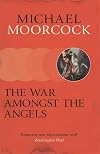
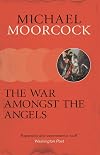
The War Amongst the Angels
by Michael Moorcock
Second Ether (book 3), The Eternal Champion (Second Ether book 3)
On This Page
Description
In the latest dazzling example of a lyrical literary genius that defies categorization, The War Amongst The Angels carries the reader across the mystical thresholds viewed from afar in Blood and Fabulous Harbors to reveal the mighty destinies and secret histories of some of Michael Moorcock's most beloved and intriguing characters. It is the story of the incomparable Rose von Bek and her adventures on an alternate, Earth and in the Second Ether -- an infinitely wondrous place where time has show more no bounds and life is a river of endless reinvention. Here, also, is the love of her life, the volatile and enigmatic Sam Oakenhurst, as well as the ill-fated lovers Colinda Dovero and gambler Jack Karaquazian, who join Rose -- along with a host of exceptional companions -- to fight shoulder-to-shoulder against the agents of evil and stagnation in the ongoing conflict some call the great War in heaven; a struggle whose outcome will determine the very nature of reality itself. show lessTags
Recommendations

















Member Reviews
The War Amongst the Angels concludes Moorcock's Second Ether trilogy, largely returning to the key characters and narrative format of the first book Blood. Although speakers and viewpoints shift throughout the book, it begins and ends in the voice of Margaret Rose Moorcock, and it is "an autobiographical story by Michael Moorcock," whom the tale tells us is Rose's cousin in Texas. (Moorcock was indeed living in Texas when he wrote this book, but he never appears in person in the story. It does feature Rose's uncle Michael, for whom the author is supposedly named.)
The title does accurately reflect the plot as it eventuates in the final arc of the book, with a multiversal conflict in a world where the Chaos Engineers and the Singularity show more vie for the lost ship Spammer Gain on an ectoplasmic sea. Our Eternals (the heroes of the tale) are at least nominally aligned with Chaos, although they are the Just who oppose Law in order to preserve Balance. Readers of other Moorcock fantasies will quickly see the recurring patterns of the Eternal Champion hyperwork, but the travel on the Moonbeam Roads, transiting the axis of scale, is an approach to supernaturalism somewhat peculiar to the Second Ether stories.
Additionally, there are specific evocations of other previous Moorcock books, particularly Stormbringer and The War Hound and the World's Pain, especially in the climactic chapter Libres des Muertes. There may well have been some key references to books that I haven't even read, since I cannot claim complete familiarity with Moorcock's enormous bibliography. The echoes and allusions that I did perceive, however, increased my appreciation for what was happening in this story to the extent that I don't think the Second Ether is a good starting point for prospective Moorcock readers.
The War Amongst the Angels is dedicated to a clutch of 19th-century English authors, all of whom had long fallen out of print in 1996. Their works furnish most and perhaps all of the epigrams that head the chapters of the book. The second Second Ether book Fabulous Harbours was definitely fiction about fiction, and here too the imaginative faculty uses narrative to create and navigate multiple realities. Moorcock muses on politics frequently, albeit in varied voices and within his fantastic setting.
The feint of setting himself up as the "poor Texan cousin" who lends his name for Rose to use as a byline in "her" fiction (18) significantly undermines the book's apparent claim to be Michael Moorcock's autobiography. As mentioned, he doesn't even figure as an immediate character in the plot. But the Rose developed in these books is perhaps either his personified anima or a feminine alter-ego. Decades later, Moorcock would return far more transparently to the enterprise of autobiography through fantasy fiction in his Sanctuary of the White Friars, a series which saw its second volume published last year. show less
The title does accurately reflect the plot as it eventuates in the final arc of the book, with a multiversal conflict in a world where the Chaos Engineers and the Singularity show more vie for the lost ship Spammer Gain on an ectoplasmic sea. Our Eternals (the heroes of the tale) are at least nominally aligned with Chaos, although they are the Just who oppose Law in order to preserve Balance. Readers of other Moorcock fantasies will quickly see the recurring patterns of the Eternal Champion hyperwork, but the travel on the Moonbeam Roads, transiting the axis of scale, is an approach to supernaturalism somewhat peculiar to the Second Ether stories.
Additionally, there are specific evocations of other previous Moorcock books, particularly Stormbringer and The War Hound and the World's Pain, especially in the climactic chapter Libres des Muertes. There may well have been some key references to books that I haven't even read, since I cannot claim complete familiarity with Moorcock's enormous bibliography. The echoes and allusions that I did perceive, however, increased my appreciation for what was happening in this story to the extent that I don't think the Second Ether is a good starting point for prospective Moorcock readers.
The War Amongst the Angels is dedicated to a clutch of 19th-century English authors, all of whom had long fallen out of print in 1996. Their works furnish most and perhaps all of the epigrams that head the chapters of the book. The second Second Ether book Fabulous Harbours was definitely fiction about fiction, and here too the imaginative faculty uses narrative to create and navigate multiple realities. Moorcock muses on politics frequently, albeit in varied voices and within his fantastic setting.
The feint of setting himself up as the "poor Texan cousin" who lends his name for Rose to use as a byline in "her" fiction (18) significantly undermines the book's apparent claim to be Michael Moorcock's autobiography. As mentioned, he doesn't even figure as an immediate character in the plot. But the Rose developed in these books is perhaps either his personified anima or a feminine alter-ego. Decades later, Moorcock would return far more transparently to the enterprise of autobiography through fantasy fiction in his Sanctuary of the White Friars, a series which saw its second volume published last year. show less
This is not one of Moorcock's best. Although part of one of his long cycles (the Von Bek cycle) that are only for true dedicatees, this book can also be read as part of the English fantasy genre that arose out of Milton's Paradise Lost. Every 'goth-minded' schoolboy thrilled at Satan's line, 'Better to reign in hell than serve in heaven'. This isn't the transgression of American libertarianism but is embedded in English culture as the struggle between God and the Light-Bringer. Milton's unintended effect was to build a glamorous lobby for resisting faith-based pretensions in every generation that had grown up under the old school curriculum. Moorcock's book contains the usual oddities and incoherences and assumes more suspension of show more belief than is good for anyone trying to maintain their sanity - but it is worth reading as an entertaining way station to the Pullman trilogy (two parts genius, one part abject failure). This genre may now have exhausted itself but Moorcock has played his role in keeping a dissenting cultural tradition alive as (insofar as the fantasy genre is regarded with disdain) literary samizdat. show less
My reaction to reading this novel in 1998. Spoilers follow.
Moorcock, when venturing outside the straightforward fantasy novel format of his Elric and von Bek series with their straightforward plots, grows on you with his psychedelic, initially incomprehensible plots. This is the culmination of the trilogy beginning with Blood then Fabulous Harbors and also in his Multiverse comic book series which retells and expands on the trilogy. A cynic would view Moorcock’s multiverse with its theoretically endless variations on certain characters, archetypes, plots, symbols as a lazy excuse to constantly recycle the same stories or an inability to collapse the story potentials of an idea via the act of observation, i.e writing, into an artistic show more statement. However, after awhile, the variations (complicated by the non-linearity of time in Moorcock’s Multiverse) become hypnotic.
I liked this bizarre mélange of real, but semi-legendary, characters like Buffalo Bill Cody, Wild Bill Hickok, and Dick Turpin, gentle artistic and political satire, wry self commentary by Moorcock, gentle English pastoralism, a war in Heaven, the bizarre antics of the Chaos Engineers in the Second Ether, and the ever present struggle to balance Law and Chaos. Mixed in with these are plenty of allusions to fake literary works and histories. I liked his gentle satirical asides on the social function of pulp renditions of outlaws, of monetarism – the mistaking of the symbol of money for real wealth, the Turpin struggle against the privately owned tram system, the slogans of conservatives, and the strange predilection for J.S. Bach amongst Law conservatives.
Moorcock’s political philosophy of seeking a third route between Chaos and Law sounds good and utopic but collapses in detailed examination – for instance freedom being reconciled with public ownership. This is not a trivial point. The book ends with New Orleans being transformed into something of a political utopia, though not perfect, by Sam Oakenhurst. Moorcock’s conflict of Law and Chaos is always interesting since both have points both good and bad and can be reconciled, at least temporarily, in a variety of ways. Michael Moorcock is the crazy uncle of narrator (though some of the novel is narrated by Jack Karaquazian) Margaret Rose Moorcock, the same Rose of the Multiverse comic and Blood though, of course, reconstructing a chronology of her life (and this novel jumps all around in her life) is pointless given the multiverse and slightly differing aspects of the same character.
Moorcock’s fondness for Western pulps is parodied here. The book veers from the pastoralism of Rose’s life to a symbolic struggle between the angelic forces of Law and Chaos at the end and is usually enthralling. I particularly liked the reappearance of Ulrich von Bek (an Elric-like character with a similar, vampiric black blade) aka Count Zodiac and his struggle with the old family acquaintance, Lucifer. (An ersatz grail is a “Fellini Chalice”. Another seeming reference to a real person is to J.G. Ballard in the weapon Ballard 70. Other weapons of a fantastical nature are also, I suspect, named after English sf figures.) I also liked the schoolmaster turned pirate and gunrunner, Captain Horatio Quelch, a figure of shifting alliances and mysterious motives, a trickster out for himself. show less
Moorcock, when venturing outside the straightforward fantasy novel format of his Elric and von Bek series with their straightforward plots, grows on you with his psychedelic, initially incomprehensible plots. This is the culmination of the trilogy beginning with Blood then Fabulous Harbors and also in his Multiverse comic book series which retells and expands on the trilogy. A cynic would view Moorcock’s multiverse with its theoretically endless variations on certain characters, archetypes, plots, symbols as a lazy excuse to constantly recycle the same stories or an inability to collapse the story potentials of an idea via the act of observation, i.e writing, into an artistic show more statement. However, after awhile, the variations (complicated by the non-linearity of time in Moorcock’s Multiverse) become hypnotic.
I liked this bizarre mélange of real, but semi-legendary, characters like Buffalo Bill Cody, Wild Bill Hickok, and Dick Turpin, gentle artistic and political satire, wry self commentary by Moorcock, gentle English pastoralism, a war in Heaven, the bizarre antics of the Chaos Engineers in the Second Ether, and the ever present struggle to balance Law and Chaos. Mixed in with these are plenty of allusions to fake literary works and histories. I liked his gentle satirical asides on the social function of pulp renditions of outlaws, of monetarism – the mistaking of the symbol of money for real wealth, the Turpin struggle against the privately owned tram system, the slogans of conservatives, and the strange predilection for J.S. Bach amongst Law conservatives.
Moorcock’s political philosophy of seeking a third route between Chaos and Law sounds good and utopic but collapses in detailed examination – for instance freedom being reconciled with public ownership. This is not a trivial point. The book ends with New Orleans being transformed into something of a political utopia, though not perfect, by Sam Oakenhurst. Moorcock’s conflict of Law and Chaos is always interesting since both have points both good and bad and can be reconciled, at least temporarily, in a variety of ways. Michael Moorcock is the crazy uncle of narrator (though some of the novel is narrated by Jack Karaquazian) Margaret Rose Moorcock, the same Rose of the Multiverse comic and Blood though, of course, reconstructing a chronology of her life (and this novel jumps all around in her life) is pointless given the multiverse and slightly differing aspects of the same character.
Moorcock’s fondness for Western pulps is parodied here. The book veers from the pastoralism of Rose’s life to a symbolic struggle between the angelic forces of Law and Chaos at the end and is usually enthralling. I particularly liked the reappearance of Ulrich von Bek (an Elric-like character with a similar, vampiric black blade) aka Count Zodiac and his struggle with the old family acquaintance, Lucifer. (An ersatz grail is a “Fellini Chalice”. Another seeming reference to a real person is to J.G. Ballard in the weapon Ballard 70. Other weapons of a fantastical nature are also, I suspect, named after English sf figures.) I also liked the schoolmaster turned pirate and gunrunner, Captain Horatio Quelch, a figure of shifting alliances and mysterious motives, a trickster out for himself. show less
Ratings
Members
- Recently Added By
Lists

Books Read in 2024
4,727 works; 128 members
Author Information

661+ Works 65,378 Members
Michael Moorcock, 1939 - Writer Michael Moorcock was born December 18, 1939 in Mitcham, Surrey, England. Moorcock was the editor of the juvenile magazine Tarzan Adventures from 1956-58, an editor and writer for the Sexton Blake Library and for comic strips and children's annuals from 1959-61, an editor and pamphleteer for Liberal Party in 1962, show more and became editor and publisher for the science fiction magazine New Worlds in 1964. He has worked as a singer-guitarist, has worked with the rock bands Hawkwind and Blue Oyster Cult and is a member of the rock band Michael Moorcock and the Deep Fix. Moorcock's writing covers a wide range of science fiction and fantasy genres. "The Chronicles of Castle Brass" was a sword and sorcery novel, and "Breakfast in the Ruins: A Novel of Inhumanity" uses the character Karl Glogauer as a different person in different times. Karl participates in the political violence of the French Revolution, the Paris Commune, and a Nazi concentration camp. Moorcock also wrote books and stories that featured the character Jerry Cornelius, who had no consistent character or appearance. "The Condition of Muzak" completed the initial Jerry Cornelius tetralogy and won Guardian Literary Prize in 1977. "Byzantium Endures" and "The Laughter of Carthage" are two autobiographical novels of the Russian emigre Colonel Pyat and were the closest Moorcock came to conventional literary fiction. "Byzantium Endures" focuses on the first twenty years of Pyat's life and tells of his role in the Russian revolution. Pyat survives the revolution and the subsequent civil war by working first for one side and then another. "The Laughter of Carthage" covers Pyat's life from 1920-1924 telling of his escape from Communist Russia and his travels in Europe and America. It's a sweeping picture of the world during the 1920's because it takes the character from living in Constantinople to Hollywood. Moorcock returned to the New Wave style in "Blood: A Southern Fantasy" (1994) and combined mainstream fiction with fantasy in "The Brothel of Rosenstrasse," which is set in the imaginary city of Mirenburg. MoorCock won the 1967 Nebula Award for Behold the Man and the 1979 World Fantasy Award for his novel, Gloriana. (Bowker Author Biography) show less
Series


Work Relationships
Is contained in
Common Knowledge
- Original publication date
- 1996
- People/Characters
- Adolf Hitler (mentioned)
Classifications
Statistics
- Members
- 182
- Popularity
- 180,606
- Reviews
- 4
- Rating
- (3.60)
- Languages
- English
- Media
- Paper
- ISBNs
- 9
- ASINs
- 1