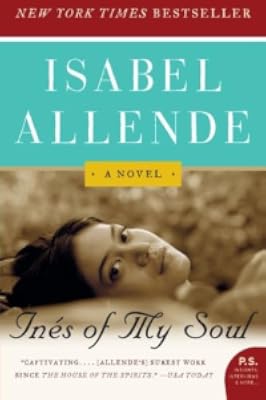
Inés of My Soul
by Isabel Allende
On This Page
Description
A passionate tale of love, freedom, and conquest from the New York Times bestselling author of The House of the Spirits, Isabel Allende. Born into a poor family in Spain, Inés Suárez, finds herself condemned to a life of poverty without opportunity as a lowly seamstress. But it's the sixteenth century, the beginning of the Spanish conquest of the Americas. Struck by the same restless hope and opportunism, Inés uses her shiftless husband's disappearance to Peru as an excuse to embark on show more her own adventure. After learning of her husband's death in battle, she meets the fiery war hero, Pedro de Valdivia and begins a love that not only changes her life but the course of history. Based on the real historical events that founded Chile, Allende takes us on a whirlwind adventure of love and loss seen through the eyes of a daring, complicated woman who fought for freedom. show lessTags
Recommendations








Member Recommendations
Member Reviews
Allende writes enjoyable and entertainingly, but in Inés of my Soul she is nowhere near at her best. In a book about not just the conquistadors of Chile, but a conquistadora, it's unsurprising that plot and melodramas, politics and romance would take up a large chunk of this book—but sadly, that often comes at the expense of character development, and there were times when Inés of my Soul felt like a run-of-the-mill romance novel.
Allende sets about to retrieve Inéz Suárez from the historical obscurity which her gender and the centuries have given her, but the portrait she paints is a rather ill-defined one. There were some passages of prose that were truly luminous, even in translation, but I never felt that I got to know Inéz show more terribly well—nor did I feel that Allende truly got to grips with the problems of writing a (largely sympathetic) novel from the point of view of a group responsible for untold levels of cultural genocide. show less
Allende sets about to retrieve Inéz Suárez from the historical obscurity which her gender and the centuries have given her, but the portrait she paints is a rather ill-defined one. There were some passages of prose that were truly luminous, even in translation, but I never felt that I got to know Inéz show more terribly well—nor did I feel that Allende truly got to grips with the problems of writing a (largely sympathetic) novel from the point of view of a group responsible for untold levels of cultural genocide. show less
Historical Fiction at its best
There are real life stories that are not celebrated enough. Such seems to be the case of the story of Inés de Suarez. In today’s society we are often looking at creating the next female hero; at times we get stories that seem more written as if the heroine was a man because authors often mistake femininity with frailty and physical prowess with strength. That’s how we get these terrible stories of 120lb femme fatales who obliterate a much bigger man in a fist fight... it doesn’t resonate with the audience.
That is not the case of Isabelle Allende’s protagonist, Inés. Here we see the perfect example of a kickass heroine, a tale that is not only believable, it is historical fact, and a female show more character that is not strong in spite of her gender, but whose strength comes in part due to her feminine charm.
Based on the story of the founding mother of Santiago, capital of Chile, and filled with the terrors of the Spanish conquest of the Americas and the wars it caused, the book juxtaposes injustice, violence and immortality with tenderness, love, passion and hope of a better future.
There are definitely fictional elements mixed with the truth, but being written as a letter to her daughter including her memoirs the mystical is successfully used to heighten the enjoyment of the fact without taking away from it.
I can say I have a new South American heroine in Inés de Suarez, and Isabel Allende continues being an author I enjoy reading.
10/10 show less
There are real life stories that are not celebrated enough. Such seems to be the case of the story of Inés de Suarez. In today’s society we are often looking at creating the next female hero; at times we get stories that seem more written as if the heroine was a man because authors often mistake femininity with frailty and physical prowess with strength. That’s how we get these terrible stories of 120lb femme fatales who obliterate a much bigger man in a fist fight... it doesn’t resonate with the audience.
That is not the case of Isabelle Allende’s protagonist, Inés. Here we see the perfect example of a kickass heroine, a tale that is not only believable, it is historical fact, and a female show more character that is not strong in spite of her gender, but whose strength comes in part due to her feminine charm.
Based on the story of the founding mother of Santiago, capital of Chile, and filled with the terrors of the Spanish conquest of the Americas and the wars it caused, the book juxtaposes injustice, violence and immortality with tenderness, love, passion and hope of a better future.
There are definitely fictional elements mixed with the truth, but being written as a letter to her daughter including her memoirs the mystical is successfully used to heighten the enjoyment of the fact without taking away from it.
I can say I have a new South American heroine in Inés de Suarez, and Isabel Allende continues being an author I enjoy reading.
10/10 show less
I don't know much about South American history, so this was an interesting way to learn about the early colonization of Peru and Chile (much like [b:Island Beneath the Sea|7005479|Island Beneath the Sea|Isabel Allende|http://photo.goodreads.com/books/1275611359s/7005479.jpg|6825396] was an interesting way to learn about Haitian and New Orleans history).
Allende took historical accounts of these events, specifically regarding Ines Suarez and Pedro de Valdivia, and fleshed them out into a novel featuring this couple who led the assault on the native inhabitants of Chile and subsequent colonization of the area. The characters were interesting, the events horrifying, but the plot wandered a bit. Some of the battle scenes and other passages show more I skimmed through. show less
Allende took historical accounts of these events, specifically regarding Ines Suarez and Pedro de Valdivia, and fleshed them out into a novel featuring this couple who led the assault on the native inhabitants of Chile and subsequent colonization of the area. The characters were interesting, the events horrifying, but the plot wandered a bit. Some of the battle scenes and other passages show more I skimmed through. show less
Ines of My Soul – Isabel Allende
4 stars
Inez Suarez, a 16th century conquistadora, played an important role in the Spanish conquest of Chile. Ines of My Soul is the fictional memoir of this amazing woman. Allende gives Inez a voice to tell the story of her marriages, love affairs and adventures. She details the brutality of the wars against the indigenous population, and describes the difficult labor of founding a city in a new land. Inez directs the text of her memoir to her step-daughter. At a certain point in the story she indicates that she is dictating to her daughter. I think this technique gave Inez a very real voice. I felt that I was listening to a conversation or that this very interesting woman was talking directly to me. show more
Inez has a great deal to say about the history of Chile, but also about the role of women. She does not spare the Spaniards in her descriptions of atrocities committed against the native population and she speaks with respect and admiration of the Mapuches. This may not be a historically accurate viewpoint, but it made her character more palatable. This was my first reading of Allende. I’m looking forward to more. show less
4 stars
Inez Suarez, a 16th century conquistadora, played an important role in the Spanish conquest of Chile. Ines of My Soul is the fictional memoir of this amazing woman. Allende gives Inez a voice to tell the story of her marriages, love affairs and adventures. She details the brutality of the wars against the indigenous population, and describes the difficult labor of founding a city in a new land. Inez directs the text of her memoir to her step-daughter. At a certain point in the story she indicates that she is dictating to her daughter. I think this technique gave Inez a very real voice. I felt that I was listening to a conversation or that this very interesting woman was talking directly to me. show more
Inez has a great deal to say about the history of Chile, but also about the role of women. She does not spare the Spaniards in her descriptions of atrocities committed against the native population and she speaks with respect and admiration of the Mapuches. This may not be a historically accurate viewpoint, but it made her character more palatable. This was my first reading of Allende. I’m looking forward to more. show less
This is the life story of Ines Suarez, a Spanish woman from a poor background, who became the gobernadora (the female governor) of Chile. She left Spain to find her husband in the New World although she had no love for him. Eventually she discovered that he had died in battle and she was a widow. By this time she was in Cuzco Peru and she encountered Pedro de Valdivia and the two of them fell passionately in love. Valdivia was a trusted military advisor to Franciso Pizarro, the Spanish conquistador who toppled the Incan empire. As a result of his service to Pizarro, Valdivia was a wealthy man but he dreamed of going to Chile and settling that land. Ines and Valdivia convinced Pizarro to let them make the attempt. They were accompanied show more by some Spanish soldiers, a priest, the pregnant Incan wife of one of the soldiers and many Yanacona Indians. This troupe crossed a barren desert and reached the site of Santiago but the Chilean Indians, the Mapuche, were not about to accept these intruders in their land. Ines was a valuable participant in the travels because of her knowledge of medicine and also her ability to dowse for water. Many years of hardship and fighting followed the settlement of Santiago. Ines and Valdivia were together for 10 years but never married since Valdivia had a wife back in Spain. After Valdivia made a trip to Peru he abandoned Ines who promptly married one of his lieutenants, Rodrigo de Quiroga, with whom she lived happily for 30 years.
That's the bare bones of the story but the details make a fascinating read. Allende had to imagine many of the details because, although Ines Suarez was a real person and did shape the history of Chile, not much is known about her. Perhaps because Allende is Chilean herself, these details ring true. Allende doesn't gloss over the grisly details of the battles with the Mapuche and some may find that off-putting. It was certainly a bloody period of history. As well as an historical story, this is also a love story. Ines was a woman who loved passionately and was loved passionately. She was also spiritual and mystical. Once you read this book I don't think you will ever forget Ines Suarez. I know I won't. show less
That's the bare bones of the story but the details make a fascinating read. Allende had to imagine many of the details because, although Ines Suarez was a real person and did shape the history of Chile, not much is known about her. Perhaps because Allende is Chilean herself, these details ring true. Allende doesn't gloss over the grisly details of the battles with the Mapuche and some may find that off-putting. It was certainly a bloody period of history. As well as an historical story, this is also a love story. Ines was a woman who loved passionately and was loved passionately. She was also spiritual and mystical. Once you read this book I don't think you will ever forget Ines Suarez. I know I won't. show less
In this book, Isabel Allende takes on the difficult task of weaving together fragments of history and distant records from the conquest of Chile in the 1530s. Written in the first person, the novel gives a voice to Inés de Suárez, a genuine female conquistador. Through her, Allende introduces us to fully developed characters, as if we were part of an intimate conversation—Inés entrusts her story to us directly. The result is a superb insight into the gruesome and treacherous wars of conquest.
Allende skillfully navigates the fine line between her own voice as author and the voice of Inés de Suárez. This is no easy task, especially since Inés herself—like any conquistador—was both a victim and, at times, a perpetrator of show more violence in order to preserve her life and that of others in the newly founded settlement, later known as Santiago de la Nueva Extremadura, or today simply Santiago, the capital of Chile. Allende places herself in Inés’ shoes with extraordinary empathy, suspending judgment (though occasional flashes of regret break through) to remain faithful to Inés’ own version of history—her voice, her perspective.
Regardless of how we view the conquest today, Inés de Suárez emerges as a woman of her time, caught in an extraordinary situation. She is not repentant; on the contrary, she is proud of her achievements. Though at times repulsed by violence, she does not fully condemn it, nor the often brutal behavior of men—particularly toward indigenous women. Her testimony offers a crucial dimension to our understanding: a distinctly female, Spanish perspective on the conquest.
While history has preserved only scant and often unflattering facts about Inés de Suárez, it has been far more generous and forgiving toward male figures such as Diego de Almagro, Francisco de Aguirre, and Pedro de Valdivia, among many others. This imbalance, I believe, is the deeper story within Allende’s book.
The novel vividly portrays the “new world” of the so-called promised land through the eyes of the colonizers. With meticulous detail, Allende describes the geography—the pristine mountains, rivers, and air—the hardships of early settlement, the birth of a city, the poverty of the colonizers, their exploitation of indigenous people, and the rivalries among themselves, all with captivating realism.
With some background knowledge of Chilean history, I recognized that at least ninety percent of the names cited in the novel belonged to real people who shaped the country’s past: indigenous leaders such as Michimalonko, Lautaro (Felipe), and Vitacura (today commemorated in one of Santiago’s municipalities), as well as Spanish officers, soldiers, and many, if not most, of the women mentioned. Yet for a non-Chilean reader, this dimension—so vital to the novel’s richness—may go unnoticed. For this reason, I would have welcomed footnotes to help readers distinguish historical fact from fiction.
Having read much of Allende’s work, and at times feeling weary of her reliance on magical realism, I found this novel a breath of fresh air. To me, it stands as one of her finest—if not her best. I deeply value the historical research she undertook to deliver such a compelling and reliable narrative of the life of Inés de Suárez. show less
Allende skillfully navigates the fine line between her own voice as author and the voice of Inés de Suárez. This is no easy task, especially since Inés herself—like any conquistador—was both a victim and, at times, a perpetrator of show more violence in order to preserve her life and that of others in the newly founded settlement, later known as Santiago de la Nueva Extremadura, or today simply Santiago, the capital of Chile. Allende places herself in Inés’ shoes with extraordinary empathy, suspending judgment (though occasional flashes of regret break through) to remain faithful to Inés’ own version of history—her voice, her perspective.
Regardless of how we view the conquest today, Inés de Suárez emerges as a woman of her time, caught in an extraordinary situation. She is not repentant; on the contrary, she is proud of her achievements. Though at times repulsed by violence, she does not fully condemn it, nor the often brutal behavior of men—particularly toward indigenous women. Her testimony offers a crucial dimension to our understanding: a distinctly female, Spanish perspective on the conquest.
While history has preserved only scant and often unflattering facts about Inés de Suárez, it has been far more generous and forgiving toward male figures such as Diego de Almagro, Francisco de Aguirre, and Pedro de Valdivia, among many others. This imbalance, I believe, is the deeper story within Allende’s book.
The novel vividly portrays the “new world” of the so-called promised land through the eyes of the colonizers. With meticulous detail, Allende describes the geography—the pristine mountains, rivers, and air—the hardships of early settlement, the birth of a city, the poverty of the colonizers, their exploitation of indigenous people, and the rivalries among themselves, all with captivating realism.
With some background knowledge of Chilean history, I recognized that at least ninety percent of the names cited in the novel belonged to real people who shaped the country’s past: indigenous leaders such as Michimalonko, Lautaro (Felipe), and Vitacura (today commemorated in one of Santiago’s municipalities), as well as Spanish officers, soldiers, and many, if not most, of the women mentioned. Yet for a non-Chilean reader, this dimension—so vital to the novel’s richness—may go unnoticed. For this reason, I would have welcomed footnotes to help readers distinguish historical fact from fiction.
Having read much of Allende’s work, and at times feeling weary of her reliance on magical realism, I found this novel a breath of fresh air. To me, it stands as one of her finest—if not her best. I deeply value the historical research she undertook to deliver such a compelling and reliable narrative of the life of Inés de Suárez. show less
3.5 Stars
This is my second book by Allende, and I can understand why people love her writing so much. She is a beautiful storyteller and her writing is so evocative and lovely and honest without being flowery or overdone. I love that quality in a writer - it's one of my favorite things about Colleen McCullough as well, especially in Tim. That book was my introduction to McCullough and it made a deep impression on me and instantly became one of my favorite books. Crap. Now I want to read it again!
Anyway, I was talking about Allende. The first book I read of hers was [b:The House of the Spirits|9328|The House of the Spirits|Isabel Allende|http://photo.goodreads.com/books/1165941575s/9328.jpg|3374404], and I really enjoyed it a lot more show more than I thought that I would. You see, I don't really care for magical realism and generally steered clear of it whenever I could. I'm gradually coming to the conclusion that, like anything else, there's good and bad magical realism, and I'd only read astoundingly bad examples of it... or read good examples of it and didn't recognize them as MR. But it took Allende and my friend Jackie recommending her books for me to see it.
Allende's books are beautifully written, and whatever mystical or magical or ethereal otherworldliness there might be is subtle and adds a little "Did you see that?" nudge in the ribs, but doesn't overtake the story, doesn't throw the narrative into confusion like some magical realism books I've read and hated with the fires of a thousand suns. I'm not going to name titles. You know who you are. >_>
Beloved.
So, this was another Jackie choice, and again I really enjoyed it, although I feel that this one lost something in the audio version. I wish that I had read this rather than listening to it. *sigh* Blair Brown did a passable Spanish accent, but quite often it was distracting. It just seemed to lack a fluidity and smoothness that native speakers have. Quite often, she'd hesitate for just a moment before pronouncing a word. It might actually only be a half second, but to me, it was a distraction. This is the kind of story that you need and want to just climb into and live for a while - and every one of those stutters pulled me out of it. I may not pronounce the Spanish correctly in my head, but reading for myself would have been smoother, since I probably wouldn't know it was wrong.
The second reason that I wish I'd have just read the book myself was that there were a whole lot of Spanish names in this one. People names, place names, historical names and Chilean native tribe names, and honestly, it was really hard to keep track of who was who when I had no visual link to the sound of the words being spoken. It didn't help much that, being told as a memoir type story, the narrative was less than linear. Wikipedia helped a lot here, and Google for being a good guesser at what I was misspelling. For instance, I'd type "Atawapa" and it would return "Did you mean Atahualpa?" Yes. Yes I did. THANK YOU GOOGLE! (And before any of you break out the ladder to get on your high horse, it's been a while since World History class, OK?) So anyway, Wikipedia helped a lot to keep the names and places and tribes and so on straight, so that I could enjoy the story and actually know who was being referred to.
I found this story fascinating. I don't really know much about Chilean history, but I feel like I know quite a bit more now. Because I was on Wikipedia and Google so much, I feel like I actually may have learned something.
This was a story about Spanish conquests and it was appropriately brutal. There were massacres and tortures and mutilations and subjugation of the indigenous people. All of that was to be expected. But there was also a softer quality to this story, a kind of empathy and understanding that Ines lent it. She claimed to not understand the 'indians' of Chile, but her description of them, and their customs and ceremonies and beliefs said otherwise. I thought several times while listening to this that she was confusing understanding with agreement. I think she understood them just fine. They wanted to live and be free and content in their lives just as she wanted to live and be free and content in her own. She could have said to the Mapuches "We're not so different, you and I." Too bad she wouldn't have gotten the Austin Powers reference. *sigh*
I really appreciated the religious aspect of the story, both from the Catholic standpoint and the Native standpoint. Allende represented both fairly, I think. Although, it seemed that there was a bit of the mystical on the side of the Christians, at least in Ines's eyes. I love that there was a little bit of that here, but also that it's interpretable. Was it a miracle that broke the rope and saved the man from hanging, or was it simply that the rope was frayed or weak? A comet, or a sign?
One thing I particularly loved regarding the religious aspect of the story was Ines, at 70, talking about how she sometimes forgets and calls God "Ngenechen", which is the Mapuche's name for their god or sometimes prays to the Earth Mother rather than the Virgin. It's such a throwaway reference, an old woman confused and mixing things up, but to me it signifies how similar beliefs can be, and how silly it is to try to force a "right" religion on someone else. What's in a name? Isn't what you believe and how you live and act more important? I think so, and I think that Ines did too. She worked for her people all her life, striving to make sure that they were as well looked after as it was in her power to do. She founded churches and hospitals and helped feed the poor and hungry, and defended the defenseless. She was definitely an awesome, if underappreciated, person.
I enjoyed this one, and might just have to read it for myself one day. I think it is a book that definitely deserves my full attention, and I couldn't give it that with the audio. But regardless, this was very good, and I'd definitely recommend it. show less
This is my second book by Allende, and I can understand why people love her writing so much. She is a beautiful storyteller and her writing is so evocative and lovely and honest without being flowery or overdone. I love that quality in a writer - it's one of my favorite things about Colleen McCullough as well, especially in Tim. That book was my introduction to McCullough and it made a deep impression on me and instantly became one of my favorite books. Crap. Now I want to read it again!
Anyway, I was talking about Allende. The first book I read of hers was [b:The House of the Spirits|9328|The House of the Spirits|Isabel Allende|http://photo.goodreads.com/books/1165941575s/9328.jpg|3374404], and I really enjoyed it a lot more show more than I thought that I would. You see, I don't really care for magical realism and generally steered clear of it whenever I could. I'm gradually coming to the conclusion that, like anything else, there's good and bad magical realism, and I'd only read astoundingly bad examples of it... or read good examples of it and didn't recognize them as MR. But it took Allende and my friend Jackie recommending her books for me to see it.
Allende's books are beautifully written, and whatever mystical or magical or ethereal otherworldliness there might be is subtle and adds a little "Did you see that?" nudge in the ribs, but doesn't overtake the story, doesn't throw the narrative into confusion like some magical realism books I've read and hated with the fires of a thousand suns. I'm not going to name titles. You know who you are. >_>
Beloved.
So, this was another Jackie choice, and again I really enjoyed it, although I feel that this one lost something in the audio version. I wish that I had read this rather than listening to it. *sigh* Blair Brown did a passable Spanish accent, but quite often it was distracting. It just seemed to lack a fluidity and smoothness that native speakers have. Quite often, she'd hesitate for just a moment before pronouncing a word. It might actually only be a half second, but to me, it was a distraction. This is the kind of story that you need and want to just climb into and live for a while - and every one of those stutters pulled me out of it. I may not pronounce the Spanish correctly in my head, but reading for myself would have been smoother, since I probably wouldn't know it was wrong.
The second reason that I wish I'd have just read the book myself was that there were a whole lot of Spanish names in this one. People names, place names, historical names and Chilean native tribe names, and honestly, it was really hard to keep track of who was who when I had no visual link to the sound of the words being spoken. It didn't help much that, being told as a memoir type story, the narrative was less than linear. Wikipedia helped a lot here, and Google for being a good guesser at what I was misspelling. For instance, I'd type "Atawapa" and it would return "Did you mean Atahualpa?" Yes. Yes I did. THANK YOU GOOGLE! (And before any of you break out the ladder to get on your high horse, it's been a while since World History class, OK?) So anyway, Wikipedia helped a lot to keep the names and places and tribes and so on straight, so that I could enjoy the story and actually know who was being referred to.
I found this story fascinating. I don't really know much about Chilean history, but I feel like I know quite a bit more now. Because I was on Wikipedia and Google so much, I feel like I actually may have learned something.
This was a story about Spanish conquests and it was appropriately brutal. There were massacres and tortures and mutilations and subjugation of the indigenous people. All of that was to be expected. But there was also a softer quality to this story, a kind of empathy and understanding that Ines lent it. She claimed to not understand the 'indians' of Chile, but her description of them, and their customs and ceremonies and beliefs said otherwise. I thought several times while listening to this that she was confusing understanding with agreement. I think she understood them just fine. They wanted to live and be free and content in their lives just as she wanted to live and be free and content in her own. She could have said to the Mapuches "We're not so different, you and I." Too bad she wouldn't have gotten the Austin Powers reference. *sigh*
I really appreciated the religious aspect of the story, both from the Catholic standpoint and the Native standpoint. Allende represented both fairly, I think. Although, it seemed that there was a bit of the mystical on the side of the Christians, at least in Ines's eyes. I love that there was a little bit of that here, but also that it's interpretable. Was it a miracle that broke the rope and saved the man from hanging, or was it simply that the rope was frayed or weak? A comet, or a sign?
One thing I particularly loved regarding the religious aspect of the story was Ines, at 70, talking about how she sometimes forgets and calls God "Ngenechen", which is the Mapuche's name for their god or sometimes prays to the Earth Mother rather than the Virgin. It's such a throwaway reference, an old woman confused and mixing things up, but to me it signifies how similar beliefs can be, and how silly it is to try to force a "right" religion on someone else. What's in a name? Isn't what you believe and how you live and act more important? I think so, and I think that Ines did too. She worked for her people all her life, striving to make sure that they were as well looked after as it was in her power to do. She founded churches and hospitals and helped feed the poor and hungry, and defended the defenseless. She was definitely an awesome, if underappreciated, person.
I enjoyed this one, and might just have to read it for myself one day. I think it is a book that definitely deserves my full attention, and I couldn't give it that with the audio. But regardless, this was very good, and I'd definitely recommend it. show less
Members
- Recently Added By
Published Reviews
Allende peppers Inés’ bio with characteristically fragrant details emotional fire-storms, lush foliage, aphrodisiac potions, and many “blazing whirlwinds” of lovemaking that turn a truly extraordinary life story into a forgettable, easy-reading romp.
added by Varinukas
“Inés is wholly a woman of her day, and Allende does not turn away from the historical record, which has her decapitating indigenous prisoners and hurling their heads over a fortress wall to terrorize their peers as well as saving lives as a gentle-handed healer.”
“Despite its graphic violence, “Ines,” like all of Allende’s novels, drips with color and sensuality. The author spent show more four years researching the era, incorporating knowledge not just about the history of Chile during the subjugation of its native people by the courageous and cruel Spanish, but such vital details as the kinds of food emigrants ate on the long ocean voyage and their manner of dress.The research pays off in finely detailed scenes.”
show less
“Despite its graphic violence, “Ines,” like all of Allende’s novels, drips with color and sensuality. The author spent show more four years researching the era, incorporating knowledge not just about the history of Chile during the subjugation of its native people by the courageous and cruel Spanish, but such vital details as the kinds of food emigrants ate on the long ocean voyage and their manner of dress.The research pays off in finely detailed scenes.”
show less
added by Varinukas
Lists

Best Contemporary Literary Fiction (Around the Last 30 Years)
388 works; 122 members

Best of World Literature
435 works; 52 members

Best 21st Century Books (So Far)
670 works; 86 members

Female Protagonist
1,056 works; 57 members

Historical Fiction
889 works; 89 members

Magic Realism
371 works; 51 members

magic realism novels
44 works; 11 members

Historical Fiction Lovers
88 works; 4 members

Reading Globally
136 works; 16 members

Books translated from Romance Languages into English
102 works; 7 members

Set in the 15th and 16th Centuries
28 works; 4 members
Author Information

88+ Works 84,839 Members
Isabel Allende was born in 1942 in Lima, Peru, the daughter of a Chilean diplomat. When her parents separated, young Isabel moved with her mother to Chile, where she spent the rest of her childhood. She married at the age of 19 and had two children, Paula and Nicolas. Her uncle was Salvador Allende, the president of Chile. When he was overthrown show more in the coup of 1973, she fled Chile, moving to Caracas, Venezuela. While living in Venezuela, Allende began writing her novels, many of them exploring the close family bonds between women. Her first novel, The House of the Spirits, has been translated into 27 languages, and was later made into a film. She then wrote Of Love and Shadows, Eva Luna, and The Stories of Eva Luna, all set in Latin America. The Infinite Plan was her first novel to take place in the United States. She explores the issues of human rights and the plight of immigrants and refugees in her novel, In The Midst of Winter. In Paula, Allende wrote her memoirs in connection with her daughter's illness and death. She delved into the erotic connections between food and love in Aphrodite: A Memoir of the Senses. In addition to writing books, Allende has worked as a TV interviewer, magazine writer, school administrator, and a secretary at a U.N. office in Chile. She received the 1996 Harold Washington Literacy Award. She lives in California. Her title Maya's Notebook made The New York Times Best Seller List in 2013. (Bowker Author Biography) show less
Some Editions
Awards and Honors
Awards
Distinctions
Notable Lists
Series
Belongs to Publisher Series
Common Knowledge
- Canonical title
- Inés of My Soul
- Original title
- Inés del alma mía
- Original publication date
- 2006
- People/Characters
- Inés Suárez (Dona); Pedro de Valdivia; Rodrigo de Quiroga; Catalina; Michimalonko; Francisco Pizarro (show all 8); Felipe; Lartaro
- Important places
- Bio Bio River; Chile; Ciudad de los Reyes, Peru; America; Peru; Santiago, Chile (show all 11); South America; Spain; Pavia, Lombardia, Italia; Roma, Lazio, Italia; Cuzco, Peru
- Important events
- Spanish Inquisition; Battle of Pavia (1525)
- First words
- I am Inés Suárez, a townswoman of the loyal city of Santiago de Nueva Extremadura in the kingdom of Chile, writing in the year of Our Lord 1580
- Last words
- (Click to show. Warning: May contain spoilers.)"Farewell, Inés of my soul ..."
- Original language
- Spanish
Classifications
- Genres
- General Fiction, Fiction and Literature, Historical Fiction
- DDC/MDS
- 863.64 — Literature & rhetoric Spanish Literature Spanish fiction 20th Century 1945-2000
- LCC
- PQ8098.1 .L54 .I5413 — Language and Literature French, Italian, Spanish and Portuguese literatures Spanish literature Provincial, local, colonial, etc. Spanish America
- BISAC
Statistics
- Members
- 2,923
- Popularity
- 6,150
- Reviews
- 95
- Rating
- (3.67)
- Languages
- 17 — Bulgarian, Danish, Dutch, English, Finnish, French, German, Greek, Italian, Lithuanian, Norwegian (Bokmål), Polish, Portuguese, Serbian, Spanish, Swedish, Turkish
- Media
- Paper, Audiobook, Ebook
- ISBNs
- 106
- ASINs
- 32