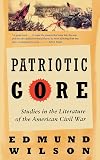
Patriotic Gore: Studies in the Literature of the American Civil War
by Edmund Wilson
On This Page
Description
Featuring critical and biographical portraits of notable figures of the American Civil War, Patriotic Gore remains one of Edmund Wilson's greatest achievements. Considered one of the 100 Best Nonfiction books by The Modern Library.Figures discussed include Harriet Beecher Stowe, Abraham Lincoln, Ulysses S. Grant, William Tecumseh Sherman, and Oliver Wendell Holmes, among many others.Tags
Recommendations


















Member Reviews
Thanks to Edmund Wilson's Patriotic Gore I have read one of America's masterpieces, A Personal Memoir of Ulysses S Grant. Wilson finds what is worthy of thought and comment on the massive amount of writing around and about the Civil War. So one expects and gets a generous exposition on Harriet Beecher Stowe, but Francis Grierson, William T Sherman, Sarah Morgan, Alboin W. Tourgee, George W Cable, Oliver Wendall Holmes, and many more may come as surprise in their numbers and completeness. Wilson sees the War as a clash of economic systems that could not tolerate the other and thus the resultant sometimes beautiful, sometimes stimulating mass of verbiage that mostly hides and obscures what the slaughter, the gore, was all about. This is show more my second reread of this provocative, thorough and informative commentary and I shall probably visit it again.
Quotes: (page 5) “To expose oneself to Uncle Tom may therefore prove a startling experience. It is a much more impressive work than one had ever been allowed to expect. The first thing that strikes one about it is a certain eruptive force. This is partly explained by the author in a preface to a late edition, in which she tells of the oppressive silence that hung over the whole question of slavery before she published her book.”
(page 536) “A Fool's Errand sold two hundred thousand copies, plus piracies, and was compared to Uncle Tom's Cabin, of which it did, indeed, have something of the compulsive and explosive force. In 1881 its sales declined steeply from the tens of thousands to the thousands...As we shall see, the people of the North and West did not by that time want to be worried by these painful intractable problems. And the problem presented by Tourgee was particularly intractable and painful, because this problem was not merely a matter of the villainy or barbarity of the South. He calls his book, A Fool's Errand, by One of the Fools, and the fool's errand is the Northerner's own mission in believing in, defending and attempting to carry out the policies of the Reconstruction government.”
(page 650) “What was it, then, that led Grant and Lincoln to express themselves with equal concision? It was undoubtedly the decisiveness with which they had to speak. They had no time in which to waist words. To temporize or deceive was too dangerous. They are obliged to issue orders and to lay down lines of policy that will immediately be understood. Their role is to convince and direct. This is the language of responsibility, and its accent of decisiveness will be carried on by the younger men who have served in the war: Ambrose Bierce in his stoical nightmare; by John De Forest in his Roman impassivity; by Justice Holmes in his judicial austerity. One finds this even in Cable when, emerging from the humid bayous and the rich dialects of Louisiana, he comes to present in unequivocal language his analysis of the problems of the South.” show less
Quotes: (page 5) “To expose oneself to Uncle Tom may therefore prove a startling experience. It is a much more impressive work than one had ever been allowed to expect. The first thing that strikes one about it is a certain eruptive force. This is partly explained by the author in a preface to a late edition, in which she tells of the oppressive silence that hung over the whole question of slavery before she published her book.”
(page 536) “A Fool's Errand sold two hundred thousand copies, plus piracies, and was compared to Uncle Tom's Cabin, of which it did, indeed, have something of the compulsive and explosive force. In 1881 its sales declined steeply from the tens of thousands to the thousands...As we shall see, the people of the North and West did not by that time want to be worried by these painful intractable problems. And the problem presented by Tourgee was particularly intractable and painful, because this problem was not merely a matter of the villainy or barbarity of the South. He calls his book, A Fool's Errand, by One of the Fools, and the fool's errand is the Northerner's own mission in believing in, defending and attempting to carry out the policies of the Reconstruction government.”
(page 650) “What was it, then, that led Grant and Lincoln to express themselves with equal concision? It was undoubtedly the decisiveness with which they had to speak. They had no time in which to waist words. To temporize or deceive was too dangerous. They are obliged to issue orders and to lay down lines of policy that will immediately be understood. Their role is to convince and direct. This is the language of responsibility, and its accent of decisiveness will be carried on by the younger men who have served in the war: Ambrose Bierce in his stoical nightmare; by John De Forest in his Roman impassivity; by Justice Holmes in his judicial austerity. One finds this even in Cable when, emerging from the humid bayous and the rich dialects of Louisiana, he comes to present in unequivocal language his analysis of the problems of the South.” show less
What strikes one at first about this fine book is its readability. From the first page, an essay on the classic Harriet Beecher Stowe novel, the prose rings true and is difficult to put down. The catalog of authors reviewed extends from Confederate ladies to soldiers who might have been lost to history if not included in this tome. This book belongs beside any library that includes the history of Shelby Foote or the poetry of Walt Whitman.
I don't often read books of literary essays anymore, but Wilson was a very fine critic and he brings to light some interesting writers of the Civil War era I hadn't come across before. He also reminds me that Reconstruction was a failed experiment that the Americans should have learned from before they dismantled the Iraqi state. How hard it is to impose democratic institutions where none had been before.
Relying heavily on primary sources, such as diaries and letters, Wilson presents the Civil War era in a more compelling fashion than many accounts that are more didactic or linked to preconceived themes and premises. His insights into what these sources reveal about the nature of war and how it is viewed in the moment versus revisionist history help to shed more light on how this terrible conflict occurred and how it affected people who lived through it. An excellent book.
Wilson discusses an obscure subject of an historically turbulent period and not only explains the transformation of American letters but the social and cultural underpinnings that led to the evolution of American literature. If a great book is one that is written well, interesting, and enlightening than this is a great book.
In 1962, when the book was published, one of the greatest literary critics of the era wrote a thick book about Civil War literature that doesn't include a single reference to writing by African American authors. Not only no Solomon Northup, but also no Frederick Douglass...an unthinkable lack of vision about "Civil War literature" that makes this interesting reading on a whole other level.
The first essay is about Harriet Beecher Stowe; I read with interest that Uncle Tom's Cabin was out of print from the late 1880's until the late 1940's.
David Blight wrote an interesting article about this book in Slate, titled "Edmund Wilson's Patriotic Gore is Not Really Much Like Any Other Book By Anyone," link here:
show more target="_top">http://www.slate.com/articles/life/history/2012/03/edmund_wilson_s_patriotic_gor..... show less
The first essay is about Harriet Beecher Stowe; I read with interest that Uncle Tom's Cabin was out of print from the late 1880's until the late 1940's.
David Blight wrote an interesting article about this book in Slate, titled "Edmund Wilson's Patriotic Gore is Not Really Much Like Any Other Book By Anyone," link here:
show more target="_top">http://www.slate.com/articles/life/history/2012/03/edmund_wilson_s_patriotic_gor..... show less
Ratings
Members
- Recently Added By
Lists

Modern Library 100 Best Nonfiction Books
100 works; 8 members

Harold Bloom - The Western Canon: D. The Chaotic Age
833 works; 24 members

Books in the Bibliography of The Alchemy of Us by Ainissa Ramirez
181 works; 1 member
Author Information

94+ Works 8,896 Members
Wilson roamed the world and read widely in many languages. He was a journalist for leading literary periodicals: Vanity Fair, where he was briefly managing editor; The New Republic, where he was associate editor for five years; and the New Yorker, where he was book reviewer in the 1940s. These varied experiences were typical of Wilson's range of show more interests and ability. Eternally productive and endlessly readable, he conquered American literature in countless essays. If he is idiosyncratic and lacks a rigid mold, that probably contributes to his success as a literary critic, since he was not committed to interpretation in the straitjacket of some popular approach or dogma. His critical position suits his cosmopolitan background---historical and sociological considerations prevail. He went through a brief Marxist period and experimented with Freudian criticism. Axel's Castle (1931), a penetrating analysis of the symbolist writer, has exerted a great influence on contemporary literary criticism. Its dedication, to Christian Gauss of Princeton, reads:"It was principally from you that I acquired.. .my idea of what literary criticism ought to be---a history of man's ideas and imaginings in the setting of the conditions which have shaped them."His volume of satiric short stories, Memoirs of Hecate County (1946), with its frankly erotic passages, was the subject of court cases in a less tolerant decade than the present one. It was Wilson's own favorite among his writings, but he complained that those individuals who like his other work tend to disregard it. (Bowker Author Biography) show less
All Editions
Awards and Honors
Awards
Distinctions
Notable Lists
Common Knowledge
- Original publication date
- 1962
- Important events
- American Civil War
- First words
- Let us begin with Uncle Tom's Cabin.
- Last words
- (Click to show. Warning: May contain spoilers.)The American Constitution was, as he came to declare, an "experiment" - what was to become of our democratic society it was impossible for a philosopher to tell - but he had taken responsibility for its working, he had subsisted and achieved his fame through his tenure of the place it had given him; and he returned to the treasury of the Union the little that he had to leave.
Classifications
Statistics
- Members
- 440
- Popularity
- 69,782
- Reviews
- 6
- Rating
- (4.06)
- Languages
- English
- Media
- Paper, Ebook
- ISBNs
- 9
- ASINs
- 8