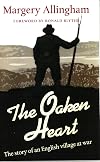
The Oaken Heart
by Margery Allingham
On This Page
Description
Margery Allingham, already a successful crime writer, was living quietly in the Essex village of Tolleshunt D'Arcy ('Auburn') when the Second World War broke out. Her house became an Air Raid Wardens' post and a First Aid centre, and Allingham herself became responsible for 275 East London evacuees in a rural community of just over 600. Commissioned by American publishing friends to recount what life was like, she began The Oaken Heart in the autumn of 1940, when the Battle of Britain gave show more way to the London Blitz. Bombs fell, even on the Essex countryside, and a German invasion was fully expected. She conceived her work as an honest letter to America. Places were given fictional names but otherwise she told it like it was, whether funny or painful. Unsentimental yet personal and rich in detail, this is an evocative first-hand account of day-to-day realities in a small community upended and terrified of the future - like so many villages of the time. show lessTags
Recommendations






















Member Recommendations

Member Reviews
This memoir of two plus years of the lead up to and beginning of World War II, as seen from Allingham's vantage in a small town in Essex, England, is a forgotten treasure. Slightly repetitive, as there are only so many ways to express resolve and resilience, but still a beautiful, interesting read. Only issue I have is that my copy (not the one shown as the book icon) is full of typos - a few a page. Maybe it was a review proof?
My four-star rating is for the modern edition of The Oaken heart (published 2011) rather than the original 1941 text. This is because that while Allingham's account of life in the lead up to and start of WWII from the perspective of a little East-coast English village is at times extremely evocative and interesting, it is also so vague (partly due to necessary censoring at the time) and filled with dozens of characters generally not properly introduced that I rarely understood who she was talking about and for some reason she insists on lengthy analogies, metaphors and similes that often went on for pages and totally lost me. In the moments when she clearly recounts anecdotes, the book is wonderful, but this is all stuck together in show more obscure soup. The modern edition has a series of appendices that really add to and clarify the book, including some notes on the text, historical information on the characters, extracts from Allingham's war diary and letters to her sister and a chapter that was originally censored. This adds a lot to the book and really improves it. My only complaint here is that the notes would have been a million times more useful and have made the book infinitely more readable had they been endnotes where you have a little number in the text and you can flip to the back to read an explanation. While reading the book, I over and over thought how much better the book would have been had someone annotated it, only to get to the very end and discover someone DID but they didn't bother putting in the asterisks so that you could look them up as you read. Baffling decision. Anyway, definitely an interesting read if you are in to British Home Front stuff. show less
The Oaken Heart - Allingham
Audio performance by Georgina Sutton
3.5 stars
Marjorie Allingham was already a well known mystery writer as England entered WW2. This memoir was commissioned by an American publisher before the United States entered the war. The intent was to give a first person account of the war’s impact on a typical English village. Although the author makes a point of saying that she is not intending to write war propaganda, (just a letter to others who may face something similar in the near future), There’s clear pro-British propaganda value in her mildly amusing anecdotes.
The tone of this memoir is very similar to the fictional Guernsey Literary and Potato Peel Society. Day to day concerns and quirky village show more characters create a light tone set against the larger reality. Allingham begins in the months before the declaration of war. The book was published in 1941. She speaks mostly of the ever changing adaptations to village life; rationing, blackouts, first aid preparations, and the accommodation of hundreds of evacuees.
She has some interesting thoughts about the ambiguous position of her own generation; too young for the first war, too old for the second. Her political opinions are fairly muddled and she says more than once that many things about the war will not be understood until it’s over. The book was apparently developed from a series of letters written to her American friends. She refers to friends and family in a way that assumes a previous familiarity, and I found myself getting completely lost in the ridiculous nicknames. I have no doubt that she described actual situations but I felt the author’s touch in the depiction of Auburn citizens as ‘characters’ in a story. show less
Audio performance by Georgina Sutton
3.5 stars
Marjorie Allingham was already a well known mystery writer as England entered WW2. This memoir was commissioned by an American publisher before the United States entered the war. The intent was to give a first person account of the war’s impact on a typical English village. Although the author makes a point of saying that she is not intending to write war propaganda, (just a letter to others who may face something similar in the near future), There’s clear pro-British propaganda value in her mildly amusing anecdotes.
The tone of this memoir is very similar to the fictional Guernsey Literary and Potato Peel Society. Day to day concerns and quirky village show more characters create a light tone set against the larger reality. Allingham begins in the months before the declaration of war. The book was published in 1941. She speaks mostly of the ever changing adaptations to village life; rationing, blackouts, first aid preparations, and the accommodation of hundreds of evacuees.
She has some interesting thoughts about the ambiguous position of her own generation; too young for the first war, too old for the second. Her political opinions are fairly muddled and she says more than once that many things about the war will not be understood until it’s over. The book was apparently developed from a series of letters written to her American friends. She refers to friends and family in a way that assumes a previous familiarity, and I found myself getting completely lost in the ridiculous nicknames. I have no doubt that she described actual situations but I felt the author’s touch in the depiction of Auburn citizens as ‘characters’ in a story. show less
A charming book that only reads like propaganda sometimes. Excellent for Anglophiles.
Ratings
Members
- Recently Added By
Lists

Women in War
148 works; 30 members

Books about World War II
241 works; 22 members

1940s
221 works; 25 members
Author Information

131+ Works 20,338 Members
Margery Allingham, one of England's leading mystery writers, was born on May 20, 1904, in Ealing, a western suburb of London, but grew up in a remote village in Essex. Both of her parents were writers, and Margery carried on that tradition when she sold her first short story as an eight-year-old. At the Regent Street Polytechnic, she continued show more writing and studied drama and speech. While there, she wrote a verse play, Dido and Aeneas, in which she had a starring role during performances in London. At age 19, Allington published her first novel, Blackkerchief Dick. She wrote another novel, The White Cottage Mystery, before creating her most famous character, Albert Campion, in The Black Dudley Murder (published in England as The Crime at Black Dudley) in 1929. Allington went on to create twenty-eight more Campion mysteries, including several collections. She wrote more than 10 other novels, some under the pseudonym Maxwell March, as well as four novellas and sixty-four short stories. During World War II, Allingham served as First Aid Commandant for her district, organized the billeting and care of evacuees from London, and allowed her house to be turned into a temporary military base for eight officers and two hundred men of the Cameronians. The war greatly deepened Allingham's passion for her country, as evidenced in her later works. Allingham died of cancer on June 30, 1966. (Bowker Author Biography) show less
Awards and Honors
Common Knowledge
- Canonical title
- The Oaken Heart
- Original publication date
- 1941
- Important events
- World War II, British Home Front; World War II (1939 | 1945)
Classifications
Statistics
- Members
- 103
- Popularity
- 314,088
- Reviews
- 4
- Rating
- (3.64)
- Languages
- English
- Media
- Paper, Audiobook, Ebook
- ISBNs
- 11
- ASINs
- 6