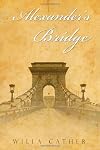
Alexander's Bridge
by Willa Cather 
On This Page
Description
Though best known as an expert chronicler of the American West, Willa Cather's first novel is an in-depth character study of world-renowned bridge designer Bartley Alexander, whose seemingly settled life is thrown into turmoil when he takes up with a former lover during a stay in London. This thought-provoking tale is sure to be a pleasant surprise for fans of Cather's later novels..
Tags
Recommendations





























Member Reviews
22. Alexander's Bridge by Willa Cather
published: 1912
format: 97-page paperback
acquired: June 2020
read: Jun 5
time reading: 2:26, 1.5 mpp
rating: 4
locations: Boston, London and New York – especially London.
about the author: born near Winchester, VA, later raised in Red Cloud, NE. December 7, 1873 – April 24, 1947
Cather's first novel is one she sort of wanted to take back. She later published an essay on how her real first novel was [O Pioneers!] (pub. 1913), and this one instead a kind of false start, overly influenced by and designed to impress the literary crowd she had become a part of. It's a nice novel, but one that only hints at Cather's later strengths.
One thing I felt was different here was the persistent exploration of show more psychology. The book is roughly a tragedy, one of Bartley Alexander, an American engineer. He has made himself something of a heroic bridge builder, called to work in Canada, London, Paris and Tokyo among other places. But his admirers can see how unhappy he is. Early on we're told he probably doesn't remember his own childhood. His admiring one-time professor explains "He was never introspective. He was simply the most tremendous response to stimuli I have ever known." And later, "No past, no future for Bartley; just the fiery moment. The only moment that ever was or will be in the world."
The same professor foreshadows our bridge-builder's future - right to him. He tells him, "The more dazzling the front you presented, the higher your facade rose, the more I expected to see a big crack zigzagging from top to bottom...then a crash and clouds of dust." Further, he observes to himself, "... that even after dinner, when most men achieve a decent impersonality, Bartley had merely closed the door of the engine-room and come up for an airing. The machinery itself was still pounding on."
Cather doesn't stop there with Bartely. But the stage is set. This force of nature runs, almost naturally, almost carelessly into an extra-marital affair, and then heads to disaster. The strain of managing his secret second life starts to pull him apart, without him able to understand it. (bridge metaphors intended) As the book goes forward, Bartley's internal tension increases, and the text reflects that.
The main complaint about the book, from Cather herself, as well as other critics, is that themes are oversimplified. And probably they are. But for 2.5 hours reading, it was a nice insight into her early thinking and writing.
2021
https://www.librarything.com/topic/330945#7524281 show less
published: 1912
format: 97-page paperback
acquired: June 2020
read: Jun 5
time reading: 2:26, 1.5 mpp
rating: 4
locations: Boston, London and New York – especially London.
about the author: born near Winchester, VA, later raised in Red Cloud, NE. December 7, 1873 – April 24, 1947
Cather's first novel is one she sort of wanted to take back. She later published an essay on how her real first novel was [O Pioneers!] (pub. 1913), and this one instead a kind of false start, overly influenced by and designed to impress the literary crowd she had become a part of. It's a nice novel, but one that only hints at Cather's later strengths.
One thing I felt was different here was the persistent exploration of show more psychology. The book is roughly a tragedy, one of Bartley Alexander, an American engineer. He has made himself something of a heroic bridge builder, called to work in Canada, London, Paris and Tokyo among other places. But his admirers can see how unhappy he is. Early on we're told he probably doesn't remember his own childhood. His admiring one-time professor explains "He was never introspective. He was simply the most tremendous response to stimuli I have ever known." And later, "No past, no future for Bartley; just the fiery moment. The only moment that ever was or will be in the world."
The same professor foreshadows our bridge-builder's future - right to him. He tells him, "The more dazzling the front you presented, the higher your facade rose, the more I expected to see a big crack zigzagging from top to bottom...then a crash and clouds of dust." Further, he observes to himself, "... that even after dinner, when most men achieve a decent impersonality, Bartley had merely closed the door of the engine-room and come up for an airing. The machinery itself was still pounding on."
Cather doesn't stop there with Bartely. But the stage is set. This force of nature runs, almost naturally, almost carelessly into an extra-marital affair, and then heads to disaster. The strain of managing his secret second life starts to pull him apart, without him able to understand it. (bridge metaphors intended) As the book goes forward, Bartley's internal tension increases, and the text reflects that.
The main complaint about the book, from Cather herself, as well as other critics, is that themes are oversimplified. And probably they are. But for 2.5 hours reading, it was a nice insight into her early thinking and writing.
2021
https://www.librarything.com/topic/330945#7524281 show less
Willa Cather’s first novel, published in 1912 just one year before her breakout work ‘O Pioneers!’, shows all of her promise, and is excellent in its own right. Cather is said to have been influenced by Henry James, but I think the novel reflects more of another in James’s circle, Edith Wharton, possibly because of her feminine viewpoint. At the same time, Cather at 39 years old channels the thoughts of a middle-aged man who is torn between a loving wife and an affair with an exciting woman from his past. It’s a brilliant psychological study, and she uses just the right amount of restraint while telling the story. I also liked the little touches she includes from the era about things like meals, ocean travel, and show more theater-going. This edition from Simon & Schuster was nice as well, as it included a number of large black and white photographs from the period, to help set the tone.
Quotes:
On affairs:
“’I am not a man who can live two lives,’ he went on feverishly. ‘Each life spoils the other. I get nothing but misery out of either. The world is all there, just as it used to be, but I can’t get at it any more. There is this deception between me and everything.’”
“It seems that a man is meant to live only one life in this world. When he tries to live a second, he develops another nature. I feel as if a second man had been grafted onto me. At first he seemed only a pleasure-loving simpleton, of whose company I was rather ashamed, and who I used to hide under my coat when I walked the Embankment, in London. But now he is strong and sullen, and he is fighting for his life at the cost of mine. That is his one activity: to grow strong. No creature ever wanted so much to live. Eventually, I suppose, he will absorb me altogether. Believe me, you will hate me then.”
On beauty:
“He liked everything about her, he told himself, but he particularly liked her eyes; when she looked at one directly for a moment they were like a glimpse of fine windy sky that may bring all sorts of weather.”
“He leaned forward and beamed felicitations as warmly as Mainhall himself when, at the end of the play, she came again and again before the curtain, panting a little and flushed, her eyes dancing and her eager, nervous little mouth tremulous with excitement.”
“She was sitting on the edge of her chair, as if she had alighted there for a moment only. Her primrose satin gown seemed like a soft sheath for her slender, supple figure, and its delicate color suited her white Irish skin and brown hair. Whatever she wore, people felt the charm of her active, girlish body with its slender hips and quick, eager shoulders.”
“He was looking at her round, slender figure, as she stood by the piano, turning over a pile of music, and he felt the energy in every line of it.”
On middle age:
“He found himself living exactly the kind of life he had determined to escape. What, he asked himself, did he want with these genial honors and substantial comforts? Hardships and difficulties he had carried lightly; overwork had not exhausted him; but this dead calm of middle life which confronted him, - of that he was afraid. He was not ready for it. It was like being buried alive. In his youth he would not have believed such a thing possible. The one thing he had really wanted all his life was to be free; and there was still something unconquered in him, something besides the strong work-horse that his profession had made of him.”
On transience:
“Since then Bartley had always thought of the British Museum as the ultimate repository of mortality, where all the dead things in the world were assembled to make one’s hour of youth the more precious. One trembled lest before he got out it might somehow escape him, lest he might drop the glass from over-eagerness and see it shivered on the stone floor at his feet. How one hid his youth under his coat and hugged it! And how good it was to turn one’s back upon all that vaulted cold, to take Hilda’s arm and hurry out of the great door and down the steps into the sunlight among the pigeons – to know that the warm and vital thing within him was still there and had not been snatched away to flush Caesar’s lean cheek or to feed the veins of some bearded Assyrian king. They in their day had carried the flaming liquor, but to-day was his!”
“I’m not tired at all. I was just wondering how people can ever die. Why did you remind me of the mummy? Life seems the strongest and most indestructible thing in the world. Do you really believe that all those people rushing about down there, going to good dinners and clubs and theatres, will be dead some day, and not care about anything? I don’t believe it, and I know I shan’t die, ever! You see, I feel too – too powerful!” show less
Quotes:
On affairs:
“’I am not a man who can live two lives,’ he went on feverishly. ‘Each life spoils the other. I get nothing but misery out of either. The world is all there, just as it used to be, but I can’t get at it any more. There is this deception between me and everything.’”
“It seems that a man is meant to live only one life in this world. When he tries to live a second, he develops another nature. I feel as if a second man had been grafted onto me. At first he seemed only a pleasure-loving simpleton, of whose company I was rather ashamed, and who I used to hide under my coat when I walked the Embankment, in London. But now he is strong and sullen, and he is fighting for his life at the cost of mine. That is his one activity: to grow strong. No creature ever wanted so much to live. Eventually, I suppose, he will absorb me altogether. Believe me, you will hate me then.”
On beauty:
“He liked everything about her, he told himself, but he particularly liked her eyes; when she looked at one directly for a moment they were like a glimpse of fine windy sky that may bring all sorts of weather.”
“He leaned forward and beamed felicitations as warmly as Mainhall himself when, at the end of the play, she came again and again before the curtain, panting a little and flushed, her eyes dancing and her eager, nervous little mouth tremulous with excitement.”
“She was sitting on the edge of her chair, as if she had alighted there for a moment only. Her primrose satin gown seemed like a soft sheath for her slender, supple figure, and its delicate color suited her white Irish skin and brown hair. Whatever she wore, people felt the charm of her active, girlish body with its slender hips and quick, eager shoulders.”
“He was looking at her round, slender figure, as she stood by the piano, turning over a pile of music, and he felt the energy in every line of it.”
On middle age:
“He found himself living exactly the kind of life he had determined to escape. What, he asked himself, did he want with these genial honors and substantial comforts? Hardships and difficulties he had carried lightly; overwork had not exhausted him; but this dead calm of middle life which confronted him, - of that he was afraid. He was not ready for it. It was like being buried alive. In his youth he would not have believed such a thing possible. The one thing he had really wanted all his life was to be free; and there was still something unconquered in him, something besides the strong work-horse that his profession had made of him.”
On transience:
“Since then Bartley had always thought of the British Museum as the ultimate repository of mortality, where all the dead things in the world were assembled to make one’s hour of youth the more precious. One trembled lest before he got out it might somehow escape him, lest he might drop the glass from over-eagerness and see it shivered on the stone floor at his feet. How one hid his youth under his coat and hugged it! And how good it was to turn one’s back upon all that vaulted cold, to take Hilda’s arm and hurry out of the great door and down the steps into the sunlight among the pigeons – to know that the warm and vital thing within him was still there and had not been snatched away to flush Caesar’s lean cheek or to feed the veins of some bearded Assyrian king. They in their day had carried the flaming liquor, but to-day was his!”
“I’m not tired at all. I was just wondering how people can ever die. Why did you remind me of the mummy? Life seems the strongest and most indestructible thing in the world. Do you really believe that all those people rushing about down there, going to good dinners and clubs and theatres, will be dead some day, and not care about anything? I don’t believe it, and I know I shan’t die, ever! You see, I feel too – too powerful!” show less
Bartley Alexander is a successful man with an accomplished wife, internationally sought after in structural engineering circles and builder of record-setting bridges. In his forties he re-encounters an early love and recognizes that he has lost the youthful sense of power and seeks it out through her. He is soon taken aback by the inevitable cost in internal conflicts. The story is an earlier N. American strand of the later The Bridge of San Luis Rey but in reverse.
Willa Cather presumably had a different intention in revealing the self-destructive, self-indulgent self-pity of the successful middle-aged professional man wallowed in by so many male writers of the 20th century, but it doesn't read so differently from this perspective.
Willa Cather presumably had a different intention in revealing the self-destructive, self-indulgent self-pity of the successful middle-aged professional man wallowed in by so many male writers of the 20th century, but it doesn't read so differently from this perspective.
A not-very-engaging-or impressive first novel from an author who later achieved something marvelous with Death Comes for the Archbishop, which I read a couple years ago. Even the author herself noted the weakness of this work in a preface she reluctantly wrote for a new edition in 1922. This is the story of a successful bridge-builder whose life is unraveling. He is forced to cut corners on his latest project; he half-heartedly re-connects with an old flame although he acknowledges that he has married the perfect woman for him, and loves his life. He seems to have no gumption to stand up for his work or his marriage, and he is such a flat and uninteresting character that I couldn't care less whether he ever found his spine or show more not.
Reviewed in 2014 show less
Reviewed in 2014 show less
Willa Cather is one of the authors who I am determined to read a lot more of this year. I already have several waiting to be read, I feel she is a writer that I have so far neglected a little bit.
Alexander’s Bridge was Willa Cather’s first novel, published in 1912, it is quite different to O! Pioneers – her second novel and the first of her Prairie trilogy that she is perhaps best known for and depicts Pioneer life in Nebraska.
In 1907 the great new cantilever bridge that was being built over the St. Lawrence River in Quebec collapsed with terrible loss of life, including the chief engineer. At this time Willa Cather was working for a magazine in New York, but she was obviously later inspired to use this dramatic real life story in show more her first novel.
Bartley Alexander is a middle aged engineer, famous for the increasingly ambitious bridges that he has designed. Married to Winifred, a beautiful, elegant woman, whom he loves and who thoroughly adores him, he has an enviable home in Boston. As the novel opens the Alexanders are visited by Professor Wilson, Bartley’s one time teacher who has watched his career with pride and in Winifred finds a wonderfully warm and considerate hostess. Soon after on a trip to London, Bartley comes across Hilda Burgoyne an Irish actress who he had loved years earlier. At first Bartley is nervous of approaching her, and having watched her perform on stage takes to walking in the streets around her house.
“He started out upon these walks half guiltily, with a curious longing and expectancy which were wholly gratified by solitude. Solitude, but not solitariness; for he walked shoulder to shoulder with a shadowy companion – not little Hilda Burgoyne, by any means, but someone vastly dearer to him that she had ever been – his own young self, the youth who had waited for him upon the steps of the British Museum that night, and who, though he had tried to pass so quietly, had known him and came down and linked an arm in his
It was not until long afterwards that Alexander learned that for him this youth was the most dangerous of companions”
Of course the two do meet, and Bartley Alexander is delighted to find her so little changed. The relationship is resumed and Bartley finds himself emotionally torn between his beautiful, faultless wife and the excitement of a re-kindled love affair.
Winifred is the woman who has supported him throughout his career, who he met whilst building his very first bridge – their shared history is that of his success. Hilda is impulsive, passionate and generous, and with her Bartley is brought back to his youth. As he struggles with the two sides of himself – the cracks begin to show in his professional life. In the construction of his latest bridge in Canada, a bridge everyone is already taking about – Bartley Alexander has been forced to cut costs on his most audacious structure yet.
Willa Cather’s short first novel is beautifully and sympathetically written, and this struggle with differing sides of the self is a theme she comes back to in later work. Not a word is wasted in this novel, which combines extraordinary drama with real compassion. Cather’s characters are wonderfully real, their humanness and vulnerabilities are brilliantly explored. Apparently in later years, Cather was rather disparaging about her first novel, but I loved it. It is a simple story in many ways but it is so well written, it perfectly shows the brilliance that was to come. show less
Alexander’s Bridge was Willa Cather’s first novel, published in 1912, it is quite different to O! Pioneers – her second novel and the first of her Prairie trilogy that she is perhaps best known for and depicts Pioneer life in Nebraska.
In 1907 the great new cantilever bridge that was being built over the St. Lawrence River in Quebec collapsed with terrible loss of life, including the chief engineer. At this time Willa Cather was working for a magazine in New York, but she was obviously later inspired to use this dramatic real life story in show more her first novel.
Bartley Alexander is a middle aged engineer, famous for the increasingly ambitious bridges that he has designed. Married to Winifred, a beautiful, elegant woman, whom he loves and who thoroughly adores him, he has an enviable home in Boston. As the novel opens the Alexanders are visited by Professor Wilson, Bartley’s one time teacher who has watched his career with pride and in Winifred finds a wonderfully warm and considerate hostess. Soon after on a trip to London, Bartley comes across Hilda Burgoyne an Irish actress who he had loved years earlier. At first Bartley is nervous of approaching her, and having watched her perform on stage takes to walking in the streets around her house.
“He started out upon these walks half guiltily, with a curious longing and expectancy which were wholly gratified by solitude. Solitude, but not solitariness; for he walked shoulder to shoulder with a shadowy companion – not little Hilda Burgoyne, by any means, but someone vastly dearer to him that she had ever been – his own young self, the youth who had waited for him upon the steps of the British Museum that night, and who, though he had tried to pass so quietly, had known him and came down and linked an arm in his
It was not until long afterwards that Alexander learned that for him this youth was the most dangerous of companions”
Of course the two do meet, and Bartley Alexander is delighted to find her so little changed. The relationship is resumed and Bartley finds himself emotionally torn between his beautiful, faultless wife and the excitement of a re-kindled love affair.
Winifred is the woman who has supported him throughout his career, who he met whilst building his very first bridge – their shared history is that of his success. Hilda is impulsive, passionate and generous, and with her Bartley is brought back to his youth. As he struggles with the two sides of himself – the cracks begin to show in his professional life. In the construction of his latest bridge in Canada, a bridge everyone is already taking about – Bartley Alexander has been forced to cut costs on his most audacious structure yet.
Willa Cather’s short first novel is beautifully and sympathetically written, and this struggle with differing sides of the self is a theme she comes back to in later work. Not a word is wasted in this novel, which combines extraordinary drama with real compassion. Cather’s characters are wonderfully real, their humanness and vulnerabilities are brilliantly explored. Apparently in later years, Cather was rather disparaging about her first novel, but I loved it. It is a simple story in many ways but it is so well written, it perfectly shows the brilliance that was to come. show less
I read this book years ago and did not recognize that fact until I was 20 or so pages in. Unlike the first time, I savored every single word. Cather's writing is akin to experiencing ascending diamond tipped ocean waves as they glide to the shore on a warm and restful day; mesmerizing. The story was more interesting to me at 57 than it was many years ago, in it's humanness and her main character, Bartley Alexander. I was surprised at the compassion that her story evoked toward Bartley and in treading into a world and time that I've been charmed by only in old films. I have read reviews on this book, her first published novel, and I am relieved to not be tethered by narrow viewpoints that put every book through a series of tests and show more report on where it did and didn't meet the collective ideal. My review is simply experiential and based on the sheer delight in revisiting and being touched by a story well told. show less
Reason read: I do enjoy Willa Cather’s writing. This one is short in length and her debut as an author. She did not like it and wanted to basically disown it. I enjoyed this story of a bridge builder. It maybe doesn’t have the greatness of her following works but I still think it has merit.
Members
- Recently Added By
Lists

Fiction with Men's Given Names in the Title
302 works; 10 members
Author Information

151+ Works 45,841 Members
Willa Siebert Cather was born in 1873 in the home of her maternal grandmother in western Virginia. Although she had been named Willela, her family always called her "Willa." Upon graduating from the University of Nebraska in 1895, Cather moved to Pittsburgh where she worked as a journalist and teacher while beginning her writing career. In 1906, show more Cather moved to New York to become a leading magazine editor at McClure's Magazine before turning to writing full-time. She continued her education, receiving her doctorate of letters from the University of Nebraska in 1917, and honorary degrees from the University of Michigan, the University of California, Columbia, Yale, and Princeton. Cather wrote poetry, short stories, essays, and novels, winning awards including the Pulitzer Prize for her novel, One of Ours, about a Nebraska farm boy during World War I. She also wrote The Professor's House, My Antonia, Death Comes for the Archbishop, and Lucy Gayheart. Some of Cather's novels were made into movies, the most well-known being A Lost Lady, starring Barbara Stanwyck. In 1961, Willa Cather was the first woman ever voted into the Nebraska Hall of Fame. She was also inducted into the Hall of Great Westerners in Oklahoma in 1974, and the National Women's Hall of Fame in Seneca, New York in 1988. Cather died on April 24, 1947, of a cerebral hemorrhage, in her Madison Avenue, New York home, where she had lived for many years. (Bowker Author Biography) show less
Willa Cather has a Legacy Library. Legacy libraries are the personal libraries of famous readers, entered by LibraryThing members from the Legacy Libraries group.
Some Editions
Series
Belongs to Publisher Series
Work Relationships
Is contained in
Willa Cather - The Library of America Set Complete in 3 Volumes (1. Early Novels & Stories; 2. Stories, Poems and Other Writings; and 3. Later Novels) by Willa Cather (indirect)
The novels and stories of Willa Cather. Volume 3: Alexander's Bridge; April Twilights by Willa Cather
Willa Cather's Collected Works: My Ántonia, Song of the Lark, One of Ours, O Pioneers, The Profile, And More! by Willa Cather
Has as a reference guide/companion
Common Knowledge
- Original publication date
- 1912
- People/Characters
- Professor Lucius Wilson; Bartley Alexander; Winifred Alexander; Maurice Mainhall; Hilda Burgoyne
- Important places
- Boston, Massachusetts, USA; London, England, UK; New York, New York, USA
- First words
- Late one brilliant April afternoon Professor Lucius Wilson stood at the head of Chestnut Street, looking about him with the pleased air of a man of taste who does not very often get to Boston.
It is difficult to comply with the publisher's request that I write a preface for this new edition of an early book. (Preface)
On 29 August 1907, the great cantilever bridge that was being built over the St. Lawrence River in Quebec collapsed and fell, with a terrible sound of grinding steel and snapping girders, shouts of terror and the booming cras... (show all)h of cables. (Introduction) - Last words
- (Click to show. Warning: May contain spoilers.)They both sat looking into the fire.
(Click to show. Warning: May contain spoilers.)About the essential matter of his story he cannot argue this way or that; he has seen it, has been enlightened about it in flashes that are as unreasoning, often as unreasonable, as life itself. (Preface)
(Click to show. Warning: May contain spoilers.)In Cather this will always be the deepest split: between the life force and the desire for obliteration. (Introduction) - Original language
- English
Classifications
Statistics
- Members
- 515
- Popularity
- 57,951
- Reviews
- 26
- Rating
- (3.44)
- Languages
- 6 — Catalan, Dutch, English, French, German, Spanish
- Media
- Paper, Audiobook, Ebook
- ISBNs
- 110
- UPCs
- 2
- ASINs
- 18