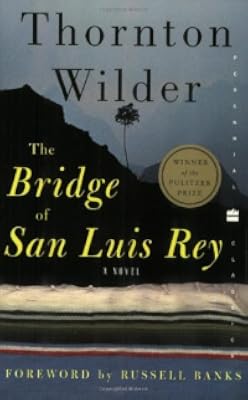
The Bridge of San Luis Rey
by Thornton Wilder
On This Page
Description
Classic Literature. Fiction. The Bridge of San Luis Rey, Thornton Wilder's second novel, won him the first of his three Pulitzer Prizes. The novel opens in the aftermath of an inexplicable tragedy-a tiny footbridge in Peru breaks, and five travelers hurtle to their deaths. Most townspeople think to themselves with secret joy, "Within 10 minutes myself...." But for Brother Juniper, a humble Franciscan friar who witnesses the catastrophe, the question is inescapable: Why those five? Suddenly, show more Brother Juniper is committed to discover what manner of lives these five disparate people led-and whether it was divine intervention that took their lives, or a capricious fate. Wilder maintained in his works that true meaning and beauty are found in ordinary experience. This is especially true of The Bridge of San Luis Rey. From the very beginning to the stunning conclusion, the listener is absorbed into the individual stories of the five victims, and how their destinies intertwine. show lessTags
Recommendations












Member Recommendations
Member Reviews
I thoroughly enjoyed this book, from its memorable opening line to its closing memorable line, and all its vividness in between. It was enjoyable to be not only so skillfully entertained but to be asked, without layers of subterfuge, the deepest philosophical question a person will ever ask at some point in their life. And I love the answer that I felt Wilder lead me to find within.
(Spoilers below.)
It's interesting that the church (who is supposed to lead us to those answers) finds Brother Juniper's work heretical. Here it is, the basic theological question, "Do we matter to God?" and the good monk is convinced the answer is Yes. But even after years of probing all the smallest pieces of evidence in the lives of the five, he feels he show more has never gained a firm understanding of the mind of God. The church judges, corrupt and barely tolerant of the question, certainly couldn't stand an unfinished answer and so condemns him in notorious Spanish Inquisition fashion. Consumed by his fiery fate, the monk never doubts God, only himself. He is the epitome of faith, believing while having no answers.
It is an interesting contrast, too, that while the pious monk's work is burned (and the other copy forgotten on a dusty shelf) the Marquesa's letters go on to great fame. The words of the drunk, the awkward, the laughable, the sincere-but-misguided Marquesa lives and inspires for centuries, an example of the fickle unpredictability of what matters and what doesn't in mere human annals.
Ultimately it's the nun, Madre Maria, who is affected in the most profound way by the collapse of the bridge and it's her thoughts on life's divine meaning that ends the novel so beautifully. She comes to believe that no, her life's work doesn't matter and that not even being remembered fondly by loved ones matters because those that remember will die soon, too. She concludes it is the love itself that matters to God. It is our love -- love by human beings destined to be unremembered and often unrewarded -- that matters by returning to "the love that made them." It's not God's love for us, or our love for God, but our love for one another is the real divine exchange, that which has its source from and that which returns to God. It is the only meaning, the only bridge between man and God. show less
(Spoilers below.)
It's interesting that the church (who is supposed to lead us to those answers) finds Brother Juniper's work heretical. Here it is, the basic theological question, "Do we matter to God?" and the good monk is convinced the answer is Yes. But even after years of probing all the smallest pieces of evidence in the lives of the five, he feels he show more has never gained a firm understanding of the mind of God. The church judges, corrupt and barely tolerant of the question, certainly couldn't stand an unfinished answer and so condemns him in notorious Spanish Inquisition fashion. Consumed by his fiery fate, the monk never doubts God, only himself. He is the epitome of faith, believing while having no answers.
It is an interesting contrast, too, that while the pious monk's work is burned (and the other copy forgotten on a dusty shelf) the Marquesa's letters go on to great fame. The words of the drunk, the awkward, the laughable, the sincere-but-misguided Marquesa lives and inspires for centuries, an example of the fickle unpredictability of what matters and what doesn't in mere human annals.
Ultimately it's the nun, Madre Maria, who is affected in the most profound way by the collapse of the bridge and it's her thoughts on life's divine meaning that ends the novel so beautifully. She comes to believe that no, her life's work doesn't matter and that not even being remembered fondly by loved ones matters because those that remember will die soon, too. She concludes it is the love itself that matters to God. It is our love -- love by human beings destined to be unremembered and often unrewarded -- that matters by returning to "the love that made them." It's not God's love for us, or our love for God, but our love for one another is the real divine exchange, that which has its source from and that which returns to God. It is the only meaning, the only bridge between man and God. show less
Thornton Wilder successfully fictionalized some ages-old core existential questions that have haunted humanity since its inception in his short novel, The Bridge of San Luis Rey. Why do bad things happen to good people indiscriminately, while bad people prosper? Is there a plan or purpose behind the bad happenings? A reason? Are seemingly senseless accidents such as the one depicted in the novel -- the collapse of a bridge, a "ladder of thin slats swung out over a gorge, with handrails of dried vine" -- or other bad happenings such as natural disasters, poverty or war, "acts of God" or acts of fate? Or neither or something else? Are they meaningful or meaningless? If those who fell to their deaths in Wilder's novel died because God show more willed them to die, as Brother Juniper's order believes, is it then a capital offense to seek proof to that effect through non-Catholic means? Complicated, convoluted questions, even for skeptics, raised by this slim, but intense, and beautifully written novel, The Bridge of San Luis Rey.
Wilder, of course, doesn't explicitly answer these universal questions, though by novel's end, our narrator, Brother Juniper, eyewitness to the collapse: "He saw the bridge divide and fling five gesticulating ants into the valley below..." certainly, in part, has answered some of them. In some socks-you-in-the-gut, brutal irony, Brother Juniper, after he's dared ask why -- why did these people die?, why did the bridge collapse for them instead of others? -- and then travelled by foot great distances to probe the lives and personal histories of those who fell for possible clues to answer these deeper questions that are only natural for an inquisitive mind's pursuit, ultimately becomes the sixth and final victim of the bridge of San Luis Rey's collapse.
Brother Juniper lacked the foresight in recognizing how dangerous his questions were in a culture whose pious insularity accepted nothing less than rote avowals of faith in God's sovereign will. Moreover, and to the practical point, Brother Juniper was stealing time from his ascetic duties to solitude and prayer in order to play detective. In the least he was egregiously undisciplined; at worst, a heretic. But his fellow monks had it wrong. Brother Juniper wasn't looking to discredit God, but rather sought in his investigations a way to prove God's sovereignty, to affirm his faith in God not just by faith but facts.
Brother Juniper's decision to mix his intellect with his faith, instead of abiding strictly by faith alone; which he denied the second he began his investigation into why those five unfortunate travelers may have perished when, where, and how they perished, was not surprisingly condemned on the spot as insubordination and blatant blasphemy, an unforgivable rejection of faith in God and the most holy and sacred tenets of Catholicism. How dare a middling monk not take God automatically on faith! Who did this insignificant little man, Brother Juniper, think he was, embarrassing the Church like that with his foolish questions? And so for the supposed unpardonable sin of suggesting God's will -- God's very mind -- could be accessed through an investigation, through the woefully finite human insight of what amounted to empiricism, Brother Juniper, a devout Catholic, became essentially a martyr for science.
If there are any answers in this indifferent universe that can even partially explain how Evil and Human Suffering can comfortably coexist alongside a purported All-good and Omnipotent God, an All-wise Deity to be trusted and praised by His adherents even when disasters on a scale more monstrous than the collapse of a flimsy, make-believe bridge in Peru occur ... say the collapse of the Twin Towers, the collapse of the cities of Nagasaki and Hiroshima, or the unending collapse that has been Genocide throughout the ages, continuing still today in Syria ... then it's clear to me that Brother Juniper (one of my favorite catholics real or fictitious ever!) was at least partly successful in his heroic -- and in my opinion faithful -- quest for truth. show less
Wilder, of course, doesn't explicitly answer these universal questions, though by novel's end, our narrator, Brother Juniper, eyewitness to the collapse: "He saw the bridge divide and fling five gesticulating ants into the valley below..." certainly, in part, has answered some of them. In some socks-you-in-the-gut, brutal irony, Brother Juniper, after he's dared ask why -- why did these people die?, why did the bridge collapse for them instead of others? -- and then travelled by foot great distances to probe the lives and personal histories of those who fell for possible clues to answer these deeper questions that are only natural for an inquisitive mind's pursuit, ultimately becomes the sixth and final victim of the bridge of San Luis Rey's collapse.
Brother Juniper lacked the foresight in recognizing how dangerous his questions were in a culture whose pious insularity accepted nothing less than rote avowals of faith in God's sovereign will. Moreover, and to the practical point, Brother Juniper was stealing time from his ascetic duties to solitude and prayer in order to play detective. In the least he was egregiously undisciplined; at worst, a heretic. But his fellow monks had it wrong. Brother Juniper wasn't looking to discredit God, but rather sought in his investigations a way to prove God's sovereignty, to affirm his faith in God not just by faith but facts.
Brother Juniper's decision to mix his intellect with his faith, instead of abiding strictly by faith alone; which he denied the second he began his investigation into why those five unfortunate travelers may have perished when, where, and how they perished, was not surprisingly condemned on the spot as insubordination and blatant blasphemy, an unforgivable rejection of faith in God and the most holy and sacred tenets of Catholicism. How dare a middling monk not take God automatically on faith! Who did this insignificant little man, Brother Juniper, think he was, embarrassing the Church like that with his foolish questions? And so for the supposed unpardonable sin of suggesting God's will -- God's very mind -- could be accessed through an investigation, through the woefully finite human insight of what amounted to empiricism, Brother Juniper, a devout Catholic, became essentially a martyr for science.
If there are any answers in this indifferent universe that can even partially explain how Evil and Human Suffering can comfortably coexist alongside a purported All-good and Omnipotent God, an All-wise Deity to be trusted and praised by His adherents even when disasters on a scale more monstrous than the collapse of a flimsy, make-believe bridge in Peru occur ... say the collapse of the Twin Towers, the collapse of the cities of Nagasaki and Hiroshima, or the unending collapse that has been Genocide throughout the ages, continuing still today in Syria ... then it's clear to me that Brother Juniper (one of my favorite catholics real or fictitious ever!) was at least partly successful in his heroic -- and in my opinion faithful -- quest for truth. show less
”On Friday noon, July the twentieth, 1714, the finest bridge in all Peru broke and precipitated five travelers into the gulf below.” So begins Thornton Wilder’s The Bridge of San Luis Rey, a timeless parable, properly lauded as one of the great novels in American literature. Brother Juniper, a monk who happens to witness the tragedy, seeks to prove that some divine intervention rather than chance led to the deaths of those particular five victims. Wilder’s seemingly simple narrative belies the deep underlying complexities of emotions that weave through the story: love and respect, fear and jealousy, pain and insecurity; and the nuances that give deeper insight into the human condition. As I can attest, it is not uncommon to show more completely miss the message and the meaning after an initial reading of the book. This is a rich, powerful, and profound novel whose beauty, clarity, and poignancy comes ever clearer with successive readings. show less
Summary: A friar witnesses the collapse of a woven rope bridge with five people falling to their deaths and tries to discern some reason why, in God’s providence, each of them died.
It’s the unanswerable question we struggle with in every untimely death. We try to find some reason to explain why the death or deaths occurred, often some version of “it was God’s time,” or “they were too good for earth,” or that there was some sinful reason why they died. In the end we are left with uncertainty–none of these rationalizations satisfy or comfort and most explanations seem cruel or trite.
That is the premise of this Thornton Wilder story, which launched his literary career, winning him a Pulitzer Prize in fiction, and creating show more the opportunity for him to live a life of teaching and writing. Brother Juniper has just come into view of the woven rope bridge over a river gorge between Lima and Cuzco when the bridge collapses, sending five people on the bridge to their death. As a theologically oriented religious man, he sets himself the task to find evidence in their lives that would demonstrate that this was God’s plan for each person.
After the opening chapter, which lays out the premise of the story, the next three represent the account of six years of research on the part of Brother Juniper, talking to everyone who knew those who fell. The first concerns Dona Maria, the Marquesa de Montemayor, a difficult woman estranged from her daughter, who lives in Spain, and her companion Pepita, a young girl being groomed by Madre Maria de Pilar, to succeed her in the work of abbess of the orphanage where Pepita grew up. The two go on pilgrimage to a shrine so that Dona Maria can pray for her pregnant daughter. While she is praying, Pepita writes a letter to Madre Maria that Dona Maria sees, of how difficult life is with her. Pepita destroys the letter before Dona Maria confronts her, deciding it was not brave. They reconcile, Dona Maria writes a “brave” letter to her daughter, and it is on their return that they die in the collapse.
The next character is Esteban, twin brother of Manuel. The two grew up in the orphanage and became scribes, writing for, among others, Camilla Perichole, a famous and rather vain actress. Manuel dies of an infection, and Esteban, grief stricken despairs of life, attempting suicide, prevented by the captain who wants to take him to sea to restore him. Esteban wants to make a present of the pay advanced to him to Madre Maria de Pilar and dies on the bridge enroute to the orphanage.
The final two are Uncle Pio, who had mentored Camilla Perichole, helping her to achieve fame, and Perichole’s son Jaime. When small pox disfigures her, her career is ended. Uncle Pio sees her one night and she refuses to see him again but agrees to let him mentor her son. Uncle Pio and Jaime are on the way to Lima when the bridge collapses.
The final chapter describes the completion of Brother Juniper’s book in which he even tries formulas that he applies to each life, to no avail. This all ends badly for Juniper who is declared a heretic, punishable by death.
The account of their lives, in very formal language, brings no conclusion, just facts of people with their loves, longings, loneliness, petty, and noble acts. It’s simply, this is the story of their lives…and then they died on the bridge. The closest Wilder gets in the novel to making sense of it all is at the funeral in the famous, oft-quoted closing line spoken by Abbess Madre Maria de Pilar: “There is a land of the living and a land of the dead, and the bridge is love, the only survival, the only meaning.”
I cannot decide whether this is a beautiful or a trite thought. I suspect some find comfort in keeping their dead alive in loving memory which connects them to the loved ones they’ve lost. I have those memories, particularly of father and mother and dear friends who have died, but also the apprehension of the yawning void that separates us that love may bridge in thought but not reality. I’m not sure we ever find “meaning” in the death of anyone, even if they die in some cause. I wonder instead, and this reflects my Christian convictions, if what we may talk about is hope, the belief that they, and we, will “rise in glory” after resting in peace. It doesn’t offer a “meaning” to death, which may faith tells me is the “last enemy” but it consoles in loss and grief. show less
It’s the unanswerable question we struggle with in every untimely death. We try to find some reason to explain why the death or deaths occurred, often some version of “it was God’s time,” or “they were too good for earth,” or that there was some sinful reason why they died. In the end we are left with uncertainty–none of these rationalizations satisfy or comfort and most explanations seem cruel or trite.
That is the premise of this Thornton Wilder story, which launched his literary career, winning him a Pulitzer Prize in fiction, and creating show more the opportunity for him to live a life of teaching and writing. Brother Juniper has just come into view of the woven rope bridge over a river gorge between Lima and Cuzco when the bridge collapses, sending five people on the bridge to their death. As a theologically oriented religious man, he sets himself the task to find evidence in their lives that would demonstrate that this was God’s plan for each person.
After the opening chapter, which lays out the premise of the story, the next three represent the account of six years of research on the part of Brother Juniper, talking to everyone who knew those who fell. The first concerns Dona Maria, the Marquesa de Montemayor, a difficult woman estranged from her daughter, who lives in Spain, and her companion Pepita, a young girl being groomed by Madre Maria de Pilar, to succeed her in the work of abbess of the orphanage where Pepita grew up. The two go on pilgrimage to a shrine so that Dona Maria can pray for her pregnant daughter. While she is praying, Pepita writes a letter to Madre Maria that Dona Maria sees, of how difficult life is with her. Pepita destroys the letter before Dona Maria confronts her, deciding it was not brave. They reconcile, Dona Maria writes a “brave” letter to her daughter, and it is on their return that they die in the collapse.
The next character is Esteban, twin brother of Manuel. The two grew up in the orphanage and became scribes, writing for, among others, Camilla Perichole, a famous and rather vain actress. Manuel dies of an infection, and Esteban, grief stricken despairs of life, attempting suicide, prevented by the captain who wants to take him to sea to restore him. Esteban wants to make a present of the pay advanced to him to Madre Maria de Pilar and dies on the bridge enroute to the orphanage.
The final two are Uncle Pio, who had mentored Camilla Perichole, helping her to achieve fame, and Perichole’s son Jaime. When small pox disfigures her, her career is ended. Uncle Pio sees her one night and she refuses to see him again but agrees to let him mentor her son. Uncle Pio and Jaime are on the way to Lima when the bridge collapses.
The final chapter describes the completion of Brother Juniper’s book in which he even tries formulas that he applies to each life, to no avail. This all ends badly for Juniper who is declared a heretic, punishable by death.
The account of their lives, in very formal language, brings no conclusion, just facts of people with their loves, longings, loneliness, petty, and noble acts. It’s simply, this is the story of their lives…and then they died on the bridge. The closest Wilder gets in the novel to making sense of it all is at the funeral in the famous, oft-quoted closing line spoken by Abbess Madre Maria de Pilar: “There is a land of the living and a land of the dead, and the bridge is love, the only survival, the only meaning.”
I cannot decide whether this is a beautiful or a trite thought. I suspect some find comfort in keeping their dead alive in loving memory which connects them to the loved ones they’ve lost. I have those memories, particularly of father and mother and dear friends who have died, but also the apprehension of the yawning void that separates us that love may bridge in thought but not reality. I’m not sure we ever find “meaning” in the death of anyone, even if they die in some cause. I wonder instead, and this reflects my Christian convictions, if what we may talk about is hope, the belief that they, and we, will “rise in glory” after resting in peace. It doesn’t offer a “meaning” to death, which may faith tells me is the “last enemy” but it consoles in loss and grief. show less
“On Friday noon, July the twentieth, 1714, the finest bridge in all Peru broke and precipitated five travelers into the gulf below.” And so begins The Bridge of San Luis Rey, which is a small masterpiece. Wilder’s prose is beautiful and he creates great character sketches in a work that is all framed to consider the question “Is there a direction and meaning in lives beyond the individual’s own will?” He applies just the right touch artistically for so weighty a subject, and in the end, as in life, the “answer” is really up to the reader. Highly recommended.
Some fun facts: Wilder was born in Madison, Wisconsin, and graduated from Berkeley High School. The book launched him to immediate worldwide fame; his teaching salary show more at the time was $3,000 and the book made him $87,000 in 1928 alone, which is about a million dollars in today’s currency. Lastly, David Mitchell fans will recall the character Luisa Rey, named as an homage to this work, as well as perhaps recall the epigraph to Ghostwritten, taken from the end of the first chapter:
“And I, who claim to know so much more, isn’t it possible that even I have missed the very spring within the spring?
Some say that we shall never know and that to the gods we are like flies that the boys kill on a summer day, and some say, on the contrary, that the very sparrows do not lose a feather that has not been brushed away by the finger of God.”
A couple of other quotes that I loved:
On literature:
“…the Conde delighted in her letters, but he thought that when he had enjoyed the style he had extracted all their richness and intention, missing (as most readers do) the whole purport of literature, which is the notation of the heart.”
And this one on love, which I found that Tony Blair used in a memorial service for British victims of 9/11:
“But soon we shall die and all memories of those five will have left the earth, and we ourselves shall be loved for a while and forgotten. But the love will have been enough; all those impulses of love return to the love that made them. Even memory is not necessary for love. There is a land of the living and a land of the dead and the bridge is love, the only survival, the only meaning." show less
Some fun facts: Wilder was born in Madison, Wisconsin, and graduated from Berkeley High School. The book launched him to immediate worldwide fame; his teaching salary show more at the time was $3,000 and the book made him $87,000 in 1928 alone, which is about a million dollars in today’s currency. Lastly, David Mitchell fans will recall the character Luisa Rey, named as an homage to this work, as well as perhaps recall the epigraph to Ghostwritten, taken from the end of the first chapter:
“And I, who claim to know so much more, isn’t it possible that even I have missed the very spring within the spring?
Some say that we shall never know and that to the gods we are like flies that the boys kill on a summer day, and some say, on the contrary, that the very sparrows do not lose a feather that has not been brushed away by the finger of God.”
A couple of other quotes that I loved:
On literature:
“…the Conde delighted in her letters, but he thought that when he had enjoyed the style he had extracted all their richness and intention, missing (as most readers do) the whole purport of literature, which is the notation of the heart.”
And this one on love, which I found that Tony Blair used in a memorial service for British victims of 9/11:
“But soon we shall die and all memories of those five will have left the earth, and we ourselves shall be loved for a while and forgotten. But the love will have been enough; all those impulses of love return to the love that made them. Even memory is not necessary for love. There is a land of the living and a land of the dead and the bridge is love, the only survival, the only meaning." show less
Det er yderst sjældent, jeg støder på bøger, der så ømt, så elegant, så poetisk og så smukt formår at beskrive kærligheden i al dens skrøbelighed, selvmodsigelse, styrke og smerte.
Thornton Wilder’s 1927 masterpiece is a contemplative and delicately mournful work, brilliant in the simple power of its prose. Battling with God, fate, or destiny- particularly the God of the Catholic faith – is a facet that has preoccupied many authors, including Evelyn Waugh and Graham Greene, and Wilder brings his own unique vision to that individual struggle, viewing it with a mixture of bitterness and faith. He approaches it through the lens of a very human but very haunting question: Why did those people – those people in particular – die? So often throughout the novel it seems that someone else should have died – the close friend or relative or mentor of one of those who fell to their deaths, rather than the actual show more victim. Each of them – a brilliantly intellectual but half-mad matriarch, an intelligent, lonely orphan, a sailor with nothing left to live for, and a old, multi-talented man with the crippled son of a great actress in tow – has reached some sort of turning point in their lives, and is going to make a new beginning. Why then should they die? The book does not provide an answer – not in that way. Rather, Wilder’s answer to death, and perhaps in a way to the sacrifices exacted by death or God or whatever he considers the dominant force – is love. “Love...the only meaning.”
The characters are brilliantly drawn and sketched, particularly The Marquesa de Montemayor, a woman risen from peasant stock to become a noblewoman, but whose life is wasted in hungry, desperate longings for a daughter who despises her. From this hunger springs a series of brilliantly witty and profound letters which will be the wonder of every generation after her, while in between the writing of them the Marquesa plunges into drunkenness with the regularity of clockwork. Uncle Pio, similarly, a man born with a knack for life and success and the even rarer knack of loving beauty and talent without hungering for the woman who possesses them, is a character who burns with originality and pathos. These two, along with Esteban, the twin, are the three around whom the book is centered, while the two younger, Pepita and Jaime, act as supplements to them among the quintet of victims. The Bridge of San Luis Rey is a hauntingly beautiful exploration into the meaning of life and of death, full of tenderness and subtle ironies, and reminiscent of both Brideshead Revisited and The Bridges of Madison County. Not a book to be missed. show less
The characters are brilliantly drawn and sketched, particularly The Marquesa de Montemayor, a woman risen from peasant stock to become a noblewoman, but whose life is wasted in hungry, desperate longings for a daughter who despises her. From this hunger springs a series of brilliantly witty and profound letters which will be the wonder of every generation after her, while in between the writing of them the Marquesa plunges into drunkenness with the regularity of clockwork. Uncle Pio, similarly, a man born with a knack for life and success and the even rarer knack of loving beauty and talent without hungering for the woman who possesses them, is a character who burns with originality and pathos. These two, along with Esteban, the twin, are the three around whom the book is centered, while the two younger, Pepita and Jaime, act as supplements to them among the quintet of victims. The Bridge of San Luis Rey is a hauntingly beautiful exploration into the meaning of life and of death, full of tenderness and subtle ironies, and reminiscent of both Brideshead Revisited and The Bridges of Madison County. Not a book to be missed. show less
Members
- Recently Added By
Published Reviews
ThingScore 100
It is no exaggeration to say that on second reading I was completely blown away, not so much by Wilder's sensitive treatment of his central theme as by the richness and power of his prose.
It is an entirely remarkable book, it has lost none of its pertinence in the eight decades since its publication, and I'm very glad indeed that my old friend sent me back to it.
It is an entirely remarkable book, it has lost none of its pertinence in the eight decades since its publication, and I'm very glad indeed that my old friend sent me back to it.
added by tim.taylor
Lists

1001 Books You Must Read Before You Die
1,448 works; 1,134 members

Pulitzer Prize Winners for Fiction
102 works; 54 members

Metafiction
86 works; 23 members

Philosophical Fiction
97 works; 27 members

Global Reads: Books Set South and Central America
40 works; 7 members

Canon de la narrativa universal del siglo XX
254 works; 6 members
Time Magazine's "All-Time 100"
113 works; 15 members

Time's All-Time 100 Novels
100 works; 27 members

Top Five Books of 2018
802 works; 265 members

Short and Sweet
246 works; 24 members
The Modern Library's 100 Best Novels: The Board's List
85 works; 6 members

1964 College Preparatory Reading List
202 works; 8 members

1920s
141 works; 6 members

Books with Twins
175 works; 12 members

BOOKS READ IN 1980's and 1990's
52 works; 4 members

Books Read in 2017
4,249 works; 129 members

CCE 1000 Good Books List
1,033 works; 12 members

Books Read in 2020
4,379 works; 124 members

Books Read in 2022
5,226 works; 115 members

My Favourite Books
86 works; 5 members

For Further Reading: A List of 160 Novels from 15 Literatures
160 works; 4 members

Schwob Nederland
207 works; 2 members
American Lit for Eng 11 Research Project
368 works; 6 members

Set in the 18th century
13 works; 4 members

Publisher's Weekly Bestsellers Part I - 1895-1939
399 works; 8 members

Books We Love to Reread
688 works; 296 members

Mustich's 1000 Books to Read Before You Die: A Life Changing List
1,001 works; 19 members

Read For Your Life
157 works; 1 member
Modern Library's 100 Best Novels
100 works; 2 members
Book Recommendations Masterlist
28 works; 1 member

Books We Discovered On LibraryThing
530 works; 130 members

Mensa for Kids Excellence in Reading Award Program (Grades 7-8)
62 works; 3 members

Honey For a Child's Heart
1,152 works; 25 members

Mensa for Kids Excellence in Reading Award Program (Grades 7-8)
62 works; 1 member
Accidents in Fiction
22 works; 5 members
Best Books of 1926-1935
403 works; 10 members

al.vick-parents books
301 works; 1 member

Meditations on Death
18 works; 3 members

Writers In Public Domain 2026
90 works; 1 member
Best of American Literature
146 works; 9 members
20th Century Literature
1,161 works; 54 members
Author Information

One of the most honored and versatile of modern writers, Thornton Wilder combined a career as a successful novelist with work for the theater that made him one of this century's outstanding dramatists. It was an early short novel, however, that first brought him fame. The Bridge of San Luis Rey (1927), a bestseller that won the Pulitzer Prize in show more 1927, is the story of a group of assorted people who happen to be on a bridge in Peru when it collapses. Ingeniously constructed and rich in its philosophical implications about fate and synchronicity, Wilder's book would seem to be the first well-known example of a formula that has become a cliche in popular literature. His attraction to classical themes is manifested in The Woman of Andros (1930), a tragedy about young love in pre-Christian Greece, and The Ides of March (1948), set in the time of Julius Caesar and told in letters and documents covering a long span of years. Heaven's My Destination (1934), is a seriocomic and picaresque story about a young book salesman traveling through the Midwest during the early years of the Great Depression.Theophilus North (1973), Wilder's last novel, disappointed many reviewers, but it provided its author with opportunities to offer some wry observations on the life of the idle rich in Newport during the summer of 1926 and to ponder in the story of his alter ego what might have happened if Wilder had stayed home, so to speak, instead of becoming Thornton Wilder. As a serious writer of fiction, Wilder's main claim rests on The Eighth Day (1967), an intellectual thriller, which the N.Y. Times called "the most substantial fiction of his career." It won the National Book Award for fiction in 1968. (Bowker Author Biography) show less
Some Editions
Awards and Honors
Series
Belongs to Publisher Series
De Roos (ex. 106), (ex. 106)
Pocket Books (9)
Wereldbibliotheek-vereniging (1951)
Reader's Enrichment Series (RE 102)
Harper Perennial Olive Editions (2015 Olive)
The Pocket Library (PL-36)
Penguin Books (332)
Stichting De Roos (135)
Lanterne (L 203)
Libro amigo [Bruguera] (787)
A tot vent (416)
Work Relationships
Is contained in
Best-in-Books: Treasure of Pleasant Valley / Best of H.T. Webster / Bridge of San Luis Rey / Think Fast Mr. Moto / Hawaii / H.R.H. / Story of Philip / Answer / Sea Fights and Shipwrecks by Best-in-Books
Contains
Has the adaptation
Is expanded in
Has as a study
Has as a student's study guide
Common Knowledge
- Canonical title
- The Bridge of San Luis Rey
- Original title
- The Bridge of San Luis Rey
- Original publication date
- 1927
- People/Characters
- Brother Juniper; Marquesa de Montemayor; Esteban; Manuel; Uncle Pio; Camila Perichole (show all 7); Madre Maria del Pilar
- Important places
- Peru; Lima, Peru
- Related movies
- The Bridge of San Luis Rey (1929 | IMDb); The Bridge of San Luis Rey (1944 | IMDb); The Bridge of San Luis Rey (2004 | IMDb)
- Dedication
- TO
My Mother - First words
- On Friday noon, July the twentieth, 1714, the finest bridge in all Peru broke and precipitated five travellers into the gulf below.
Foreword
Thornton Wilder's Bridge of San Luis Rey is as close to perfect a moral fable as we are ever likely to get in American literature. - Quotations
- Either we live by accident and die by accident, or we live by plan and die by plan. And on that instant Brother Juniper made the resolve to inquire into the secret lives of those five persons, that moment falling through the ... (show all)air, and to surprise the reason of their taking off.
…the Conde delighted in her letters, but he thought that when he had enjoyed the style he had extracted all their richness and intention, missing (as most readers do) the whole purport of literature, which is the notation o... (show all)f the heart. Style is but the faintly contemptible vessel in which the bitter liquid is recommended to the world.
Some days he regarded his bulk ruefully; but the distress of remorse was less poignant that the distress of fasting.
His favourite notions: that the poor, never having known happiness, are insensible to misfortune.... that only the widely read could be said to KNOW that they were unhappy. - Last words
- (Click to show. Warning: May contain spoilers.)But soon we shall die and all memory of those five will have left the earth, and we ourselves will be loved for a while and forgotten. But the love will have been enough; all those impulses of love return to the love that made them. Even memory is not necessary for love. There is a land of the living and a land of the dead and the bridge is love, the only survival, the only meaning.
- Blurbers
- Banks, Russell; Fuller, Edmund; Hicks, Granville
- Original language
- English
- Canonical DDC/MDS
- 813.52
- Canonical LCC
- PS3535.I345
Classifications
Statistics
- Members
- 5,398
- Popularity
- 2,513
- Reviews
- 129
- Rating
- (3.76)
- Languages
- 14 — Catalan, Dutch, English, Estonian, Finnish, French, German, Hungarian, Italian, Norwegian (Bokmål), Russian, Spanish, Swedish, Portuguese (Portugal)
- Media
- Paper, Audiobook, Ebook
- ISBNs
- 116
- UPCs
- 4
- ASINs
- 183