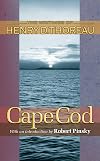
Cape Cod
by Henry David Thoreau
On This Page
Description
This new paperback edition of Henry D. Thoreau's compelling account of Cape Cod contains the complete, definitive text of the original. Introduced by American poet and literary critic Robert Pinsky--himself a resident of Cape Cod--this volume contains some of Thoreau's most beautiful writings. In the plants, animals, topography, weather, and people of Cape Cod, Thoreau finds "another world" Encounters with the ocean dominate this book, from the fatal shipwreck of the opening chapter to his show more later reflections on the Pilgrims' landing and reconnaissance. Along the way, Thoreau relates the experiences of fishermen and oystermen, farmers and salvagers, lighthouse-keepers and ship captains, as well as his own intense confrontations with the sea as he travels the land's outermost margins. Chronicles of exploration, settlement, and survival on the Cape lead Thoreau to reconceive the history of New England--and to recognize the parochialism of history itself. show lessTags
Recommendations



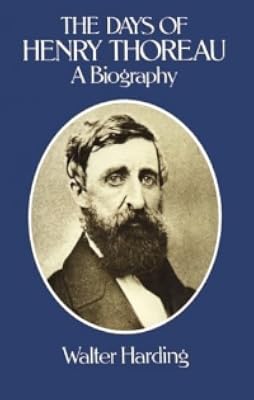



































Member Recommendations

Member Reviews
Thoreau made three trips to Cape Cod but structured the ten chapters of this book according to the course of his first visit, when he and a companion walked the length of it from Cohasset to Provincetown. However, he brings in reminiscences of his later trips, as well as of some developments he heard of. For much of their expedition, they stayed on the Atlantic side; it was Thoreau’s aim, as he writes in the book’s opening, “to get a better view than I had yet had of the ocean, which, we are told, covers more than two-thirds of the globe, but of which a man who lives a few miles inland may never see any trace, more than of another world.”
The result is an odd travelog, mixed with historical and philosophical digressions and told show more with dry Yankee humor. It opens, though, in a way that seems calculated to put off readers, at least those who weren’t meant to be his readers. The choice of Cohasset as the starting point was dictated by headlines of the wreck of an emigrant-laden brig from Ireland, with the loss of almost all passengers. Thoreau, the ambulance chaser? He observes the wreckage washing ashore and the funeral for the bodies recovered so far, yet seems detached. He admits as much: “It is the individual and the private that demands our sympathy,” then muses in transcendentalist fashion that they sailed to a new land, but without setting foot on it, “had been cast upon some shore further west.”
It fascinated me then how this transcendentalist was anchored in the this-ness of the world. He keenly observes people and, even more so, wildlife and plants. From his description, this thin spit of sand hosted a teeming multitude of cod, mackerel, whales, stormy petrels, gulls, frogs, and turtles, along with a sparse human population, most of the males among them spending more time aboard a boat than at home. As I read, I suspected that the ratio of humans to other forms of animals had been reversed. It wouldn’t have surprised Thoreau. As he resignedly writes at the book’s close, “the time must come when this coast will be a place of resort. . . . But this shore will never be more attractive than it is now.” show less
The result is an odd travelog, mixed with historical and philosophical digressions and told show more with dry Yankee humor. It opens, though, in a way that seems calculated to put off readers, at least those who weren’t meant to be his readers. The choice of Cohasset as the starting point was dictated by headlines of the wreck of an emigrant-laden brig from Ireland, with the loss of almost all passengers. Thoreau, the ambulance chaser? He observes the wreckage washing ashore and the funeral for the bodies recovered so far, yet seems detached. He admits as much: “It is the individual and the private that demands our sympathy,” then muses in transcendentalist fashion that they sailed to a new land, but without setting foot on it, “had been cast upon some shore further west.”
It fascinated me then how this transcendentalist was anchored in the this-ness of the world. He keenly observes people and, even more so, wildlife and plants. From his description, this thin spit of sand hosted a teeming multitude of cod, mackerel, whales, stormy petrels, gulls, frogs, and turtles, along with a sparse human population, most of the males among them spending more time aboard a boat than at home. As I read, I suspected that the ratio of humans to other forms of animals had been reversed. It wouldn’t have surprised Thoreau. As he resignedly writes at the book’s close, “the time must come when this coast will be a place of resort. . . . But this shore will never be more attractive than it is now.” show less
This includes Thoreau's funniest, and his most plangent writing: plangent, early in "The Shipwreck," where he witnessed the fairly common wreck of a square-rigger from Europe, this one from Ireland. I do conflate this shipwreck with the one that took the life--and the great MS on Garibaldi-- of Margaret Fuller. That would, of course, have been later in the century.
Because the storm had shut down the Provincetown ferry from Boston, Thoreau took a train to Cape Cod, and on the way, at Cohasset on the South Shore there was a shipwreck (the St John from Galway, Ireland), with bodies washed ashore, and awaiting relatives trying to identify them. A touching, resonant scene, among Thoreau's finest writing. "I witnessed no signs of grief, but show more there was a sober dispatch of business which was affecting."
On the other hand, the Wellfleet Oysterman is hilarious. Thoreau and his companion find a cottage willing to put them up for the night. But not knowing their character, the landlord with such chance guests locked them in their room. This common practice was done. When breakfast was prepared, Thoreau observed the landlord spitting on the fire near the eggs; his companion thought it was nearer the oatmeal. Each, of course, chose his preference according to their conflicting observations. show less
Because the storm had shut down the Provincetown ferry from Boston, Thoreau took a train to Cape Cod, and on the way, at Cohasset on the South Shore there was a shipwreck (the St John from Galway, Ireland), with bodies washed ashore, and awaiting relatives trying to identify them. A touching, resonant scene, among Thoreau's finest writing. "I witnessed no signs of grief, but show more there was a sober dispatch of business which was affecting."
On the other hand, the Wellfleet Oysterman is hilarious. Thoreau and his companion find a cottage willing to put them up for the night. But not knowing their character, the landlord with such chance guests locked them in their room. This common practice was done. When breakfast was prepared, Thoreau observed the landlord spitting on the fire near the eggs; his companion thought it was nearer the oatmeal. Each, of course, chose his preference according to their conflicting observations. show less
Down on Cape Cod, Thoreau walked with an eye cocked for the unique. It is all here -- the great beach and the windswept dunes, the tall cliffs and the ever rolling sea and screaming gulls. The moods of those idyllic New England seasons were his to feel and reflect in unforgettable prose, together with the traditional text of previous editions entitled Cape Cod, there has been coupled here for the first time Thoreau's Journal account of his 4th and last visit in June 1857 to the bared and bended arm of Massachusetts. This is for those who love to walk the length of lonely beaches, for in these pages Thoreau walks alone.
This collection of essays on Cape Cod shows the unique stretch of Massachusetts land before it was a tourist attraction. Thoreau, often with a friend, took four trips out to Cape Cod and this collects some history, humor, and tales of the people he met on his journeys.
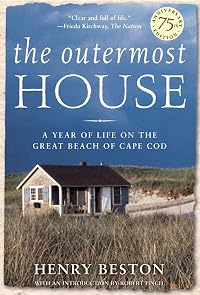
Cape Cod was published in 1865, a few years after Thoreau died. Its origin as essays is apparent, as its rather roughly cobbled together. The edition I read, from the 1950s with an introduction by Henry Beston of The Outermost House fame, includes notes from Henry Beston and others to explain some of the references, helpfully (?) give updates on census records for the towns mentioned, yet doesn't translate the Greek or Latin passages. I was also rather confused about a show more couple of times the editors decided to take out some of Thoreau's originally writing and move it to the back in an appendix. I would've liked an introduction that said less about the Cape and more about the way the book was put together, but that's not Thoreau's fault. His observations at times were very funny and memorable, but it's more a collection of vignettes that will be more or less interesting for each reader. Recommended for Thoreau completists and Cape Cod enthusiasts. show less
Cape Cod was published in 1865, a few years after Thoreau died. Its origin as essays is apparent, as its rather roughly cobbled together. The edition I read, from the 1950s with an introduction by Henry Beston of The Outermost House fame, includes notes from Henry Beston and others to explain some of the references, helpfully (?) give updates on census records for the towns mentioned, yet doesn't translate the Greek or Latin passages. I was also rather confused about a show more couple of times the editors decided to take out some of Thoreau's originally writing and move it to the back in an appendix. I would've liked an introduction that said less about the Cape and more about the way the book was put together, but that's not Thoreau's fault. His observations at times were very funny and memorable, but it's more a collection of vignettes that will be more or less interesting for each reader. Recommended for Thoreau completists and Cape Cod enthusiasts. show less
An extremely enjoyable read, though I felt as if I dipped into it periodcally, rather than a straight through reading. Considering the only other Thoreau I read was the highly confusing to my high school brain essay on Civil Disobdience (it might resonant more now...), this was truly delightful. I had a sense of how little the Cape has changed in some ways, the shore and the ocean remain the same, even as it is full of strip malls and over built houses. It reminded me of how lovely it can be.
This book collects essays Thoreau wrote on several trips to Cape Cod and was published after his death. Thoreau's great journeys were rarely far from his home in Concord, and yet the descriptions of every day detail are as if he'd traveled around the world. No more so than his writing about Cape Cod which after a century and a half of time passed sounds like it could've been a journey to Mars. The writing is beautiful whether he's describing a shipwreck, beachcombing, or the people who populate the sand-covered villages.
Thoreau provides a glimpse of the relationship between Americans and the seashore in the 19th century. Characteristically insightful, Thoreau's powers of observation and ability to draw insight are remarkable.
Members
- Recently Added By
Lists

Best 19th and 20th Century Travel
22 works; 4 members

Geography and Travel from The Book-Lover
291 works; 1 member

Book Titles Mentioned In Newberry Medal And Honor Books
884 works; 3 members
Author Information

615+ Works 49,279 Members
In September 1842, Nathaniel Hawthorne noted this social encounter in his journal: "Mr. Thorow dined with us yesterday. He is a singular character---a young man with much of wild original nature still remaining in him; and so far as he is sophisticated, it is in a way and method of his own. He is as ugly as sin, long-nosed, queer-mouthed, and with show more uncouth and somewhat rustic, although courteous manners, corresponding very well with such an exterior. But his ugliness is of an honest and agreeable fashion, and becomes him much better than beauty. On the whole, I find him a healthy and wholesome man to know." Most responses to Thoreau are as ambiguously respectful as was Hawthorne's. Thoreau was neither an easy person to like nor an easy writer to read. Thoreau described himself as a mystic, a Transcendentalist, and a natural philosopher. He is a writer of essays about nature---not of facts about it but of his ideals and emotions in its presence. His wish to understand nature led him to Walden Pond, where he lived from 1845 to 1847 in a cabin that he built. Though he was an educated man with a Harvard degree, fluent in ancient and modern German, he preferred to study nature by living "a life of simplicity, independence, magnanimity, and trust." Knowing this, we should beware of misreading the book that best reflected this great experience in Thoreau's life: Walden; or, Life in the Woods (1854). It is not a handbook of the simple life. Though there are elements in the book of a "whole-earth catalogue" mentality, to focus on the radical "economic" aspects of Thoreau's work is to miss much in the book. Nor is it an autobiography. The right way to read Walden is as a "transcendental" narrative prose poem, whose hero is a man named Henry, a modern Odysseus in search of a "true America." Thoreau left Walden Pond on September 6, 1846, exactly two years, two months, and two days after he had settled there. As he explained in the pages of Walden: "I left the woods for as good a reason as I went to live there. Perhaps it seemed to me that I had several more lives to live, and could not spare any more time for that one." Growth, change, and development were essential to his character. One should not overlook the significance of his selecting July 4 as the day for taking possession of his residence at Walden Pond, a day that celebrates the establishment of a new government whose highest ideal is individual freedom. In terms of Thoreau's redefinition of the nation-idea, "the only true America" is that place where one may grow wild according to one's nature, where one may "enjoy the land, but own it not." Thoreau believed that each person should live according to individual conscience, willing to oppose the majority if necessary. An early proponent of nonviolent resistance, he was jailed briefly for refusing to pay his poll tax to support the Mexican War and the slave system that had promoted that war. His essay "On Civil Disobedience" (1849), which came from this period of passive resistance, was acknowledged by Mahatma Gandhi (who read it in a South African jail) as the basis for his campaign to free India. Martin Luther King, Jr. later attributed to Thoreau and Gandhi the inspiration for his leadership in the civil rights movement in the United States. Thoreau contracted tuberculosis in 1835 and suffered from it sporadically afterwards. His health declined over three years with brief periods of remission, until he eventually became bedridden. Recognizing the terminal nature of his disease, Thoreau spent his last years revising and editing his unpublished works, particularly The Maine Woods and Excursions, and petitioning publishers to print revised editions of A Week and Walden. He died on May 6, 1862 at age 44. (Bowker Author Biography) show less
Some Editions
Series
Belongs to Publisher Series
Work Relationships
Is contained in
Is abridged in
Common Knowledge
- Original publication date
- 1865
- Important places
- Cape Cod, Massachusetts, USA; Massachusetts, USA
- First words
- Wishing to get a better view than I had yet had of the ocean, which, we are told, covers more than two-thirds of the globe, but of which a man who lives a few miles inland may never see any trace, more than of another world, ... (show all)I made a visit to Cape Cod in October, 1849, another the succeeding June, and another to Truro in July, 1855; the first and last time with a single companion, the second time alone.
- Last words
- (Click to show. Warning: May contain spoilers.)A man may stand there and put all America behind him.
Classifications
Statistics
- Members
- 879
- Popularity
- 30,788
- Reviews
- 10
- Rating
- (3.76)
- Languages
- 7 — English, French, German, Italian, Japanese, Spanish, Swedish
- Media
- Paper, Audiobook, Ebook
- ISBNs
- 81
- UPCs
- 2
- ASINs
- 44