On This Page
Description
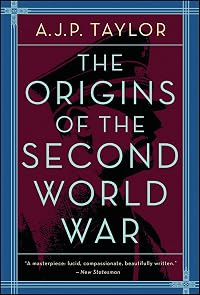
This book chronicles three decades largely overshadowed by war and mass unemployment. It was a period that saw in England the formation of a national government, the only genuine incidence of three-party politics, the fruition of campaigns for trades union recognition, women's suffrage, and Irish independence, and abroad withdrawal from the Gold Standard and involvement in collective security. Written in Taylor's customary provocative style, this is historical writing at its best. -- From show more https://books.google.com (April 20, 2018). show lessTags
Recommendations




















Member Reviews
A good many books have been written about this period of British history since Taylor's first appeared in the shops, but this author's lively and sometimes controversial account shouldn't be overlooked. I found his explanation of the causes of the General Strike easier to understand than some I have read - Roy Hattersley take note - and his surprisingly sympathetic portrait of Neville Chamberlain puts a different slant on Munich, appeasement, and the man in general. On the minus side, there are an awful lot of footnotes, not all of them relevant, but I got used to them after a while; and as we witness the decline of Britain from empire state to poor relation of the USA, Taylor's final optimistic note for the future doesn't quite ring show more true. Nevertheless, still worth a read. show less
This is the book that taught me what writing about history could be. Discursive, opinionated, and entertaining, Professor Taylor leads us through the history of England between and during two world wars in his own inimitable style, culminating in the last, glorious, uplifting paragraph, expressive of an optimism long gone.
2379 English History 1914-1945, by A. J. P. Taylor (read 28 Apr 1991) This is a big book, opinionated, and excellent reading at times. It is volume 15 of The Oxford History of England. I would like to read the other volumes in this series but I don't suppose I ever will. This book seemed dated and I would like to read a more recent book on the same subject.
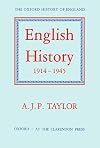
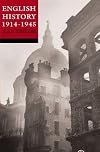
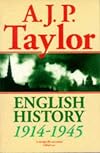
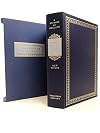
English History 1914-1945
A. J. P. Taylor
Published by Book Club Associates
Book Club Associates. Hardcover.
A. J. P. Taylor
Published by Book Club Associates
Book Club Associates. Hardcover.
http://www.crummy.com/rachel/2005/08/25/0
This book is supposedly the "Pity of War" of WWII
This book is supposedly the "Pity of War" of WWII
Rústica editorial ilustrada. Mapas.
1ª edición en ingles 1965 Oxford Universitiy Press
Cubierta algo fatigada.
Alan John Percivale "A. J. P." Taylor, FBA (Birkdale, Lancashire, 25 de marzo de 1906 - Londres, 7 de septiembre de 1990) fue un historiador, periodista y escritor inglés especializado en la diplomacia europea de los siglos XIX y XX. Tanto como periodista y como locutor, se hizo muy conocido por millones de televidentes a través de sus conferencias por televisión.580
1ª edición en ingles 1965 Oxford Universitiy Press
Cubierta algo fatigada.
Alan John Percivale "A. J. P." Taylor, FBA (Birkdale, Lancashire, 25 de marzo de 1906 - Londres, 7 de septiembre de 1990) fue un historiador, periodista y escritor inglés especializado en la diplomacia europea de los siglos XIX y XX. Tanto como periodista y como locutor, se hizo muy conocido por millones de televidentes a través de sus conferencias por televisión.580
Jun 4, 2023Spanish
Ratings
Members
- Recently Added By
Lists

Books referenced in A Very Great Profession: The Woman's Novel 1914-39
199 works; 6 members
Author Information

191+ Works 6,222 Members
British historian A.J.P. Taylor studied at Oxford University and in 1938 became a fellow of Magdalen College. Interested chiefly in diplomatic and central European history, he is a prolific and masterful writer. Fritz Stern wrote of him and his The Struggle for Mastery in Europe, 1848--1918 (1954) in the Political Science Quarterly: "There is show more something Shavian about A. J. P. Taylor and his place among academic historians; he is brilliant, erudite, witty, dogmatic, heretical, irritating, insufferable, and withal inescapable. He sometimes insults and always instructs his fellow-historians, and never more so than in his present effort to reinterpret the diplomatic history of Europe from 1848 to the end of the First World War. . . . After a brilliant introduction, in which he defines the balance of power and assesses the relative and changing strength of the Great Powers, Mr. Taylor presents a chronological survey, beginning with the diplomacy of war, 1914--1918. . . . [He] writes on two levels. He narrates the history of European diplomacy and compresses it admirably into a single volume. Imposed upon the narrative is his effort to probe the historical meaning of given actions and conditions. . . . He has a peculiar sense of inevitability, growing out of what he regards the logic of a given development, as well as a delicate feeling for live options and alternatives. Mr. Taylor suggests that fear, not aggression, was the dominant impulse of pre-war diplomacy." The Origins of the Second World War (1961), again controversial and lively, starts from the premise (in Taylor's words) that "the war of 1939, far from being premeditated, was a mistake, the result on both sides of diplomatic blunders." The New Statesman said of it: "Taylor is the only English historian now writing who can bend the bow of Gibbon and Macaulay. [This is] a masterpiece: lucid, compassionate, beautifully written in a bare, sparse style, and at the same time deeply disturbing." Several of Taylor's other works also received high praise. Among these were Bismarck, the Man and the Statesman (1955), in which he exonerated Bismarck; Hapsburg Monarchy, 1809--1914, a survey of the era; and English History, 1919--1945, a volume in the Oxford History of England Series, greeted by the N.Y. Review of Books as "an astonishing tour de force." (Bowker Author Biography) show less
All Editions
Some Editions
Series

Belongs to Publisher Series
Work Relationships
Common Knowledge
- Canonical title
- English History, 1914-1945
- Original publication date
- 1965
- Important places
- England, UK
- Important events
- World War I (1914-1918); World War II (1939-1945); Interbellum
- Epigraph
- [None]
- Dedication
- [None]
- First words
- When the Oxford History of England was launched a generation ago, 'England' was still an all-embracing word. It meant indiscriminately England and Wales; Great Britain; the United Kingdom; and even the British Empire.
Until August 1914 a sensible, law-abiding Englishman could pass through life and hardly notice the existence of the state, beyond the post office and the policeman.
I. The Great War: old style, 1914-15.
History gets thicker as it approaches recent times: more people, more events, and more books written about them.
Revised bibliography (June 1973). - Last words
- (Click to show. Warning: May contain spoilers.)Imperial greatness was on the way out; the welfare state was on the way in. The British empire declined; the condition of the people improved. Few now sang 'Land of Hope and Glory'. Few even sang 'England Arise'. England has risen all the same.
- Original language
- English
- Disambiguation notice
- Sir G N Clark was the general editor of the series - this volume was written by A J P Taylor.
Classifications
- Genres
- History, Nonfiction, General Nonfiction
- DDC/MDS
- 941.083 — History & geography History of Europe British Isles Historical periods of British Isles 1837- Period of Victoria and House of Windsor 1910-1936 George V
- LCC
- DA566 .T38 — History of Europe, Asia, Africa and Oceania Great Britain History of Great Britain England History By period Modern, 1485- 20th century
- BISAC
Statistics
- Members
- 705
- Popularity
- 40,631
- Reviews
- 6
- Rating
- (3.89)
- Languages
- English, Norwegian
- Media
- Paper, Ebook
- ISBNs
- 9
- ASINs
- 31