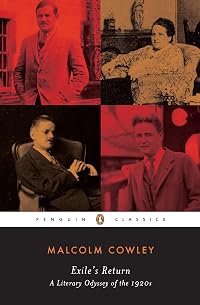
Exile's Return: A Literary Odyssey of the 1920s
by Malcolm Cowley
On This Page
Description
Feeling alienated in the America of the 1920s, Fitzgerald, Crane, Hemingway, Wilder, Dos Passos, Cowley and others "escaped" to Europe, as exiles. The adventures and attitudes shared by these American writers, dubbed "the lost generation", are brought to life in this book of prose works.Tags
Recommendations








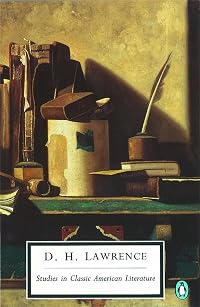
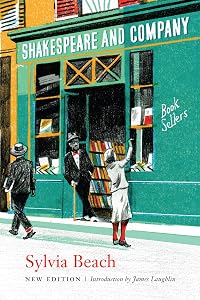

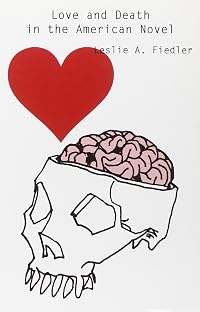
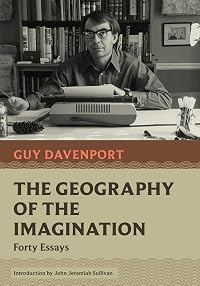








Member Recommendations
Member Reviews
Malcolm Cowley’s memoir about his generation of literary artists who graduated from college between 1915 and 1922 is an insightful guide to the Lost Generation milieu in Paris and New York. In the second edition, published during the Cold War, Cowley adds an introduction and epilogue but leaves his 1934 voice intact. They were a generation who served in the First World War, often as ambulance drivers, or were just young enough to miss it. They felt “like strangers in their own land,” disconnected from their middle-class American culture, though many returned to it after a time in artist colonies in Paris and Greenwich Village. The Greenwich Village of 1920, Cowley says, attracted youth who wanted to escape what they felt was the show more mechanical standardization of their early education. They wanted to express themselves artistically, live for the moment, and shun their Puritan heritage. Living for the moment often meant buying a car and other products of twentieth-century capitalism on the installment plan. Village values swept the nation. They were often rebels but seldom revolutionaries. Some young rebels, like Cowley, moved to France looking for values in their exile. What they found instead was a romanticized image of America.
One would think that T. S. Eliot’s The Waste Land (1922) would have been celebrated as an anthem of their generation. However, it created a dilemma for the Paris exiles, even though “it had all the qualities demanded in our slogans.” Cowley says, “We were prepared fervently to defend it against the attacks of the people who didn’t understand what Eliot was trying to do—but we made private reservations. The poem had forced us into a false position, . . . brought our consciously adopted principles into conflict with our instincts. At heart—not intellectually, but in a purely emotional fashion—we didn’t like it. We didn’t agree with what we regarded as the principal idea that the poem set forth.”
James Joyce was also a problematic figure for Cowley and his friends because they knew that he had written a great work, but they had doubts about his value as a model for their own work. Should they emulate his pride, ambition, and contempt for others? Maybe not. Ezra Pound was equally troublesome, even though they did not know he had a major hand in polishing up The Waste Land. They were more in tune with Paul Valery’s pronouncement that “literature was an exercise, a game worth playing for the same reasons that one plays tennis or bridge.” The game eventually led Cowley to the contrarian Dadaists, who thought that “all the writers of the past had been enslaved by reality.”
Later in the decade, Hemingway became a cult figure, and Nathanael West and F. Scott Fitzgerald chronicled the excesses and absurdities of the Jazz Age. Fitzgerald’s work, Cowley says, is “in some ways the best record of this whole period. Cowley closes with the sad stories of Hart Crane and Harry Crosby. Crane, like Fitzgerald, seemed to have to drink to write, and Crosby, a lesser-known poet and traumatized veteran, committed suicide. show less
One would think that T. S. Eliot’s The Waste Land (1922) would have been celebrated as an anthem of their generation. However, it created a dilemma for the Paris exiles, even though “it had all the qualities demanded in our slogans.” Cowley says, “We were prepared fervently to defend it against the attacks of the people who didn’t understand what Eliot was trying to do—but we made private reservations. The poem had forced us into a false position, . . . brought our consciously adopted principles into conflict with our instincts. At heart—not intellectually, but in a purely emotional fashion—we didn’t like it. We didn’t agree with what we regarded as the principal idea that the poem set forth.”
James Joyce was also a problematic figure for Cowley and his friends because they knew that he had written a great work, but they had doubts about his value as a model for their own work. Should they emulate his pride, ambition, and contempt for others? Maybe not. Ezra Pound was equally troublesome, even though they did not know he had a major hand in polishing up The Waste Land. They were more in tune with Paul Valery’s pronouncement that “literature was an exercise, a game worth playing for the same reasons that one plays tennis or bridge.” The game eventually led Cowley to the contrarian Dadaists, who thought that “all the writers of the past had been enslaved by reality.”
Later in the decade, Hemingway became a cult figure, and Nathanael West and F. Scott Fitzgerald chronicled the excesses and absurdities of the Jazz Age. Fitzgerald’s work, Cowley says, is “in some ways the best record of this whole period. Cowley closes with the sad stories of Hart Crane and Harry Crosby. Crane, like Fitzgerald, seemed to have to drink to write, and Crosby, a lesser-known poet and traumatized veteran, committed suicide. show less
"The 1920s were an age of islands, real and metaphorical. An age when Americans by thousands and tens of thousands were scheming to take the next boat for the South Sea or the West Indies, or better still for Paris."
What a joy this book was for me. Like sitting for a long chat with someone who 'was there' and able to tell you all about it in the most interesting and illuminating way.
Escape from machines, and assembly lines, and expected ways of living. The effects of war, bohemianism, individualism, and perceptions of art. Experiencing and realizing the world tilting on its axis. By accident I learned so much more about a time in world history that was missing from my body of knowledge. Might there be a Roaring Twenties 2.0 waiting in show more the wings? show less
What a joy this book was for me. Like sitting for a long chat with someone who 'was there' and able to tell you all about it in the most interesting and illuminating way.
Escape from machines, and assembly lines, and expected ways of living. The effects of war, bohemianism, individualism, and perceptions of art. Experiencing and realizing the world tilting on its axis. By accident I learned so much more about a time in world history that was missing from my body of knowledge. Might there be a Roaring Twenties 2.0 waiting in show more the wings? show less
This is the story of the so-called lost generation of American writers, their alienation from their American roots, their attempts to replace America's "mechanical" values with moral values, by escaping to Europe or into themselves. Of their struggle to reconcile their need for self-expression with their need to make a living. The crass money values of America drove them overseas, but their need for American money always drew them back, back to an America that was changed, in their perceptions.
This is not an easy read. It is literary criticism but also contains strong elements of aesthetics, philosophy, history, and especially, sociology. So many interweaving threads are hard to follow. The isms involved are complex: Bohemianism, show more Dadaism, Symbolism, etc. But there are flashes of brilliant writing here.
The author was steeped in literature, up to his neck. He lived it, full-time. He knew the big names on both sides of the Atlantic. This book is very much an inside view of the mostly-American literary scene to 1930. show less
This is not an easy read. It is literary criticism but also contains strong elements of aesthetics, philosophy, history, and especially, sociology. So many interweaving threads are hard to follow. The isms involved are complex: Bohemianism, show more Dadaism, Symbolism, etc. But there are flashes of brilliant writing here.
The author was steeped in literature, up to his neck. He lived it, full-time. He knew the big names on both sides of the Atlantic. This book is very much an inside view of the mostly-American literary scene to 1930. show less
3253. Exile's Return: A Literary Odyssey of the 1920s, by Malcolm Cowley (read Oct 8, 1999) I've wanted to read this book for ages, and when I quite by accident came across it in the library of a local college, I had to read it. Most of it was good reading, tho some of the discussion of literary theory was over my head. But most of the book was of interest.
A classic but wrong in historical perspective.
Ratings
Members
- Recently Added By
Lists

Modernism
140 works; 8 members
Author Information

43+ Works 1,577 Members
Malcolm Cowley, critic, poet, editor, and translator, was an influential figure in American letters. The son of a Pittsburgh physician, Cowley studied at Harvard University and the University of Montpelier, "starved" in Greenwich Village, and lived in France, where he met the Dada crowd and worked on two expatriate magazines, Secession and Broom. show more From 1929 to 1944, he was associate editor of The New Republic. Perhaps the most famous work he wrote was his early book of poetry entitled, Blue Juniata (1929). As an editorial consultant to Viking Press, he pushed for the publication of Jack Kerouac's On the Road. His book The Faulkner-Cowley File: Letters and Memories, 1944-1962 documents his early recognition of William Faulkner. The Portable Faulkner was published at Cowley's instigation and under his editorship in 1946, when all 17 of Faulkner's books were out of print. Its publication had a profound effect -- virtually creating Faulkner's literary revival. Cowley died in 1989. (Bowker Author Biography) show less
Series
Belongs to Publisher Series
Common Knowledge
- Canonical title
- Exile's Return: A Literary Odyssey of the 1920s
- Original title
- Exile's Return
- Original publication date
- 1934
- People/Characters
- John Dos Passos; F. Scott Fitzgerald; Ernest Hemingway; James Joyce; T. S. Eliot; Ezra Pound (show all 9); e. e. cummings; Matthew Josephson; Hart Crane
- Important places
- Paris, France; Greenwich Village, New York, New York, USA
- Important events
- 1920s
- Dedication
- to Muriel
- First words
- This book is the story to 1930 of what used to be called the lost generation of American writers. [Prologue]
Somewhere the turn of a dirt road or the unexpected crest of a hill reveals your own childhood, the fields where you once played barefoot, the kindly trees, the landscape by which all others are measured and condemned. - Last words
- (Click to show. Warning: May contain spoilers.)In spite of himself he had died at the right time.
(Click to show. Warning: May contain spoilers.)It was an easy, quick, adventurous age, good to be young in; and yet on coming out of it one felt a sense of relief, as on coming out of a room too full of talk and people into the sunlight of the winter trees. [Epilogue] - Blurbers
- Brooks, Van Wyck; Morris, Lloyd; Mizener, Arthur
- Original language
- English
Classifications
- Genres
- Nonfiction, Literature Studies and Criticism, Biography & Memoir
- DDC/MDS
- 810.90052 — Literature & rhetoric American literature in English American literature in English History and criticism of American literature
- LCC
- PS221 .C65 — Language and Literature American literature American literature By period 20th century
- BISAC
Statistics
- Members
- 528
- Popularity
- 56,643
- Reviews
- 5
- Rating
- (3.89)
- Languages
- English, Italian
- Media
- Paper, Ebook
- ISBNs
- 7
- ASINs
- 20