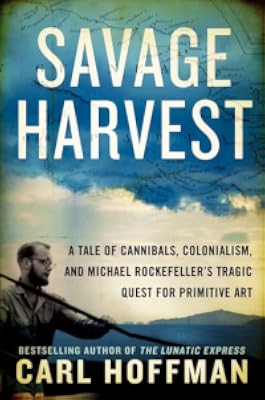
Savage Harvest: A Tale of Cannibals, Colonialism, and Michael Rockefeller's Tragic Quest for Primitive Art
by Carl Hoffman
On This Page
Description
The mysterious disappearance of Michael Rockefeller in New Guinea in 1961 has kept the world and his powerful, influential family guessing for years. Now, Carl Hoffman uncovers startling new evidence that finally tells the full, astonishing story.Despite exhaustive searches, no trace of Rockefeller was ever found. Soon after his disappearance, rumors surfaced that he'd been killed and ceremonially eaten by the local Asmat—a native tribe of warriors whose complex culture was built around show more sacred, reciprocal violence, head hunting, and ritual cannibalism. The Dutch government and the Rockefeller family denied the story, and Michael's death was officially ruled a drowning. Yet doubts lingered. Sensational rumors and stories circulated, fueling speculation and intrigue for decades. The real story has long waited to be told—until now.
Retracing Rockefeller's steps, award-winning journalist Carl Hoffman traveled to the jungles of New Guinea, immersing himself in a world of headhunters and cannibals, secret spirits and customs, and getting to know generations of Asmat. Through exhaustive archival research, he uncovered never-before-seen original documents and located witnesses willing to speak publically after fifty years.
In Savage Harvest he finally solves this decades-old mystery and illuminates a culture transformed by years of colonial rule, whose people continue to be shaped by ancient customs and lore. Combining history, art, colonialism, adventure, and ethnography, Savage Harvest is a mesmerizing whodunit, and a fascinating portrait of the clash between two civilizations that resulted in the death of one of America's richest and most powerful scions.
. show less
Tags
Recommendations




























Member Recommendations

akblanchard Writers reconstruct crimes that happened before they were born.
Member Reviews
I was in Junior High when the disappearance of Michael Rockefeller on an expedition for primitive art in New Guinea splashed all over the national media. One night at dinner my dad, who had been stationed there during World War II said, "I bet the headhunters ate him." We all laughed & my mom swatted him with a dish cloth because it was so ridiculous. Such things did not happen in 1961. However, that apparently is exactly what did happen as Carl Hoffman describes in detail in this extraordinary book.
In 1961, Michael Rockefeller, the 23-year-old son of Nelson Rockefeller (then Governor of New York) and freshly graduated from Harvard launched an expedition to Dutch New Guinea to collect primitive art for his father's new museum. He had show more been there several months earlier on a Harvard Peabody Expedition that included the noted writer Peter Matthiessen, but this time he was basically on his own. As the child of extreme privilege, Rockefeller was used to everything pretty much going his way, but on this trip he, unfortunately learned otherwise.
In 1961 the area where Rockefeller was searching for artifacts was a dangerous place. Although, the Dutch put out the story for their own political reasons that headhunting and cannibalism had ended in the southern Asmat region of the country, nothing could have been further from the truth. All during the 1950's the region had been the scene of bloody internecine warfare among the Asmat with each killing leading to revenge killings in a cycle that seemingly could not be unbroken. Rockefeller, who did not speak the language proceeded with a hubris that would lead to his grisly downfall.
On November 19, 1961 he and Dutch anthropologist Renee Wasing, along with two young Asmat guides set out on an expedition to collect primitive art, moat especially the ceremonial bisj poles. They soon ran into trouble in rough seas and their catamaran capsized. The young guides went for help, but Rockefeller grew impatient & after several hours decided to swing to shore himself in defiance of every known precept of how to survive a shipwreck. Unbelievably he survived the 14-hour, 10-mile swim to shore, but once there was met by a group of Asmat warriors looking to avenge killings in their village several years before, who took their opportunity.The young guides, had, of course made it to shore, and notified the Dutch authorities who, given the importance of the man on board, launched a full-scale military rescue mission. Rene Wassing was quickly found, but Michael Rockefeller seemed to have disappeared into thin air
Now the Dutch government's worst nightmare began. They had to notify Rockefeller's family and given the fact that they were petitioning the United Nations to hold onto their colony, they also had to cover-up the more unsavory aspects of the native population. Already rumors were swirling about that Rockefeller fils had been killed and eaten by the Asmat. The Dutch had to suppress these rumors at all costs.
Nelson Rockefeller and Michael's twin sister, Mary arrived in New Guinea several days later accompanied by an entourage of press and political aides. The Dutch government officials told them a probable story about an exhaustive search reaching the conclusion that Michael had died by drowning.This story was accepted by the Rockefeller family and they returned to the United States full of praise and thanks to the Dutch officials for all their help in trying to find Michael.
Flash forward fifty years and the author, a self-professed outsider who has made his living writing about adventure is now pursuing the story. He travels to New Guinea (now part of Indonesia), immerses himself in the Asmat culture and does exhaustive work in the Dutch colonial archives to arrive at the story of what really happened. What he finds is incredible documentary proof that Rockefeller was, indeed, killed, beheaded, butchered and eaten by a group of Asmat warriors on that fateful day. These facts were specifically covered-up by the Dutch Colonial officials to further their own political ends. The Asmat, however, are not so willing to give up their secrets. Although he comes very close, no one will admit to him directly what happened on that fateful morning. But that detail hardly matters. The story is all there: the clash of the last vestiges of a prehistoric people meeting the modern world so sure of themselves and their superior culture. This is a cautionary tale. show less
In 1961, Michael Rockefeller, the 23-year-old son of Nelson Rockefeller (then Governor of New York) and freshly graduated from Harvard launched an expedition to Dutch New Guinea to collect primitive art for his father's new museum. He had show more been there several months earlier on a Harvard Peabody Expedition that included the noted writer Peter Matthiessen, but this time he was basically on his own. As the child of extreme privilege, Rockefeller was used to everything pretty much going his way, but on this trip he, unfortunately learned otherwise.
In 1961 the area where Rockefeller was searching for artifacts was a dangerous place. Although, the Dutch put out the story for their own political reasons that headhunting and cannibalism had ended in the southern Asmat region of the country, nothing could have been further from the truth. All during the 1950's the region had been the scene of bloody internecine warfare among the Asmat with each killing leading to revenge killings in a cycle that seemingly could not be unbroken. Rockefeller, who did not speak the language proceeded with a hubris that would lead to his grisly downfall.
On November 19, 1961 he and Dutch anthropologist Renee Wasing, along with two young Asmat guides set out on an expedition to collect primitive art, moat especially the ceremonial bisj poles. They soon ran into trouble in rough seas and their catamaran capsized. The young guides went for help, but Rockefeller grew impatient & after several hours decided to swing to shore himself in defiance of every known precept of how to survive a shipwreck. Unbelievably he survived the 14-hour, 10-mile swim to shore, but once there was met by a group of Asmat warriors looking to avenge killings in their village several years before, who took their opportunity.The young guides, had, of course made it to shore, and notified the Dutch authorities who, given the importance of the man on board, launched a full-scale military rescue mission. Rene Wassing was quickly found, but Michael Rockefeller seemed to have disappeared into thin air
Now the Dutch government's worst nightmare began. They had to notify Rockefeller's family and given the fact that they were petitioning the United Nations to hold onto their colony, they also had to cover-up the more unsavory aspects of the native population. Already rumors were swirling about that Rockefeller fils had been killed and eaten by the Asmat. The Dutch had to suppress these rumors at all costs.
Nelson Rockefeller and Michael's twin sister, Mary arrived in New Guinea several days later accompanied by an entourage of press and political aides. The Dutch government officials told them a probable story about an exhaustive search reaching the conclusion that Michael had died by drowning.This story was accepted by the Rockefeller family and they returned to the United States full of praise and thanks to the Dutch officials for all their help in trying to find Michael.
Flash forward fifty years and the author, a self-professed outsider who has made his living writing about adventure is now pursuing the story. He travels to New Guinea (now part of Indonesia), immerses himself in the Asmat culture and does exhaustive work in the Dutch colonial archives to arrive at the story of what really happened. What he finds is incredible documentary proof that Rockefeller was, indeed, killed, beheaded, butchered and eaten by a group of Asmat warriors on that fateful day. These facts were specifically covered-up by the Dutch Colonial officials to further their own political ends. The Asmat, however, are not so willing to give up their secrets. Although he comes very close, no one will admit to him directly what happened on that fateful morning. But that detail hardly matters. The story is all there: the clash of the last vestiges of a prehistoric people meeting the modern world so sure of themselves and their superior culture. This is a cautionary tale. show less
"The cultural collision was too great, the power imbalance too extreme, between men who knew nothing beyond their immediate world and men who thought they knew everything." (p. 81)
That line stands as a fair assessment of Michael Rockefeller's 1961 foray to the Asmat of New Guinea and for Hoffman's own first trip there in early 2012: both affluent, white, Western men who rode above the "primitive," unconsciously blind to the reality inhabited by the indigenous. Hoffman's epiphany relative to the Asmat grows upon him, but he remains either blind to or accessory with the constructs within his own, Western world. Prestige in the West comes from wealth, and Hoffman seems to accept that wealth is apparently a moral good of its own; that show more implicit thread made some of this book really unappealing.
This book is an odd mix of travel documentary, cold case investigation, journey of individual spiritual growth, ethnography, and Conrad's Heart of Darkness. The switching back and forth from a thread of past events to Hoffman's 2012 experiences is a strength of the book; since each narrative shapes the other as it plays out, I appreciated watching Hoffman's understanding change how he interacted with the Asmat, and thus how the cold case appeared to him. What he has to say regarding Rockefeller's death notwithstanding, this book really is about Hoffman's own awakening and that much really is a pleasure to watch unfold. I do wish, though, that "travel journalists" would bother to get a BA in anthropology before assuming the role of ethnographic writers. Much of his anthro theory and understanding is piecemeal and out-of-date, and perhaps he should have bothered to learn the language before he went there.
A small note to the publisher relative to this edition: it was unhelpful that several key villages (i.e., Atsj, Basim) are not on the map of the Asmat Tribal Area provided and yet a small constellation of villages never involved in the book at all are included. Why? show less
That line stands as a fair assessment of Michael Rockefeller's 1961 foray to the Asmat of New Guinea and for Hoffman's own first trip there in early 2012: both affluent, white, Western men who rode above the "primitive," unconsciously blind to the reality inhabited by the indigenous. Hoffman's epiphany relative to the Asmat grows upon him, but he remains either blind to or accessory with the constructs within his own, Western world. Prestige in the West comes from wealth, and Hoffman seems to accept that wealth is apparently a moral good of its own; that show more implicit thread made some of this book really unappealing.
This book is an odd mix of travel documentary, cold case investigation, journey of individual spiritual growth, ethnography, and Conrad's Heart of Darkness. The switching back and forth from a thread of past events to Hoffman's 2012 experiences is a strength of the book; since each narrative shapes the other as it plays out, I appreciated watching Hoffman's understanding change how he interacted with the Asmat, and thus how the cold case appeared to him. What he has to say regarding Rockefeller's death notwithstanding, this book really is about Hoffman's own awakening and that much really is a pleasure to watch unfold. I do wish, though, that "travel journalists" would bother to get a BA in anthropology before assuming the role of ethnographic writers. Much of his anthro theory and understanding is piecemeal and out-of-date, and perhaps he should have bothered to learn the language before he went there.
A small note to the publisher relative to this edition: it was unhelpful that several key villages (i.e., Atsj, Basim) are not on the map of the Asmat Tribal Area provided and yet a small constellation of villages never involved in the book at all are included. Why? show less
In 1961, Michael Rockefeller, the youngest son of Nelson Rockefeller and an heir to the Rockefeller family fortune, was on a expedition to purchase "primitive" art from New Guinea's Asmat ethnic group when he went missing. After an extensive manhunt failed to locate him, his family had him declared dead, with drowning listed as the cause of death. Nonetheless, rumors that he was murdered and eaten by cannibals persisted, despite official statements that such barbaric acts could not take place in Dutch-ruled New Guinea.
In 2012 journalist and travel writer Carl Hoffman set out to discover the truth behind Michael Rockefeller's mysterious disappearance. Hoffman visited to the remote region where the Asmat live, which is still very show more primitive by Western standards, and investigated "dusty" Dutch archival documents (why are archival documents always "dusty"?). He learned an Indonesian language to speak to the sons of the men who were implicated in the disappearance. Most importantly, he tried to understand the Asmat cosmology and worldview, which are based on the idea that the spirit world demands balance--life for life, and death for death.
Hoffman turns himself into the hero of his own book, a man willing to forgo even the most basic of Western comforts in order to solve a fifty-year-old mystery. I have the impression that Hoffman cared less about Rockefeller and his fate, or about the Asmat and their culture, than he did about being "right" about what actually happened on the coast of New Guinea on November 19, 1961.
How much you enjoy this book will depend on how much you enjoy spending time with the author. show less
In 2012 journalist and travel writer Carl Hoffman set out to discover the truth behind Michael Rockefeller's mysterious disappearance. Hoffman visited to the remote region where the Asmat live, which is still very show more primitive by Western standards, and investigated "dusty" Dutch archival documents (why are archival documents always "dusty"?). He learned an Indonesian language to speak to the sons of the men who were implicated in the disappearance. Most importantly, he tried to understand the Asmat cosmology and worldview, which are based on the idea that the spirit world demands balance--life for life, and death for death.
Hoffman turns himself into the hero of his own book, a man willing to forgo even the most basic of Western comforts in order to solve a fifty-year-old mystery. I have the impression that Hoffman cared less about Rockefeller and his fate, or about the Asmat and their culture, than he did about being "right" about what actually happened on the coast of New Guinea on November 19, 1961.
How much you enjoy this book will depend on how much you enjoy spending time with the author. show less
Great book on a topic I knew nothing about. In the end I didn't care what really happened to Michael Rockefeller but was entranced by the tribes of New Guinea and Hoffman's trip there. The book takes on literary qualities about the power of myth over materialism. The natives may be "dirt poor" and uneducated, but through their ownership of story about Michael Rockefeller, they have reclaimed some of the power taken from them by the encroachment of modernity, the tables are turned. It also reminded me of a real-life Life of Pi, dealing as it does in a ship-wreck, cannibalism and two alternate stories left up to the reader to decide which to believe.
Michael Rockefeller disappeared, and was presumable killed, in New Guinea in 1961. The official cause of death was drowning (or possibly being consumed by sharks or crocodiles). Unofficially, many people have speculated that he was actually killed and eaten by a cannibalistic headhunting people called the Asmat. In Savage Harvest, Carl Hoffman travels to New Guinea to investigate the matter.
As this was an event that happened over 50 years ago in what is essentially a swamp among close-mouthed and (in the 60s) fairly primitive people, it should come as little surprise that Hoffman didn't manage to find any definitive proof. He does however dig up some fairly substantial circumstantial evidence. This includes documents from the Dutch show more government (who ruled the area at the time of the disappearance) and a fair amount of information on the culture and religion of the Asmat.
For readers who are interested in odd history, the grotesque, and foreign people, this is a book that's well worth reading. show less
As this was an event that happened over 50 years ago in what is essentially a swamp among close-mouthed and (in the 60s) fairly primitive people, it should come as little surprise that Hoffman didn't manage to find any definitive proof. He does however dig up some fairly substantial circumstantial evidence. This includes documents from the Dutch show more government (who ruled the area at the time of the disappearance) and a fair amount of information on the culture and religion of the Asmat.
For readers who are interested in odd history, the grotesque, and foreign people, this is a book that's well worth reading. show less
Part memoir, part biography, this non-fiction delves into the mystery of the disappearance of Michael Rockefeller, son of Nelson Rockefeller, in 1961. At age 23, Michael had just graduated from Harvard. He traveled to what was then Netherlands New Guinea (now part of Indonesian Papua) to film a documentary and collect artifacts for his father’s Museum of Primitive Art. Michael and his colleague, René Wassing, were crossing the mouth of a turbulent river in a catamaran on the Arafura sea off the southwest coast of New Guinea when the boat capsized. Michael thought he could make it to shore to get help, so he swam away and was never seen again. His companion stayed with the boat and was rescued the next day. An extensive search was show more conducted by the authorities, but nothing substantial was found, and eventually they declared Michael had drowned. Rumors began to spread that he made it to shore but was killed by the men from the nearby village of Otsjanep. The Asmat had practiced headhunting and cannibalism, which was thought to have been eradicated due to the influence of Catholic missionaries and colonial authorities. The author decided to retrace Michael’s steps and search for evidence to solve the mystery surrounding his death.
This book touches on a fascinating combination of anthropology, art, spiritual beliefs, cultural dissonance, history, political coverups, the dynamics of power, and the gruesome specter of cannibalism. It shifts narratives between Michael’s trip in 1961 and the author’s trip in 2012. It relates the history of the territorial dispute regarding Netherlands New Guinea and the political tensions between the Dutch and Indonesian governments, which impacted Rockefeller’s disappearance. The greatest strength of this book may also be its greatest weakness. Hoffman is a journalist, and his research is based on solid reporting techniques, and an analysis of interviews, historical documents, letters, and journals. He seeks out the “big picture,” but as a journalist, it seems he could not resist the temptation to insert a sensationalistic and graphic depiction of what “could” have happened to Michael. The writing style is uneven, at times choppy and other times eloquent. The author traveled twice to the region, once with an American journalist’s approach of asking direct questions and expecting direct answers, and the second time with a more nuanced perspective of gaining an understanding of the Asmat people by living among them and recognizing their complexities. The book brings up thought-provoking questions about the accumulation of artifacts without understanding of the meaning behind them, and of attempting to judge the past based on modern viewpoints.
Hoffman makes a good case for his interpretation of events. He sheds light on the culture of the Asmat people and puts it in context of the time and place and leaves it to the reader to render a verdict. This book will appeal to those that enjoy unsolved mysteries, world history, or cultural anthropology. show less
This book touches on a fascinating combination of anthropology, art, spiritual beliefs, cultural dissonance, history, political coverups, the dynamics of power, and the gruesome specter of cannibalism. It shifts narratives between Michael’s trip in 1961 and the author’s trip in 2012. It relates the history of the territorial dispute regarding Netherlands New Guinea and the political tensions between the Dutch and Indonesian governments, which impacted Rockefeller’s disappearance. The greatest strength of this book may also be its greatest weakness. Hoffman is a journalist, and his research is based on solid reporting techniques, and an analysis of interviews, historical documents, letters, and journals. He seeks out the “big picture,” but as a journalist, it seems he could not resist the temptation to insert a sensationalistic and graphic depiction of what “could” have happened to Michael. The writing style is uneven, at times choppy and other times eloquent. The author traveled twice to the region, once with an American journalist’s approach of asking direct questions and expecting direct answers, and the second time with a more nuanced perspective of gaining an understanding of the Asmat people by living among them and recognizing their complexities. The book brings up thought-provoking questions about the accumulation of artifacts without understanding of the meaning behind them, and of attempting to judge the past based on modern viewpoints.
Hoffman makes a good case for his interpretation of events. He sheds light on the culture of the Asmat people and puts it in context of the time and place and leaves it to the reader to render a verdict. This book will appeal to those that enjoy unsolved mysteries, world history, or cultural anthropology. show less
Part memoir, part biography, this non-fiction delves into the mystery of the disappearance of Michael Rockefeller, son of Nelson Rockefeller, in 1961. At age 23, Michael had just graduated from Harvard. He traveled to what was then Netherlands New Guinea (now part of Indonesian Papua) to film a documentary and collect artifacts for his father’s Museum of Primitive Art. Michael and his colleague, René Wassing, were crossing the mouth of a turbulent river in a catamaran on the Arafura sea off the southwest coast of New Guinea when the boat capsized. Michael thought he could make it to shore to get help, so he swam away and was never seen again. His companion stayed with the boat and was rescued the next day. An extensive search was show more conducted by the authorities, but nothing substantial was found, and eventually they declared Michael had drowned. Rumors began to spread that he made it to shore but was killed by the men from the nearby village of Otsjanep. The Asmat had practiced headhunting and cannibalism, which was thought to have been eradicated due to the influence of Catholic missionaries and colonial authorities. The author decided to retrace Michael’s steps and search for evidence to solve the mystery surrounding his death.
This book touches on a fascinating combination of anthropology, art, spiritual beliefs, cultural dissonance, history, political coverups, the dynamics of power, and the gruesome specter of cannibalism. It shifts narratives between Michael’s trip in 1961 and the author’s trip in 2012. It relates the history of the territorial dispute regarding Netherlands New Guinea and the political tensions between the Dutch and Indonesian governments, which impacted Rockefeller’s disappearance. The greatest strength of this book may also be its greatest weakness. Hoffman is a journalist, and his research is based on solid reporting techniques, and an analysis of interviews, historical documents, letters, and journals. He seeks out the “big picture,” but as a journalist, it seems he could not resist the temptation to insert a sensationalistic and graphic depiction of what “could” have happened to Michael. The writing style is uneven, at times choppy and other times eloquent. The author traveled twice to the region, once with an American journalist’s approach of asking direct questions and expecting direct answers, and the second time with a more nuanced perspective of gaining an understanding of the Asmat people by living among them and recognizing their complexities. The book brings up thought-provoking questions about the accumulation of artifacts without understanding of the meaning behind them, and of attempting to judge the past based on modern viewpoints.
Hoffman makes a good case for his interpretation of events. He sheds light on the culture of the Asmat people and puts it in context of the time and place and leaves it to the reader to render a verdict. This book will appeal to those that enjoy unsolved mysteries, world history, or cultural anthropology. show less
This book touches on a fascinating combination of anthropology, art, spiritual beliefs, cultural dissonance, history, political coverups, the dynamics of power, and the gruesome specter of cannibalism. It shifts narratives between Michael’s trip in 1961 and the author’s trip in 2012. It relates the history of the territorial dispute regarding Netherlands New Guinea and the political tensions between the Dutch and Indonesian governments, which impacted Rockefeller’s disappearance. The greatest strength of this book may also be its greatest weakness. Hoffman is a journalist, and his research is based on solid reporting techniques, and an analysis of interviews, historical documents, letters, and journals. He seeks out the “big picture,” but as a journalist, it seems he could not resist the temptation to insert a sensationalistic and graphic depiction of what “could” have happened to Michael. The writing style is uneven, at times choppy and other times eloquent. The author traveled twice to the region, once with an American journalist’s approach of asking direct questions and expecting direct answers, and the second time with a more nuanced perspective of gaining an understanding of the Asmat people by living among them and recognizing their complexities. The book brings up thought-provoking questions about the accumulation of artifacts without understanding of the meaning behind them, and of attempting to judge the past based on modern viewpoints.
Hoffman makes a good case for his interpretation of events. He sheds light on the culture of the Asmat people and puts it in context of the time and place and leaves it to the reader to render a verdict. This book will appeal to those that enjoy unsolved mysteries, world history, or cultural anthropology. show less
Members
- Recently Added By
Lists

Weirdo Nonfiction
138 works; 3 members
Author Information

5 Works 1,002 Members
Carl Hoffman is a former contributing editor to National Geographic Traveler and Wired. He is the author of the New York Times bestseller Savage Harvest and The Last Wild Men of Borneo. He lives in Washington, D.C.
Some Editions
Awards and Honors
Awards
Common Knowledge
- Canonical title
- Savage Harvest: A Tale of Cannibals, Colonialism, and Michael Rockefeller's Tragic Quest for Primitive Art
- Original title
- Savage Harvest
- Original publication date
- 2014-03-18
- People/Characters
- Michael Rockefeller
- Important places
- Dutch New Guinea
Classifications
- Genres
- Anthropology, General Nonfiction, Nonfiction, Travel, Art & Design, History, Biography & Memoir
- DDC/MDS
- 995.1 — History & geography Oceania & Polar Regions Papua New Guinea Western New Guinea (Irian Barat)
- LCC
- G465 .H663 — Geography, Anthropology and Recreation Geography (General) Special voyages and travels
- BISAC
Statistics
- Members
- 515
- Popularity
- 58,268
- Reviews
- 30
- Rating
- (3.61)
- Languages
- Dutch, English, Portuguese (Portugal)
- Media
- Paper, Audiobook, Ebook
- ISBNs
- 14
- UPCs
- 1
- ASINs
- 7