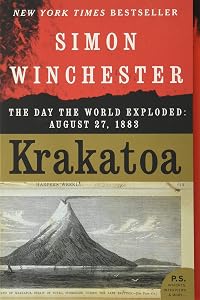
Krakatoa: The Day the World Exploded: August 27, 1883
by Simon Winchester
On This Page
Description
The bestselling author of The Professor and the Madman and The Map That Changed the World examines the enduring and world-changing effects of the catastrophic eruption off the coast of Java of the earth's most dangerous volcano — Krakatoa.The legendary annihilation in 1883 of the volcano-island of Krakatoa — the name has since become a byword for a cataclysmic disaster — was followed by an immense tsunami that killed nearly forty thousand people. Beyond the purely physical horrors of show more an event that has only very recently been properly understood, the eruption changed the world in more ways than could possibly be imagined. Dust swirled round die planet for years, causing temperatures to plummet and sunsets to turn vivid with lurid and unsettling displays of light. The effects of the immense waves were felt as far away as France. Barometers in Bogotá and Washington, D.C., went haywire. Bodies were washed up in Zanzibar. The sound of the island's destruction was heard in Australia and India and on islands thousands of miles away. Most significant of all — in view of today's new political climate — the eruption helped to trigger in Java a wave of murderous anti-Western militancy among fundamentalist Muslims: one of the first outbreaks of Islamic-inspired killings anywhere.
Simon Winchester's long experience in the world wandering as well as his knowledge of history and geology give us an entirely new perspective on this fascinating and iconic event as he brings it telling back to life.
. show less
Tags
Recommendations









Member Recommendations


The Million Death Quake: The Science of Predicting Earth's Deadliest Natural Disaster by Roger Musson
RChurch earthquake vs volcano
Member Reviews
Started off 2023 with a book that has been on my shelf for years and an author that I've never read, despite his popularity and many available books. And I really enjoyed it. As is evidenced by the title, this is a nonfiction work about the explosion of Krakatoa, a volcano between Sumatra and Java. This happened in 1883 and was one of the first major natural disasters that happened when global communication was possible through telegraphs. There were also enough scientific instruments in place to really get a handle on some of the repercussions of the eruption. Krakatoa's explosion was so violent that the entire volcano disappeared under the ocean. The explosion was heard 3000 miles away and the shock waves circled the entire globe 7 show more times! Almost 40,000 people died.
Winchester goes through what we know about plate tectonics and volcanoes in clear and informative words. He also gives good insight into the Dutch colonization of Java and how the eruption began to change the island and Dutch rule. I was also really interested in what happened to the immediate surroundings of a new volcano springing up near Krakatoa and how life returned to the islands.
The book is not highly technical and it's obviously intended for the curious layperson. It's very readable nonfiction and probably won't satisfy anyone with a lot of expertise in the topic, but for me it hit just the right note. Sort of like watching a history channel hour long documentary but reading it instead. show less
Winchester goes through what we know about plate tectonics and volcanoes in clear and informative words. He also gives good insight into the Dutch colonization of Java and how the eruption began to change the island and Dutch rule. I was also really interested in what happened to the immediate surroundings of a new volcano springing up near Krakatoa and how life returned to the islands.
The book is not highly technical and it's obviously intended for the curious layperson. It's very readable nonfiction and probably won't satisfy anyone with a lot of expertise in the topic, but for me it hit just the right note. Sort of like watching a history channel hour long documentary but reading it instead. show less
Reading anything by Simon Winchester is like going into a restaurant that has a twenty-plus page menu. So much information and everything looks good. I personally find Winchester fun to read because he is not didactic, dry or stale. His personal anecdotes add flavor and spice to just about any topic he cares to write. In this case, "the day the world exploded," the day the volcano, Krakatoa, erupted. Winchester delves into the science behind the disaster; what caused the eruption and the deadly tsunami that followed. For example, on the "explosivity index" Krakatoa was a seven; measured by the amount of material that is ejected and the height to which it is spewed through the atmosphere. Rest assured, he will tell you everything beyond show more the science as well. Death counts, survivor recollections, political implications, even information you didn't know you needed like the origin story of time zones and anecdotal information about historical characters. He'll joke about the different ways to spell Krakatoa and emphasize the fact that the original island was blown to smithereens.
My only letdown was that I was disappointed with the inclusion of a black and white photograph of Frederic Edwin Church's painting of a sunset over ice on Chaumont Bay of Lake Ontario. The whole point of mentioning the painting was the colors most likely caused be Krakatoa. Not helpful as a black and white picture. show less
My only letdown was that I was disappointed with the inclusion of a black and white photograph of Frederic Edwin Church's painting of a sunset over ice on Chaumont Bay of Lake Ontario. The whole point of mentioning the painting was the colors most likely caused be Krakatoa. Not helpful as a black and white picture. show less
“Explosions like a battery of guns are heard… The lighthouse… is hit by a wave and destroyed, ripped off its base, leaving only an amputated stump of jagged masonry. An immense wave then leaves Krakatoa at almost exactly 10:00 A.M. – and then, two minutes later, according to all the instruments that record it, came the fourth and greatest explosion of them all, a detonation that was heard thousands of miles away and that is still said to be the most violent explosion ever recorded and experienced by modern man. The cloud of gas and white-hot pumice, fire, and smoke is believed to have risen… as many as twenty-four miles into the air.” – Simon Winchester, Krakatoa
Krakatoa lies in the Sunda Strait, between Sumatra and Java, show more in current-day Indonesia. Winchester visited the area many years ago and returned recently to climb Anak Krakatoa, the ever-growing newest incarnation of the volcano that has arisen from the sea at the same location as the one destroyed in 1883. (Yes, he actually climbed the volcano and peered into its caldera.) He was inspired to research and document the history of Krakatoa and describe the cyclical process of rejuvenation.
This book is a delightful mix of history, science, and sociology. Winchester provides a comprehensive look at the time period, what led up to the disaster, the tremendous explosion itself, and the resulting impact on the people and the environment. He also discusses political and biological aftermath in the area, some of which is surprising.
The history of the period is examined in depth. Winchester covers the advances in telecommunications that enabled the story to be reported quickly rather than the two weeks in took in the past. He covers such history as the Dutch colonial rule of the area, natural resources, shipping methods, commerce, and past eruptions. He makes a case for Krakatoa as the beginning of the idea of the earth as a “global village.”
It helps to have a strong interest in science, as Winchester goes into a detailed explanation of the scientific factors behind the disaster – plate tectonics, tsunamis, seismology, continental drift, subduction zones, and more. It is a thorough analysis – not for someone that wants the high-level overview. It is more oriented toward those that like to uncover the interconnections among seemingly discrete topics.
This book is not a typical “disaster story,” though it does include eye-witness accounts and the extent of devastation. It does not tell the story by focusing on particular people and where they were. It is more focused on why the event occurred. The narrative does not arrive at the catastrophic explosion until the half-way point. If I have to pick a minor blemish, the sub-title does not convey the breadth of the book. It is much more extensive than what happened on a single day.
Winchester tells the story in an erudite, engrossing, and educational manner. He excels at putting the event into its historical context. This book is well-researched – it includes an extensive bibliography and footnotes that are as interesting to read as the text. It contains all the elements I look for in non-fiction. I found it absolutely mesmerizing. show less
Krakatoa lies in the Sunda Strait, between Sumatra and Java, show more in current-day Indonesia. Winchester visited the area many years ago and returned recently to climb Anak Krakatoa, the ever-growing newest incarnation of the volcano that has arisen from the sea at the same location as the one destroyed in 1883. (Yes, he actually climbed the volcano and peered into its caldera.) He was inspired to research and document the history of Krakatoa and describe the cyclical process of rejuvenation.
This book is a delightful mix of history, science, and sociology. Winchester provides a comprehensive look at the time period, what led up to the disaster, the tremendous explosion itself, and the resulting impact on the people and the environment. He also discusses political and biological aftermath in the area, some of which is surprising.
The history of the period is examined in depth. Winchester covers the advances in telecommunications that enabled the story to be reported quickly rather than the two weeks in took in the past. He covers such history as the Dutch colonial rule of the area, natural resources, shipping methods, commerce, and past eruptions. He makes a case for Krakatoa as the beginning of the idea of the earth as a “global village.”
It helps to have a strong interest in science, as Winchester goes into a detailed explanation of the scientific factors behind the disaster – plate tectonics, tsunamis, seismology, continental drift, subduction zones, and more. It is a thorough analysis – not for someone that wants the high-level overview. It is more oriented toward those that like to uncover the interconnections among seemingly discrete topics.
This book is not a typical “disaster story,” though it does include eye-witness accounts and the extent of devastation. It does not tell the story by focusing on particular people and where they were. It is more focused on why the event occurred. The narrative does not arrive at the catastrophic explosion until the half-way point. If I have to pick a minor blemish, the sub-title does not convey the breadth of the book. It is much more extensive than what happened on a single day.
Winchester tells the story in an erudite, engrossing, and educational manner. He excels at putting the event into its historical context. This book is well-researched – it includes an extensive bibliography and footnotes that are as interesting to read as the text. It contains all the elements I look for in non-fiction. I found it absolutely mesmerizing. show less
Krakatoa is one long and scattered digression on the subject of the titanic eruption of 1883. It's a lot of fun, since Winchester has a natural knack as a storyteller and a particular love for geology, but don't expect anything like focus. The story weaves through the spice trade, Dutch colonial policies, telegraphs, the Wallace line separating the biomes of Asia and Australia, and then the history of plate tectonics and the discovery of the source of volcanism along subduction zones, as water rich seabed slides into the mantle, melts, and bubbles upwards.
But if you're interested in the eruption itself, it takes several hundred pages for the story to wind it's way there. And the eruption is a hard thing to write about, so cataclysmic show more that most of the witnesses died. Though a few survivors carried forward stories of ashfalls at sea, 100 foot tsunamis, and thunderous cracks heard 3000 miles away.
Winchester's thesis, as much as this book has one, is that Krakatoa catalyzed the idea of the global community. News of the disaster spread worldwide in hours along commercial telegraph lines, a dramatic use of a tool more regularly used for reporting shipping news. Victorian recording barometers showed the spreading air shockwave reverberate 14 times around the world from Kratakoa, while tide meters pegged the change in the sea. Sadly, the eruption was also a missed opportunity for science, as geology lacked the theories to understand volcanism, and close biological surveys were understandly absent in the critical early months to see how life returned to the remaining islands of Krakatoa, and the new island of Anakrakatoa, a volcano growing at the rate of 20' per year from the submerged caldera. show less
But if you're interested in the eruption itself, it takes several hundred pages for the story to wind it's way there. And the eruption is a hard thing to write about, so cataclysmic show more that most of the witnesses died. Though a few survivors carried forward stories of ashfalls at sea, 100 foot tsunamis, and thunderous cracks heard 3000 miles away.
Winchester's thesis, as much as this book has one, is that Krakatoa catalyzed the idea of the global community. News of the disaster spread worldwide in hours along commercial telegraph lines, a dramatic use of a tool more regularly used for reporting shipping news. Victorian recording barometers showed the spreading air shockwave reverberate 14 times around the world from Kratakoa, while tide meters pegged the change in the sea. Sadly, the eruption was also a missed opportunity for science, as geology lacked the theories to understand volcanism, and close biological surveys were understandly absent in the critical early months to see how life returned to the remaining islands of Krakatoa, and the new island of Anakrakatoa, a volcano growing at the rate of 20' per year from the submerged caldera. show less
Listening to this book was a great way to learn history -- not generally one of my favorite subjects. I didn't know anything about Krakatoa except that the the volcano's exlosion is considered the loudest sound ever produced on earth. Simon Winchester, who wrote and read the book, weaves in the history of the Spice Islands, eventually focusing on the Dutch trading centers near Krakatoa. He describes the volcano's activity leading up to the ultimate event, shares many first-hand accounts of it, and describes the communication technologies at the time and how news of the explosion reached other parts of the world. It was a boon to scientists, who studied the eruption and its aftermath; meteorology and geology in particular made major show more gains. The art world was also influenced as sunsets were particularly vivid for a long time afterwards and were a subject for many painters, one of whom created hundreds of images each evening, creating a sort of time lapse record of what the skies looked like. The Royal Geological Society in England got into the act, inviting people from around the world to write to them with information about their experience of the event, which resulted in thousands of letter, all of which were recorded and catalogued. There were widespread tsunamis whose devastation was far greater than anything else that's been recorded. All in all, it provided a fascinating view of the specific event and the world in 1883. Highly recommended. show less
I've been interested in Krakatoa for quite a while--can't remember when I first heard about the volcano, but I do know that I'd heard of it in conjunction with planet-wide cooling brought on by the dust kicked up by the explosion. Honestly, I thought I'd be getting more of that, the social and global impact of the eruption. I have a feeling my enjoyment of Dead Wake colored my expectations. That said, there was plenty I found fascinating. It's almost amazing how much information is fit into this book, from history to geology to technology to...erm, memoir?
The book probably could have used a bit more editing, which surprised me since I enjoyed The Professor and the Madman. Quite possibly the editor of Krakatoa let the author rest a bit show more too much on his laurels earned for that book. The strangest part was the author's random description of a research trip he took to Iceland, which was smack dab in the middle of an explanation of geological phenomena. I don't believe there was anywhere else in the main body of the text where he inserted himself even in passing, but there were four or five pages about his little northward jaunt. While definitely interesting, it was just out of place. That kind of information belongs in the preface and epilogue--where he did have a great deal of personal information that very neatly bookended the distance of science and history with the closeness of personal experience. There were also quite a few footnotes that seemed like they should have been integrated into the text, since they had information that was actually important (though most were good, fun but skipable footnotes). I might have also liked a little more easing in to the explosion--Winchester seems to have started with the assumption that readers have more than passing familiarity with the events, but I knew next to nothing and found it hard to keep up with dates until he broke down the eruption's timeline in the middle of the book.
My favorite aspect of the book was learning about how the eruption of Krakatoa was really the first disaster with a worldwide impact to be felt by people all over the world. I don't mean in physical terms--other volcanoes have erupted and changed the climate, other disasters have occurred--but in terms of technological globalization. By the end of the 1800s, communication could happen by wire even over vast distances beneath the ocean, which meant that the event was discussed in world newspapers a day or two after it happened. (I'd still like to learn how telegraph lines were laid in oceans.) For the first time, instead of just noticing that sunsets were exceptionally brilliant or winters exceptionally cold, people all over the world knew why. I couldn't help thinking several times about the tsunamis that devastated the same region in 2004, especially in how the media approached the disaster. Without the speedy spread of photography in 1883, it sounds like the general public was more interested in the scientific aspects of the explosion. In 2004, the emphasis was very much on the human loss and devastation.
If you're interested in volcanoes, geology, regional history, or Krakatoa itself, you'll enjoy this book--but you'll definitely want to have at least some sort of interest before you pick this book up, to keep you going through the wide variety of topics.
Quote/Key Thought Roundup
6) In learning of [Java, Sumatra, Sunda Strait, Batavia] and of the terrible events that occurred there, so the world's people suddenly became part of a new brotherhood of knowledge--in a sense it was that day in August 1883 that the modern phenomenon known as "the global village" was born.
First mention of the communication angle that so fascinated me. On another note, I was cheered and tickled to see that Winchester uses almost as many dashes in his writing as I do.
72) There had been a great southern continent, Gondwanaland [...] According to early theorists the Tethys [Ocean] had originated by way of continental sinking--an ever popular explanation for all manner of earthly mysteries, and which of course remained the basis for such enduring myths as the vanishing of Atlantis.
"Gondwanaland". Seriously? Actually, the funniest part about the name to me is it's distant, completely accidental similarity (g! a! l! d!) to the name of Galard, the continent that sank in my awful book, Lavardia.
111) During the infamous San Francisco Earthquake of 1906 parts of the fault, which in recent years has accelerated its rate of sliding to almost four inches a year, shot past each other a total of twenty-one feet in a matter of twenty seconds!
A) Holy cow! Twenty-one feet!
B) How did anyone think it was a good idea to rebuild after that?
C) Another earthquake is unlikely to happen in exactly the same place, but...do people know if their house is built on that slipped fault line?
D) Why the heck is Starfleet HQ built in such an unstable part of the planet?
267) The [air] shock wave from Krakatoa's final cataclysmic explosion had traveled around the earth not once but seven times.
A) Holy cow! Air waves! Seven times!
B) I was fascinating to learn that, since weather forecasting was in vogue in the late Victorian times, hundreds if not thousands of upper-class people had these waves recorded on their personal barographs.
269) Here was one of the first provable instances in which a natural event occurring in one corner of the planet had effects that spread over the entire world. [...] Few in Victorian times had begun to think truly globally. [...] The world was now suddenly seen to be much more than an immense collection of unrelated peoples and isolated happenings: It was, rather, an almost infinitely large association of interconnected individuals and perpetually intersecting events.
While I won't wax lyrical about beautiful prose in this book, I did get very caught up in these eloquent descriptions about the globalizing impact of the event. Obviously my interest in this aspect of the book is coloring my opinion, but still...
317) Chapter 9: Rebellion of a Ruined People
In this chapter, Winchester remembers that there were more people than just the Dutch colonists living near Krakatoa. There were a few mentions of the local populations earlier on in the book, but they tended to be colored with the exoticization of his contemporary sources--not exactly comfortable reading. This chapter, though, aiyah! It's the first chapter actually devoted to the native population of the region rather than heavily favoring the European colonists and it focuses a great deal on the influence of Islam. In addition to being annoyed that more wasn't said about the local people earlier on (aside from bashing their record keeping), I was surprised how aggressively the author went after the militant factions of the religion as key instigators of post-Krakatoa uprisings. It sounds like there's no doubt that religious leaders did have a big impact on the events, but there's relatively little space devoted to other potential causes of dissatisfaction with the alien colonizers. Don't you think that after several hundred years of rule by a foreign body there might be a few local people interested in independence instead of a holy war? Take this paragraph:
322) Did Islam come to act as a banner under which these people might turn against the Dutchmen whom they could now, all of a sudden and with the clarity of a new perspective see not as their benevolent leaders and well-intentioned mentors but, as so many imperial agents are eventually viewed, as their oppressors?
Wow, dude, you really think that this change in outlook toward the Dutch was "sudden"? That there was no reason for Indonesian Muslims and non-Muslims alike to be dissatisfied with the imperialists? While I readily accept that the eruption may have pushed the situation to a boiling point, I am incredibly skeptical that this revolt came out of nowhere but Islam and Krakatoa.
337) The rebellion had been crushed; an inquiry was staged; the Dutch slowly instituted reforms; taxation was eased; strictures on travel were relaxed; a mood of tolerance and ethical standards took root.
Okay, I kind of hesitate to bring this up, but the author is British. I can't help but feel that there's some lingering imperialist resentment seeping into this section, in which the Dutch are portrayed only as mild, reasonable people and Indonesian Muslims as an uncontrollable, violent element.
361) Unnecessarily long word(s) of the day: chemolithoautotrophic hyperthermophilic archaebacteria. They're bacteria that live in heat vents in the bottom of the ocean. They're in a footnote, and barely relevant.
371) The author visits the Volcanological Survey of Indonesia's Krakatoa observatory where an observer describes a "routine eruption".
He said he watched [the eruption] for a moment only, counting the seconds by snapping his fingers. He walked back to the Kinematics machine and, sure enough, ten seconds after the first sight of the smoke, after ten snaps of his fingers, the needle began to move. [...] He was still clicking his fingers while he watched the machine--until another five seconds had passed, when ... right on cue, there came from across the strait a rumble.
As someone who does not live in a geologically active area, this man's cool calm impressed me. "Oh, just another eruption. I've got the visual, mechanical, and sound distances memorized. Tra la la."
382) [The new Krakatoa crater] was a place that was all too evidently primed, ready at any instant to explode again--and, in exploding, to do goodness knows how much harm to goodness knows how many souls waiting unwittingly down below.
A) You just got done telling us that Indonesia has this earthquake detector in place along with plans of action in case of another massive event--there's no preparing for a sudden event, but it's not nothing.
B) You just got done telling us that consistently active volcanoes are much less likely to explode because they're constantly releasing bits of pressure instead of building it up.
C) We get that it's scary. You just spent a whole book telling us why. You don't need to go out of your way to sensationalize an already impressive natural phenomenon. show less
The book probably could have used a bit more editing, which surprised me since I enjoyed The Professor and the Madman. Quite possibly the editor of Krakatoa let the author rest a bit show more too much on his laurels earned for that book. The strangest part was the author's random description of a research trip he took to Iceland, which was smack dab in the middle of an explanation of geological phenomena. I don't believe there was anywhere else in the main body of the text where he inserted himself even in passing, but there were four or five pages about his little northward jaunt. While definitely interesting, it was just out of place. That kind of information belongs in the preface and epilogue--where he did have a great deal of personal information that very neatly bookended the distance of science and history with the closeness of personal experience. There were also quite a few footnotes that seemed like they should have been integrated into the text, since they had information that was actually important (though most were good, fun but skipable footnotes). I might have also liked a little more easing in to the explosion--Winchester seems to have started with the assumption that readers have more than passing familiarity with the events, but I knew next to nothing and found it hard to keep up with dates until he broke down the eruption's timeline in the middle of the book.
My favorite aspect of the book was learning about how the eruption of Krakatoa was really the first disaster with a worldwide impact to be felt by people all over the world. I don't mean in physical terms--other volcanoes have erupted and changed the climate, other disasters have occurred--but in terms of technological globalization. By the end of the 1800s, communication could happen by wire even over vast distances beneath the ocean, which meant that the event was discussed in world newspapers a day or two after it happened. (I'd still like to learn how telegraph lines were laid in oceans.) For the first time, instead of just noticing that sunsets were exceptionally brilliant or winters exceptionally cold, people all over the world knew why. I couldn't help thinking several times about the tsunamis that devastated the same region in 2004, especially in how the media approached the disaster. Without the speedy spread of photography in 1883, it sounds like the general public was more interested in the scientific aspects of the explosion. In 2004, the emphasis was very much on the human loss and devastation.
If you're interested in volcanoes, geology, regional history, or Krakatoa itself, you'll enjoy this book--but you'll definitely want to have at least some sort of interest before you pick this book up, to keep you going through the wide variety of topics.
Quote/Key Thought Roundup
6) In learning of [Java, Sumatra, Sunda Strait, Batavia] and of the terrible events that occurred there, so the world's people suddenly became part of a new brotherhood of knowledge--in a sense it was that day in August 1883 that the modern phenomenon known as "the global village" was born.
First mention of the communication angle that so fascinated me. On another note, I was cheered and tickled to see that Winchester uses almost as many dashes in his writing as I do.
72) There had been a great southern continent, Gondwanaland [...] According to early theorists the Tethys [Ocean] had originated by way of continental sinking--an ever popular explanation for all manner of earthly mysteries, and which of course remained the basis for such enduring myths as the vanishing of Atlantis.
"Gondwanaland". Seriously? Actually, the funniest part about the name to me is it's distant, completely accidental similarity (g! a! l! d!) to the name of Galard, the continent that sank in my awful book, Lavardia.
111) During the infamous San Francisco Earthquake of 1906 parts of the fault, which in recent years has accelerated its rate of sliding to almost four inches a year, shot past each other a total of twenty-one feet in a matter of twenty seconds!
A) Holy cow! Twenty-one feet!
B) How did anyone think it was a good idea to rebuild after that?
C) Another earthquake is unlikely to happen in exactly the same place, but...do people know if their house is built on that slipped fault line?
D) Why the heck is Starfleet HQ built in such an unstable part of the planet?
267) The [air] shock wave from Krakatoa's final cataclysmic explosion had traveled around the earth not once but seven times.
A) Holy cow! Air waves! Seven times!
B) I was fascinating to learn that, since weather forecasting was in vogue in the late Victorian times, hundreds if not thousands of upper-class people had these waves recorded on their personal barographs.
269) Here was one of the first provable instances in which a natural event occurring in one corner of the planet had effects that spread over the entire world. [...] Few in Victorian times had begun to think truly globally. [...] The world was now suddenly seen to be much more than an immense collection of unrelated peoples and isolated happenings: It was, rather, an almost infinitely large association of interconnected individuals and perpetually intersecting events.
While I won't wax lyrical about beautiful prose in this book, I did get very caught up in these eloquent descriptions about the globalizing impact of the event. Obviously my interest in this aspect of the book is coloring my opinion, but still...
317) Chapter 9: Rebellion of a Ruined People
In this chapter, Winchester remembers that there were more people than just the Dutch colonists living near Krakatoa. There were a few mentions of the local populations earlier on in the book, but they tended to be colored with the exoticization of his contemporary sources--not exactly comfortable reading. This chapter, though, aiyah! It's the first chapter actually devoted to the native population of the region rather than heavily favoring the European colonists and it focuses a great deal on the influence of Islam. In addition to being annoyed that more wasn't said about the local people earlier on (aside from bashing their record keeping), I was surprised how aggressively the author went after the militant factions of the religion as key instigators of post-Krakatoa uprisings. It sounds like there's no doubt that religious leaders did have a big impact on the events, but there's relatively little space devoted to other potential causes of dissatisfaction with the alien colonizers. Don't you think that after several hundred years of rule by a foreign body there might be a few local people interested in independence instead of a holy war? Take this paragraph:
322) Did Islam come to act as a banner under which these people might turn against the Dutchmen whom they could now, all of a sudden and with the clarity of a new perspective see not as their benevolent leaders and well-intentioned mentors but, as so many imperial agents are eventually viewed, as their oppressors?
Wow, dude, you really think that this change in outlook toward the Dutch was "sudden"? That there was no reason for Indonesian Muslims and non-Muslims alike to be dissatisfied with the imperialists? While I readily accept that the eruption may have pushed the situation to a boiling point, I am incredibly skeptical that this revolt came out of nowhere but Islam and Krakatoa.
337) The rebellion had been crushed; an inquiry was staged; the Dutch slowly instituted reforms; taxation was eased; strictures on travel were relaxed; a mood of tolerance and ethical standards took root.
Okay, I kind of hesitate to bring this up, but the author is British. I can't help but feel that there's some lingering imperialist resentment seeping into this section, in which the Dutch are portrayed only as mild, reasonable people and Indonesian Muslims as an uncontrollable, violent element.
361) Unnecessarily long word(s) of the day: chemolithoautotrophic hyperthermophilic archaebacteria. They're bacteria that live in heat vents in the bottom of the ocean. They're in a footnote, and barely relevant.
371) The author visits the Volcanological Survey of Indonesia's Krakatoa observatory where an observer describes a "routine eruption".
He said he watched [the eruption] for a moment only, counting the seconds by snapping his fingers. He walked back to the Kinematics machine and, sure enough, ten seconds after the first sight of the smoke, after ten snaps of his fingers, the needle began to move. [...] He was still clicking his fingers while he watched the machine--until another five seconds had passed, when ... right on cue, there came from across the strait a rumble.
As someone who does not live in a geologically active area, this man's cool calm impressed me. "Oh, just another eruption. I've got the visual, mechanical, and sound distances memorized. Tra la la."
382) [The new Krakatoa crater] was a place that was all too evidently primed, ready at any instant to explode again--and, in exploding, to do goodness knows how much harm to goodness knows how many souls waiting unwittingly down below.
A) You just got done telling us that Indonesia has this earthquake detector in place along with plans of action in case of another massive event--there's no preparing for a sudden event, but it's not nothing.
B) You just got done telling us that consistently active volcanoes are much less likely to explode because they're constantly releasing bits of pressure instead of building it up.
C) We get that it's scary. You just spent a whole book telling us why. You don't need to go out of your way to sensationalize an already impressive natural phenomenon. show less
August 1883. Events happening on a tiny island in the Sunda Strait between the Indonesian islands of Sumatra and Java were about to dramatically change the world. On the morning of August 27 the volcanic island of Krakatoa erupted in an earth-shattering explosion. Krakatoa’s eruption was dramatic on many scales. Tsunami and volcanic ash devastated many of the villages that sat on the coastline of the Sunda Strait on both Java and Sumatra. In the capital of the Dutch colony Batavia (present day Jakarta) day turned into night from ash. The sound of Krakatoa’s explosion was heard in Bangkok, Manila, Perth, and Rodriguez Island - nearly 3000 miles from its source! The pressure wave caused by the eruption displaced barometers in dozens show more of fashionable gentlemen’s clubs across Europe and was later found to have traveled around the globe at least seven times! Once it was over nothing but two small islands remained of the once mighty volcanic island. Krakatoa was the largest volcanic eruption in recorded human history and the recent connection of many countries by telegraph cable made it one of the first truly global events.
Winchester takes the reader on a wonderful journey, looking not only at the eruption of the volcano but also at the events that shaped the world at the time of the eruption. Winchester’s story focuses on the geology of Krakatoa and on the history of Indonesia and the lasting effects of Dutch colonization. The book begins with a look at the history of Indonesia. The islands of Indonesia, that today make up the most populous Islamic country in the world, were key to the ambitions of European countries during the height of the Colonial Era due to the riches brought by its spices – pepper, clove, and nutmeg, what Winchester calls the “holy trinity of the Asian spice trade.”
Winchester’s back-story and history of colonization set the stage for the dramatic events of 1883. Through this set-up the reader learns a great deal of geology. Indonesia sits at one of the crucial sites found on our Earth, located at a junction between two tectonic plates. To the south sits the Australian plate that is traveling north and subducting under the Eurasian plate. The results create one of the most tectonic and volcanically active regions on Earth. Winchester takes the reader through the thought processes that led to the unifying theory of geology, plate tectonics, and is the key to understanding how and why Krakatoa erupted.
As in Winchester’s other books his style is straightforward and easy to read. For many readers the thought of reading a book that covers both geology and history may seem daunting and dry, but Winchester envelopes the reader with a rich and vibrant writing style combined with over 50 illustrations, maps, and photos that keeps you turning page after page. We experience the eruption of Krakatoa from many perspectives, those of sailors traveling through the Sunda Strait at the time of the eruption, to colonial administrators living along the Straits. We are immersed in the lives of those people that experienced the eruption first hand and those that struggled to interpret and study the volcano’s activities. In the end Winchester takes us up to the summit of Anak Krakatoa – the child of Krakatoa, the volcano reborn from the sea to experience the rebirth of this amazing island first hand.
I highly recommend Krakatoa, The Day the World Exploded to anybody interested in geology, or history, or with a passion for both (like me). You will come away with a deeper understanding of the geology of plate tectonics and the area of the Java Trench as well as the history of Indonesia and how events on a small island on the morning of August 27, 1883 started us down a path to a connected, global community. show less
Winchester takes the reader on a wonderful journey, looking not only at the eruption of the volcano but also at the events that shaped the world at the time of the eruption. Winchester’s story focuses on the geology of Krakatoa and on the history of Indonesia and the lasting effects of Dutch colonization. The book begins with a look at the history of Indonesia. The islands of Indonesia, that today make up the most populous Islamic country in the world, were key to the ambitions of European countries during the height of the Colonial Era due to the riches brought by its spices – pepper, clove, and nutmeg, what Winchester calls the “holy trinity of the Asian spice trade.”
Winchester’s back-story and history of colonization set the stage for the dramatic events of 1883. Through this set-up the reader learns a great deal of geology. Indonesia sits at one of the crucial sites found on our Earth, located at a junction between two tectonic plates. To the south sits the Australian plate that is traveling north and subducting under the Eurasian plate. The results create one of the most tectonic and volcanically active regions on Earth. Winchester takes the reader through the thought processes that led to the unifying theory of geology, plate tectonics, and is the key to understanding how and why Krakatoa erupted.
As in Winchester’s other books his style is straightforward and easy to read. For many readers the thought of reading a book that covers both geology and history may seem daunting and dry, but Winchester envelopes the reader with a rich and vibrant writing style combined with over 50 illustrations, maps, and photos that keeps you turning page after page. We experience the eruption of Krakatoa from many perspectives, those of sailors traveling through the Sunda Strait at the time of the eruption, to colonial administrators living along the Straits. We are immersed in the lives of those people that experienced the eruption first hand and those that struggled to interpret and study the volcano’s activities. In the end Winchester takes us up to the summit of Anak Krakatoa – the child of Krakatoa, the volcano reborn from the sea to experience the rebirth of this amazing island first hand.
I highly recommend Krakatoa, The Day the World Exploded to anybody interested in geology, or history, or with a passion for both (like me). You will come away with a deeper understanding of the geology of plate tectonics and the area of the Java Trench as well as the history of Indonesia and how events on a small island on the morning of August 27, 1883 started us down a path to a connected, global community. show less
Members
- Recently Added By
Published Reviews
Most controversially, Winchester attempts to credit Krakatoa with the rise of militant Islamism in Indonesia.
added by John_Vaughan
Lists

Disaster Books
74 works; 19 members

Best History Books about Disasters
33 works; 19 members

Non-Fiction Worth Reading
1,025 works; 264 members

Accidents, Disasters, and Tragedies
175 works; 7 members

For Science!
39 works; 5 members

Geology - Disaster/Epic Change
8 works; 3 members

Authors from England
147 works; 4 members

The r/AskScience Reading List
159 works; 3 members

My List
302 works; 1 member
Author Information

53+ Works 38,720 Members
Simon Winchester was born in London, England on September 28, 1944. He read geology at St. Catherine's College, Oxford. After graduation in 1966, he joined a Canadian mining company and worked as field geologist in Uganda. The following year he decided to become a journalist. His first reporting job was for The Journal, Newcastle upon Tyne. In show more 1969, he joined The Guardian and was named Britain's Journalist of the Year in 1971. He also worked for the Daily Mail and the Sunday Times before becoming a freelancer. He is the author of numerous books including In Holy Terror, The River at the Center of the World, The Alice Behind Wonderland, The Professor and the Madman: A Tale of Murder, Insanity, the Making of the Oxford English Dictionary, and.Exactly: How Precision Engineers Created the Modern World. In 2006, he was made an Officer of the Order of the British Empire for services to journalism and literature. (Bowker Author Biography) show less
Some Editions
Awards and Honors
Awards
Distinctions
Series
Belongs to Publisher Series
btb (73336)
Work Relationships
Common Knowledge
- Original title
- Krakatoa: The Day the World Exploded. 17. August 1883
- Original publication date
- 2003
- Important places
- Indonesia; Krakatoa, Indonesia
- Important events
- Krakatoa Eruption (1883); Disaster: Volcano Eruption
- Dedication
- I dedicate this book, with pleasure and with thanks, to my mother and father.
- First words
- (Prelude) It was early on a warm summer's evening in the 1970's, as I stood in a palm plantation high on a green hillside in western Java, that I saw for the first time, silhouetted against the faint blue hills of faraway Sum... (show all)atra, the small gathering of islands that is all that remains of what was once a mountain called Krakatoa.
Though we think first of Java as an eponym for coffee (or, to some today, a computer language), it is in fact the trading of aromatic tropical spices on which the fortunes of the great island's colonizers and Western discover... (show all)ers were first founded. - Quotations
- Indonesia itself has and has had more volcanoes and more volcanic activity than any other political entity on the earth, in all recorded history.
- Last words
- (Click to show. Warning: May contain spoilers.)The crucible of life turns out to be most difficult of vessels to break: Not even the world's most dangerous volcano could do it truly irreparable damage.
(Click to show. Warning: May contain spoilers.)(Epilogue) And as we sailed into the gathering dark, so the twinkling lights of the west of Java were coming up fast over the bow. - Publisher's editor
- Mount, Mary
- Original language
- English
- Canonical DDC/MDS
- 551.210959818
- Canonical LCC
- QE523.K73
Classifications
- Genres
- General Nonfiction, History, Science & Nature, Nonfiction
- DDC/MDS
- 551.210959818 — Natural sciences & mathematics Earth sciences; geology Geology, Hydrology Meteorology Volcanoes, earthquakes, thermal waters and gases Volcanoes Volcans
- LCC
- QE523 .K73 — Science Geology Geology Dynamic and structural geology Volcanoes and earthquakes
- BISAC
Statistics
- Members
- 4,592
- Popularity
- 3,187
- Reviews
- 129
- Rating
- (3.80)
- Languages
- 8 — Dutch, English, French, German, Hebrew, Indonesian, Italian, Portuguese (Portugal)
- Media
- Paper, Audiobook, Ebook
- ISBNs
- 34
- ASINs
- 13