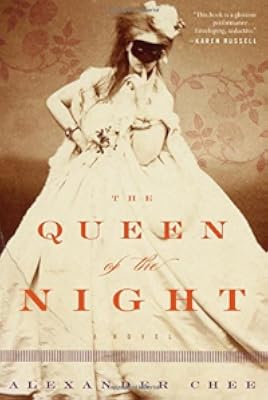
The Queen of the Night
by Alexander Chee
On This Page
Description
Fiction. Literature. Historical Fiction. From a ferociously talented writer, praised as "the fire, in my opinion. And the light," by Junot Diaz, comes a blazing portrait of one woman's rise from courtesan to world-renowned diva.Lilliet Berne is a sensation of the Paris Opera, a legendary soprano with every accolade except an original role, every singer's chance at immortality. When one is finally offered to her, she realizes with alarm that the libretto is based on a hidden piece of her show more past. Only four could have betrayed her: one is dead, one loves her, one wants to own her. And one, she hopes, never thinks of her at all.As she mines her memories for clues, she recalls her life as an orphan who left the American frontier for Europe and was swept up into the glitzy, gritty world of Second Empire Paris. To survive, she transformed herself from hippodrome rider to courtesan, from empress' maid to debut singer, all the while weaving a complicated web of romance, obligation, and political intrigue. Featuring a cast of characters drawn from history, The Queen of the Night follows Lilliet as she moves closer to the truth behind the mysterious opera and the role that could secure her reputation—or destroy her with the secrets it reveals. show lessTags
Recommendations





Member Reviews
OH MY GOD this man can write. His writing is so beautiful I found myself reading passages out loud to people and looking forward to every page.
On the other hand, I lost the plot a little about halfway through, and it took both me and the book a second to grab it back. At times it was so hyper-nuanced I wasn't entirely sure what kind of interactions were happening between characters and got very confused. This, thankfully, was brief, and then we all returned to intrigue.
I'm a crazy sucker for historical fiction and period pieces, especially with a little love and scandal. I would LOVE to see this adapted to film as I suspect the clothing and costumes would also be pretty spectacular, as would the scenery.
(Update 2025: I was OVERJOYED to show more find that this book had become an audiobook sometime between the time I read it and now - until I started listening to it. The narrator fell so completely flat it was depressing. DO OVER! Julia Whalen, get on this). show less
On the other hand, I lost the plot a little about halfway through, and it took both me and the book a second to grab it back. At times it was so hyper-nuanced I wasn't entirely sure what kind of interactions were happening between characters and got very confused. This, thankfully, was brief, and then we all returned to intrigue.
I'm a crazy sucker for historical fiction and period pieces, especially with a little love and scandal. I would LOVE to see this adapted to film as I suspect the clothing and costumes would also be pretty spectacular, as would the scenery.
(Update 2025: I was OVERJOYED to show more find that this book had become an audiobook sometime between the time I read it and now - until I started listening to it. The narrator fell so completely flat it was depressing. DO OVER! Julia Whalen, get on this). show less
This book is beautifully written and fantastically entertaining. I've only seen light-opera productions, but I feel like I've actually been living inside an epic opera during these 500 + pages. The protagonist, Lilliet Berne, leads a tragic yet magical life. Her struggle to find true love is thwarted only by her own efforts to escape her present circumstances. She is always running from one thing to another, seeking love, yet terrified of being controlled. Her final effort to end the man she belongs to (literally) by murdering the Tenor was a shock, but even this horrible act doesn't get her what she truly wants. I believe the end was perfect, as it brings Lilliet full circle and back to her roots. I would recommend this book to anyone show more who wants to be taken on a journey through Europe on the wings of a Falcon opera singer. show less
I'm not really sure what to say about Alexander Chee's novel The Queen of the Night other than it is magnificent. A sprawling, epic tale that put me in mind of Arthur Golden's Memoirs of a Geisha, we follow Paris Opera sensation Lilliet Berne as she recounts her life from her humble beginnings as an orphaned American child, who tried to make her way to Europe to the only family she new of after the death of her family and ended up being swept up by one circumstance after another into the spectacle that was the Second French Empire. We follow her life from her time with a traveling circus, to becoming a prostitute in one of Paris' more prestigious whorehouses, to her time as a dresser for Empress Eugénie de Montijo at the Tuileries, show more until she finally makes her debut at the French Opera. Through this tale, she is trying to discover who might know of her secrets, as each time she took on a new role, she also cast off her old life and name and reinvented herself at each turn, trying to finally free herself from her own past and come into the life that she wants for herself.
Chee seems to have thoroughly researched his setting for Lillet's journey, and his writing is strong and precise. Lilliet's life is quite an adventure, but it never seems to be dull, and I never felt like I was wishing that her tale would hurry along. I listened to the audio version, and Lisa Flanagan's narration is spot on; she truly became the voice of Lilliet for me. The only thing that I added to my own listening of the book that I think could possibly benefit other readers is that I listened to selections of the operas and other musical pieces that are mentioned in the book, to add that next level of enjoyment to the story.
Chee is an extraordinary storyteller and I'll definitely be reading more by him in the future. show less
Chee seems to have thoroughly researched his setting for Lillet's journey, and his writing is strong and precise. Lilliet's life is quite an adventure, but it never seems to be dull, and I never felt like I was wishing that her tale would hurry along. I listened to the audio version, and Lisa Flanagan's narration is spot on; she truly became the voice of Lilliet for me. The only thing that I added to my own listening of the book that I think could possibly benefit other readers is that I listened to selections of the operas and other musical pieces that are mentioned in the book, to add that next level of enjoyment to the story.
Chee is an extraordinary storyteller and I'll definitely be reading more by him in the future. show less
Honestly, March was a crap reading month for me. The pandemic panic found my work hours doing, and me more than a little exhausted.
I did, however, manage to read this bit of fantasticness. It is, certainly, on the problematic side for me. Lilliet has nearly no agency, no ability to to anything but careen from one disaster to the next. Her "great love" is....suspicious at best. Her "friendships" are clearly only of convenience.
And yet. This novel about the opera was, truly, an opera itself. Full of all the drama - OH THE DRAMA - and betrayal and infidelity and magic. Can you think in your mind what it would be like if The Phantom of the Opera had a part two, staring the magnificent, malevolent Carlotta? This is not that....but it's show more pretty darn close. Even as it frustrated me, it delighted me.
It felt like just the right sort of book to be reading in the surreal days that were the last month of my life. Would I recommend it? Maybe not. Would I read it again? Absolutely. show less
I did, however, manage to read this bit of fantasticness. It is, certainly, on the problematic side for me. Lilliet has nearly no agency, no ability to to anything but careen from one disaster to the next. Her "great love" is....suspicious at best. Her "friendships" are clearly only of convenience.
And yet. This novel about the opera was, truly, an opera itself. Full of all the drama - OH THE DRAMA - and betrayal and infidelity and magic. Can you think in your mind what it would be like if The Phantom of the Opera had a part two, staring the magnificent, malevolent Carlotta? This is not that....but it's show more pretty darn close. Even as it frustrated me, it delighted me.
It felt like just the right sort of book to be reading in the surreal days that were the last month of my life. Would I recommend it? Maybe not. Would I read it again? Absolutely. show less
'The Queen of the Night' was my penultimate unread library book. I snatched it off the shelf in a panic on the Last Day of the Library, knowing nothing about it except that it's long. Thus I had little idea of what to expect. According to the cover The New Yorker called it, 'A postmodern bodice ripper,' which could mean absolutely anything. The circuitous first person narrative follows a woman through successive phases in her life, during which she has different names and identities. She is born in frontier America, then spends much of her life in Paris during the Second Empire, siege, Commune, and Third Republic as a maid, courtesan, and opera singer. The nonlinear fashion in which she narrated her tale was initially a little show more confusing, especially given the total absence of speech marks. (Parenthetically, I've come up with a theory that speech marks are the underwear of punctuation. You can go without them, but the rest of the outfit had better be well-structured and suitably covering or the overall effect will be embarrassing.) Once I got used to this style, though, I found the plot compelling. It is loosely based on opera, both within the reality of the book and from the author's note, so is perpetually melodramatic and overwrought. Combining this heightened atmosphere with the prosaic limitations of women's lives in the 19th century does prove interesting.
Once I got into 'The Queen of the Night', I was unsurprised by what I did and didn't appreciate about it. I liked the female friendships, details of clothing and grooming, intrusions of historical events (particularly the Paris Commune), and historical personages as background characters. The depiction of sex work in 19th century France is notable, as it includes details of how 'filles de carte' had to be registered with the police. I did not enjoy the perpetual exploitation of women by men, the excessively florid passages of our protagonist's emotional reflections, the romance, and the occasional modern Americanisms. I know the narrator is American, but they still jolted me. Ultimately, I did not find myself as involved as I would expect from such a lengthy first person narrative. There were definitely some interesting themes around exploitative relationships, shifting identities, and music as both constraint and freedom. However I found the narrative voice and complex machinations of the characters a little too mannered to be convincing. Many scenes are vivid and suitably theatrical, yet the whole thing seems to add up to less than the sum of its parts. From the author's note, I gather 'The Queen of the Night' was partly influenced by Zola's [b:Nana|371456|Nana|Émile Zola|https://i.gr-assets.com/images/S/compressed.photo.goodreads.com/books/1174236758l/371456._SY75_.jpg|89633]. Perhaps I enjoyed it less as there are so many exceptional works of 19th century French literature to live up to. Sadly, Chee does not attain the standards set by Zola, Balzac, or Hugo. Nonetheless, I found the novel diverting and at times cinematic, very suitable for adaptation into a BBC miniseries. show less
Once I got into 'The Queen of the Night', I was unsurprised by what I did and didn't appreciate about it. I liked the female friendships, details of clothing and grooming, intrusions of historical events (particularly the Paris Commune), and historical personages as background characters. The depiction of sex work in 19th century France is notable, as it includes details of how 'filles de carte' had to be registered with the police. I did not enjoy the perpetual exploitation of women by men, the excessively florid passages of our protagonist's emotional reflections, the romance, and the occasional modern Americanisms. I know the narrator is American, but they still jolted me. Ultimately, I did not find myself as involved as I would expect from such a lengthy first person narrative. There were definitely some interesting themes around exploitative relationships, shifting identities, and music as both constraint and freedom. However I found the narrative voice and complex machinations of the characters a little too mannered to be convincing. Many scenes are vivid and suitably theatrical, yet the whole thing seems to add up to less than the sum of its parts. From the author's note, I gather 'The Queen of the Night' was partly influenced by Zola's [b:Nana|371456|Nana|Émile Zola|https://i.gr-assets.com/images/S/compressed.photo.goodreads.com/books/1174236758l/371456._SY75_.jpg|89633]. Perhaps I enjoyed it less as there are so many exceptional works of 19th century French literature to live up to. Sadly, Chee does not attain the standards set by Zola, Balzac, or Hugo. Nonetheless, I found the novel diverting and at times cinematic, very suitable for adaptation into a BBC miniseries. show less
I am not a fan of opera by any stretch. I've tried, honest-to-god I have. The world of opera is interesting though, and if there'd been more of that rather than of the operatic drama I might have enjoyed this book more. It is an opera, after all, with the loves and hates, the villain, the hapless heroine, the hero who dies (maybe, maybe not, in this it's all up in the air until the very end.) It's an opera within a novel about opera, and I wish I'd liked it more than I did.
It started out pretty well, but after a few hundred pages Lilliet, or whatever she was calling herself at that point, wore thin with me. She's so passive and seemingly indecisive that by the end I was shouting at my Kindle "For God's sake just make up your mind!" She show more lurches through the book doing what people tell her to do, resenting it, making a move, changing her mind, backsliding, trying to decide what she feels... it was like reading the diary of a teenager. Basically Lilliet is a bore as are the people around her. The only truly interesting character in the entire book is a real person, Pauline Viardot, a famous soprano and voice teacher who lived for many years en menage with her husband and Ivan Turgenev. Viardot is vibrant and charming, in this book, and provides some of the best passages.
Other than that, the book is filled with people giving up love for the sake of someone else, descriptions of operas, and really endless descriptions of clothing and jewels. I admit I skimmed the last hundred pages because I simply wanted it to end. I don't really know what else to say about it.
Opinion seems divided on this one, and that's fine. However you feel about a book is how you feel about it, and it's perfectly valid even if everyone else felt differently. The thing is, I wanted to love it, I truly did. And that made my disappointment the greater.
Oh well... show less
It started out pretty well, but after a few hundred pages Lilliet, or whatever she was calling herself at that point, wore thin with me. She's so passive and seemingly indecisive that by the end I was shouting at my Kindle "For God's sake just make up your mind!" She show more lurches through the book doing what people tell her to do, resenting it, making a move, changing her mind, backsliding, trying to decide what she feels... it was like reading the diary of a teenager. Basically Lilliet is a bore as are the people around her. The only truly interesting character in the entire book is a real person, Pauline Viardot, a famous soprano and voice teacher who lived for many years en menage with her husband and Ivan Turgenev. Viardot is vibrant and charming, in this book, and provides some of the best passages.
Other than that, the book is filled with people giving up love for the sake of someone else, descriptions of operas, and really endless descriptions of clothing and jewels. I admit I skimmed the last hundred pages because I simply wanted it to end. I don't really know what else to say about it.
Opinion seems divided on this one, and that's fine. However you feel about a book is how you feel about it, and it's perfectly valid even if everyone else felt differently. The thing is, I wanted to love it, I truly did. And that made my disappointment the greater.
Oh well... show less
The narrator of this novel cannot get a break. Born on the American frontier, she is hopeless at the tasks normally assigned to girls. Her singing voice is sublime, though- and her mother won’t let her use it, saying she has the sin of pride, even going to far as to tie her mouth shut. When her whole family dies of fever, the issue is moot; she leaves for the coast to find a way to get to Lucerne, where her mother’s people are. To get there, she joins a circus, doing trick riding, shooting, and singing. On the way she steals a name from a gravestone, Lilliet Berne. Her adventures include being a maid to the Empress, an unknowing spy, a courtesan, and an opera singer. She changes identities with ease. But every time she thinks show more she’s got things under her control, the floor gets pulled out from under her. In her life, she only loves one man… and can never seem to get free to spend her life with him.
The story actually begins when Lilliet, now an acclaimed opera star, receives a novel, which clearly tells the story of her life, exposing all her secrets. There are only three people in the world who know this story, and she must discover which one of them it is. It shouldn’t be hard; one is dead, one loves her, and one wants to own her. But finding who it is leads to a still greater web of secrets. She may end up dead or enslaved again.
Lilliet is the narrator of her story; she speaks clearly and does not spare herself. She describes things vividly, whether it’s about things royal and beautiful or poor and dreadful; how things look, feel, sound, smell. The prose is lush, and envelopes the reader in the story.
I loved this book. I did not want to put it down, and did not want it to end. Lilliet is an ingenious survivor, a strong woman who does what it takes to make a decent life for herself, even when she seems totally trapped. show less
The story actually begins when Lilliet, now an acclaimed opera star, receives a novel, which clearly tells the story of her life, exposing all her secrets. There are only three people in the world who know this story, and she must discover which one of them it is. It shouldn’t be hard; one is dead, one loves her, and one wants to own her. But finding who it is leads to a still greater web of secrets. She may end up dead or enslaved again.
Lilliet is the narrator of her story; she speaks clearly and does not spare herself. She describes things vividly, whether it’s about things royal and beautiful or poor and dreadful; how things look, feel, sound, smell. The prose is lush, and envelopes the reader in the story.
I loved this book. I did not want to put it down, and did not want it to end. Lilliet is an ingenious survivor, a strong woman who does what it takes to make a decent life for herself, even when she seems totally trapped. show less
Members
- Recently Added By
Lists

Historical Fiction Lovers
88 works; 4 members

Books Read in 2016
4,666 works; 197 members

Kirkus Starred Fiction Reviews of Books Published in 2016
63 works; 3 members

Actors
65 works; 5 members
Author Information

7+ Works 2,539 Members
Awards and Honors
Awards
Distinctions
Notable Lists
Common Knowledge
- Canonical title
- The Queen of the Night
- Original title
- The Queen of the Night
- Original publication date
- 2016
- People/Characters
- Lilliet Berne; The Tenor; Aristofeo Cadiz; Pauline Viardot Garcia; Empress Eugénie; Ivan Turgenev (show all 9); Giuseppe Verdi; Giuseppina Verdi; Virginia Oldoini
- Important places
- Paris, France; Baden-Baden, Baden-Württemberg, Germany; London, England, UK
- Important events
- Franco-Prussian War
- Dedication
- This novel is for D.S., who likes to write his initials in his books.
- First words
- When it began, it began as an opera would begin, in a palace, at a ball, in an encounter with a stranger who, you discover, has your fate in his hands.
Classifications
Statistics
- Members
- 1,120
- Popularity
- 22,602
- Reviews
- 51
- Rating
- (3.64)
- Languages
- English
- Media
- Paper, Audiobook, Ebook
- ISBNs
- 15
- UPCs
- 1
- ASINs
- 6