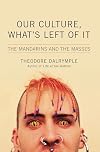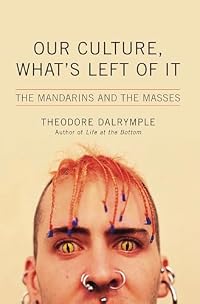
Our Culture, What's Left of It: The Mandarins and the Masses
by Theodore Dalrymple
On This Page
Description
"This new collection of essays bears the unmistakable stamp of Theodore Dalrymple's bracingly clearsighted view of the human condition. In these twenty-six pieces, Dr. Dalrymple ranges over literature and ideas, from Shakespeare to Marx, from the break-down of Islam to the legalization of drugs. The book includes "When Islam Breaks Down," named by David Brooks of the New York Times as the best journal article of 2004." "Informed by years of medical practice in a wide variety of settings, Dr. show more Dalrymple's acquaintance with the outer limits of human experience allows him to discover the universal in the local and the particular, and makes him impatient with the humbug and obscurantism that have too long marred our social and political discourse." "His essays are incisive yet undogmatic, beautifully composed and devoid of disfiguring jargon. Our Culture, What's Left of It is a book that restores our faith in the central importance of literature and criticism to our civilization."--Jacket. show lessTags
Recommendations







Member Recommendations
Member Reviews
If you want a collection of dyspeptic essays, here it is. The educated elite have destroyed the culture within the cities of Britain. Also, Paris is fucked, no one can state difficult truths, Islam is to rigid an ideology to support free inquiry and progress (the same progress elsewhere derided.
His observations are undoubtedly accurate, and worth some of the time reading them, but by no means all the book requires. Dalrymple's conclusions are not as convincing but should be considered.
His observations are undoubtedly accurate, and worth some of the time reading them, but by no means all the book requires. Dalrymple's conclusions are not as convincing but should be considered.
I disagree with Dalrymple on many things, but he's still my favourite writer to go to when I feel the need to challenge my own assumptions, prejudices and opinions. Is originality really that important in art? Is it always good to be non-judgmental? What is the value of being transgressive? His writing can be lucid and moving, but sometimes suffers from pretentious long-windedness.
His essays on good literature and its benefits are a joy to read. No-one could disagree with 'Sex and the Shakespeare Reader's caution against fundamentalism. Almost every essay in the arts and letters section made me want to read ever author he recommended. There were also some hilarious deflations of literature's 'greats'. Virginia Woolf was taken down a peg show more for being a self-pitying whiner; Marx is a narcissist; D.H. Lawrence is a vulgar bore who can't write. Even if you disagree (and I am generally a Woolf fan) you can't fail to enjoy these precision puncturings.
His opinions on society and politics I find harder to agree with. This is partly because of his infuriating failure to back up his opinions with actual numbers. Dalrymple works, deliberately, among the most impoverished sections of British society and yet he assumes that what he witnesses is indicative of a universal trend. On the rare occasion where numbers are included the source isn't given. And so it's difficult to believe him when he claims that crime and violence of all kinds is rising. Especially as I read this in conjunction with [b:The Better Angels of Our Nature: A History of Violence and Humanity|16076785|The Better Angels of Our Nature A History of Violence and Humanity|Steven Pinker|http://d.gr-assets.com/books/1349778774s/16076785.jpg|16029496] in which Pinker provides ample evidence to demonstrate that crime and violence have been in a long decline.
Dalrymple condemns the intelligentsia for dismantling our civilisation, through their post-modern insistence that there is no right or wrong, good or bad, and their subsequent promotion of drugs, profanity and promiscuity. He then goes on to demonstrate the detrimental effects of these things on the working class. But plenty of people can indulge in sex, drugs and rock 'n' roll without becoming utterly depraved. Should we conclude that the middle class are capable of indulgences that the working class cannot handle? Doesn't this lead us to the unfortunate conclusion that there should be one law for the rich and one for the poor? Or should we limit the freedom of everyone because for a few that freedom leads to self-destruction?
Elsewhere I just flat-out disagree with him. 'Thanks to the sexual revolution, current confusions are manifold [...] men become women by surgical means, and women men, while demands for tolerance and understanding grow even more shrill and imperious'. I honestly can't see anything wrong with people changing sex if they want to, or in many cases need to, and describing demands for tolerance as 'shrill' in this instance seems rather petty.
Despite disagreeing with him, I do find Dalrymple thought-provoking. I find myself uncomfortable, but persuaded, when he elegantly demonstrates how a welfare culture makes people dependent and their dependency infantilises them, robbing them of the capacity to ever extricate themselves from the situation. But what is the solution? Should we return to the Victorian era when poor children died of cholera but, hey, at least they had their dignity? I don't know, I don't think Dalrymple does either, but he does make me think about it. show less
His essays on good literature and its benefits are a joy to read. No-one could disagree with 'Sex and the Shakespeare Reader's caution against fundamentalism. Almost every essay in the arts and letters section made me want to read ever author he recommended. There were also some hilarious deflations of literature's 'greats'. Virginia Woolf was taken down a peg show more for being a self-pitying whiner; Marx is a narcissist; D.H. Lawrence is a vulgar bore who can't write. Even if you disagree (and I am generally a Woolf fan) you can't fail to enjoy these precision puncturings.
His opinions on society and politics I find harder to agree with. This is partly because of his infuriating failure to back up his opinions with actual numbers. Dalrymple works, deliberately, among the most impoverished sections of British society and yet he assumes that what he witnesses is indicative of a universal trend. On the rare occasion where numbers are included the source isn't given. And so it's difficult to believe him when he claims that crime and violence of all kinds is rising. Especially as I read this in conjunction with [b:The Better Angels of Our Nature: A History of Violence and Humanity|16076785|The Better Angels of Our Nature A History of Violence and Humanity|Steven Pinker|http://d.gr-assets.com/books/1349778774s/16076785.jpg|16029496] in which Pinker provides ample evidence to demonstrate that crime and violence have been in a long decline.
Dalrymple condemns the intelligentsia for dismantling our civilisation, through their post-modern insistence that there is no right or wrong, good or bad, and their subsequent promotion of drugs, profanity and promiscuity. He then goes on to demonstrate the detrimental effects of these things on the working class. But plenty of people can indulge in sex, drugs and rock 'n' roll without becoming utterly depraved. Should we conclude that the middle class are capable of indulgences that the working class cannot handle? Doesn't this lead us to the unfortunate conclusion that there should be one law for the rich and one for the poor? Or should we limit the freedom of everyone because for a few that freedom leads to self-destruction?
Elsewhere I just flat-out disagree with him. 'Thanks to the sexual revolution, current confusions are manifold [...] men become women by surgical means, and women men, while demands for tolerance and understanding grow even more shrill and imperious'. I honestly can't see anything wrong with people changing sex if they want to, or in many cases need to, and describing demands for tolerance as 'shrill' in this instance seems rather petty.
Despite disagreeing with him, I do find Dalrymple thought-provoking. I find myself uncomfortable, but persuaded, when he elegantly demonstrates how a welfare culture makes people dependent and their dependency infantilises them, robbing them of the capacity to ever extricate themselves from the situation. But what is the solution? Should we return to the Victorian era when poor children died of cholera but, hey, at least they had their dignity? I don't know, I don't think Dalrymple does either, but he does make me think about it. show less
This compendium of some of the best of cultural critic Theodore Daylrymple's City Journal essays from the past 10 years is an end-to-end winner. Dalrymple is one of the best prose stylists around, and his brutally honest take on the decline of western culture should be required reading for anyone with eyes to see and the willingness to resist the panjandrums of political correctness.
Interesante colección de ensayos del autor, un médico que anduvo por todo el mundo (o, al menos, por los países sobre los que escribe). Resalto lo reconfortante del hecho de que una persona con conocimiento de causa in situ, sea la que esté detrás de este tipo de libros; en lugar de la aburguesada inteliguentsia refugiada en la comodidad de sus penthouses céntricos.
Theodore posee también amplios conocimientos de literatura y arte; de hecho, estas temáticas son las que ocupan las páginas más interesantes de esta recopilación. Por otro lado, en lo que concierne al aspecto socioeconómico no termino de comulgar con sus ideas; incluso en un par de pasajes sentí lo que las nuevas generaciones llaman cringe. A pesar de ello, me show more sigue pareciendo una lectura muy positiva y recomendable, tanto por la calidad de información y la experiencia de primera mano, como por la falta de pelos en la lengua de este escritor.
Ensayos recomendados: «Why Shakespeare is for all time», «The rage of Virginia Woolf», «When Islam breaks down» y «How -and how not- to love mankind» show less
A literate, incisive, series of essays on the decline of Western society by a master wordsmith.
This is a fascinating book by a right-leaning British doctor. His take on crime and the poor is very interesting, though I don't agree with all of his conclusions. It's well worth reading for one view of what the future holds for 'civilization' as we know it.
Compelling writing. The author is courageous, thoughtful, perceptive, observant, dead.
Members
- Recently Added By
Lists

Jordan B. Peterson's Recommended Books
104 works; 5 members
Author Information

62+ Works 3,231 Members
Theodore Dalrymple is a physician and psychiatrist who practices in England. He writes a column for the London Spectator, contributes frequently to the Daily Telegraph, and is a contributing editor of the Manhattan's Institute's City Journal
Common Knowledge
- Canonical title
- Our Culture, What's Left of It: The Mandarins and the Masses
- Original publication date
- 2005
Classifications
Statistics
- Members
- 566
- Popularity
- 52,000
- Reviews
- 13
- Rating
- (4.18)
- Languages
- Dutch, English, French, Portuguese
- Media
- Paper, Ebook
- ISBNs
- 5
- ASINs
- 3