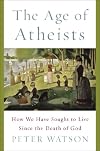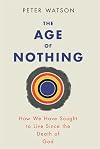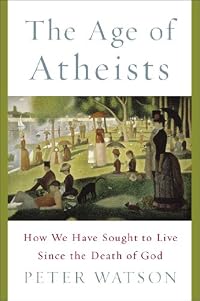
The Age of Atheists: How We Have Sought to Live Since the Death of God
by Peter Watson
On This Page
Description
Explores the way atheism has evolved, deepened, matured, and gained unprecedented resonance and popularity as it has sought to replace an unknowable God in the afterlife with the voluptuous detail and warmth of this life, woven into art, philosophy, science, and a rational, secular morality.Tags
Recommendations




















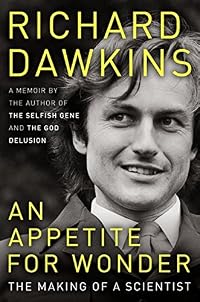
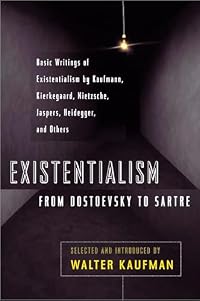



Member Recommendations
by anonymous user
Member Reviews
How has the cultural shift away from theistic beliefs been reflected in literature, art, and philosophy? Historian Peter Watson provides a painfully detailed response to this question. Admittedly, I ended up skimming a lot, well, most of this book after the first 200 pages. The overall insight I inferred from all of the minutia presented here is that there must be some kind of instinctive human aversion to uncertainty about the meaning of life, the universe, and everything. Abandoning one seemingly nonsensical explanation leaves a kind of vacuum that makes a person susceptible to other, often equally nonsensical, explanations. Watson provides an historical account of several of these (although, oddly, not the most succinct: 42). They show more are like examples that demonstrate a conclusion that Watson never explicitly states (not that I noticed, but I did skim most of the book)—Humans are extremely good at creative rationalization and fooling themselves. show less
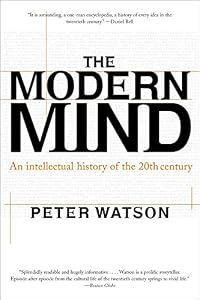
I found the author's "The Modern Mind" and "The German Genius" two of the most satisfying books I've read in recent decades. "The Age of Atheists" is not, for me, in the same category. Perhaps the problem is that the people and cultural and intellectual movements in this book are less recognizable by a general reader. But somehow this book simply does not have the flare and excitement of the two books mentioned above.
Once again Peter Watson has surveyed the literature of a major idea and presented a brilliant compilation of the development of that idea. In this case atheism in the world where the death of god has been pronounced is the great idea under discussion.
Ratings
Members
- Recently Added By
Published Reviews
ThingScore 67
Science uncovers new, often counter-intuitive facts, while as Peter Watson puts it in his new book The Age of Nothing: How we have sought to live since the death of God, literature and poetry “clarify … thoughts we have almost had, that we wish we had had.”
added by tsangal
“The Age of Atheists” frequently makes for an exhilarating ride through the cerebra of disparate men (few women feature here) who have tried to fashion a Godless yet nonetheless ordered and sustaining worldview. It is a topical book, to be sure, but also one that will stand the test of time as a masterful account of its subject.
added by tsangal
The Age of Atheists will likely stay confined to certain intellectual circles: The casual philosopher, the dogmatic non-believer, the coffee-table book collector. But insofar as its argument represents a broader pathology in contemporary conversations about belief, this book matters. Most people form their beliefs and live their lives somewhere in the middle of the so-called "culture divide" show more that outspoken atheists and believers shout across. The more these shouters shout, the more public discourse veers away from the subtle struggle of the average person's attempt to be human. show less
added by tsangal
Author Information

34+ Works 5,011 Members
Peter Watson is an intellectual historian, journalist, and author of thirteen books, including The Age of Atheists; Ideas: A History; The German Genius; The Medici Conspiracy; and The Great Divide. He has written for the Sunday Times, the New York Times, the Observer, and the Spectator. He lives in London.
Awards and Honors
Distinctions
Common Knowledge
- Canonical title*
- Das Zeitalter des Nichts. Eine Ideen- und Kulturgeschichte von Friedrich Nietzsche bis Richard Dawkins
- Original title
- The Age of Nothing: How We Have Sought to Live Since the Death of God
- Alternate titles
- The Age of Atheists: How We Have Sought to Live Since the Death of God
- Original publication date
- 2014-02
- People/Characters
- Friedrich Nietzsche; Karl Marx; Martin Heidegger; George Gadamer
- Epigraph
- The drive to make sense out of experience, to give it form and order, is evidently as real and pressing as the more familiar biological needs. - Clifford Geertz
We feel that even when all possible scientific questions have been answered, the problems of life remain completely untouched. - Ludwig Wittgenstein
Thinking out how to live is a more basic and urgent use of the human intellect than the discovery of any fact whatsoever. - Mary Midgley
Man cannot stand a meaningless life. - Carl Jung
Life cannot wait until the sciences have explained the universe scientifically. We cannot put off living until we are ready. - José Ortega Y Gasset
We must wager on meaning's existence. - James Wood, paraphrasing George Steiner
Meaning is not a security blanket. - Seamus Heaney, paraphrasing W. H. Auden
What is so admirable in being ruled by a need for peace of mind? - John Gray
Religion is being replaced by therapy, with "Christ the Saviour" becoming "Christ the counsellor." - Dr. George Carey, former Archbishop of Canterbury
[E]xistence may have no meaning, yet the rage to live is stronger than the reason for life. - John Patrick Diggins
A meaningful world is one that holds a future that extends beyond the incomplete personal life of the individual; so that a life sacrificed at the right moment is well spent, while a life too carefully hoarded, too ignominiou... (show all)sly preserved, is a life utterly wasted. - Lewis Mumford
[T]he problem of the meaning of life...arises because we are capable of occupying a standpoint from which our most compelling personal concerns appear insignificant. - Thomas Nagel
If God does not exist, then everything is permitted. - Fyodor Dostoevsky
All religions share the same grievance. - Olivier Roy
But is there something where God used to be? - Iris Murdoch
There is nothing to express, nothing with which to express, nothing from which to express, no desire to express--together with the obligation to express. - Samuel Beckett
We are evolving, in ways that Science cannot measure, to ends that Theology dares not contemplate. - E. M. Forster
We are here on Earth to do good to others. What the others are here for, I don't know. - W. H. Auden
He who has the most toys when he dies wins. - Materialist slogan
A human being is not one in pursuit of happiness, but rather in search of a reason to become happy. - Viktor Frankl
It isn't that I don't believe in God and, naturally, hope there is no God! I don't want there to be a God; I don't want the universe to be like that, as I hope to show. - Thomas Nagel
The concepts of redness and roundness are as much imaginative creations as those of God, of the positron, and of constitutioanl democracy. - Richard Rorty
A life which contains nothing for which one is not prepared to die is unlikely to be very fruitful. - Terry Eagleton
The final value of our lives is adverbial, not adjectival. It is the value of the performance, not anything that is left over when the performance is subtracted. - Ronald Dworking
Happiness is something we can imagine, but not experience. - Leszek Kołakowski
There is another world, but it is in this one. - Paul Éluard
Men should walk as prophecies of the next age, rather than in the fear of God or in the light of reason. - Richard Rorty
Philosophers used to speculate about what they called the meaning of life. (That is now the job of mystics and comedians.) - Ronald Dworkin - Dedication
- This book is dedicated to Guislaine Vincent Morland and to Nicholas Pearson
- First words
- By summer of 1990 the author Salman Rushdie had been living in hiding for more than a year.
- Quotations*
- Welch ein Engel birgst du in der Wange ? Welch Stimme ohne Fehl sagt dir des Kornes Wahrheit ? (Federico Garcia Lorca)
- Last words
- (Click to show. Warning: May contain spoilers.)So let us end by repeating the wise words of that great lover of poetic chestnuts, the philosopher Richard Rorty, referring to those who have named more of the world: "Cultures with richer vocabularies are more fully human--farther removed from the beasts--than those with poorer ones."
- Blurbers
- Charles de Groot; William Kistler; Scruton, Roger
- Original language
- English
*Some information comes from Common Knowledge in other languages. Click "Edit" for more information.
Classifications
Statistics
- Members
- 285
- Popularity
- 112,622
- Reviews
- 3
- Rating
- (3.45)
- Languages
- 5 — Chinese, English, German, Spanish, Swedish
- Media
- Paper, Ebook
- ISBNs
- 13
- ASINs
- 5