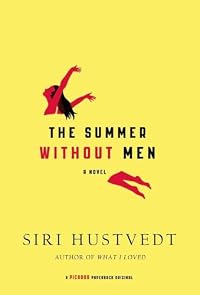
The Summer without Men
by Siri Hustvedt
On This Page
Description
Mia is forced to reexamine her life when her husband puts their marriage on "pause" after thirty years. She returns to the prairie town of her childhood, and is drawn into the lives of those around her.Tags
Recommendations











Member Recommendations

Member Reviews
Poet Mia Fredricksen's husband asks for a "pause" in their thirty year marriage so he can have a fling with a French neuroscientist in his laboratory. Her reaction is to go quite mad, requiring a brief stint in a mental hospital and medication. When Mia gets out, she goes to stay near her mother, and takes a class teaching poetry to teenaged girls. Thus starts her summer without men: she makes friends with her mother's elderly friends (who she calls "the Swans"); she befriends the young woman who lives next door with two small children (the joyous Flora and the baby Simon); and she shepherds her young teenaged charges through the pitfalls of poetry and puberty.
In between, she attempts a journal about her sexual encounters, she fends off show more emails from "Mr Nobody", she gets regular updates from her daughter Daisy about her husband, she discovers the beautiful embroidered art that one of the Swans produces (and, oh, how I wanted one of those pieces!), she reads poetry, she contemplates philosophy, and she rants about neuroscience.
This is an amazingly wide-ranging work, in a remarkably fresh, entertaining and truly funny voice. Every character is wonderfully delineated (okay, some of the teenaged girls were hard to distinguish, but I think that's true in real life, now I'm well past that age myself), and even though there is heartbreak in here (Mia's madness and the people she meets in the hospital are rather terrifying; the elderly Swans are reduced in number by the end; and Mia also recalls the suicide of her brother-in-law some years prior) it never comes across as depressing.
Mia's voice is a bit all over the shop, which I feel is quite intentional, although it did take a while to get used to. At times she's mucking around, writing bits in different voices for the sheer fun of it all; at other times one worries that her madness is returning, or was never far from the surface to start off with.
I would have liked more plot, because I do like plot most of all in my books. But the plot (when it appears for brief moments) is fascinating and it's probably made me think more than any other book yet this year, forcing me out of my comfort zone and into contemplating growing old, madness, and reading poetry and philosophy and neuroscience.
And it's all (almost) without men. ;) show less
In between, she attempts a journal about her sexual encounters, she fends off show more emails from "Mr Nobody", she gets regular updates from her daughter Daisy about her husband, she discovers the beautiful embroidered art that one of the Swans produces (and, oh, how I wanted one of those pieces!), she reads poetry, she contemplates philosophy, and she rants about neuroscience.
This is an amazingly wide-ranging work, in a remarkably fresh, entertaining and truly funny voice. Every character is wonderfully delineated (okay, some of the teenaged girls were hard to distinguish, but I think that's true in real life, now I'm well past that age myself), and even though there is heartbreak in here (Mia's madness and the people she meets in the hospital are rather terrifying; the elderly Swans are reduced in number by the end; and Mia also recalls the suicide of her brother-in-law some years prior) it never comes across as depressing.
Mia's voice is a bit all over the shop, which I feel is quite intentional, although it did take a while to get used to. At times she's mucking around, writing bits in different voices for the sheer fun of it all; at other times one worries that her madness is returning, or was never far from the surface to start off with.
I would have liked more plot, because I do like plot most of all in my books. But the plot (when it appears for brief moments) is fascinating and it's probably made me think more than any other book yet this year, forcing me out of my comfort zone and into contemplating growing old, madness, and reading poetry and philosophy and neuroscience.
And it's all (almost) without men. ;) show less
I really like Hustvedts's writing. It's always smart and emotional and just on the right side of being pretentious. She's smart in that she picks intelligent, worldy, artistic characters as her voice so that her novels are believable.
In this short novel, 50-something year old Mia has been left by her husband, had a mental breakdown, and gone to visit her mother for the summer. During this summer, she is surrounded by women. She is a poet and author and teaches a summer course on poetry to a group of seven drama-filled young teenage girls. She also gets to know her mother's aging circle of friends in her nursing home. Setting up the contrasts and similarities between these two groups gives the book structure and depth. And then she also show more meets a neighbor who is a young mother in an abusive marriage.
This is not my favorite Siri Hustvedt novel (that remains The Blazing World), but it's a good and accessible intro to her writing. show less
In this short novel, 50-something year old Mia has been left by her husband, had a mental breakdown, and gone to visit her mother for the summer. During this summer, she is surrounded by women. She is a poet and author and teaches a summer course on poetry to a group of seven drama-filled young teenage girls. She also gets to know her mother's aging circle of friends in her nursing home. Setting up the contrasts and similarities between these two groups gives the book structure and depth. And then she also show more meets a neighbor who is a young mother in an abusive marriage.
This is not my favorite Siri Hustvedt novel (that remains The Blazing World), but it's a good and accessible intro to her writing. show less
[The Summer without Men] is by far the best book I've read this summer. It's a small volume but packed with ideas. Mia Frederickson, the poet narrator, is recovering from a breakdown after Boris, her husband of thirty years, asks for a "pause." An old story but Hustvedt makes is fresh.
It really is a summer without men; Mia returns to her hometown in Minnesota to visit her aging mother. She agrees to teach a poetry class to seven pubescent girls. Her neighbors are a young couple with two small children. The couple yells a lot. As Mia moves from adolescents to octogenarians, she contemplates the roles of women at different ages and stages.
When she's alone, she does a fair amount of ruminating that involves women in literature, as well as show more how philosophers and scientists treat women. And as if this weren't enough, Hustvedt also plays with the narrative. At points, Mia informs us that many things are going on simultaneously, but words are sequential, so we have to wait to find out what happens.
I just finished it and can't wait to read it again. show less
It really is a summer without men; Mia returns to her hometown in Minnesota to visit her aging mother. She agrees to teach a poetry class to seven pubescent girls. Her neighbors are a young couple with two small children. The couple yells a lot. As Mia moves from adolescents to octogenarians, she contemplates the roles of women at different ages and stages.
When she's alone, she does a fair amount of ruminating that involves women in literature, as well as show more how philosophers and scientists treat women. And as if this weren't enough, Hustvedt also plays with the narrative. At points, Mia informs us that many things are going on simultaneously, but words are sequential, so we have to wait to find out what happens.
I just finished it and can't wait to read it again. show less
An unusual work, and difficult to review. The protagonist is a 50-something poet who has been left by her husband of 30 years, and has a psychotic break. The novel picks up as she is recovering, and has gone back to her old hometown to spend the summer and get back together. The work trails through art, literature, poetry, and biology, with a lot of feminism to focus the work. The characters are strangely, oddly disengaged. The protagonist, even when subject to crying bouts, seems to be detached from the world she inhabits, moving through it as a ghost or spectator that occasionally finds herself drawn into the strange, all too real world of the natives. Between the teenage girls and their catty meanness, and the old ladies with their show more gracious charm, and a young neighbor couple with a rocky marriage, she richochets without direction or meaning, mostly trying to keep up. The work will bring back difficult memories for many middle-aged women who have experienced some of the same emotions, and corporeal situations, described in this work. The ending is not unexpected, but not known far in advance, either, and it resists the urge to clean up the messy, chaotic world the narrator inhabits. Disturbing, familiar, and a strong look at the rich world inhabited by middle-aged women (something sadly lacking in most literature). show less
Hustvedt brings together a kind of 21st century Mrs Herzog with the old "maiden, mother and crone" canard to take an ironic look at some of the ways gender identities still define the lives of middle-class middle-American women, and at the creative ways in which women sometimes manage to subvert those definitions. It's a very clever novel, full of interesting ideas and more-or-less buried literary allusions (not to mention poems, parodies of poems, emails, and Stevie-Smith-style pen-drawings), but it's doesn't come over as a philosophical mind-stretcher like the other two of her novels I've read: more like very superior chick-lit (for literature graduates and above). If Mrs Gaskell were still around and living in the Midwest instead of show more Cheshire, this is what she might have written instead of Cranford... show less
It was with a certain sense of irony that I alighted on Siri Hustvedt’s novel. Acerbic, witty and intellectual, it tells the story of an emotionally tumultuous summer in the life of the poet Mia Fredricksen. Married for thirty years, she is blindsided when her husband Boris announces that he wants a ‘pause’, a euphemism that Mia can decipher only too well: ‘The Pause was French … She had significant breasts that were real, not manufactured, narrow rectangular glasses and an excellent mind.‘ Distraught and incandescent, Mia heads back to her childhood home – the town of Bonden in Minnesota – where she grieves, regroups and contemplates that eternally mysterious disconnect between the sexes. But, while her rift with Boris show more frames the novel, Mia’s time in Bonden gives her a fresh perspective on life, focused on the multifarious nature of female friendship...
For the full review, please see my blog:
https://theidlewoman.net/2018/07/01/the-summer-without-men-siri-hustvedt/ show less
For the full review, please see my blog:
https://theidlewoman.net/2018/07/01/the-summer-without-men-siri-hustvedt/ show less
Feelings and words and coming back to the self. Light and tripping and celebratory even though the subject matters don't sound that effervescent: recovering from a nervous breakdown caused by her husband's affair, getting to know her mother's friends in the assisted living center, dealing with the hurtful back-stabbing wounds of a group of young teen girls. Maiden, mother, and crone plus memory and presence.
Members
- Recently Added By
Published Reviews
ThingScore 75
Here, although the subject matter is serious - a woman's search for her lost identity - the tempo is upbeat. In a narrative without chapter breaks, Hustvedt explores the idea that differences between the genders is less important than "how much difference the difference makes".
added by riverwillow
Hustvedt creates a voice for Mia that is witty, concise, demanding; delighted by the concordances of sounds in words, compassionate and aware of its own faults. Hustvedt shows us Mia as she stumbles through the female relationships around her, all painted in with a wry eye.
added by riverwillow
Velment, men ikke helt vellykket
Siri Hustvedt er med sitt navn og sine aner liksom litt norsk, selv om hun er oppvokst i Minnesota og nå bor i Brooklyn. Hun skriver sine bøker på engelsk, og de oversettes til mange språk, deriblant norsk. Hennes siste roman er velment, men ikke udelt vellykket.
Siri Hustvedt er med sitt navn og sine aner liksom litt norsk, selv om hun er oppvokst i Minnesota og nå bor i Brooklyn. Hun skriver sine bøker på engelsk, og de oversettes til mange språk, deriblant norsk. Hennes siste roman er velment, men ikke udelt vellykket.
added by annek49
Lists

A Novel Cure
742 works; 23 members

Worst books read in 2011
36 works; 20 members

Llibres que he llegit el 2020
50 works; 1 member

Literature About Adultery
69 works; 10 members
Author Information

35+ Works 9,650 Members
Siri Hustvedt is the author of seven novels, four collections of essays, and two works of nonfiction. She has a PhD from Columbia University in English literature and is a lecturer in psychiatry at Weill Cornell Medical College. She is the recipient of numerous awards, including the International Gabbaron Prize for Thought and Humanities (2012). show more Her novel The Blazing World was nominated for the Booker Prize and won the Los Angeles Times Book Prize for Fiction (2014). In 2019, she received an American Academy of Arts and Letters Award for Literature; the European Essay Prize for "The Delusions of Certainty," a work on the mind-body problem; and the Princess of Asturias Award for Literature. Her work has been translated into more than thirty languages. She lives in Brooklyn, New York. show less
Some Editions
Awards and Honors
Awards
Distinctions
Series
Belongs to Publisher Series
Common Knowledge
- Canonical title
- The Summer without Men
- Original title
- The Summer without Men
- Original publication date
- 2011
- People/Characters
- Mia Fredricksen
- Important places
- Bonden, Minnesota, USA
- Epigraph*
- LUCY (Irene Dunne): You're all confused, aren't you?
JERRY (Cary Grant): Uh-huh. Aren't you?
LUCY: No.
JERRY: Well, you should be, because you're wrong about things being different because they're not the same. Thing... (show all)s are different, except in a different way. You're still the same, only I've been a fool. Well, I'm not now. So, as long as I'm different, don't you think things could be the same again? Only a little different.
- "The Awful Truth"
directed by Leo McCarey
screenplay by Viña Delmar - Dedication*
- Pour Frances Cohen
- First words*
- Eine Weile nachdem er das Wort Pause ausgesprochen hatte, drehte ich durch und landete im Krankenhaus.
- Last words*
- (Click to show. Warning: May contain spoilers.)"Let him come to me."
- Publisher's editor*
- Marie-Catherine Vachet
- Original language*
- Anglais (USA) (USA)
*Some information comes from Common Knowledge in other languages. Click "Edit" for more information.
Classifications
Statistics
- Members
- 1,012
- Popularity
- 25,572
- Reviews
- 69
- Rating
- (3.44)
- Languages
- 16 — Catalan, Danish, Dutch, English, Estonian, Finnish, French, German, Greek, Italian, Norwegian (Bokmål), Portuguese, Romanian, Slovenian, Spanish, Swedish
- Media
- Paper, Audiobook, Ebook
- ISBNs
- 59
- ASINs
- 11
