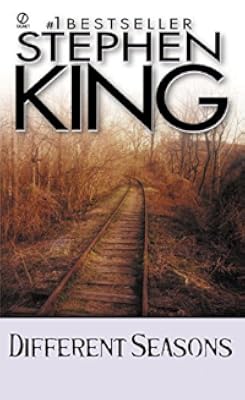
Different Seasons
by Stephen King
On This Page
Description
From the Magical Pen of Stephen King, Four Mesmerizing Novellas… “Rita Hayworth and the Shawshank Redemption” An unjustly imprisoned convict seeks a strange and startling revenge…the basis for the Best Picture Academy Award nominee The Shawshank Redemption. “Apt Pupil” Todd Bowden is one of the top students in his high school class and a typical American sixteen-year-old—until he becomes obsessed about the dark and deadly past of an older man in town. The inspiration for the show more film Apt Pupil from Phoenix Pictures. “The Body” Four rambunctious young boys plunge through the fa#65533;ade of a small town and come face-to-face with life, death, and intimations of their own mortality. The film Stand By Me is based on this novella. “The Breathing Method” A disgraced woman is determined to triumph over death. show lessTags
Recommendations











Member Recommendations
Member Reviews
This is, of course, the book that made fans for Stephen King that don't even know they're fans. My wife, for example, counts the Stand By Me and Shawshank Redemption movies as among the very best, but she doesn't like Stephen King.
Shawshank that starts this collection off is very much standard King fare. A quiet person who's driven beyond normal human measuring. Andy Dufresne is cut from the same cloth as Roland, Stu Redmond, the Loser's Club, Paul Sheldon, and many other King characters. There's nothing remarkable here, and yet, the whole thing's remarkable in the way that he slowly, easily, and with great care and patience, lays the entire story out for us.
The comes Apt Pupil, a story I didn't like originally, and didn't like this show more time around. Hey, it happens. Where the first story seemed to move along, not quickly, not slowly, but just right, this one seemed to drag and drag. It could be because I found no redeeming features in either of the two main characters, I don't know. To me, there was a genius little short story shoehorned into this novella when the Jewish concentration camp survivor comes to learn that he's sharing a hospital room with his Nazi torturer. That, my friends, would have made for a suspenseful little slice of hell. But it was not to be. Ah well. This story is the reason this book is rated a 4 instead of a 5 for me.
The Body, quite simply, is some of the finest writing King has ever produced. His observances of childhood, of life, of his own reputation as a writer...all of it. This story simply sings.
And finally, we have the oddity known as The Breathing Method, a strange little story that shouldn't work, and likely wouldn't have had it not been sandwiched within the much more intriguing framework of the club, also one of King's better creations.
Overall, the thing that struck me the most about this collection, that didn't really hit me the first time around, is that each story is about characters who go through a story, but that also have a story of their own. Sometimes, there's even a story within a story within a story. In each of the four novellas collected here.
Together, though I'm not fond of one of them, this should stand as one of King's top releases, and one that can be pointed to when discussing his genius. show less
Shawshank that starts this collection off is very much standard King fare. A quiet person who's driven beyond normal human measuring. Andy Dufresne is cut from the same cloth as Roland, Stu Redmond, the Loser's Club, Paul Sheldon, and many other King characters. There's nothing remarkable here, and yet, the whole thing's remarkable in the way that he slowly, easily, and with great care and patience, lays the entire story out for us.
The comes Apt Pupil, a story I didn't like originally, and didn't like this show more time around. Hey, it happens. Where the first story seemed to move along, not quickly, not slowly, but just right, this one seemed to drag and drag. It could be because I found no redeeming features in either of the two main characters, I don't know. To me, there was a genius little short story shoehorned into this novella when the Jewish concentration camp survivor comes to learn that he's sharing a hospital room with his Nazi torturer. That, my friends, would have made for a suspenseful little slice of hell. But it was not to be. Ah well. This story is the reason this book is rated a 4 instead of a 5 for me.
The Body, quite simply, is some of the finest writing King has ever produced. His observances of childhood, of life, of his own reputation as a writer...all of it. This story simply sings.
And finally, we have the oddity known as The Breathing Method, a strange little story that shouldn't work, and likely wouldn't have had it not been sandwiched within the much more intriguing framework of the club, also one of King's better creations.
Overall, the thing that struck me the most about this collection, that didn't really hit me the first time around, is that each story is about characters who go through a story, but that also have a story of their own. Sometimes, there's even a story within a story within a story. In each of the four novellas collected here.
Together, though I'm not fond of one of them, this should stand as one of King's top releases, and one that can be pointed to when discussing his genius. show less
I've always wanted to read something by Stephen King, if only because he's such a widely-read author who's had a huge influence on pop culture. I'm not really that keen on horror (especially the sort of O.T.T. horror – haunted cars, haunted houses, demon dogs, telekinesis – that King dabbles in) so Different Seasons – containing among others the novella that was the inspiration for a truly impressive film, The Shawshank Redemption – was the obvious choice for my first foray.
'Rita Hayworth and Shawshank Redemption', the first story, was the basis for that film and more than deserves to stand alongside it. No doubt my impressions of the story were coloured by my familiarity with the film, but even with that in mind, it is a fine show more novella. It is quick to read, with a great message and fully fleshed-out characters. King can really tell a story, and you finish 'Shawshank Redemption' having been fully absorbed in it – its characters, its settings, its phrasings, its whole essence of being – in the same way you might after reading a big novel. King achieves the same effect in about 100 pages – it is most impressive.
There's a bit of mood whiplash between this first story and the second (but then the book is called Different Seasons…). 'Apt Pupil', a creepy story about a young weirdo's relationship with an elderly Nazi war criminal hiding out under an assumed name in an American suburb, is absorbing, but without the richness of the preceding story, and at twice its length. It uses clichés (revealing dreams, plot coincidences) commonly used to grease the wheels of stories and its appeal is that of the morbid or the voyeur, in reading salacious details of tortures, murders and other pulp-fetish depravities. After the impressive transcendence of the first story, this – alas – was closer to what I expected from a writer of King's reputation. King's stories generally seem to have the character of attacking a seedy underbelly of American suburbia that, frankly, I don't think is really there. I think it is probably an invention or an exaggeration from the darker recesses of King's imagination; people are too plain to go to this sort of depraved trouble. 'Apt Pupil' was creepy, but forgettable: serviceable pulp.
The third story, 'The Body', is alongside 'Shawshank' the other truly commendable story. The inspiration for the film Stand By Me, it is a coming-of-age story that would be wholesome if not for the fact that the 12-year-old protagonist and his friends are on an adventure to see the dead body of a missing kid. It has characters you care about (although, like 'Shawshank', I wonder how much of my enjoyment has been coloured by the film) and, aside from a weird and unfocused interlude in which the protagonist delivers a story about a man named Chico, it is well-written. However, it seems to be striving for a more highbrow sort of American literature that King has never really been able to reach (more on that later…). This doesn't cripple one's enjoyment of the tale, and the inclusion of 'The Body' ensures there's more to Different Seasons than just 'Shawshank'.
The fourth and final story, 'The Breathing Method', is the shortest, and the one that most screams 'Stephen King'. It is a pseudo-horror story that plays on the horrors of childbirth, and childbirth out of wedlock at that. It reads like a lost story from The Twilight Zone – that statement is not meant to sound like a criticism – and King might have had half a mind to send the cheque for the story to Richard Matheson. I'm game enough for stories like this, particularly when they're short, and coming at the end of the book it reminds you of King's more typical works.
As my first experience of Stephen King, I was fascinated to discover how I reacted to the prose of this household name. I've never considered myself a book snob – though like all avid readers my sensibilities have refined over time – and so I was surprised to find myself passing judgment on King's prose. He reads like the stories are first drafts – good first drafts, mind – and with lots of gamey slang and easy outs. By the time I read King's admission, in the Afterword, that his writing is "fairly plain, not very literary, and sometimes (although it hurts like hell to admit it) downright clumsy" (pg. 557), it did not even cross my mind that he might be being self-effacing – as would be the case for most writers who made such an admission – but simply being honest and self-aware.
Enjoying the stories but feeling grimy at the prose, reading Stephen King made me realize that many of those I've lauded in the past for being excellent storytellers – George R. R. Martin, George MacDonald Fraser, Nevil Shute, to name a few – also had the great fortune of being fine writers. King, in stark contrast, is an excellent storyteller but not a compelling writer. I do not intend that opinion to read snobbishly, for in my opinion praising storytelling ability is one of the highest compliments one can pay a writer, and one that, come to think about it, I am able to pay far less frequently than I would have thought. But it was the impression that imposed itself most forcefully upon me in reading Stephen King for the first time and I would be remiss if I did not mention it in my review of his book.
King is excellent at breathing life into a story; at slipping little details into the narrative that really flesh out a character or a setting. He reads like he's in the room with you, spinning you a story, rather than the more imperious, this-could-be-passed-down-through-the-generations style most writers seem to go for. He writes like he doesn't care about posterity, only wanting you to enjoy the story in the moment. Perhaps this is why, ironically, he has proved more enduring than many of those writers who do strive for meaning and legacy. show less
'Rita Hayworth and Shawshank Redemption', the first story, was the basis for that film and more than deserves to stand alongside it. No doubt my impressions of the story were coloured by my familiarity with the film, but even with that in mind, it is a fine show more novella. It is quick to read, with a great message and fully fleshed-out characters. King can really tell a story, and you finish 'Shawshank Redemption' having been fully absorbed in it – its characters, its settings, its phrasings, its whole essence of being – in the same way you might after reading a big novel. King achieves the same effect in about 100 pages – it is most impressive.
There's a bit of mood whiplash between this first story and the second (but then the book is called Different Seasons…). 'Apt Pupil', a creepy story about a young weirdo's relationship with an elderly Nazi war criminal hiding out under an assumed name in an American suburb, is absorbing, but without the richness of the preceding story, and at twice its length. It uses clichés (revealing dreams, plot coincidences) commonly used to grease the wheels of stories and its appeal is that of the morbid or the voyeur, in reading salacious details of tortures, murders and other pulp-fetish depravities. After the impressive transcendence of the first story, this – alas – was closer to what I expected from a writer of King's reputation. King's stories generally seem to have the character of attacking a seedy underbelly of American suburbia that, frankly, I don't think is really there. I think it is probably an invention or an exaggeration from the darker recesses of King's imagination; people are too plain to go to this sort of depraved trouble. 'Apt Pupil' was creepy, but forgettable: serviceable pulp.
The third story, 'The Body', is alongside 'Shawshank' the other truly commendable story. The inspiration for the film Stand By Me, it is a coming-of-age story that would be wholesome if not for the fact that the 12-year-old protagonist and his friends are on an adventure to see the dead body of a missing kid. It has characters you care about (although, like 'Shawshank', I wonder how much of my enjoyment has been coloured by the film) and, aside from a weird and unfocused interlude in which the protagonist delivers a story about a man named Chico, it is well-written. However, it seems to be striving for a more highbrow sort of American literature that King has never really been able to reach (more on that later…). This doesn't cripple one's enjoyment of the tale, and the inclusion of 'The Body' ensures there's more to Different Seasons than just 'Shawshank'.
The fourth and final story, 'The Breathing Method', is the shortest, and the one that most screams 'Stephen King'. It is a pseudo-horror story that plays on the horrors of childbirth, and childbirth out of wedlock at that. It reads like a lost story from The Twilight Zone – that statement is not meant to sound like a criticism – and King might have had half a mind to send the cheque for the story to Richard Matheson. I'm game enough for stories like this, particularly when they're short, and coming at the end of the book it reminds you of King's more typical works.
As my first experience of Stephen King, I was fascinated to discover how I reacted to the prose of this household name. I've never considered myself a book snob – though like all avid readers my sensibilities have refined over time – and so I was surprised to find myself passing judgment on King's prose. He reads like the stories are first drafts – good first drafts, mind – and with lots of gamey slang and easy outs. By the time I read King's admission, in the Afterword, that his writing is "fairly plain, not very literary, and sometimes (although it hurts like hell to admit it) downright clumsy" (pg. 557), it did not even cross my mind that he might be being self-effacing – as would be the case for most writers who made such an admission – but simply being honest and self-aware.
Enjoying the stories but feeling grimy at the prose, reading Stephen King made me realize that many of those I've lauded in the past for being excellent storytellers – George R. R. Martin, George MacDonald Fraser, Nevil Shute, to name a few – also had the great fortune of being fine writers. King, in stark contrast, is an excellent storyteller but not a compelling writer. I do not intend that opinion to read snobbishly, for in my opinion praising storytelling ability is one of the highest compliments one can pay a writer, and one that, come to think about it, I am able to pay far less frequently than I would have thought. But it was the impression that imposed itself most forcefully upon me in reading Stephen King for the first time and I would be remiss if I did not mention it in my review of his book.
King is excellent at breathing life into a story; at slipping little details into the narrative that really flesh out a character or a setting. He reads like he's in the room with you, spinning you a story, rather than the more imperious, this-could-be-passed-down-through-the-generations style most writers seem to go for. He writes like he doesn't care about posterity, only wanting you to enjoy the story in the moment. Perhaps this is why, ironically, he has proved more enduring than many of those writers who do strive for meaning and legacy. show less
5/5
Amazing, just truly and simply amazing. These are four short stories and every single one of them is very very good. King's short story collections are usually pretty good, a little bit worse than his longer works, but this just blows it right out of the water.
The first one is the story that Shawshank Redemption was based on and it's just as amazing as the movie. I read the whole thing, about 100 pages, in just one sitting. I cared for every single prisoner and really wanted to see what would happen to Red.
The second one, Apt Pupil, is probably the third best of the bunch, and even then it's insanely good. Just a great explanation about how evil can "sleep" and be awaken by being exposed to other evil individuals. I bet some people show more might be slightly bothered by the way casualty brings the end of the story, but I still loved it. And I honestly do believe the kid was a sociopath from the start, even before meeting the old man.
The third one, The Body, is what "Stand by me" was based on. I also really liked this one, it's probably the second best and feels very personal. It's all about the logic of "being stuck in a bad place", both literally and figuratively, with both the idea of being around people that drag you down, even without intent, and how just being born in a bad place can be an inescapable prison.
The last one is the weakest of the bunch, the Breathing Method, but it's still really good. A story inside a story, but I really loved it. There's just a vague air of mystery around it that felt really satisfying. A great show of how King can develop what I can only call "casual supernatural", I wish he did work the mysterious club a bit more, though.
To conclude, this book is amazing and one of King's best work. It's a great introduction to his non-horror works. I don't think newcomers to his work should start with this book, but it's probably the first you should read after a couple of good horror stories. show less
Amazing, just truly and simply amazing. These are four short stories and every single one of them is very very good. King's short story collections are usually pretty good, a little bit worse than his longer works, but this just blows it right out of the water.
The first one is the story that Shawshank Redemption was based on and it's just as amazing as the movie. I read the whole thing, about 100 pages, in just one sitting. I cared for every single prisoner and really wanted to see what would happen to Red.
The second one, Apt Pupil, is probably the third best of the bunch, and even then it's insanely good. Just a great explanation about how evil can "sleep" and be awaken by being exposed to other evil individuals. I bet some people show more might be slightly bothered by the way casualty brings the end of the story, but I still loved it. And I honestly do believe the kid was a sociopath from the start, even before meeting the old man.
The third one, The Body, is what "Stand by me" was based on. I also really liked this one, it's probably the second best and feels very personal. It's all about the logic of "being stuck in a bad place", both literally and figuratively, with both the idea of being around people that drag you down, even without intent, and how just being born in a bad place can be an inescapable prison.
The last one is the weakest of the bunch, the Breathing Method, but it's still really good. A story inside a story, but I really loved it. There's just a vague air of mystery around it that felt really satisfying. A great show of how King can develop what I can only call "casual supernatural", I wish he did work the mysterious club a bit more, though.
To conclude, this book is amazing and one of King's best work. It's a great introduction to his non-horror works. I don't think newcomers to his work should start with this book, but it's probably the first you should read after a couple of good horror stories. show less
This is a collection of four short stories/novellas, with seasonal divisions:
Hope Springs Eternal – Rita Hayworth and the Shawshank Redemption
Summer of Corruption – Apt Pupil
Fall from Innocence – The Body
A Winter’s Tale – The Birthing Method
In the Afterword King writes: Although “Where do you get your ideas?” has always been the question I’m most frequently asked … the runner-up is undoubtedly this one: “Is horror all you write?” When I say it isn’t, it’s hard to tell if the questioner seems relieved or disappointed.
This was the first Stephen King book published which wasn’t specifically in the horror genre, and his publisher was hesitant. Of course, since publication, two of these stories have been show more immortalized in very popular films, so apparently readers WOULD buy and appreciate a non-horror novel by King. Make no mistake, however; the hallmarks of King’s writing are still here: tight plotting, graphically vivid scenes, memorable characters, great dialogue. There were times as I was reading that would I simply stop and exclaim aloud, “Damn, he can write!”
The two stories which have not been filmed were the two I found most disturbing. Apt Pupil shows two characters – a young boy and a frail old man – bound by a secret and a shared passion for inflicting pain. I was horrified, and mesmerized. I certainly don’t think it’s a coincidence that King gives his young character the same initials as Ted Bundy!
In The Breathing Method King has the members of an exclusive gentleman’s club meeting regularly to share stories. Their tradition is to save a particularly chilling horror story for their Christmas meeting. At one such meeting one member tells the story of a young, unmarried woman in 1935 who is determined to have her baby. The ending is tragic and horrific and disturbing.
I think my favorite of the four stories was The Body because of his descriptions of four boys’ adventure in the woods.
There’s something horrible and fascinating about the way dark comes to the woods, its coming unsoftened by headlights or streetlights or houselights or neon. It comes with no mothers’ voices, calling for their kids to leave off and come on in now, to herald it. If you’re used to the town, the coming of the dark in the woods seems more like a natural disaster than a natural phenomenon; it rises like the Castle River rises in the spring.
I couldn’t help but think of all the times when I was a child that my brother and I would join with friends to take off into the woods on our own – no parents hovering over us. Like the four boys in this story we had learned how to make a fire and find shelter, knew the plants and streams and hiding places of that environment from endless hours, days, seasons, years of exploring. And we had the capacity to scare ourselves silly with our own imaginations. Like most kids our imaginations were far more real to us than the actual dangers we might have encountered. And that, in a nutshell, is why I love reading fiction in general, and King in particular. show less
Hope Springs Eternal – Rita Hayworth and the Shawshank Redemption
Summer of Corruption – Apt Pupil
Fall from Innocence – The Body
A Winter’s Tale – The Birthing Method
In the Afterword King writes: Although “Where do you get your ideas?” has always been the question I’m most frequently asked … the runner-up is undoubtedly this one: “Is horror all you write?” When I say it isn’t, it’s hard to tell if the questioner seems relieved or disappointed.
This was the first Stephen King book published which wasn’t specifically in the horror genre, and his publisher was hesitant. Of course, since publication, two of these stories have been show more immortalized in very popular films, so apparently readers WOULD buy and appreciate a non-horror novel by King. Make no mistake, however; the hallmarks of King’s writing are still here: tight plotting, graphically vivid scenes, memorable characters, great dialogue. There were times as I was reading that would I simply stop and exclaim aloud, “Damn, he can write!”
The two stories which have not been filmed were the two I found most disturbing. Apt Pupil shows two characters – a young boy and a frail old man – bound by a secret and a shared passion for inflicting pain. I was horrified, and mesmerized. I certainly don’t think it’s a coincidence that King gives his young character the same initials as Ted Bundy!
In The Breathing Method King has the members of an exclusive gentleman’s club meeting regularly to share stories. Their tradition is to save a particularly chilling horror story for their Christmas meeting. At one such meeting one member tells the story of a young, unmarried woman in 1935 who is determined to have her baby. The ending is tragic and horrific and disturbing.
I think my favorite of the four stories was The Body because of his descriptions of four boys’ adventure in the woods.
There’s something horrible and fascinating about the way dark comes to the woods, its coming unsoftened by headlights or streetlights or houselights or neon. It comes with no mothers’ voices, calling for their kids to leave off and come on in now, to herald it. If you’re used to the town, the coming of the dark in the woods seems more like a natural disaster than a natural phenomenon; it rises like the Castle River rises in the spring.
I couldn’t help but think of all the times when I was a child that my brother and I would join with friends to take off into the woods on our own – no parents hovering over us. Like the four boys in this story we had learned how to make a fire and find shelter, knew the plants and streams and hiding places of that environment from endless hours, days, seasons, years of exploring. And we had the capacity to scare ourselves silly with our own imaginations. Like most kids our imaginations were far more real to us than the actual dangers we might have encountered. And that, in a nutshell, is why I love reading fiction in general, and King in particular. show less
Forty years on, early King novels are nearing 'classic' status in their genre (although nobody quite agrees on how old a book has to be, whether the author can still be living, etc.) This collection of four novellas deserves the status consideration, but whether it belongs to King's typical horror genre is debatable. Three of its four stories have made the leap to screen, two of which are classics in their own right. I've already read more of King's work than I intended to, but I didn't want to miss this one.
Rita Hayworth and Shawshank Redemption - the character Red in this story is named so for his red hair, so I'd imagine he's white, but I kept hearing Morgan Freeman's voice anyway. It goes much like the movie does, as far as I show more remember, with the absence of Andy's playing music and maybe some other things. Knowing the ending allows every bit of foreshadowing and dramatic irony to leap out, and there's quite a bit of that to enjoy. Funny to observe, this book is now older than Red's prison sentence is long.
Apt Pupil - gave me more than I expected, the most gripping read of the four. King offers a study of how easily anyone (anyone!) can be brought under the sway of evil, if they ask the right (wrong) questions and encounter the right (wrong) mentor. Granted, Todd's heart is in the wrong place from go. When I lost all sympathy for him I began to read this as a story about two King villains trapped in a room together, forced to cooperate but unable to trust.
The Body - four young friends in 1960 embark on their most memorable adventure together, managing to pack nearly every coming-of-age lesson into one 24 hour period. Stephen King is probably evoking his own childhood, including every common expression from that time and place. Some of those are still cute, while others are hopelessly politically incorrect sixty years later. If you're not a Western white male, prepare to get zapped.
The Breathing Method - this also exceeded my low expectations, which I'd based on its being the only story not transferred to film and its most strongly belonging to the horror genre. Despite its revolving around a central event of that type, the framing story that nests it is engaging and drew me right in. It isn't wrapped up neatly with a bow but leaves some lingering mysteries, making this a good note to end on.
I read the original 1982 hardcover. In "The Body", Chris tells Teddy and Vern about the pistol but later they don't know anything about it. I'm curious whether that mistake was fixed in a later edition. show less
Rita Hayworth and Shawshank Redemption - the character Red in this story is named so for his red hair, so I'd imagine he's white, but I kept hearing Morgan Freeman's voice anyway. It goes much like the movie does, as far as I show more remember, with the absence of Andy's playing music and maybe some other things. Knowing the ending allows every bit of foreshadowing and dramatic irony to leap out, and there's quite a bit of that to enjoy. Funny to observe, this book is now older than Red's prison sentence is long.
Apt Pupil - gave me more than I expected, the most gripping read of the four. King offers a study of how easily anyone (anyone!) can be brought under the sway of evil, if they ask the right (wrong) questions and encounter the right (wrong) mentor. Granted, Todd's heart is in the wrong place from go. When I lost all sympathy for him I began to read this as a story about two King villains trapped in a room together, forced to cooperate but unable to trust.
The Body - four young friends in 1960 embark on their most memorable adventure together, managing to pack nearly every coming-of-age lesson into one 24 hour period. Stephen King is probably evoking his own childhood, including every common expression from that time and place. Some of those are still cute, while others are hopelessly politically incorrect sixty years later. If you're not a Western white male, prepare to get zapped.
The Breathing Method - this also exceeded my low expectations, which I'd based on its being the only story not transferred to film and its most strongly belonging to the horror genre. Despite its revolving around a central event of that type, the framing story that nests it is engaging and drew me right in. It isn't wrapped up neatly with a bow but leaves some lingering mysteries, making this a good note to end on.
I read the original 1982 hardcover. In "The Body", Chris tells Teddy and Vern about the pistol but later they don't know anything about it. I'm curious whether that mistake was fixed in a later edition. show less
It is difficult to paint all four novellas with the same brush. I loved The Body, enjoyed The Shawshank Redemption, was intrigued by The Breathing Method and absolutely hated Apt Pupil (I can't believe a movie was made from this one).
While undoubtedly King is a great storyteller, his character development is weak and he relies too much on describing rather than showing to really create interest. We want to know what happens but we don't really care about his world (the exception being the boys in The Body). The Afterword was what I enjoyed most: King seems to have a just understanding of his talent, and I appreciate what he tried to do with this series. Certainly he succeeds with The Body.
While undoubtedly King is a great storyteller, his character development is weak and he relies too much on describing rather than showing to really create interest. We want to know what happens but we don't really care about his world (the exception being the boys in The Body). The Afterword was what I enjoyed most: King seems to have a just understanding of his talent, and I appreciate what he tried to do with this series. Certainly he succeeds with The Body.
Different Seasons is a showcase for Stephen King. Four diverse novellas, only one of them the kind of horror tale he is synonymous with (and it may be the weakest of the bunch).
The book is divided into four 'seasons': Hope Springs Eternal (Rita Hayworth and the Shawshank Redemption), Summer of Corruption (Apt Pupil), Fall From Innocence (The Body) and A Winter's Tale (The Breathing Method). The tones of the stories alternate between light and dark, with Apt Pupil perhaps being the darkest thing he has ever written.
Rita Hayworth and the Shawshank Redemption
Rita Hayworth and the Shawshank Redemption is a mini-masterpiece of a tale. A tale of hope set in a prison, dealing with a man whose spirit remains free despite all obstacles. I'd show more originally read it years before the legendary movie, and was worried that it wouldn't be quite the same reading it now. Luckily King's narrative holds up. Even knowing what was coming, the story telling was as gripping as ever.
Apt Pupil
Apt Pupil. I was almost dreading rereading Apt Pupil. A well written but morally disturbing tale of the mutually parasitic relationship between a young California golden boy and the Nazi war criminal he has blackmailed. It is an excellent dark thriller, but it is so powerfully written and so pitch black, you are kept in suspense while feeling the need to cleanse yourself of the story being told. I remember the 'Bachman book' Rage felt a little like this, but Apt Pupil provokes a much stronger reaction and is a better book overall.
The Body
Third up is The Body which was famously (and very faithfully) adapted into the movie Stand By Me. This is Stephen King’s coming of age tale of four boys in 1960 who head out through the woods to find the body of a boy that was struck by a train.
Though all four of the stories are top-notch Stephen King, I believe I enjoyed The Body the most. King so expertly captures the bittersweet feeling of the boys, two of which at least understand that they are going through a life changing experience; that things will not be the same from here on.
The Breathing Method
The Breathing Method is the closest to Stephen King’s ‘typical’ supernatural spook story. This one (appropriately dedicated to Peter Straub) seems to be King’s answer to Straub’s Chowder Society (see Straub's Ghost Story), as it deals with a group of old men that belong to a mysterious ‘gentleman’s club’ where they tell each other stories.
Earlier I called The Breathing Method the weakest story here. It is, but please don't take that to mean that the story isn't worth reading. It is a good read that only pales because the other three stories shine so brightly.
This is the book I would loan to someone who looked down on King without reading any of his work. He shows that while he can write some very scary spook stories, that isn't why he sells so many books. Each of the four stories is King writing at the top of the game. There's a reason three of the four stories have been turned into movies and they are three of the best screen adaptations he's had. show less
The book is divided into four 'seasons': Hope Springs Eternal (Rita Hayworth and the Shawshank Redemption), Summer of Corruption (Apt Pupil), Fall From Innocence (The Body) and A Winter's Tale (The Breathing Method). The tones of the stories alternate between light and dark, with Apt Pupil perhaps being the darkest thing he has ever written.
Rita Hayworth and the Shawshank Redemption
Rita Hayworth and the Shawshank Redemption is a mini-masterpiece of a tale. A tale of hope set in a prison, dealing with a man whose spirit remains free despite all obstacles. I'd show more originally read it years before the legendary movie, and was worried that it wouldn't be quite the same reading it now. Luckily King's narrative holds up. Even knowing what was coming, the story telling was as gripping as ever.
Apt Pupil
Apt Pupil. I was almost dreading rereading Apt Pupil. A well written but morally disturbing tale of the mutually parasitic relationship between a young California golden boy and the Nazi war criminal he has blackmailed. It is an excellent dark thriller, but it is so powerfully written and so pitch black, you are kept in suspense while feeling the need to cleanse yourself of the story being told. I remember the 'Bachman book' Rage felt a little like this, but Apt Pupil provokes a much stronger reaction and is a better book overall.
The Body
Third up is The Body which was famously (and very faithfully) adapted into the movie Stand By Me. This is Stephen King’s coming of age tale of four boys in 1960 who head out through the woods to find the body of a boy that was struck by a train.
Though all four of the stories are top-notch Stephen King, I believe I enjoyed The Body the most. King so expertly captures the bittersweet feeling of the boys, two of which at least understand that they are going through a life changing experience; that things will not be the same from here on.
The Breathing Method
The Breathing Method is the closest to Stephen King’s ‘typical’ supernatural spook story. This one (appropriately dedicated to Peter Straub) seems to be King’s answer to Straub’s Chowder Society (see Straub's Ghost Story), as it deals with a group of old men that belong to a mysterious ‘gentleman’s club’ where they tell each other stories.
Earlier I called The Breathing Method the weakest story here. It is, but please don't take that to mean that the story isn't worth reading. It is a good read that only pales because the other three stories shine so brightly.
This is the book I would loan to someone who looked down on King without reading any of his work. He shows that while he can write some very scary spook stories, that isn't why he sells so many books. Each of the four stories is King writing at the top of the game. There's a reason three of the four stories have been turned into movies and they are three of the best screen adaptations he's had. show less
Members
- Recently Added By
Lists

Best Horror Books
281 works; 85 members

Read the book and saw the movie
1,170 works; 193 members
Top 5 Books by Stephen King
27 works; 18 members
Stephen King Bibliography
77 works; 3 members

Fiction Set Primarily in a Prison
52 works; 24 members

Favorite Short Fiction
228 works; 99 members

Derry and Castle Rock Books By Stephen King
21 works; 3 members

To Read - Horror
137 works; 14 members

Sinister AudioTales
65 works; 1 member
Eerie eTales
192 works; 3 members

KING of Scare
48 works; 2 members

Jones & Newman: Best Horror Books Further Recommended Reading
577 works; 4 members

Books Read in 2005
185 works; 7 members

Books Read in 2021
5,361 works; 114 members

Books With Time Words in the Title
160 works; 4 members

Top Five Books of 2017
757 works; 231 members

Short Story and Novella Collections
47 works; 6 members

Five star books
1,767 works; 110 members

Favourite Books
1,820 works; 316 members
Favorite Coming of Age Novels.
164 works; 51 members

Summer Books
82 works; 9 members

My favourite books
96 works; 3 members

Short and Sweet
246 works; 24 members
Best Book and Movie Combos
70 works; 11 members
Best Books of the 20th Century
193 works; 5 members

Short Story Collections and Anthologies
261 works; 42 members

The American Experience
173 works; 18 members

Short Books to Read
14 works; 2 members

1980s
356 works; 23 members
Stephen King books
81 works; 1 member
Talk Discussions
Past Discussions
August's SK Flavor of the Month - Different Seasons (Rita Hayworth, Apt Pupil) in King's Dear Constant Readers (July 2017)
September's SK Flavor of the Month - Different Seasons (The Body, The Breathing Method) in King's Dear Constant Readers (October 2009)
Author Information

966+ Works 867,771 Members
Stephen King was born in Portland, Maine, on September 21, 1947. After graduating with a Bachelor's degree in English from the University of Maine at Orono in 1970, he became a teacher. His spare time was spent writing short stories and novels. King's first novel would never have been published if not for his wife. She removed the first few show more chapters from the garbage after King had thrown them away in frustration. Three months later, he received a $2,500 advance from Doubleday Publishing for the book that went on to sell a modest 13,000 hardcover copies. That book, Carrie, was about a girl with telekinetic powers who is tormented by bullies at school. She uses her power, in turn, to torment and eventually destroy her mean-spirited classmates. When United Artists released the film version in 1976, it was a critical and commercial success. The paperback version of the book, released after the movie, went on to sell more than two-and-a-half million copies. Many of King's other horror novels have been adapted into movies, including The Shining, Firestarter, Pet Semetary, Cujo, Misery, The Stand, and The Tommyknockers. Under the pseudonym Richard Bachman, King has written the books The Running Man, The Regulators, Thinner, The Long Walk, Roadwork, Rage, and It. He is number 2 on the Hollywood Reporter's '25 Most Powerful Authors' 2016 list. King is one of the world's most successful writers, with more than 100 million copies of his works in print. Many of his books have been translated into foreign languages, and he writes new books at a rate of about one per year. In 2003, he received the National Book Foundation Medal for Distinguished Contribution to American Letters. In 2012 his title, The Wind Through the Keyhole made The New York Times Best Seller List. King's title's Mr. Mercedes and Revival made The New York Times Best Seller List in 2014. He won the Edgar Allan Poe Award in 2015 for Best Novel with Mr. Mercedes. King's title Finders Keepers made the New York Times bestseller list in 2015. Sleeping Beauties is his latest 2017 New York Times bestseller. (Bowker Author Biography) Stephen King is the author of more than thirty books, all of them worldwide bestsellers. Among his most recent are "Hearts in Atlantis", "The Girl Who Loved Tom Gordon", "Bag of Bones", & "The Green Mile". "On Writing" is his first book of nonfiction since "Danse Macabre", published in 1981. He served as a judge for Prize Stories: The Best of 1999, The O. Henry Awards. He lives in Bangor, Maine with his wife, novelist Tabitha King. King's book, The Bazaar of Bad Dreams: Stories, made the 2015 New York Times bestseller list. (Publisher Provided) show less
Some Editions
Awards and Honors
Awards
Distinctions
Series
Belongs to Publisher Series
Heyne Allgemeine Reihe (8403)
Work Relationships
Common Knowledge
- Canonical title
- Different Seasons
- Original title
- Different Seasons
- Alternate titles*
- Différentes saisons (La rédemption de Shawshank / Un élève doué / Le corps / La méthode respiratoire) (La rédemption de Shawshank / Un élève doué / Le corps / La méthode respiratoire)
- Original publication date
- 1982-08-27
- People/Characters
- Andy Dufresne; Red; Bogs Diamond; Normaden; Brooks Hatlen; Warden Norton (show all 19); Tommy; Ace Merrill; Todd Bowden; Arthur Denker (Kurt Dussander | Victor Bowden); Edward French; Morris Heisel; Weiskopf; Gordon Lachance; Vern Tessio; Chris Chambers; Teddy; David; Dr. Emlyn McCarron
- Important places
- Castle Rock, Maine, USA; Santo Donato, California , USA; Shawshank State Prison, Maine, USA
- Related movies
- The Shawshank Redemption (1994 | IMDb); Stand by Me (1986 | IMDb); Apt Pupil (1998 | IMDb)
- Epigraph
- It is the tale, not he who tells it.
Dirty deeds done dirt cheap. -AC/DC
I heard it through the grapevine. - Norman Whitfield
Tout s'en va, tout passe, l'eau coule, et le oublie. -Flaubert - Dedication
- Hope Springs Eternal (Hayworth and Shawshank Redemption) Russ and Florence Dorr
Summer Of Corruption (Apt Pupil) For Elaine Koster and Herbert Schnall
Fall From Innocence (The Body) For George McLeod
A Winter's Tale (The Breathing Method) For Peter and Susan Straub - First words
- Hope Springs Eternal ∙Hayworth and Shawshank Redemption∙ ... There's a guy like me in every state and federal prison in America, I guess-I'm the guy who can get it for you.
Summer Of Corruption ∙Apt Pupil∙ ... He looked like the total all-American kid as he pedaled his twenty-six inch Schwinn with the apehanger handlebars up the residential suburban street, and that's just what he was: Tod... (show all)d Bowden, thirteen years old, five-feet-eight and a healthy one hundred and forty pounds, hair the color of ripe corn, blue eyes, white even teeth, lightly tanned skin marred by not even the first shadow of adolescent acne.
Fall From Innocence ∙The Body∙ ... The most important things are the hardest things to say.
A Winter's Tale ∙The Breathing Method∙ ... I dressed a bit more speedily than normal on the snowy,windy, bitter night-I admit. - Quotations
- Since I am innocent of this crime, sir, and since I am telling the truth about throwing my gun into the river the day before the crime took place, then it seems to me decidedly inconvenient that the gun was never found. -Andy... (show all) Dufresne, Rita Hayworth and Shawshank Redemption
- Last words
- (Click to show. Warning: May contain spoilers.)Hope Springs Eternal ∙Rita Hayworth and Shawshank Redemption∙ ... I hope.
(Click to show. Warning: May contain spoilers.)Summer Of Corruption ∙Apt Pupil∙ ... It was five hours later and almost dark before they took him down.
(Click to show. Warning: May contain spoilers.)Fall From Innocence ∙The Body∙ ... So am I.
(Click to show. Warning: May contain spoilers.)A Winter's Tale ∙The Breathing Method∙ ... And, one day soon, perhaps I'll tell you another. - Original language
- English
- Canonical DDC/MDS
- 813.54
- Canonical LCC
- PS3561.I483
*Some information comes from Common Knowledge in other languages. Click "Edit" for more information.
Classifications
Statistics
- Members
- 10,229
- Popularity
- 963
- Reviews
- 136
- Rating
- (4.02)
- Languages
- 21 — Chinese, Czech, Dutch, English, Estonian, Finnish, French, German, Hungarian, Italian, Polish, Portuguese, Romanian, Russian, Serbian, Croatian, Slovenian, Spanish, Swedish, Turkish, Ukrainian
- Media
- Paper, Audiobook, Ebook
- ISBNs
- 100
- ASINs
- 51