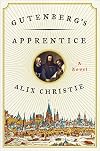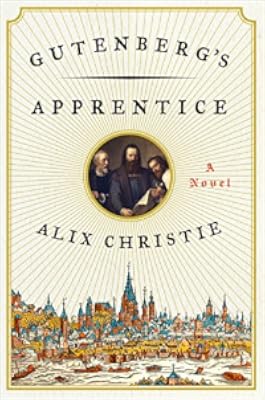
Gutenberg's Apprentice
by Alix Christie
On This Page
Description
When his foster father, a wealthy merchant and bookseller, finances Johann Gutenberg and his printing press, Peter Schoeffer is ordered to become Gutenberg's apprentice and begins his education in the "darkest art" as they print copies of the Holy Bible, drawing the wrath of the Church.Tags
Recommendations

































Member Reviews
The greatest thing since sliced bread? There's no contest; it's obviously the printing press. Without the genius of Johann Gutenberg, the world as we know it would be so fundamentally different I can't even begin to imagine what it would look like. And for me personally, well, I would have had to disguise myself as a boy so I could be a monk because I don't think I could survive without books. But Gutenberg didn't change the world from scribes to printing presses singlehandedly as Alix Christie's debut novel, Gutenberg's Apprentice, suggests. Gutenberg's Bible was not the work of one man but a miracle of many. He had a financial backer, a devoted apprentice, and a whole workshop of people dedicated to his vision.
Peter Schoeffer is a show more scribe in Paris, good at his work and starting to become known in his field, when his adoptive father, Johann Fust, calls him back to Mainz, Germany. Fust is a wealthy merchant who sees the promise in Gutenberg's latest invention and he wants his foster son to not only apprentice in the new art but also to serve as his eyes and ears in the workshop. Peter is bitter at first and worried that what they are doing is the devil's work but as he comes to understand the process and its implications for the city of Mainz, each church, and indeed, people all over, he grows as invested in the art of printing as he ever was in being a scribe. But the path to the Bible was not a straight one. The expenses for starting up this newfangled press were staggering and threatened to mushroom out of control before anything was ever printed. The Bible itself was not originally the work intended to be printed but the church's internal wrangling over reform and unchecked greed made it impossible for anything but God's Own Word. The time consuming nature of the work, although significantly faster than scribing, was also against them. The secrecy in which the workshop had to toil was precarious but vital. And the growing enmity and lack of trust between the partners, Fust and Gutenberg, pulled at Peter and caused him stress.
Christie has done a beautiful job laying out the political climate of the time and the struggle between religious and secular interests. She has captured the corruption and greed that defined the late medieval church and which would, in a few short years, result in the Reformation. She shows the guilds growing in power to challenge the established church and the price that the common man paid in this struggle. Gutenberg is shown as visionary but crafty, self-serving, and eager for fame and fortune. Fust starts off lenient and willing to invest greatly in the venture but grows increasingly impatient and mercenary when he tots up his probable losses. And Peter, who owes much to both men, is torn, his loyalty divided and tested. The frame device, whereby Peter tells the tale of the Bibles to a curious monk some twenty or thirty years after the events and after the deaths of both Fust and Gutenberg, allows him to reflect on the way that they each contributed to history and to finally see the good and ill of each decision from the vantage of a more impartial time, reflecting on the miracle that it lasted only the span of time that it required.
Mainz and the surrounding areas were well described and the details of how the press worked and the technique involved in making all aspects of the book perfect were fascinating. The tightrope they all walked in keeping the rapacious archbishop ignorant enough of their work to continue on without interference lends tension to a plot, the outcome of which all of history records. Peter is a wonderful narrator, having a foot in both camps, truly understanding the monumental achievement towards which they strove, and having to learn everything just as the reader does. Historical fiction readers will appreciate the bringing to life of the major players in the birth of the printing press, the intriguing and fraught tale of Gutenberg's famous Bible, and the beginning of the publishing industry and readily accessible books. Then they'll want to lay eyes on one of the remaining Gutenberg Bibles themselves. I know I do! show less
Peter Schoeffer is a show more scribe in Paris, good at his work and starting to become known in his field, when his adoptive father, Johann Fust, calls him back to Mainz, Germany. Fust is a wealthy merchant who sees the promise in Gutenberg's latest invention and he wants his foster son to not only apprentice in the new art but also to serve as his eyes and ears in the workshop. Peter is bitter at first and worried that what they are doing is the devil's work but as he comes to understand the process and its implications for the city of Mainz, each church, and indeed, people all over, he grows as invested in the art of printing as he ever was in being a scribe. But the path to the Bible was not a straight one. The expenses for starting up this newfangled press were staggering and threatened to mushroom out of control before anything was ever printed. The Bible itself was not originally the work intended to be printed but the church's internal wrangling over reform and unchecked greed made it impossible for anything but God's Own Word. The time consuming nature of the work, although significantly faster than scribing, was also against them. The secrecy in which the workshop had to toil was precarious but vital. And the growing enmity and lack of trust between the partners, Fust and Gutenberg, pulled at Peter and caused him stress.
Christie has done a beautiful job laying out the political climate of the time and the struggle between religious and secular interests. She has captured the corruption and greed that defined the late medieval church and which would, in a few short years, result in the Reformation. She shows the guilds growing in power to challenge the established church and the price that the common man paid in this struggle. Gutenberg is shown as visionary but crafty, self-serving, and eager for fame and fortune. Fust starts off lenient and willing to invest greatly in the venture but grows increasingly impatient and mercenary when he tots up his probable losses. And Peter, who owes much to both men, is torn, his loyalty divided and tested. The frame device, whereby Peter tells the tale of the Bibles to a curious monk some twenty or thirty years after the events and after the deaths of both Fust and Gutenberg, allows him to reflect on the way that they each contributed to history and to finally see the good and ill of each decision from the vantage of a more impartial time, reflecting on the miracle that it lasted only the span of time that it required.
Mainz and the surrounding areas were well described and the details of how the press worked and the technique involved in making all aspects of the book perfect were fascinating. The tightrope they all walked in keeping the rapacious archbishop ignorant enough of their work to continue on without interference lends tension to a plot, the outcome of which all of history records. Peter is a wonderful narrator, having a foot in both camps, truly understanding the monumental achievement towards which they strove, and having to learn everything just as the reader does. Historical fiction readers will appreciate the bringing to life of the major players in the birth of the printing press, the intriguing and fraught tale of Gutenberg's famous Bible, and the beginning of the publishing industry and readily accessible books. Then they'll want to lay eyes on one of the remaining Gutenberg Bibles themselves. I know I do! show less
Peter Schoeffer, scribe, thinks he has it made. He loves Paris, his adopted city, where the Seine smells “of chalk and stone, a sharp and thrilling city thriving.” At twenty-five, he sees a path upward, because the Church will pay for manuscripts penned in a fine hand such as his.
But in September 1450, his stepfather, a wealthy merchant and bookseller, summons him home to Mainz without saying why, and you sense Peter’s resentment at the peremptory recall.
The reason makes Peter feel even worse. He’s to accept an apprenticeship—at his age, with his accomplishments!—to aid an effort that feels both socially beneath him and blasphemous. But he can’t say no, because stepdad has raised him, educated him, and made him who he is. show more But to be shackled to a stinking, cellar workshop and its forge alongside half-educated smiths offends his pride and aesthetic soul. He’s also uncertain where he belongs socially, so he’s free to resent those above and below him.
Furthermore, and most important, his new master is Johann Gensfleisch, known as Gutenberg, who’s undertaken a sacrilegious project out of arrogant greed—to produce scores of books at once, selling holy texts for profit. No wonder that everyone’s sworn to secrecy, for if the Church found out, they’d seize everything and have the printers arrested.
Not just that; Gutenberg represents all that Peter has learned to detest. The master belongs to Mainz’s upper crust, called Elders, one of the thirty leading families who treat the city like a fiefdom. The Elders act hand-in-glove with the archbishop to bleed the merchants, guilds, and less exalted citizens for their own gain.
Consequently, that Peter’s stepfather has chosen to bankroll Gutenberg seems corrupt, and his own presence designed to keep an eye on stepdad’s investment—until the young scribe realizes how ruthless, manipulative, and controlling his new master is. Maybe Peter’s there as Gutenberg’s pawn against his chief creditor. In any case, Peter feels like a slave, with no respite from either quarter.
Even so, he admires artistic talent, and Gutenberg never lets anyone forget he’s a genius. Christie has done a terrific job rendering the era, the political machinations, and the process of printing as its inventors devise it on the fly. Most of her characters are historical figures, including Peter, and she reimagines them with flair and attention to detail. The scenes of fashioning, failure, and gradual surmounting of obstacles are as gripping as any; I never appreciated how difficult or painstaking it was to print a book in the fifteenth century, or how many years it took.
Peter’s coming-of-age story, in which his growing technical skill and innovative sense mirror his emotional maturation, works nicely. He also comes to terms with his religious objections to the project, gradually understanding that the Church’s presumed opposition derives partly from its role as sole representative of God on earth, so its guardianship of scribes has both economic and political significance. Reproduce religious texts that any literate person can read, and the printer not only makes scribes superfluous, individual people can seek God for themselves, a gauntlet thrown down to church power. Accordingly, this narrative foreshadows the Reformation, mere decades away.
At its best, Gutenberg’s Apprentice reads like a thriller. Tension arises from the need for secrecy, compromised by the length of time the project takes, the ever-increasing number of participants, and Gutenberg’s indiscretions—he’s constantly cutting deals with clerics and merchants, infuriating Peter’s stepfather and squeezing the young man between two powerful men he’s doomed to displease. Throughout, Christie captures the mindset, the strivings, and the fixation on social class.
In such a complicated narrative, it’s not always easy to penetrate the politics, despite Christie’s gift for depicting the power struggles. I’m also not persuaded, in a couple instances, that Peter would either forgive his stepfather his hard hand or feel warmly toward him; these crucial transitions seem rushed or simple.
But overall, Gutenberg’s Apprentice does what excellent historical fiction should do, and I highly recommend it. show less
But in September 1450, his stepfather, a wealthy merchant and bookseller, summons him home to Mainz without saying why, and you sense Peter’s resentment at the peremptory recall.
The reason makes Peter feel even worse. He’s to accept an apprenticeship—at his age, with his accomplishments!—to aid an effort that feels both socially beneath him and blasphemous. But he can’t say no, because stepdad has raised him, educated him, and made him who he is. show more But to be shackled to a stinking, cellar workshop and its forge alongside half-educated smiths offends his pride and aesthetic soul. He’s also uncertain where he belongs socially, so he’s free to resent those above and below him.
Furthermore, and most important, his new master is Johann Gensfleisch, known as Gutenberg, who’s undertaken a sacrilegious project out of arrogant greed—to produce scores of books at once, selling holy texts for profit. No wonder that everyone’s sworn to secrecy, for if the Church found out, they’d seize everything and have the printers arrested.
Not just that; Gutenberg represents all that Peter has learned to detest. The master belongs to Mainz’s upper crust, called Elders, one of the thirty leading families who treat the city like a fiefdom. The Elders act hand-in-glove with the archbishop to bleed the merchants, guilds, and less exalted citizens for their own gain.
Consequently, that Peter’s stepfather has chosen to bankroll Gutenberg seems corrupt, and his own presence designed to keep an eye on stepdad’s investment—until the young scribe realizes how ruthless, manipulative, and controlling his new master is. Maybe Peter’s there as Gutenberg’s pawn against his chief creditor. In any case, Peter feels like a slave, with no respite from either quarter.
Even so, he admires artistic talent, and Gutenberg never lets anyone forget he’s a genius. Christie has done a terrific job rendering the era, the political machinations, and the process of printing as its inventors devise it on the fly. Most of her characters are historical figures, including Peter, and she reimagines them with flair and attention to detail. The scenes of fashioning, failure, and gradual surmounting of obstacles are as gripping as any; I never appreciated how difficult or painstaking it was to print a book in the fifteenth century, or how many years it took.
Peter’s coming-of-age story, in which his growing technical skill and innovative sense mirror his emotional maturation, works nicely. He also comes to terms with his religious objections to the project, gradually understanding that the Church’s presumed opposition derives partly from its role as sole representative of God on earth, so its guardianship of scribes has both economic and political significance. Reproduce religious texts that any literate person can read, and the printer not only makes scribes superfluous, individual people can seek God for themselves, a gauntlet thrown down to church power. Accordingly, this narrative foreshadows the Reformation, mere decades away.
At its best, Gutenberg’s Apprentice reads like a thriller. Tension arises from the need for secrecy, compromised by the length of time the project takes, the ever-increasing number of participants, and Gutenberg’s indiscretions—he’s constantly cutting deals with clerics and merchants, infuriating Peter’s stepfather and squeezing the young man between two powerful men he’s doomed to displease. Throughout, Christie captures the mindset, the strivings, and the fixation on social class.
In such a complicated narrative, it’s not always easy to penetrate the politics, despite Christie’s gift for depicting the power struggles. I’m also not persuaded, in a couple instances, that Peter would either forgive his stepfather his hard hand or feel warmly toward him; these crucial transitions seem rushed or simple.
But overall, Gutenberg’s Apprentice does what excellent historical fiction should do, and I highly recommend it. show less
As a novel, Gutenberg’s Apprentice is good, but not great; as an historical piece, it’s fascinating. The plot is straightforward. Peter Schoeffer (all these characters are historical figures), an aspiring scribe, is called home by his step-father Johann Furst, who has become business partners with Johann Gensgleisch, who we know as Gutenberg. Peter is to be Gutenberg’s apprentice—and his step-father’s eyes in the workshop. Initially Peter finds the printing process spiritless, far inferior to the production of individual books by hand, but eventually he comes to see printing as a miracle, a gift that honors God. As Peter learns the printing business, relations between Furst and Gutenberg grow increasingly strained. The reader show more knows all this because the framework for the novel is an elderly Peter’s relating of these events to the Abbott Johannes Trithenius, who becomes a historian of bookmaking and printing (among other things).
While it’s is intended to be Peter’s recounting of his life’s story, the novel is written in third person, which distances readers from the central character. Readers are told of Peter’s doubts about this new form of bookmaking: “This wasn’t even work that in the end brought forth some lovely thing. A brooch, a chalice, or a gleaming monstrance could at least lift a soul above the flames.” Peter’s conflicting feelings as Furst and Gutenberg grow increasingly hostile to one another are described, but one never feels that one is getting to experience these events as Peter did.
As I said, however, this book is fascinating, a must-read for book lovers and historical fiction enthusiasts. Christie herself is a letter press printer, as well as a novelist, and the mechanics of early printing are described in detail bringing the process to life. The fist letter-molds were made of sand hand-impressed with a reverse image of the desired letter, and were good for only a single use, a process that seems to be almost no improvement over hand-lettering. The staff of the workshop shifts as Gutenberg comes to learn the different rates of compositing and printing.
Similarly interesting are the passages examining the different character’s perceptions of the art of printing and its purpose. Peter comes to see printing as sacred work, at first not realizing that the presses can be put to use for inglorious purposes, as well as glorious ones: “He had not thought of it before—the prospect of their art abused, its glory twisted to the traffic of the church.”
One can also see in the Mainz of the novel the church practices that will lead to Luther’s reformation in another hundred years: the varying ways that ecclesiastics wring monies from the poorest under their jurisdiction, the selling of indulgences, with money lining clerical pockets at all levels.
Harper’s initial run of this book is 75,000 copies, a substantial number, particularly for a first novel. Their faith in it is well-placed. The multiple layers of historical detail contained in Gutenberg’s Apprentice make it a book that can be read and pondered repeatedly. show less
While it’s is intended to be Peter’s recounting of his life’s story, the novel is written in third person, which distances readers from the central character. Readers are told of Peter’s doubts about this new form of bookmaking: “This wasn’t even work that in the end brought forth some lovely thing. A brooch, a chalice, or a gleaming monstrance could at least lift a soul above the flames.” Peter’s conflicting feelings as Furst and Gutenberg grow increasingly hostile to one another are described, but one never feels that one is getting to experience these events as Peter did.
As I said, however, this book is fascinating, a must-read for book lovers and historical fiction enthusiasts. Christie herself is a letter press printer, as well as a novelist, and the mechanics of early printing are described in detail bringing the process to life. The fist letter-molds were made of sand hand-impressed with a reverse image of the desired letter, and were good for only a single use, a process that seems to be almost no improvement over hand-lettering. The staff of the workshop shifts as Gutenberg comes to learn the different rates of compositing and printing.
Similarly interesting are the passages examining the different character’s perceptions of the art of printing and its purpose. Peter comes to see printing as sacred work, at first not realizing that the presses can be put to use for inglorious purposes, as well as glorious ones: “He had not thought of it before—the prospect of their art abused, its glory twisted to the traffic of the church.”
One can also see in the Mainz of the novel the church practices that will lead to Luther’s reformation in another hundred years: the varying ways that ecclesiastics wring monies from the poorest under their jurisdiction, the selling of indulgences, with money lining clerical pockets at all levels.
Harper’s initial run of this book is 75,000 copies, a substantial number, particularly for a first novel. Their faith in it is well-placed. The multiple layers of historical detail contained in Gutenberg’s Apprentice make it a book that can be read and pondered repeatedly. show less
"The Word of God willed its completion, after all."
- from Alix Christie's "Gutenberg's Assistant"
Alix Christie has written a fabulously passionate ode to the written word. Clearly a student of the 'Ars impressoria' (art of engraving), Christie builds a sepia-toned portrait of the late Middle Ages, with a myriad of characters who burst through the narrative to color the realities of this uniquely world-changing period of history.
Great historical fiction is grounded in the 'touch and feel' of a place and time. Christie finely textures her world with a sturdy poetic sense that splendidly blends the historical sense of the moments with a clear ardor she has for the printed word.
Christie centers her story around Peter Shoeffer, the show more real-life apprentice (at first), and later 'shop' boss for Johann Gutenberg in his printing workshop. Peter's adopted father asks him to return to Mainz, Germany from Paris where he was enjoying the life of a monastic scribe. Peter was "…a man of letters, a cleric, a scribe. He bore the tools of his profession in a pouch slung like a quiver at his side: the sealed horn of ink, his quills and reeds, his bone and chalk and chamois."
"The textura lettering was squat and ugly, yet every string of letters was unnervingly even, all across the line. Each of those lines ended with an utter, chilling harmony, at precisely the same distance from the edge. What hand could write a line that straight, and end exactly underneath the one above? What human hand could possibly achieve a thing so strange? He felt his hear squeeze and his soul flood with an overwhelming dread."
- description of Peter Shoeffer's first look at a sample page run off of Gutenberg's press.
Religion is a pervasive force in the lives of the people in Mainz. From Peter's youth, he recalls his master's words: "Your hand is but His tool. The parchment that we write on is pure conscience, on which all good works are noted. The rule that we use to draw the lines for writing is God's will. The ink with which we write is pure humility, the desk on which we write the calming of our hearts."
This religious specter floats over the entire notion of the written word delivered by anything other than the human hand. Writing is akin to religion. The act of putting thought to paper, next to godliness. What then is the press? I couldn't help but connect the introduction of automated printing, to the more recent lettered debates centered on the arrival of the ebook (though on a much less religious scale, of course).
Gutenberg lives in a world of guilds, corrupt religious leaders, and where people don't have to think too far back to remember the horrors of the Black Death. Describing a scene at a local tavern, Peter describes "Elders all, patricians from the city or the minor nobles from the land: the clergy was made up of second sons from wealthy families, stashed and suckled by the Mother Church for life."
It's a world of reformation, fear, and paranoia. Christie captures this world through a religious weightiness to her prose; a serious communion between the words of her novel and the printed word's of Peter's and Gutenberg's within the story.
Of course this story is based on the real life events surrounding the printing of the Gutenberg Bible. It didn't just 'happen', there were years of exceedingly hard, and mundane, work, amidst a world stepping out of the Medieval darkness and into the light of the Renaissance. Christie deftly intertwines the more easily written drama between characters and classes, with the more difficult dramatization of the technical aspects of the printing itself.
"When you get to my age, Peter, you do begin to wonder. If it really is a gift from God---and not a curse sent up from hell."
- Gutenberg to Peter, in Alex Christies 'Gutenberg's Apprentice'
While Peter's personal story includes his adoptive family, a love interest that introduces a view into Middle Ages Germany's class distinctions, Christie's tale orbits around the explosive personality of Johann Gutenberg. He's really cast as mad scientist – moody, aggressive, undeniably driven. As Peter reflects on the years (yes years!) printing the now-famous bible he considers, "Much has been said in the decades since, but almost none of it is true. They've practically canonized the man who found this wondrous art. How Gutenberg would laugh if he could see them from above…or else below."
The most exquisite drama of the novel is the growing reformation of religious attitudes and worldwide outlook. Gutenberg's press was introduced during a time when class wars were playing over the halls of Mainz and were reflected in the church's ever lessening control over its population. Revolution was in the air. An overhaul of Church abuses was on the horizon. Gutenberg and Shoeffer race to publish the first editions of the book before the secrets of their methods for publishing quickly and inexpensively (at least relative to the hand-copying method of monastic scribes) float up to the corrupt church.
My only wish for this novel is that it would've come with a map or two, as there's a significant amount of traveling in and around Mainz, and perhaps a diagram or two of the actual press itself.
I received this book through the Amazon Vine program. show less
- from Alix Christie's "Gutenberg's Assistant"
Alix Christie has written a fabulously passionate ode to the written word. Clearly a student of the 'Ars impressoria' (art of engraving), Christie builds a sepia-toned portrait of the late Middle Ages, with a myriad of characters who burst through the narrative to color the realities of this uniquely world-changing period of history.
Great historical fiction is grounded in the 'touch and feel' of a place and time. Christie finely textures her world with a sturdy poetic sense that splendidly blends the historical sense of the moments with a clear ardor she has for the printed word.
Christie centers her story around Peter Shoeffer, the show more real-life apprentice (at first), and later 'shop' boss for Johann Gutenberg in his printing workshop. Peter's adopted father asks him to return to Mainz, Germany from Paris where he was enjoying the life of a monastic scribe. Peter was "…a man of letters, a cleric, a scribe. He bore the tools of his profession in a pouch slung like a quiver at his side: the sealed horn of ink, his quills and reeds, his bone and chalk and chamois."
"The textura lettering was squat and ugly, yet every string of letters was unnervingly even, all across the line. Each of those lines ended with an utter, chilling harmony, at precisely the same distance from the edge. What hand could write a line that straight, and end exactly underneath the one above? What human hand could possibly achieve a thing so strange? He felt his hear squeeze and his soul flood with an overwhelming dread."
- description of Peter Shoeffer's first look at a sample page run off of Gutenberg's press.
Religion is a pervasive force in the lives of the people in Mainz. From Peter's youth, he recalls his master's words: "Your hand is but His tool. The parchment that we write on is pure conscience, on which all good works are noted. The rule that we use to draw the lines for writing is God's will. The ink with which we write is pure humility, the desk on which we write the calming of our hearts."
This religious specter floats over the entire notion of the written word delivered by anything other than the human hand. Writing is akin to religion. The act of putting thought to paper, next to godliness. What then is the press? I couldn't help but connect the introduction of automated printing, to the more recent lettered debates centered on the arrival of the ebook (though on a much less religious scale, of course).
Gutenberg lives in a world of guilds, corrupt religious leaders, and where people don't have to think too far back to remember the horrors of the Black Death. Describing a scene at a local tavern, Peter describes "Elders all, patricians from the city or the minor nobles from the land: the clergy was made up of second sons from wealthy families, stashed and suckled by the Mother Church for life."
It's a world of reformation, fear, and paranoia. Christie captures this world through a religious weightiness to her prose; a serious communion between the words of her novel and the printed word's of Peter's and Gutenberg's within the story.
Of course this story is based on the real life events surrounding the printing of the Gutenberg Bible. It didn't just 'happen', there were years of exceedingly hard, and mundane, work, amidst a world stepping out of the Medieval darkness and into the light of the Renaissance. Christie deftly intertwines the more easily written drama between characters and classes, with the more difficult dramatization of the technical aspects of the printing itself.
"When you get to my age, Peter, you do begin to wonder. If it really is a gift from God---and not a curse sent up from hell."
- Gutenberg to Peter, in Alex Christies 'Gutenberg's Apprentice'
While Peter's personal story includes his adoptive family, a love interest that introduces a view into Middle Ages Germany's class distinctions, Christie's tale orbits around the explosive personality of Johann Gutenberg. He's really cast as mad scientist – moody, aggressive, undeniably driven. As Peter reflects on the years (yes years!) printing the now-famous bible he considers, "Much has been said in the decades since, but almost none of it is true. They've practically canonized the man who found this wondrous art. How Gutenberg would laugh if he could see them from above…or else below."
The most exquisite drama of the novel is the growing reformation of religious attitudes and worldwide outlook. Gutenberg's press was introduced during a time when class wars were playing over the halls of Mainz and were reflected in the church's ever lessening control over its population. Revolution was in the air. An overhaul of Church abuses was on the horizon. Gutenberg and Shoeffer race to publish the first editions of the book before the secrets of their methods for publishing quickly and inexpensively (at least relative to the hand-copying method of monastic scribes) float up to the corrupt church.
My only wish for this novel is that it would've come with a map or two, as there's a significant amount of traveling in and around Mainz, and perhaps a diagram or two of the actual press itself.
I received this book through the Amazon Vine program. show less
One always hears about Gutenberg and how invented the moveable press leading to the first printing of books. However, this book shows that, like most inventions, it was not just the work of one person but a team of dedicated practitioners. In fact, although Gutenberg had the initial idea without the financial backing and his assistants he might never have brought it to fruition.
Peter Schoeffer was born in poverty and his mother died when he was young. But she had a wish that Peter become a scribe and so he was taught to read and write. Then he was fostered by a rich merchant in Mainz, Johann Fust, and his future seemed assured. He went to Paris and quickly gained renown for his fine hand but his foster father ordered him back to Mainz. show more Fust had met and agreed to back Johann Gutenberg and he wanted Peter to learn this new method of making books. He also wanted Peter's eyes on Gutenberg to make sure he didn't cheat. At first Peter was appalled at the idea of producing books by mechanical means but when he saw his first printed page he was won over. Peter developed many improvements for the printing press and worked tirelessly to complete the massive job of printing the Bible. Gutenberg appointed him as foreman of the shop while Gutenberg went on to other things. The printing press and the Bible needed to be kept secret because some clergy (and others) thought it was blasphemy to print the word of God. Yet Gutenberg endangered the secrecy by printing indulgences and other works. Peter Schoeffer kept the whole enterprise going but his name has been forgotten. Until now.
This is Alix Christie's debut novel and there are a few things that show this. Some things could have been left out but others should have been expanded. One thing that I'm glad she did put in is a love story subplot. It gave a human dimension to the whole enterprise. show less
Peter Schoeffer was born in poverty and his mother died when he was young. But she had a wish that Peter become a scribe and so he was taught to read and write. Then he was fostered by a rich merchant in Mainz, Johann Fust, and his future seemed assured. He went to Paris and quickly gained renown for his fine hand but his foster father ordered him back to Mainz. show more Fust had met and agreed to back Johann Gutenberg and he wanted Peter to learn this new method of making books. He also wanted Peter's eyes on Gutenberg to make sure he didn't cheat. At first Peter was appalled at the idea of producing books by mechanical means but when he saw his first printed page he was won over. Peter developed many improvements for the printing press and worked tirelessly to complete the massive job of printing the Bible. Gutenberg appointed him as foreman of the shop while Gutenberg went on to other things. The printing press and the Bible needed to be kept secret because some clergy (and others) thought it was blasphemy to print the word of God. Yet Gutenberg endangered the secrecy by printing indulgences and other works. Peter Schoeffer kept the whole enterprise going but his name has been forgotten. Until now.
This is Alix Christie's debut novel and there are a few things that show this. Some things could have been left out but others should have been expanded. One thing that I'm glad she did put in is a love story subplot. It gave a human dimension to the whole enterprise. show less
Alix Christie's Gutenberg's Apprentice (HarperCollins) is a fictionalized account of the Gutenberg workshop in Mainz during the production of the 42-line Bible. The story is told from the perspective of the eponymous apprentice, Peter Schoeffer, and Christie has at least to a significant degree tried to get the details right. She hasn't always succeeded, alas, and the actual plot of the novel is pretty lackluster, but Christie's writing is lovely and makes this historical reconstruction entirely worth a read. The contextualization of Gutenberg's (and Fust and Schoeffer's) work within the political and religious upheaval of 1450s Mainz alone would recommend it to anyone interested in the period.
Though I looked forward to reading this book, it turned out to be very disappointing.
As a lover of historical fiction, with a particular interest in medieval Europe, a novel about the origins of the printing press seemed like a no-brainer. And the story of the three main characters (Gutenberg, his apprentice Peter, and Peter's foster father who finances the first printing of the Bible) is complex and interesting. One moment, Gutenberg is a visionary businessmen; the next he is a supreme egotist bent on grabbing the glory and cheating his partner. Peter, who begins as a reluctant apprenticeship, forced by his foster father to work for Gutenberg so he can watch over his parent's financial investment, soon rises to foreman and becomes the show more heart and soul of the enterprise. But how much is Gutenberg willing to honor the contributions of a mere apprentice? So there are the basics of a very good story here, right?
Unfortunately, the way in which the author describes the four years it takes to complete the Bible often seemed plodding and sometimes even hard to follow. Christie seems to assume the reader already has some knowledge of medieval Germany, where Gutenberg worked, especially relationships that played out within towns, between guilds and the Catholic Church. I had no such knowledge. So I had difficulty grasping how Gutenberg's decision to print indulgences helped him keep his printing press secret. Maybe you'll have better luck! show less
As a lover of historical fiction, with a particular interest in medieval Europe, a novel about the origins of the printing press seemed like a no-brainer. And the story of the three main characters (Gutenberg, his apprentice Peter, and Peter's foster father who finances the first printing of the Bible) is complex and interesting. One moment, Gutenberg is a visionary businessmen; the next he is a supreme egotist bent on grabbing the glory and cheating his partner. Peter, who begins as a reluctant apprenticeship, forced by his foster father to work for Gutenberg so he can watch over his parent's financial investment, soon rises to foreman and becomes the show more heart and soul of the enterprise. But how much is Gutenberg willing to honor the contributions of a mere apprentice? So there are the basics of a very good story here, right?
Unfortunately, the way in which the author describes the four years it takes to complete the Bible often seemed plodding and sometimes even hard to follow. Christie seems to assume the reader already has some knowledge of medieval Germany, where Gutenberg worked, especially relationships that played out within towns, between guilds and the Catholic Church. I had no such knowledge. So I had difficulty grasping how Gutenberg's decision to print indulgences helped him keep his printing press secret. Maybe you'll have better luck! show less
Members
- Recently Added By
Lists

I Can't Finish This Book
189 works; 22 members

Dublin Literary Award Longlist 2016
148 works; 4 members
Author Information

9 Works 673 Members
Awards and Honors
Awards
Distinctions
Common Knowledge
- Canonical title
- Gutenberg's Apprentice
- Original publication date
- 2014
- Important places
- Mainz, Rhineland-Palatinate, Germany
- Original language
- English
Classifications
Statistics
- Members
- 646
- Popularity
- 44,944
- Reviews
- 35
- Rating
- (3.58)
- Languages
- Chinese, English, Portuguese (Portugal), Spanish
- Media
- Paper, Audiobook, Ebook
- ISBNs
- 21
- ASINs
- 7