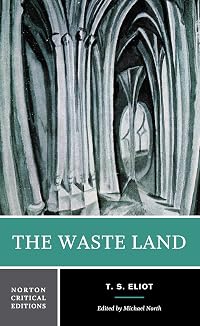
The Waste Land (Norton Critical Editions)
by T. S. Eliot, Michael North (Editor)
On This Page
Description
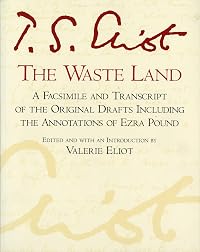
Prints the first American edition (Boni & Liveright) of Eliot's most important work, accompanied by the editor's detailed annotations. Eliot's own notoriously inscrutable notes, placed at the end, are also annotated. The abundant explanatory material includes background on the poem's sources, composition, and publication history as well as 25 critical reviews and essays.Tags
Recommendations

Member Reviews
The Waste Land, Eliot’s masterpiece, is a poem filled with allusions and references to everything from Shakespeare to Buddha, and one that cannot be quickly read nor easily understood. It is considered one of the most important of the modernist poems, and rightfully so.
Written in 1922, in the aftermath of World War I, Eliot explores both the loss of life, its meaning, and the resultant changes in society and values. There is cynicism throughout the poem, and ultimately hope expressed in the final section–a looking back and a reaching forward.
Eliot shows us detailed examples of people lost and leading empty, meaningless lives. There is a lack of morality, a turning against the natural order, a lack of faith in the future and a show more discarding of the lessons of the past. The masses walk through their days with hedonistic fervor and no feeling. The Waste Land is complete, and the waste is personal.
The conclusion seems to me to say there is a way to overcome, not only endure, but thrive, however that way requires something of each individual. It requires, per Eliot, “giving” “sympathizing” and “control.” And, it seems to me Eliot tells us that it also requires faith; a faith in something larger than self. The result of such a faith being “inner peace”.
This is the third time I have studied this poem, and each time I feel I have grasped a tiny bit more. I would imagine that I could read this a dozen more times and not have digested it all. It took Eliot three years to write it, so it deserves the time and effort, but to know it in all its complexity, you need to read another dozen works, Dante, Shakespeare, the Bible among them. This edition contains Eliot's notes, criticisms by other prominent authors, and reference materials from Eliot's bibliography.
I believe Eliot wanted us to work for his meaning, because I think he wanted us to understand what had been lost and that it would not be an easy thing to recover. show less
Written in 1922, in the aftermath of World War I, Eliot explores both the loss of life, its meaning, and the resultant changes in society and values. There is cynicism throughout the poem, and ultimately hope expressed in the final section–a looking back and a reaching forward.
Eliot shows us detailed examples of people lost and leading empty, meaningless lives. There is a lack of morality, a turning against the natural order, a lack of faith in the future and a show more discarding of the lessons of the past. The masses walk through their days with hedonistic fervor and no feeling. The Waste Land is complete, and the waste is personal.
The conclusion seems to me to say there is a way to overcome, not only endure, but thrive, however that way requires something of each individual. It requires, per Eliot, “giving” “sympathizing” and “control.” And, it seems to me Eliot tells us that it also requires faith; a faith in something larger than self. The result of such a faith being “inner peace”.
This is the third time I have studied this poem, and each time I feel I have grasped a tiny bit more. I would imagine that I could read this a dozen more times and not have digested it all. It took Eliot three years to write it, so it deserves the time and effort, but to know it in all its complexity, you need to read another dozen works, Dante, Shakespeare, the Bible among them. This edition contains Eliot's notes, criticisms by other prominent authors, and reference materials from Eliot's bibliography.
I believe Eliot wanted us to work for his meaning, because I think he wanted us to understand what had been lost and that it would not be an easy thing to recover. show less
The best thing about this edition isn't the historical information (blah), the initial reception (much fun) or the later criticism (you've seen it all before). It's . . . okay, the best thing is the poem itself, obviously. So wonderful to see bleak modernism that's this rich and bloody, as opposed to Beckett's bleak modernism, say, which is so gratingly, scrapingly anti-life.
But what I was actually referring to was the painstaking inclusion of original texts, from the central (Tiresias) to the very peripheral (the Goldsmith poem that is adapted for a couple of lines). They widen and deepen the poem before your eyes like a fourth dimension, an undiscovered dialogic country. I know that's what critical editions are meant to do, but The show more Waste Land is particularly well suited for it - it goes from an epic grumble to something approaching novelized poetry, in the Bakhtinian sense of "novel;" a knot of intersubjectivities. It's also wonderful. show less
But what I was actually referring to was the painstaking inclusion of original texts, from the central (Tiresias) to the very peripheral (the Goldsmith poem that is adapted for a couple of lines). They widen and deepen the poem before your eyes like a fourth dimension, an undiscovered dialogic country. I know that's what critical editions are meant to do, but The show more Waste Land is particularly well suited for it - it goes from an epic grumble to something approaching novelized poetry, in the Bakhtinian sense of "novel;" a knot of intersubjectivities. It's also wonderful. show less
This isn't a review of the poem. If you've read anything written since, say, 1938, and liked it, then you like The Waste Land. You might not know it, but there it is. Even if what you like was written by a hater of this poem, it wouldn't have existed without it. Giving it stars is like giving stars to Homer, or Dante, or Goethe, or Shakespeare. You've already decided if you like it or not before you start reading it. Are you a rebellious teenager with a leftist bent? You already hate it. Are you a snob who believes in nothing so much as the inevitable decline of culture? You'll love it. And so on.
But I am reviewing this Norton Critical Edition, which includes the poem; 'Sources' ranging from Buddha's Fire-Sermon and the relevant show more Upanishad down to Frazer Weston and Baudelaire; some relevant statements by Eliot; reviews and criticism.
Sources: Useful, but really, why bother putting in the KJV while not putting in the Verlaine and Nerval which Eliot quotes? That's an odd choice. The KJV is available wherever bytes are being consumed; the poems are substantially harder to track down and more obviously important for this poem.
Eliot's writings: nice to have all in one place, but there's nothing more annoying than skipping paragraphs out of essays, or printing one paragraph from an essay. Could this book not have been 15 pages longer? Then we could have had all of 'Tradition...' at least.
Reviews and First Reactions: A good sampling of how people read it at the time it was released, although not particularly valuable as readings of the poem. Malcolm Cowley's piece was especially interesting: "we were excited by the adventure of living in the present... we were entering a new world of art that did not impress us as being a spiritual desert," and so his generation rejected The Waste Land. Too bad they were wrong, eh Mal? Turns out post-war was pretty shitty.
Criticism: two halves. First, essays grouped under 'The New Criticism.' Those which are appreciative generally take an optimistic view of the poem as solving some problem, or making possible salvation. The more recent criticism is predictably eye-rolling. Moody's 'A Cure for a Crisis...' is good; Bush gives us some sub-Freudian dubieties (Tiresias is in the Oedipus myth! Therefore...!!!) Ellmann gives us scads of those same dubieties mingled with the conflations of which recent criticism can't rid itself: "emasculation corresponds to other injuries, particularly to the mutilation of the voice: as if the phallus were complicit with the Logos. Lacking both, language has become a 'waste of breath', a barren dissemination." Of course it has. Because, y'know, daddy = the signified = the phallus = Jesus = the abject = self-consumign artifacts = Eliot. And Armstrong gives us such gems as "sieving is a process applied to sewage" rather than, say, the making of flour or panning for gold. Apparently the most important bits of The Waste Land are the bits Pound and Eliot cut out of the drafts, and Pound welled "phallicly and creatively" for John Quinn, which would probably have been news to Quinn, who just thought he was being asked for money (again) rather than a blow job.
The editors have done a good job, there's no doubt about it. They couldn't have shown better the fatuity of contemporary criticism if they'd tried. If the study of literature persists into this century, I hope we move past what is clearly the anal phase of scholarly culture. Leave the poop alone, people. show less
But I am reviewing this Norton Critical Edition, which includes the poem; 'Sources' ranging from Buddha's Fire-Sermon and the relevant show more Upanishad down to Frazer Weston and Baudelaire; some relevant statements by Eliot; reviews and criticism.
Sources: Useful, but really, why bother putting in the KJV while not putting in the Verlaine and Nerval which Eliot quotes? That's an odd choice. The KJV is available wherever bytes are being consumed; the poems are substantially harder to track down and more obviously important for this poem.
Eliot's writings: nice to have all in one place, but there's nothing more annoying than skipping paragraphs out of essays, or printing one paragraph from an essay. Could this book not have been 15 pages longer? Then we could have had all of 'Tradition...' at least.
Reviews and First Reactions: A good sampling of how people read it at the time it was released, although not particularly valuable as readings of the poem. Malcolm Cowley's piece was especially interesting: "we were excited by the adventure of living in the present... we were entering a new world of art that did not impress us as being a spiritual desert," and so his generation rejected The Waste Land. Too bad they were wrong, eh Mal? Turns out post-war was pretty shitty.
Criticism: two halves. First, essays grouped under 'The New Criticism.' Those which are appreciative generally take an optimistic view of the poem as solving some problem, or making possible salvation. The more recent criticism is predictably eye-rolling. Moody's 'A Cure for a Crisis...' is good; Bush gives us some sub-Freudian dubieties (Tiresias is in the Oedipus myth! Therefore...!!!) Ellmann gives us scads of those same dubieties mingled with the conflations of which recent criticism can't rid itself: "emasculation corresponds to other injuries, particularly to the mutilation of the voice: as if the phallus were complicit with the Logos. Lacking both, language has become a 'waste of breath', a barren dissemination." Of course it has. Because, y'know, daddy = the signified = the phallus = Jesus = the abject = self-consumign artifacts = Eliot. And Armstrong gives us such gems as "sieving is a process applied to sewage" rather than, say, the making of flour or panning for gold. Apparently the most important bits of The Waste Land are the bits Pound and Eliot cut out of the drafts, and Pound welled "phallicly and creatively" for John Quinn, which would probably have been news to Quinn, who just thought he was being asked for money (again) rather than a blow job.
The editors have done a good job, there's no doubt about it. They couldn't have shown better the fatuity of contemporary criticism if they'd tried. If the study of literature persists into this century, I hope we move past what is clearly the anal phase of scholarly culture. Leave the poop alone, people. show less
This critical edition is great. The two stars are for the poem. This book finally provided me with enough information to realize that it's not my lack of understanding that makes this poem incomprehensible. Virginia Woolf, on first hearing the poem read by Eliot, said in her diary "It has great beauty & force of phrase; symmetry; & tensity. What connects it together, I'm not so sure." I concur. You can read all the background material and bring all that knowledge to the poem, but there's still nothing in the poem itself connecting these disparate elements. There's lots of emotion, but not much meaning.
The Waste Land. T.S. Eliot. A Norton Critical Edition, edited by Michael North. 2001. We read this poem along with “Lepanto” for our book club, Dipso. I was more impatient reading it this time as some of my blind adoration of modern poetry has faded as I aged. It is just a difficult to read now as it was in the 60s and 70s, I do prefer Eliot’s other works. If you want to stumble through it again, this edition has great essays and tons of notes. Does it have memorable lines? Is it a just and apt description of our present civilization? Will I re-read it agin? Yes, Yes, and no, probably not.
Some dazzling and unusual imagery, which makes for an interesting and unforgettable read, but I don't like the fact that one has to sit with an encyclopedia on one's lap to be able to get all the references.
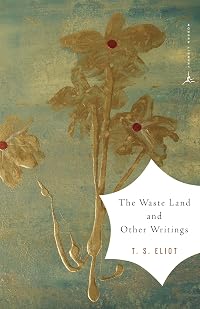
Great poem and great edition. As always, Norton is excellent at providing contextual materials and shitty at making covers that aren't ugly.
Members
- Recently Added By
Lists

20th Century Literature
1,161 works; 55 members

Poetry Corner
187 works; 15 members

Experimental Literature
141 works; 19 members
Author Information

507+ Works 48,035 Members
T. S. Eliot is considered by many to be a literary genius and one of the most influential men of letters during the half-century after World War I. He was born on September 26, 1888, in St. Louis, Missouri. Eliot attended Harvard University, with time abroad pursuing graduate studies at the Sorbonne, Marburg, and Oxford. The outbreak of World War show more I prevented his return to the United States, and, persuaded by Ezra Pound to remain in England, he decided to settle there permanently. He published his influential early criticism, much of it written as occasional pieces for literary periodicals. He developed such doctrines as the "dissociation of sensibility" and the "objective correlative" and elaborated his views on wit and on the relation of tradition to the individual talent. Eliot by this time had left his early, derivative verse far behind and had begun to publish avant-garde poetry (including "The Love Song of J. Alfred Prufrock" (1915), which exploited fresh rhythms, abrupt juxtapositions, contemporary subject matter, and witty allusion. This period of creativity also resulted in another collection of verse (including "Gerontian") and culminated in The Waste Land, a masterpiece published in 1922 and produced partly during a period of psychological breakdown while married to his wife, Vivienne Haigh-Wood Eliot. In 1922, Eliot became a director of the Faber & Faber publishing house, and in 1927 he became a British citizen and joined the Church of England. Thereafter, his career underwent a change. With the publication of Ash Wednesday in 1930, his poetry became more overtly Christian. As editor of the influential literary magazine The Criterion, he turned his hand to social as well as literary criticism, with an increasingly conservative orientation. His religious poetry culminated in Four Quartets, published individually from 1936 onward and collectively in 1943. This work is often considered to be his greatest poetic achievement. Eliot also wrote poetry in a much lighter vein, such as Old Possum's Book of Practical Cats (1939), a collection that was used during the early 1980s as the basis for the musical, Cats. In addition to his contributions in poetry and criticism, Eliot is the pivotal verse dramatist of this century. He followed the lead of William Butler Yeats in attempting to revive metrical language in the theater. But, unlike Yeats, Eliot wanted a dramatic verse that would be self-effacing, capable of expressing the most prosaic passages in a play, and an insistent, undetected presence capable of elevating itself at a moment's notice. His progression from the pageant The Rock (1934) and Murder in the Cathedral (1935), written for the Canterbury Festival, through The Family Reunion (1939) and The Cocktail Party (1949), a West End hit, was thus a matter of neutralizing obvious poetic effects and bringing prose passages into the flow of verse. Recent critics have seen Eliot as a divided figure, covertly attracted to the very elements (romanticism, personality, heresy) he overtly condemned. His early attacks on romantic poets, for example, often reveal him as a romantic against the grain. The same divisions carry over into his verse, where violence struggles against restraint, emotion against order, and imagination against ironic detachment. This Eliot is more human and more attractive to contemporary taste. During his lifetime, Eliot received many honors and awards, including the Nobel Prize for literature in 1948. (Bowker Author Biography) show less

Michael North is professor of English at the University of California, Los Angeles and the author of several books, including The Dialect of Modernism, Reading 1922, and Camera Works.
All Editions
Series
Belongs to Publisher Series
Work Relationships
Contains
Is a commentary on the text of
Common Knowledge
- Canonical title
- The Waste Land (Norton Critical Editions) (Norton Critical Editions)
- Original publication date
- 2000
- People/Characters
- Madame Sosostris
- Original language
- English
- Disambiguation notice
- Do not combine: This is a "Norton Critical Edition", a unique work with substantial added material, including essays and background materials. Do not combine with other editions of the work. Please maintain the phrase ... (show all)"Norton Critical Edition" in the Canonical Title and Series fields.
Classifications
- Genres
- Poetry, Literature Studies and Criticism, Fiction and Literature
- DDC/MDS
- 821.912 — Literature & rhetoric English & Old English literatures English Poetry 1900- 1900-1999 1900-1945
- LCC
- PS3509 .L43 .W3 — Language and Literature American literature American literature Individual authors 1900-1960
- BISAC
Statistics
- Members
- 1,734
- Popularity
- 12,806
- Reviews
- 12
- Rating
- (4.10)
- Languages
- English
- Media
- Paper, Ebook
- ISBNs
- 1
- UPCs
- 2
- ASINs
- 6