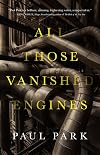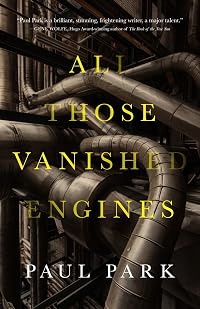
All Those Vanished Engines
by Paul Park
On This Page
Description
Paul Park returns to science fiction after completing his impressive four-volume fantasy, A Princess of Roumania, with an extraordinary, intense, compressed SF novel containing three parts, each set in its own alternate-history universe. The sections are all rooted in Virginia and the Battle of the Crater, and are also grounded in the real history of the Park family, from differing points of view. They are gorgeously imaginative and carefully constructed, and reverberate richly with one show more another. The first section is set in the aftermath of the Civil War, in a world in which the Queen of the North has negotiated a two-nation settlement. The second, taking place in northwestern Massachusetts, investigates a secret project during World War II, in a time somewhat like the present. The third is set in the near-future United States, with aliens from history. The cumulative effect is awesome. show lessTags
Recommendations







Member Reviews
An astonishing, brilliant, challenging meditation on memory, reality and imagination, the three engines that drive us or through which we drive, cobbling together our visions of ourselves and our families and the world. In the past a girl writes a story about a boy in the future, or is the boy in the future telling a story about a girl in the past? Their strange adventures intertwine like a moebius strip, one of the best technical achievements of such I've seen outside comics. An interview with an elderly engineer about a secret World War 2 project turns out to be the textual element of an art installation, written by a writing teacher and science fiction writer visiting home not long after the death of his mother, wrestling with the show more next step of putting his father in a nursing home and worrying about his severely autistic sister. Many years later the writer explores his family history dating back to the Civil War and earlier using documents left behind by ancestors on both sides, alluding to a strange nocturnal war with the dead.
So, not a conventional narrative, but a playful one that takes itself seriously and makes few concessions other than being up front about what it is doing and not doing. Books like these are frustrating as hell if you don't just let go of preconceptions and go with it. Park seems to be exploring the way he uses his personal life and his family history in his fiction, and the middle section in particular has some brutal, but also haunting, insights into writing not as a process but as a state of mind, almost. Memory and imagination twist reality in ways subtle and not-so-subtle. What can the reader trust and what can the writer? Not much, but you can certainly enjoy the results, and every now and then you can pick up a weapon and fight back against the armies of the dead from the past that are devouring the future. show less
So, not a conventional narrative, but a playful one that takes itself seriously and makes few concessions other than being up front about what it is doing and not doing. Books like these are frustrating as hell if you don't just let go of preconceptions and go with it. Park seems to be exploring the way he uses his personal life and his family history in his fiction, and the middle section in particular has some brutal, but also haunting, insights into writing not as a process but as a state of mind, almost. Memory and imagination twist reality in ways subtle and not-so-subtle. What can the reader trust and what can the writer? Not much, but you can certainly enjoy the results, and every now and then you can pick up a weapon and fight back against the armies of the dead from the past that are devouring the future. show less
"It occurs to me that every memoirist and every historian should begin by reminding their readers that the mere act of writing something down, of organizing something in a line of words, involves a clear betrayal of the truth." -- All Those Vanished Engines by Paul Park (Pg. 173)
Of the novels I've reviewed in the last year, this is by far one of the most difficult. All Those Vanished Engines (2014) by Paul Park is not your typical SF novel. It is layered, divergent, and postmodern. If I were to describe this book in a single phrase, it would be "a destabilized metanarrative about art and history with mindscrew tendencies." Though I appreciate the ambitiousness of Park's narrative styling and prose, All Those Vanished Engines is a show more somewhat cold work.
All Those Vanished Engines (ATVE) is essentially a collection of three novellas. The first is the most mystical of the bunch. Set during an alternate post-Civil War America, it follows Paulina as she attempts to make sense of her past by way of a fictional journal about a science fictional future. As the narrative progresses, however, the journal and the real world become increasingly closer to the same thing, destabilizing the reality with which the novel opens. Of the three narratives, this is by far the most compelling, not only because of its deliberate meta-ness, but also because of the way that meta-ness manipulates the actual reality of the text. The interaction between fiction and a fiction-within-a-fiction produces a chilling effect that is somewhat absent throughout the rest of the book, in no small part because this is the only section which seems dedicated to uprooting the reader's grasp on something "real." What became apparent as I continued reading, however, is that each individual section might have been better served as its own novel. The first narrative clearly connects to the second and third, but the first narrative's closing moments leave too much wide open -- too many questions unanswered.
The second narrative is the first seemingly autobiographical section, drawing upon Park's actual writings to examine the writing practice (a supposed postmodernist trait) and a (initially) fictional account of a dying man's confessions about a secret project conducted during the Second World War (presumably some variation of the Manhattan Project, but with a distinctly 50s nuclear-monsters quality to it). Much of the section follows the narrator as he tutors another writer in the literary art, but it jumps between the narrator's personal relationships and his efforts to write a novel (Park's only Wizards of the Coast contribution). Though I am a fan of the postmodern tendency towards self-awareness of the processes of fiction, the second section seemed to me a tad overindulgent, drawing so much attention to the narrator's writing process as to shove the remaining narrative elements into the background. In particular, I found myself more interested in the bizarre Manhattan-style project and the narrator's relationship with his family than the long digressions into the fictionality of fiction. Unfortunately, much like the previous section, this one doesn't offer any sense of closure, leaving much to be desired.
The third narrative (the Nebula-nominated novell, "Ghosts Doing the Orange Dance") is also autobiographical in form, appearing to take place both in the future of the first narrative and during the period in which Park wrote A Princess of Roumania (2005). The cover copy identifies this third narrative as occurring in a near-future U.S., though this must be a remarkably subtle shift forward, as I failed to notice what identified the narrative's events as "in the future" (I may have forgotten, since each of Park's sections contain multiple intersecting narratives and time periods). Regardless, here, Park's marriage to the metanarrative and the seemingly deliberate memoirist focus settles around the history of Park's grandfather, Edwin, and an unsolved murder in the Park-McCullough House -- a real historical house from the 1860s, which I assume was once owned by Park's actual family; the narrator returns to the house on his journey through his family's history, unpacking some of the house's "secrets." The third section is less abstract than the second, in part because the metanarrative focuses on a multi-layered examination of Edwin Park's "real" writings (real in the fictional world, at least) in relation to the writing process of the narrator (presumably, Paul).
Though this third section returns to the uprooting of reality present in the first narrative (as a form of closure, it seems), I must admit to being somewhat frustrated with the structure and direction. By the time I arrived at "Ghosts Doing the Orange Dance," I think I had gotten to the point where I wanted the ATVE to stop with its literary games and get to a "point" or "root" that would tie everything together. This became especially important to me because my own knowledge of the manipulated materials is inadequate, a problem which may not bother fans of Park's work. ATVE is primarily an alternative history with a heavy dose of what appears to be autobiographical material. Much of the shifts in history revolve around the Civil War, a period which I am woefully uneducated. While some of Park's shifts are obvious (aliens in the first narrative), the other shifts are less so, such that references to characters and moments were, for me, somewhat abstracted. This is made more difficult by the fact that many aspects of the novel seem to refer to Park's real life and his family, particularly in the second and third narratives, which focus on writing (with references to Park's work) and family (presumably Park's actual family members, or analogues thereof).
The abstractness of the novel, in other words, became too overbearing for me. For me, it seemed as though the novel lacked a grounding element, something to tie the reader to a solid reality. A time period doesn't seem like enough to me, especially since the novel is split across three narratives set in what seem to be different versions of reality. I could tell that there was a purpose behind this narrative strategy, but what that purpose was never quite materialized as I read the novel. It may be that this is the kind of book that demands additional readings; certainly, one would be hard pressed to suggest this is traditional SF, as Park's style and delivery are far more in tune with the literary vein of the field than with the more public face of the genre.
Abstraction is not necessarily a bad thing, however. ATVE's abstractness -- or my perception thereof -- or unrootedness, perhaps, needed to be facilitated by some sort of closure which would clearly tie things together so that an additional reading would not only seem immediately valuable, but also necessary. That closure, however, doesn't really exist for any of the individual narratives. I always got the feeling that Park felt compelled to stop in media res. It immediately made me think of Margaret Atood's Surfacing (1972), which has no discernible plot and engages postmodern metanarrativity in a less pronounced manner than ATVE. But that novel ends up "somewhere." That "somewhere" may be unexpected -- the main character has a mental breakdown which some have interpreted as a feminist social break from the patriarchal standards of society -- but it is still a "somewhere." Surfacing's plotless ending also leaves an opening, as what we learn about the main character's almost violent rejection of society doesn't close off the character's possible narratives; the novel's narrative, as the title might suggest, does end. But ATVE seems to lack this closure -- or, if such closure exists, it didn't read as such to me.
In the end, I think my issue with ATVE is that I found it more frustrating than anything else. I recognize the strategies at play -- and even appreciate them -- but the destabilizing effect of the three vaguely-connected narratives continuously pulled me out of the reading process. I became too self-aware that I was reading a book which seemed determined to force me to think about the narrative process through an autobiographical funnel. But without either a grounding narrative (a plot, for example) or a ground frame of reference (a singular, clear "setting"), ATVE fell flat more often than not. Ambitious it may be -- as the cover copy enthusiastically declares -- but its success is questionable.
Based on what I know about Park's other work, I suspect this will be a novel best appreciated by his dedicated readers. For me, it was a miss. show less
Of the novels I've reviewed in the last year, this is by far one of the most difficult. All Those Vanished Engines (2014) by Paul Park is not your typical SF novel. It is layered, divergent, and postmodern. If I were to describe this book in a single phrase, it would be "a destabilized metanarrative about art and history with mindscrew tendencies." Though I appreciate the ambitiousness of Park's narrative styling and prose, All Those Vanished Engines is a show more somewhat cold work.
All Those Vanished Engines (ATVE) is essentially a collection of three novellas. The first is the most mystical of the bunch. Set during an alternate post-Civil War America, it follows Paulina as she attempts to make sense of her past by way of a fictional journal about a science fictional future. As the narrative progresses, however, the journal and the real world become increasingly closer to the same thing, destabilizing the reality with which the novel opens. Of the three narratives, this is by far the most compelling, not only because of its deliberate meta-ness, but also because of the way that meta-ness manipulates the actual reality of the text. The interaction between fiction and a fiction-within-a-fiction produces a chilling effect that is somewhat absent throughout the rest of the book, in no small part because this is the only section which seems dedicated to uprooting the reader's grasp on something "real." What became apparent as I continued reading, however, is that each individual section might have been better served as its own novel. The first narrative clearly connects to the second and third, but the first narrative's closing moments leave too much wide open -- too many questions unanswered.
The second narrative is the first seemingly autobiographical section, drawing upon Park's actual writings to examine the writing practice (a supposed postmodernist trait) and a (initially) fictional account of a dying man's confessions about a secret project conducted during the Second World War (presumably some variation of the Manhattan Project, but with a distinctly 50s nuclear-monsters quality to it). Much of the section follows the narrator as he tutors another writer in the literary art, but it jumps between the narrator's personal relationships and his efforts to write a novel (Park's only Wizards of the Coast contribution). Though I am a fan of the postmodern tendency towards self-awareness of the processes of fiction, the second section seemed to me a tad overindulgent, drawing so much attention to the narrator's writing process as to shove the remaining narrative elements into the background. In particular, I found myself more interested in the bizarre Manhattan-style project and the narrator's relationship with his family than the long digressions into the fictionality of fiction. Unfortunately, much like the previous section, this one doesn't offer any sense of closure, leaving much to be desired.
The third narrative (the Nebula-nominated novell, "Ghosts Doing the Orange Dance") is also autobiographical in form, appearing to take place both in the future of the first narrative and during the period in which Park wrote A Princess of Roumania (2005). The cover copy identifies this third narrative as occurring in a near-future U.S., though this must be a remarkably subtle shift forward, as I failed to notice what identified the narrative's events as "in the future" (I may have forgotten, since each of Park's sections contain multiple intersecting narratives and time periods). Regardless, here, Park's marriage to the metanarrative and the seemingly deliberate memoirist focus settles around the history of Park's grandfather, Edwin, and an unsolved murder in the Park-McCullough House -- a real historical house from the 1860s, which I assume was once owned by Park's actual family; the narrator returns to the house on his journey through his family's history, unpacking some of the house's "secrets." The third section is less abstract than the second, in part because the metanarrative focuses on a multi-layered examination of Edwin Park's "real" writings (real in the fictional world, at least) in relation to the writing process of the narrator (presumably, Paul).
Though this third section returns to the uprooting of reality present in the first narrative (as a form of closure, it seems), I must admit to being somewhat frustrated with the structure and direction. By the time I arrived at "Ghosts Doing the Orange Dance," I think I had gotten to the point where I wanted the ATVE to stop with its literary games and get to a "point" or "root" that would tie everything together. This became especially important to me because my own knowledge of the manipulated materials is inadequate, a problem which may not bother fans of Park's work. ATVE is primarily an alternative history with a heavy dose of what appears to be autobiographical material. Much of the shifts in history revolve around the Civil War, a period which I am woefully uneducated. While some of Park's shifts are obvious (aliens in the first narrative), the other shifts are less so, such that references to characters and moments were, for me, somewhat abstracted. This is made more difficult by the fact that many aspects of the novel seem to refer to Park's real life and his family, particularly in the second and third narratives, which focus on writing (with references to Park's work) and family (presumably Park's actual family members, or analogues thereof).
The abstractness of the novel, in other words, became too overbearing for me. For me, it seemed as though the novel lacked a grounding element, something to tie the reader to a solid reality. A time period doesn't seem like enough to me, especially since the novel is split across three narratives set in what seem to be different versions of reality. I could tell that there was a purpose behind this narrative strategy, but what that purpose was never quite materialized as I read the novel. It may be that this is the kind of book that demands additional readings; certainly, one would be hard pressed to suggest this is traditional SF, as Park's style and delivery are far more in tune with the literary vein of the field than with the more public face of the genre.
Abstraction is not necessarily a bad thing, however. ATVE's abstractness -- or my perception thereof -- or unrootedness, perhaps, needed to be facilitated by some sort of closure which would clearly tie things together so that an additional reading would not only seem immediately valuable, but also necessary. That closure, however, doesn't really exist for any of the individual narratives. I always got the feeling that Park felt compelled to stop in media res. It immediately made me think of Margaret Atood's Surfacing (1972), which has no discernible plot and engages postmodern metanarrativity in a less pronounced manner than ATVE. But that novel ends up "somewhere." That "somewhere" may be unexpected -- the main character has a mental breakdown which some have interpreted as a feminist social break from the patriarchal standards of society -- but it is still a "somewhere." Surfacing's plotless ending also leaves an opening, as what we learn about the main character's almost violent rejection of society doesn't close off the character's possible narratives; the novel's narrative, as the title might suggest, does end. But ATVE seems to lack this closure -- or, if such closure exists, it didn't read as such to me.
In the end, I think my issue with ATVE is that I found it more frustrating than anything else. I recognize the strategies at play -- and even appreciate them -- but the destabilizing effect of the three vaguely-connected narratives continuously pulled me out of the reading process. I became too self-aware that I was reading a book which seemed determined to force me to think about the narrative process through an autobiographical funnel. But without either a grounding narrative (a plot, for example) or a ground frame of reference (a singular, clear "setting"), ATVE fell flat more often than not. Ambitious it may be -- as the cover copy enthusiastically declares -- but its success is questionable.
Based on what I know about Park's other work, I suspect this will be a novel best appreciated by his dedicated readers. For me, it was a miss. show less
Paul Park’s been busy with fantasy—the four-volume A Princess of Roumania series—but now turns to a metafiction-slash-family history-slash experimental novel.
Set in four alternate universes which take the Battle of the Crater, fought near Petersburg, Va., in 1864, as a major element, All Those Vanished Engines has multiple narrators and points of view.
There’s the girl living in a steampunk-y Reconstruction era in which the Civil War was ended by treaty between the Queen of the North and the Union of Confederate Daughters; a boy and girl facing an early-1960s Martian invasion; an academic—named Paul Park—investigating a WWII-era top-secret installation intended to develop industrial-strength sound; and finally, there’s a show more post-apocalyptic near-future in which plague has depopulated the U.S. and survivors live in gate communities.
This is not your typical science fiction novel; it’s got much more in common with some of Thomas Pynchon’s or Robert Cooley’s work and will fascinate readers so inclined. In fact, this falls more clearly into the speculative fiction genre, since despite all these typical science fiction elements (alternate universes/timelines, steampunkishness), it’s mostly concerned with the power of narrative in our lives—and that makes it literary fiction.
Reviewed on Lit/Rant: www.litrant.tumblr.com show less
Set in four alternate universes which take the Battle of the Crater, fought near Petersburg, Va., in 1864, as a major element, All Those Vanished Engines has multiple narrators and points of view.
There’s the girl living in a steampunk-y Reconstruction era in which the Civil War was ended by treaty between the Queen of the North and the Union of Confederate Daughters; a boy and girl facing an early-1960s Martian invasion; an academic—named Paul Park—investigating a WWII-era top-secret installation intended to develop industrial-strength sound; and finally, there’s a show more post-apocalyptic near-future in which plague has depopulated the U.S. and survivors live in gate communities.
This is not your typical science fiction novel; it’s got much more in common with some of Thomas Pynchon’s or Robert Cooley’s work and will fascinate readers so inclined. In fact, this falls more clearly into the speculative fiction genre, since despite all these typical science fiction elements (alternate universes/timelines, steampunkishness), it’s mostly concerned with the power of narrative in our lives—and that makes it literary fiction.
Reviewed on Lit/Rant: www.litrant.tumblr.com show less
All Those Vanished Engines was a real doozy to read and rate, as you would expect of meta-fiction. I admit I’m quite inexperienced when it comes books that use it as a literary device, and my feelings for this book remain rather mixed. On the one hand, the ideas and themes in here intrigued me and I found the execution of those themes to be quite clever. That interest alone fueled me throughout the novel, but on the flip side, I don’t know if I could have soldiered on if the book had been any longer. At a quick 269 pages, I have to confess that was also just about as much as I could take.
Told in three sections, the story first begins in the post-Civil War era. The north is ruled by a Queen, who has negotiated a two-nation settlement show more after the conflict. The narrator here attempts to reconstruct her past through a series of journal, about a fanciful and bizarre future. The second part is told in an auto-biographical style, taking place somewhere in northern Massachusetts where Park recounts a story about a secret investigation during World War II. Within this section are also elements from a writing project by one of his writing protégés, as well as Park’s own Wizards of the Coast novel that he is working on at the time. The third part finishes things off supposedly in the future, with aliens from history. Again, it’s told in an auto-biographical style, but at this point my perception of these realities have become so frazzled, I’d long given up on teasing out any semblance of a plot or purpose.
In case you couldn’t tell, all of that was my clumsy and very inadequate attempt to recap the book. I found it very difficult to extract a summary from the prose alone, and I had to have help from the book’s own description to fill in some of the blanks for me. This is because all three sections and their characters and stories are jumbled or nestled within one another, making it never really all that clear what “reality” I’m in at any given time. I think the best way I can think of to describe this mind-bending approach is by using the example of the artist M.C. Escher’s Drawing Hands, which as it happens also gets a mention somewhere in the novel. The art piece depicts two hands rising from wrists that remain flat on a sheet of paper, drawing one another into existence. Like the hands, the three sections of All Those Vanished Engines feel as though they are both feeding and taking from one another, all at once and all together. It’s as confusing as it sounds, but I also thought it was original and quite ingenious.
Obviously, this novel is intended for a very niche audience. A lot of readers will no doubt struggle with it, and personally, I’m surprised I was able to read it almost to completion without getting the urge to abandon it. My taste in speculative fiction doesn’t typically run towards the abstract and “weird”, and this book most definitely fits both those labels.
But thanks to some of the reviews I’ve seen for this book, I was prepared to read this with a whole different perspective, and going in fully expecting that I was going to be stepping out of my comfort zone helped me immensely. Knowing what I do about this book now, I probably wouldn’t have picked it up if I had to do it all over again, but I also can’t deny a certain appreciation for particular aspects of it so hence I can’t say the experience was all that unenjoyable. I’d say give this one a shot if you’re into meta-fiction or if you’re feeling brave and hankering to take on something unconventional and way, way, way outside the box. show less
Told in three sections, the story first begins in the post-Civil War era. The north is ruled by a Queen, who has negotiated a two-nation settlement show more after the conflict. The narrator here attempts to reconstruct her past through a series of journal, about a fanciful and bizarre future. The second part is told in an auto-biographical style, taking place somewhere in northern Massachusetts where Park recounts a story about a secret investigation during World War II. Within this section are also elements from a writing project by one of his writing protégés, as well as Park’s own Wizards of the Coast novel that he is working on at the time. The third part finishes things off supposedly in the future, with aliens from history. Again, it’s told in an auto-biographical style, but at this point my perception of these realities have become so frazzled, I’d long given up on teasing out any semblance of a plot or purpose.
In case you couldn’t tell, all of that was my clumsy and very inadequate attempt to recap the book. I found it very difficult to extract a summary from the prose alone, and I had to have help from the book’s own description to fill in some of the blanks for me. This is because all three sections and their characters and stories are jumbled or nestled within one another, making it never really all that clear what “reality” I’m in at any given time. I think the best way I can think of to describe this mind-bending approach is by using the example of the artist M.C. Escher’s Drawing Hands, which as it happens also gets a mention somewhere in the novel. The art piece depicts two hands rising from wrists that remain flat on a sheet of paper, drawing one another into existence. Like the hands, the three sections of All Those Vanished Engines feel as though they are both feeding and taking from one another, all at once and all together. It’s as confusing as it sounds, but I also thought it was original and quite ingenious.
Obviously, this novel is intended for a very niche audience. A lot of readers will no doubt struggle with it, and personally, I’m surprised I was able to read it almost to completion without getting the urge to abandon it. My taste in speculative fiction doesn’t typically run towards the abstract and “weird”, and this book most definitely fits both those labels.
But thanks to some of the reviews I’ve seen for this book, I was prepared to read this with a whole different perspective, and going in fully expecting that I was going to be stepping out of my comfort zone helped me immensely. Knowing what I do about this book now, I probably wouldn’t have picked it up if I had to do it all over again, but I also can’t deny a certain appreciation for particular aspects of it so hence I can’t say the experience was all that unenjoyable. I’d say give this one a shot if you’re into meta-fiction or if you’re feeling brave and hankering to take on something unconventional and way, way, way outside the box. show less
This was a strange book. To say the least.
Apparently, many people strongly disliked it; I actually found it interesting, confusing, misleading, meandering... and a good read.
But I fully understand people not liking it. This is a book that requires a certain... reader? attitude? patience? point of view? ...a certain something to enjoy, and is definitely not for everyone.
Apparently, many people strongly disliked it; I actually found it interesting, confusing, misleading, meandering... and a good read.
But I fully understand people not liking it. This is a book that requires a certain... reader? attitude? patience? point of view? ...a certain something to enjoy, and is definitely not for everyone.
This is one of those cases of a whole being less than the sum of its parts.
There is some good writing here. I've had Park's 'Princess of Roumania' on by TBR for a while now, and I'm not revising my plans to read it.
However, this is very explicitly not in the vein of Park's other novels. It's more of a piece of writing *about* his novels (and a number of other things). It's metafiction that explores the differences between (and the intersection of) reality, memory, and imagination.
It's an ambitious project - and there are interesting ideas in it. But it doesn't pull together. I read all the way through, hoping that it would - that the random and disparate elements would come together in some kind of philosophical conclusion. But then... show more it just kind of fizzles out.
As I said, I'm still planning on reading some of the author's other work - but I wouldn't recommend this as a place to start (especially since it seems to refer to and discuss elements of Park's other published works, expecting a reader's familiarity with them.)
Thanks to NetGalley for the opportunity to read an advance copy... show less
There is some good writing here. I've had Park's 'Princess of Roumania' on by TBR for a while now, and I'm not revising my plans to read it.
However, this is very explicitly not in the vein of Park's other novels. It's more of a piece of writing *about* his novels (and a number of other things). It's metafiction that explores the differences between (and the intersection of) reality, memory, and imagination.
It's an ambitious project - and there are interesting ideas in it. But it doesn't pull together. I read all the way through, hoping that it would - that the random and disparate elements would come together in some kind of philosophical conclusion. But then... show more it just kind of fizzles out.
As I said, I'm still planning on reading some of the author's other work - but I wouldn't recommend this as a place to start (especially since it seems to refer to and discuss elements of Park's other published works, expecting a reader's familiarity with them.)
Thanks to NetGalley for the opportunity to read an advance copy... show less
All that Iunderstand of this book is that it is a story of dystopian fiction set just after the Civil War, secession "happily occurred" and that gave birth to two matriarchy.
The remainder is so full of metastructures, stories that come into other stories, made on purpose misspellings that make the reading difficult, to the point to be completely incomprehensible.
Let me be clear, I am not opposed to meta-narrative, indeed, often providing pieces of literature really intriguing, but honestly here we go too far.
I would invite the author to look a little less the masterpiece and a bit more the comprehensibility of what he says.
Thank Tor Books and Netgalley for providing me with a free copy in exchange for an honest review.
Tutto quel che si show more capisce di questo libro è che si tratta di una una storia di fantascienza distopica ambientata subito dopo la guerra di secessione, secessione "felicemente avvenuta" e che ha dato vita a due matriarcati.
Il resto è talmente pieno di metastrutture, di storie che entrano in altre storie, di errori di ortografia voluti ma che rendono difficile la lettura, da essere del tutto incomprensibile.
Sia chiaro, io non sono contraria alle metastorie, anzi, spesso riescono a fornire dei brani di letteratura davvero intriganti, ma qui sinceramente si esagera.
Inviterei l'autore a cercare un po' meno il pezzo di bravura e un po' di più la comprensibilità di quel che racconta.
Ringrazio Tor Books e Netgalley per avermi fornito una copia gratuita in cambio di una recensione onesta. show less
The remainder is so full of metastructures, stories that come into other stories, made on purpose misspellings that make the reading difficult, to the point to be completely incomprehensible.
Let me be clear, I am not opposed to meta-narrative, indeed, often providing pieces of literature really intriguing, but honestly here we go too far.
I would invite the author to look a little less the masterpiece and a bit more the comprehensibility of what he says.
Thank Tor Books and Netgalley for providing me with a free copy in exchange for an honest review.
Tutto quel che si show more capisce di questo libro è che si tratta di una una storia di fantascienza distopica ambientata subito dopo la guerra di secessione, secessione "felicemente avvenuta" e che ha dato vita a due matriarcati.
Il resto è talmente pieno di metastrutture, di storie che entrano in altre storie, di errori di ortografia voluti ma che rendono difficile la lettura, da essere del tutto incomprensibile.
Sia chiaro, io non sono contraria alle metastorie, anzi, spesso riescono a fornire dei brani di letteratura davvero intriganti, ma qui sinceramente si esagera.
Inviterei l'autore a cercare un po' meno il pezzo di bravura e un po' di più la comprensibilità di quel che racconta.
Ringrazio Tor Books e Netgalley per avermi fornito una copia gratuita in cambio di una recensione onesta. show less
Members
- Recently Added By
Author Information

33+ Works 2,371 Members
Classifications
Statistics
- Members
- 93
- Popularity
- 345,323
- Reviews
- 10
- Rating
- (3.16)
- Languages
- English
- Media
- Paper, Ebook
- ISBNs
- 3
- ASINs
- 1