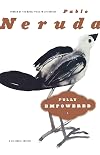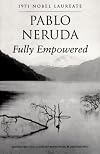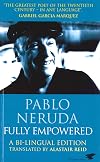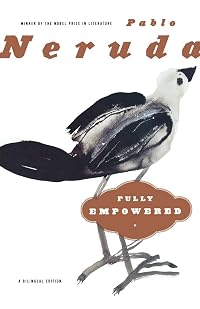
Fully Empowered
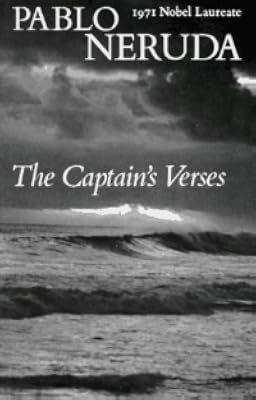
by Pablo Neruda
On This Page
Description
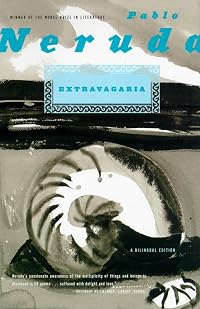
An important collection that includes some of the Nobel Prize winner's own favorite poems.Tags
Recommendations










Member Reviews
A good quick read; it's always refreshing to dip into some of Pablo Neruda's poetry from time to time. His poems achieve that rare balance of being both multi-layered and yet simple, and so they are appropriate regardless of whether you want to relax or be challenged. They are accessible to all, as befitting Neruda's status as a champion of the common people. Indeed, Fully Empowered contains perhaps his greatest commentary on the working man, 'The People'.
The Poet’s Obligation.
To whoever is not listening to the sea
this Friday morning, to whoever is cooped up
in house or office, factory or woman
or street or mine or dry prison cell,
to him I come, and without speaking or looking
I arrive and open the door of his prison,
and a vibration starts up, vague and insistent,
a long rumble of thunder adds itself
to the weight of the planet and the foam,
the groaning rivers of the ocean rise,
the star vibrates quickly in its corona
and the sea beats, dies, and goes on beating.
Excerpt from The Poets obligation
Pablo Neruda (July 12, 1904 – September 23, 1973) was the pen name and later, legal name of the Chilean poet and politician Neftalí Ricardo Reyes Basoalto. He chose his pen name after show more the Czech poet Jan Neruda, as the young poet wanted to find a name that would mislead his father, who was against his son’s interest in writing and literature. Years later, Pablo Neruda in recognition of the great Czech poet, left a flower at the foot of his statue in Prague. Pablo is thought to be from Paul Verlaine. (wikipedia)
“Fully Empowered" is an outstanding volume of poetry by Pablo Neruda. The book was translated into English in 1975, and is a bilingual edition, with the Spanish originals and English versions on facing pages. It was first published in 1962 (Spanish) and Neruda considered it one of his favourites, specifically asking for his finest translator, Alastair Reed to translate it into English. Neruda’s love for this collection of his poetry, was partly due to the fact that it grew from a period he considered really fruitful, and that it represented the diversity of his poetic style.
Through images, both public and private, he wrote with passion of the role of the poet in society, of how poetry was not some esoteric elitist word-game, that it should be the life blood of any nation, exalting the very basis of existence with an intense, personal, and childlike love.
So through me, freedom and the sea show less
To whoever is not listening to the sea
this Friday morning, to whoever is cooped up
in house or office, factory or woman
or street or mine or dry prison cell,
to him I come, and without speaking or looking
I arrive and open the door of his prison,
and a vibration starts up, vague and insistent,
a long rumble of thunder adds itself
to the weight of the planet and the foam,
the groaning rivers of the ocean rise,
the star vibrates quickly in its corona
and the sea beats, dies, and goes on beating.
Excerpt from The Poets obligation
Pablo Neruda (July 12, 1904 – September 23, 1973) was the pen name and later, legal name of the Chilean poet and politician Neftalí Ricardo Reyes Basoalto. He chose his pen name after show more the Czech poet Jan Neruda, as the young poet wanted to find a name that would mislead his father, who was against his son’s interest in writing and literature. Years later, Pablo Neruda in recognition of the great Czech poet, left a flower at the foot of his statue in Prague. Pablo is thought to be from Paul Verlaine. (wikipedia)
“Fully Empowered" is an outstanding volume of poetry by Pablo Neruda. The book was translated into English in 1975, and is a bilingual edition, with the Spanish originals and English versions on facing pages. It was first published in 1962 (Spanish) and Neruda considered it one of his favourites, specifically asking for his finest translator, Alastair Reed to translate it into English. Neruda’s love for this collection of his poetry, was partly due to the fact that it grew from a period he considered really fruitful, and that it represented the diversity of his poetic style.
Through images, both public and private, he wrote with passion of the role of the poet in society, of how poetry was not some esoteric elitist word-game, that it should be the life blood of any nation, exalting the very basis of existence with an intense, personal, and childlike love.
So through me, freedom and the sea show less
Escrito en los inicios de la etapa final de amplia madurez poetica nerudiana, Plenos Poderes se nos presenta a la vez como una sintesis del amplio registro de temas y maneras de su obra realizada hasta entonces y como un esbozo extremadamente revelador de los rasgos peculiares, con frecuencia de singularisima novedad que se incorporarian a la diccion del poeta en los anhos posteriores.
"Y así, por mí, la libertad y el mar
responderán al corazón oscuro."
responderán al corazón oscuro."
PO-5
Aug 3, 2020Catalan
Ratings
Members
- Recently Added By
Lists

Harold Bloom - The Western Canon: D. The Chaotic Age
833 works; 24 members

Poetry volumes by single author
121 works; 8 members
Author Information

653+ Works 25,997 Members
Pablo Neruda was born Ricardo Eliecer Neftalí Reyes Basoalto in Ferral, Chile on July 12, 1904. In 1923 he sold all of his possessions to finance the publication of his first book, Crepusculario (Twilight), which he published under the pseudonym Pablo Neruda. Veinte Poemas de Amor y una Cancion Desesperada (Twenty Love Poems and a Song of show more Despair), which was published the following year, made him a celebrity and allowed him to stop his studies to devote himself to poetry. His other works include España en el Corazón, Canto General, Las Uvas y el Viento, and Para Nacer He Nacido. He received numerous awards including the World Peace Prize with Paul Robeson and Pablo Picasso in 1950, the Lenin Peace Prize and the Stalin Peace Prize in 1953, and the Nobel Prize for Literature for his poetry in 1971. He died of leukemia on September 23, 1973. (Bowker Author Biography) show less
Some Editions
Work Relationships
Has as a student's study guide
Common Knowledge
- Canonical title
- Fully Empowered
- Original publication date
- 1962
Classifications
Statistics
- Members
- 275
- Popularity
- 117,595
- Reviews
- 5
- Rating
- (4.22)
- Languages
- English, Korean, Portuguese, Spanish
- Media
- Paper
- ISBNs
- 11
- ASINs
- 5