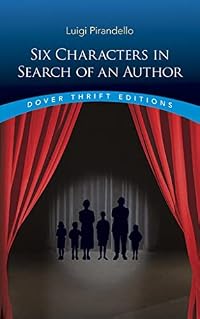
Six Characters in Search of an Author
by Luigi Pirandello
On This Page
Description
6 people arrive in a theatre during rehearsals for a play. They are the characters of a play that has not yet been written. Trapped inside a traumatic event from which they long to escape, they desperately need a writer to complete their story and release them. Intrigued by their situation, the director and his company of actors listen as the characters begin to describe and argue over the key events of their lives.Tags
Recommendations

Member Recommendations
Member Reviews
If you want a sure thing in the quest to discover your self, you could spend the next ten years in analysis, see a psychologist, join a cult, read every book of philosophy and physics or you can read Luigi Pirandello’s Six Characters in Search of an Author. I jest. But, this is about the illusory nature of theatre, more than the individual self. But still... We could wonder more about who we are by the end of it.
The forgotten modernist text that came out in that recent centenary of greats around 1922 (1921 in this case), the title sounds as good in translation as it does in the original. Clever of Pirandello to achieve that.
Plays often don’t work on the page, you miss all the staging. But in this case, the staging acts like text so show more you can read the extensive stage directions like you might read landscape details or even character descriptions. Again, pretty clever of Pirandello to make his work so usable.
What goes on here? Well, a theatre company is about to rehearse a play by Luigi Pirandello. They are gathering, the lead actress is late as one might expect, the stage is unfinished, stuff is kind of lying around, the lights aren’t set up right.
They are about to start and then, six characters come by. This is a big production. There’s half a dozen ‘actors’, producer, stage managers, prompters etc, so on stage at any one time there is usually around 15 people. Pirandello should know better, but you have to keep you budget down and think small cast. But, it’s not a play, it’s a “real” event we are watching, the play hasn’t started yet… the details haven’t been written, it’s all emerging.
These characters start telling everyone about their lives, only they are short on detail and big on passionate expression. So they come across as so ‘real’ that the producer abandons rehearsals and starts listening to the characters and thinks this would make a great play. At one level, the characters represent the stock in trade types, father, mother, son, daughter in law etc from which a family drama might be explored.
The producer and the characters go off and start to write and rehearse this new play. The producer becomes their author in a sense. They are raw, undetailed. They wear representative masks, they are not yet well drawn characters, or even selves. They think they are real and credible, based on their endless emotional outpourings. This makes me think I am reading at times a novel by Rachel Cusk and after reading this, I in fact read her recent book Second Place (funnily enough published 100 years after Six Characters, though unintentionally I suspect).
Pirandello loves to toy with illusions, the stage is not a stage, the actors are meagre performers, the only real is the unformed self, or the present embodiment of the self as it speaks in front of the audience, or perhaps the person speaking to you in the street is the only real we can experience, or what they say is the only thing we can know.
Best to read it, but there are no endings in the search. Oddly, as a Sicilian, Pirandello didn’t get much exposure in his native land for his theatre. show less
The forgotten modernist text that came out in that recent centenary of greats around 1922 (1921 in this case), the title sounds as good in translation as it does in the original. Clever of Pirandello to achieve that.
Plays often don’t work on the page, you miss all the staging. But in this case, the staging acts like text so show more you can read the extensive stage directions like you might read landscape details or even character descriptions. Again, pretty clever of Pirandello to make his work so usable.
What goes on here? Well, a theatre company is about to rehearse a play by Luigi Pirandello. They are gathering, the lead actress is late as one might expect, the stage is unfinished, stuff is kind of lying around, the lights aren’t set up right.
They are about to start and then, six characters come by. This is a big production. There’s half a dozen ‘actors’, producer, stage managers, prompters etc, so on stage at any one time there is usually around 15 people. Pirandello should know better, but you have to keep you budget down and think small cast. But, it’s not a play, it’s a “real” event we are watching, the play hasn’t started yet… the details haven’t been written, it’s all emerging.
These characters start telling everyone about their lives, only they are short on detail and big on passionate expression. So they come across as so ‘real’ that the producer abandons rehearsals and starts listening to the characters and thinks this would make a great play. At one level, the characters represent the stock in trade types, father, mother, son, daughter in law etc from which a family drama might be explored.
The producer and the characters go off and start to write and rehearse this new play. The producer becomes their author in a sense. They are raw, undetailed. They wear representative masks, they are not yet well drawn characters, or even selves. They think they are real and credible, based on their endless emotional outpourings. This makes me think I am reading at times a novel by Rachel Cusk and after reading this, I in fact read her recent book Second Place (funnily enough published 100 years after Six Characters, though unintentionally I suspect).
Pirandello loves to toy with illusions, the stage is not a stage, the actors are meagre performers, the only real is the unformed self, or the present embodiment of the self as it speaks in front of the audience, or perhaps the person speaking to you in the street is the only real we can experience, or what they say is the only thing we can know.
Best to read it, but there are no endings in the search. Oddly, as a Sicilian, Pirandello didn’t get much exposure in his native land for his theatre. show less
قبل از هر چیز اگه اثر دیگهای چه فیلم، چه نمایشنامه و چه رمان و داستان کوتاه سراغ دارید که شخصیت فردیت پیدا میکنه و از اثر خارج میشه، بهم معرفی کنید خیلی متشکرتون میشم.
من همیشه از نمایشهای و داستانهایی که به شخصیتها فردیت میبخشند و رودرروی خالق خودشون قرارشون میدن خوشم میاومده و این نمایشنامه هم از این قاعده مستثنی نیست... جالبتر اینکه این مؤلفه تو آثار پست مدرن بسیار به کار میره و show more پیراندللو این نمایشنامه رو سال ۱۹۲۱ نوشته.
این نمایشنامه همچنین یکی از اولین و بهترین نمایشنامههای گروتسکه یکی از مؤلفههاش کنار هم گذاشتن حزن و خندهست... و پیراندللو خیلی خوب فضای کمدی رو براتون ایجاد میکنه و به محض اینکه میخواید از این احساس کمدی سرخوش بشید شما رو با یه احساس گناه از این حس سرخوشی مواجه میکنه. show less
من همیشه از نمایشهای و داستانهایی که به شخصیتها فردیت میبخشند و رودرروی خالق خودشون قرارشون میدن خوشم میاومده و این نمایشنامه هم از این قاعده مستثنی نیست... جالبتر اینکه این مؤلفه تو آثار پست مدرن بسیار به کار میره و show more پیراندللو این نمایشنامه رو سال ۱۹۲۱ نوشته.
این نمایشنامه همچنین یکی از اولین و بهترین نمایشنامههای گروتسکه یکی از مؤلفههاش کنار هم گذاشتن حزن و خندهست... و پیراندللو خیلی خوب فضای کمدی رو براتون ایجاد میکنه و به محض اینکه میخواید از این احساس کمدی سرخوش بشید شما رو با یه احساس گناه از این حس سرخوشی مواجه میکنه. show less
Oh, this play is great. What a fucking thing it is. It's about how we create our own realities: how each of us choose to play a character, to such an extent that we sometimes sit outside ourselves, watching our characters act out their scenes. And it's about the subjective nature of reality: how to each of us, the scenes we live through may be be completely different to each actor in them.
I was talking to a friend recently about the beginning of our relationship, and discovered that her perception of that period has almost nothing in common with mine. If we both explained it to a third party, we would tell wholly different stories. Weird, huh? Both of our stories are equally true; they're just different.
Recently, in an unguarded moment, show more a different friend of mine let slip who he thinks I am. It was not at all who I think I am! Among other things, his version of me - inexplicably - is not a Viking. I'm pretty sure he was projecting there, but how would I know? Is there anyone less qualified to interpret me than me?
This is what Pirandello's dealing with, at least until Act III when he starts to talk about the writing process and also to wrap up his own plot. It's a very smart play, and years ahead of its time. My character enjoys it. A character under that thinks it's a little show-offy. A character under that is scared that he didn't get it at all, and a character under that is afraid that his opinion hasn't even been written. show less
I was talking to a friend recently about the beginning of our relationship, and discovered that her perception of that period has almost nothing in common with mine. If we both explained it to a third party, we would tell wholly different stories. Weird, huh? Both of our stories are equally true; they're just different.
Recently, in an unguarded moment, show more a different friend of mine let slip who he thinks I am. It was not at all who I think I am! Among other things, his version of me - inexplicably - is not a Viking. I'm pretty sure he was projecting there, but how would I know? Is there anyone less qualified to interpret me than me?
This is what Pirandello's dealing with, at least until Act III when he starts to talk about the writing process and also to wrap up his own plot. It's a very smart play, and years ahead of its time. My character enjoys it. A character under that thinks it's a little show-offy. A character under that is scared that he didn't get it at all, and a character under that is afraid that his opinion hasn't even been written. show less
“Six Characters in Search of an Author” is an absurdist metaplay that deals with the nature of reality and illusion. While a theater company is rehearsing “Mixing It Up” by Pirandello, a family of six characters arrive in search of an author. They insist that the Manager write their story. The characters have quite a melodramatic tale to tell, and the Manager, eventually intrigued, asks the actors to observe and the Prompter to take it down in shorthand while the characters reenact their story. What I liked best were the sarcastic and self-referential lines rather than the more philosophical themes. Examples of the latter:
Examples of the former:
and especially, near the beginning, which serves as both a good introduction and a neat summary:
Pirandello won the Nobel Prize in Literature in 1934 "for his bold and ingenious revival of dramatic and scenic art.” It is probably worth noting that he donated his Nobel Prize medal to the Italian Fascist government to be melted down as part of the 1935 Gold to the Fatherland campaign to raise funds in face of League of Nations sanctions. show less
The Father: “And how can we ever come to an understanding if I put in the words I utter the sense andshow more
value of things as I see them; while you who listen to me must inevitably translate them according to the conception of things each one of you has within himself. We think we understand each other, but we never really do.”
The Father: “A character, sir, may always ask a man who he is. Because a character has really a life of his own, marked with his especial characteristics; for which reason he is always ‘somebody.’ But a man—I’m not speaking of you now—may very well be ‘nobody.’”
Examples of the former:
The Manager: “Oh for God's sake, will you at least finish with this philosophizing and let us try and shape this comedy which you yourself have brought me here? You argue and philosophize a bit too much, my dear sir…”
The Step-Daughter: “In my opinion he [their original author] abandoned us in a fit of depression, of disgust for the ordinary theatre as the public knows it and likes it.”
and especially, near the beginning, which serves as both a good introduction and a neat summary:
The Manager: “Ridiculous? Ridiculous? Is it my fault if France won’t send us any more good comedies, and we are reduced to putting on Pirandello’s works, where nobody understands anything, and where the author plays the fool with us all?”
Pirandello won the Nobel Prize in Literature in 1934 "for his bold and ingenious revival of dramatic and scenic art.” It is probably worth noting that he donated his Nobel Prize medal to the Italian Fascist government to be melted down as part of the 1935 Gold to the Fatherland campaign to raise funds in face of League of Nations sanctions. show less
They say I was born in June. The day, the year somehow ceases to exist. I live with my mother. She stares at the wall, singing songs unnoticing my existence in the house. Is this how being an orphan feels like? I used to work at Madame Pace’s dress shop. Only it wasn't a dress shop. It was a whore house where I used to entertain clients throughout the night. My mother was unaware of my earnings, but as if it mattered. Then, one day I fell in love. In fact, I fell in love with his eyes. The same brown affectionate eyes that I own. They were so memorable, they were mine. I could see myself in them. My eyes on this strange face, mesmerizing yet daunting. He was my client, elderly yet so affectionate. Months went by, but he never visited show more me again. I looked for him but no avail. They say, he shot himself out of guilt. He was my biological father. The shame of seducing his own blood ate him up after finding my truth. So, as I lay in a pool of blood, the cold metal burning against my sinful hands, I pierce the sharp edge into the warm blob of flesh. I killed my baby. I killed my brother. I practically cease to exist now. Shame and numbness has weighed my soul into nothingness. The man once my mother had left my father for took her away. So, here I come to you with an unfilled life and an unfinished story pleading you to bring an authored conclusion.
“You imbecile”, yelled the stage-manager. “You expect me to believe this garbage and let my actors perform your absurdity".
“Yes”, I affirm, “The settings should be realistic and the truth should be told in its unaltered form.”
“I am an unrealized character sir”, I humbly say, “I need you to finish my story and bring it to life”.
The stage manager now enraged walks away hurling obscenities and muttering, “Acting is our business here. Truth up to a certain point, but no further”; as he looks at me with a sardonic smile.
Pirandello illuminates the ‘Theatre of Absurd’ genre in this bizarre performance. A form of drama that emphasizes the absurdity of human existence by employing disjointed, repetitious and meaningless dialogue, purposeless and confusing situations and plots that lack realistic or logical development. Purely in its theatrical form he depicts a tale of six characters in search of an author who is able not only to complete their fragmentary story but to perform their ingenuous legitimacy. A story which is not a story after all. Through the numerous arguments between the six characters and the stage manager about portrayal of reality in its unaltered state to the audiences marks the debate of life reality v/s stage reality. The sense of illusion what is illustrated to be a reality on performance stage is far from the factual forms.
The plethora of reality television that demarcates an entire generation outlook mutates the genuineness of its characters. How real are the nuances of these actors who state publicly that their respected shows are not scripted but spontaneous? The movies that state ‘based on a true story’, how far do they enact the truth or is pragmatism edited to normalization of absurdity. Pirandello stresses on the theatre being an illusion of reality where actors masquerade real emotions through rehearsals and mutability.
A brilliant existentialism perception of individuals being characters all through their life portraying roles that they're born into and the normality of emotions attached to their specific roles. Who are we? The roles that we are born into or the tangible roles we want to play. show less
“You imbecile”, yelled the stage-manager. “You expect me to believe this garbage and let my actors perform your absurdity".
“Yes”, I affirm, “The settings should be realistic and the truth should be told in its unaltered form.”
“I am an unrealized character sir”, I humbly say, “I need you to finish my story and bring it to life”.
The stage manager now enraged walks away hurling obscenities and muttering, “Acting is our business here. Truth up to a certain point, but no further”; as he looks at me with a sardonic smile.
Pirandello illuminates the ‘Theatre of Absurd’ genre in this bizarre performance. A form of drama that emphasizes the absurdity of human existence by employing disjointed, repetitious and meaningless dialogue, purposeless and confusing situations and plots that lack realistic or logical development. Purely in its theatrical form he depicts a tale of six characters in search of an author who is able not only to complete their fragmentary story but to perform their ingenuous legitimacy. A story which is not a story after all. Through the numerous arguments between the six characters and the stage manager about portrayal of reality in its unaltered state to the audiences marks the debate of life reality v/s stage reality. The sense of illusion what is illustrated to be a reality on performance stage is far from the factual forms.
The plethora of reality television that demarcates an entire generation outlook mutates the genuineness of its characters. How real are the nuances of these actors who state publicly that their respected shows are not scripted but spontaneous? The movies that state ‘based on a true story’, how far do they enact the truth or is pragmatism edited to normalization of absurdity. Pirandello stresses on the theatre being an illusion of reality where actors masquerade real emotions through rehearsals and mutability.
A brilliant existentialism perception of individuals being characters all through their life portraying roles that they're born into and the normality of emotions attached to their specific roles. Who are we? The roles that we are born into or the tangible roles we want to play. show less
I don't normally enjoy reading plays. It is like reading music notes on page instead of listening to the orchestra, or reading about perfume instead smelling the scent. I would much rather watch the play than read it. But I picked this one up because of the author and found myself enraptured by the concept.
As a part of inspiration for Waiting for Godot and other existentialism plays, this play focuses on six characters in search of an author - and their drive to make their lives into some semblance of reality.
I loved this. It was a mix of philosophy and contemplating the meaning of life, all the while breaking the fourth wall, naming the author by name, and asking whether we are all actors in a play.
This is one of my more favorited show more quotes.
The Father [with dignity, but not offended ]. A character, sir, may always ask a man who he is. Because a character has really a life of his own, marked with his especial characteristics; for which reason he is always "somebody." But a man – I'm not speaking of you now – may very well be " nobody.
Characters who have come to life, yet have no author to claim them, ask the actors whether they are playing at an illusion when they try to imitate the characters. And it is ironic because they actually do have an author.
There is just so much packed into 70 short pages.
4.5 stars. Quite lovely. show less
As a part of inspiration for Waiting for Godot and other existentialism plays, this play focuses on six characters in search of an author - and their drive to make their lives into some semblance of reality.
I loved this. It was a mix of philosophy and contemplating the meaning of life, all the while breaking the fourth wall, naming the author by name, and asking whether we are all actors in a play.
This is one of my more favorited show more quotes.
The Father [with dignity, but not offended ]. A character, sir, may always ask a man who he is. Because a character has really a life of his own, marked with his especial characteristics; for which reason he is always "somebody." But a man – I'm not speaking of you now – may very well be " nobody.
Characters who have come to life, yet have no author to claim them, ask the actors whether they are playing at an illusion when they try to imitate the characters. And it is ironic because they actually do have an author.
There is just so much packed into 70 short pages.
4.5 stars. Quite lovely. show less
Luigi Pirandello proves himself quite the character in this staged drama. It feels like the lunatics are running the asylum; more demonstrative than Shakespeare's play within a play; this is no longer breaking edgy stuff, but a good play on play on words . . . and the band played on. More than a couple of notable quotable lines in this short work, which retain relevance, as in "Life is full of strange absurdities, which, strangely enough, do not even need to appear plausible, since they are true." Welcome to our current world stage. Also good point on characters taking on lives of their own that outlast the author - think Peanuts' characters. Or feeling entitled to being indignant when an author kills off our favorite character in an show more unsatisfactory way. But in this astute absurdity, the characters are adrift, for anyone who's ever felt like they don't belong in this world. show less
Members
- Recently Added By
Lists

Plays I Like
230 works; 31 members

Books as Objects & Metatextual Works
31 works; 2 members

Next Plays / 2025
352 works; 1 member
My Play Collection
769 works; 3 members

Recommended Reading : 600 Classics Reviewed, Editors of Salem Press, 2015
634 works; 6 members

Philip Ward's Lifetime Reading Plan
592 works; 22 members
1:28 p.m.'s 350 Stage Plays Challenge
94 works; 3 members
r/acting on Reddit - Essential Plays
44 works; 2 members

1920s
141 works; 6 members

Experimental Literature
141 works; 18 members

Books Read in 2017
4,248 works; 130 members

Favourite Books
1,817 works; 308 members

Modernism
140 works; 8 members

Books With Numbers in the Title
308 works; 13 members
Overdue Podcast
800 works; 9 members

Italian Literature
556 works; 41 members

Literature in Translation
113 works; 5 members

Nobel Price Winners
222 works; 20 members

Western World's Greatest Books - Project Gutenberg
295 works; 15 members
Favourite Theatre of the Absurd
30 works; 4 members

Literary Works Read in College
316 works; 15 members

Speculative Fiction: Slipstream Literature
166 works; 16 members
In and About the 1920s
181 works; 31 members

Books Read in 2012
815 works; 34 members

New York Public Library's Books of the Century - All
170 works; 13 members
Le Monde - Les 100 livres du siècle
121 works; 23 members
New York Public Library's Books of the Century
120 works; 20 members

20th Century Literature
1,161 works; 55 members

Metafiction
84 works; 21 members

100 knjiga
100 works; 1 member
Author Information

Born in Sicily, Pirandello attended the universities of Palermo, Rome, and Bonn. He obtained his doctorate in philology with a thesis on the dialect of his native town, Agrigento before settling in Rome to teach and write. In 1894, he married a Sicilian girl, Antonietta Portulano, who bore him three children before she went mad and afterwards show more provided the inspiration for many of his stories and plays. In all, Pirandello wrote 6 novels, some 250 short stories, and about 50 plays. It was a novel, Il fu Mattia Pascal (1904), that first brought him fame. Only in 1920, when he was past 50, did he turn seriously to playwriting. His first stage success had been a comedy, Liola (1917), written in the Agrigento dialect. It took its theme, if not its mood, from the Mandragola of Machiavelli (see Vols. 3 and 4). In 1921, Pirandello presented his most famous play Six Characters in Search of an Author. Here he seeks to confuse his spectators, who are forced into a paradox of reality and illusion when six "characters" search out the actors of a theatrical troupe to play out their inexorable story. The play exemplifies the Pirandellian conflict between art, which is unchanging and constant, and life, which is a continuous succession of mutations. Pirandello deliberately destroyed the traditional boundaries between audience and spectacle, reflecting the relativity and subjectivity of human existence. The play's unconventional format, which resulted in a riot, established Pirandello as Europe's leading avant-garde dramatist. The main body of Pirandello's plays falls into three overlapping categories, the first exploring the nature of the theater, the second the complexities of personality in the etymological or dramatic sense of the term, and the third rising to dramatic representation of the categorical imperatives of social, religious, and artistic community. Besides the world-famous Six Characters in Search of an Author (1918), his best plays in the three categories include Each in His Own Way (1924), It Is So (If You Think So) (1917), Henry IV (1922), The New Colony (1925), Lazarus, As You Desire Me (1930), and The Mountain Giants (1937), written after he had been awarded the Nobel Prize in 1934 and left incomplete. Pirandello is the forerunner of much modern theater and literature; among the figures who owe their roots to the innovations of Pirandello are Bertolt Brecht, Jean Genet, Jean-Paul Sartre, and Samuel Beckett (see Vol. 1). (Bowker Author Biography) show less
Some Editions
Awards and Honors
Awards
Notable Lists
Series
Belongs to Publisher Series
Work Relationships
Is contained in
Six Characters in Search of an Author and Other Plays (Twentieth Century Classics) by Luigi Pirandello
Has the adaptation
Has as a reference guide/companion
Has as a student's study guide
Common Knowledge
- Canonical title
- Six Characters in Search of an Author
- Original title
- Sei personaggi in cerca d'autore
- Original publication date
- 1921
- Related movies
- Six Characters in Search of an Author (1976 | IMDb); Six Characters in Search of an Author (1992 | IMDb)
- First words
- When the audience arrives in the theater, the curtain is raised; and the stage, as normally in the daytime, is without wings or scenery and almost completely dark and empty.
- Last words
- (Click to show. Warning: May contain spoilers.)I am not reasoning, I am crying aloud the why and wherefore of my suffering.
- Original language
- Italian
Classifications
Statistics
- Members
- 1,642
- Popularity
- 13,563
- Reviews
- 38
- Rating
- (3.76)
- Languages
- 17 — Catalan, Chinese, Czech, Danish, Dutch, English, French, German, Greek, Italian, Norwegian (Bokmål), Norwegian, Farsi/Persian, Portuguese, Romanian, Russian, Spanish
- Media
- Paper, Audiobook, Ebook
- ISBNs
- 132
- UPCs
- 3
- ASINs
- 43