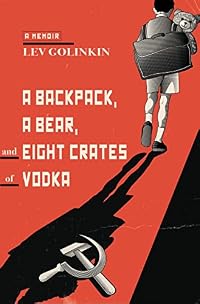
A Backpack, a Bear, and Eight Crates of Vodka: A Memoir
by Lev Golinkin
On This Page
Description
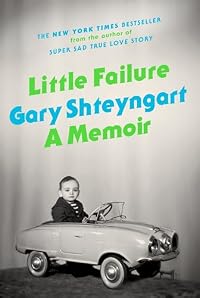
A compelling story of two intertwined journeys: a Jewish refugee family fleeing persecution and a young man seeking to reclaim a shattered pastIn the twilight of the Cold War, nine-year-old Lev Golinkin and his family cross the Soviet border with only ten suitcases, $600, and the vague promise of help awaiting in Vienna. Years later, Lev, now an American adult, sets out to retrace his family's long trek, locate the strangers who fought for his freedom, and in the process, gain a future by show more understanding his past.Lev Golinkin's memoir is the vivid, darkly comic, and poignant story of a young boy in the confusing and often chilling final decade of the Soviet Union. It's also the story of Lev Golinkin, the American man who finally confronts his buried past by returning to Austria and Eastern Europe to track down the strangers who made his escape possible ... and thank them. Written with biting, acerbic wit and emotional honesty in the vein of Gary Shteyngart, Jonathan Safran Foer, and David Bezmozgis, Golinkin's search for personal identity set against the relentless currents of history is more than a memoir: it's a portrait of a lost era. This is a thrilling tale of escape and survival, a deeply personal look at the life of a Jewish child caught in the last gasp of the Soviet Union, and a provocative investigation into the power of hatred and the search for belonging. Lev Golinkin achieves an amazing feat—and it marks the debut of a fiercely intelligent, defiant, and unforgettable new voice.. show less
Tags
Recommendations






































Member Reviews
I thought I knew a lot about emigration, myself being an emigre. But this book opened my eyes, to a previously unknown degree, on a particular group of immigrants, Soviet Jews. For them, the process to leave the Soviet Union was an excruciating one, and all this through the eyes of a 10-year-old, who then grew up and re-lived it in this book. I have some very good Jewish friends from that era, and they did hint on the difficulties in their life prior to emigration and the longing to emigrate, but this book makes it so poignant and raw, maybe especially so - as it is through the eyes of an innocent child.
1970-80s had these waves of possibilities for the Soviet Jews to emigrate, at every step of the process constantly made frustrating by show more the regime: give them hope, then snatch it away. Gorbachev's era made it more possible, and that's when the real exodus started. Golinkin family emigrated from Kharkov, Ukraine (then still the Soviet Union) in 1989-1990 winter, through the usual channels in Europe, on to America. The Jewish identity was so painful in the U.S.S.R. that they were all longing to get to a place where that identity (unlike in Israel) was to a minimum - that's one of the major reasons most Jews chose America, they "needed to cast off a stigma". Which lead, of course, to being misunderstood by American Jews (who shouldered the price of the emigration for them) as to why such irreligiousness in the newcomers...
The actual passing of the border, into Eastern Europe at first, the horribly shocking treatment by the border guards, will give you goose bumps. Then, the uncertainty, without any documents, not even birth certificates or passports (those were burned at the border!) was even more crushing. The language barrier, preventing the older generation from succeeding in the new land - all for the sake of the youngsters, to give them the new life. All these trials - all for the sake of normal life, what we take for granted.
And how about this meaningful passage about the impractical but stubborn decision to carry a tea service through all the borders on the way to America (yet I can totally relate to that): "Everyone in Russia, regardless of ethnicity or income, owned a tea service. Tea was mandatory; tea was a common denominator. From Siberia to Uzbekistan, no matter who came to your door or when they arrived, they were always offered a cup. A tea service was more than a set of cups and saucers: it represented a meal, which represented a home, which represented a life. As impractical as they were, those faded green teacups held the hope of once again having friends and entertaining guests..."
Giving this book a 5-star rating, I don't think I am biased in favor of it - just because it's about my former corner of the world. It's just plain good writing. The last few pages are especially striking. My only regret is that the author calls his former country "the Ukraine" while it's simply "Ukraine". But it's just a technicality.... However, on a lighter note, kudos to the author for once and for all stating that the word "babushka" means an "elderly woman" and not a "kerchief" or a "scarf", as so many in the west are lead to believe. show less
1970-80s had these waves of possibilities for the Soviet Jews to emigrate, at every step of the process constantly made frustrating by show more the regime: give them hope, then snatch it away. Gorbachev's era made it more possible, and that's when the real exodus started. Golinkin family emigrated from Kharkov, Ukraine (then still the Soviet Union) in 1989-1990 winter, through the usual channels in Europe, on to America. The Jewish identity was so painful in the U.S.S.R. that they were all longing to get to a place where that identity (unlike in Israel) was to a minimum - that's one of the major reasons most Jews chose America, they "needed to cast off a stigma". Which lead, of course, to being misunderstood by American Jews (who shouldered the price of the emigration for them) as to why such irreligiousness in the newcomers...
The actual passing of the border, into Eastern Europe at first, the horribly shocking treatment by the border guards, will give you goose bumps. Then, the uncertainty, without any documents, not even birth certificates or passports (those were burned at the border!) was even more crushing. The language barrier, preventing the older generation from succeeding in the new land - all for the sake of the youngsters, to give them the new life. All these trials - all for the sake of normal life, what we take for granted.
And how about this meaningful passage about the impractical but stubborn decision to carry a tea service through all the borders on the way to America (yet I can totally relate to that): "Everyone in Russia, regardless of ethnicity or income, owned a tea service. Tea was mandatory; tea was a common denominator. From Siberia to Uzbekistan, no matter who came to your door or when they arrived, they were always offered a cup. A tea service was more than a set of cups and saucers: it represented a meal, which represented a home, which represented a life. As impractical as they were, those faded green teacups held the hope of once again having friends and entertaining guests..."
Giving this book a 5-star rating, I don't think I am biased in favor of it - just because it's about my former corner of the world. It's just plain good writing. The last few pages are especially striking. My only regret is that the author calls his former country "the Ukraine" while it's simply "Ukraine". But it's just a technicality.... However, on a lighter note, kudos to the author for once and for all stating that the word "babushka" means an "elderly woman" and not a "kerchief" or a "scarf", as so many in the west are lead to believe. show less
A well-written and oft humorous account by Lev Golinkin about his family's indirect emigration to the US as Soviet Jews as well as his personal struggle with identity. While the context of this story is a disintegrating Soviet Union and the Golinkin family's departure from the Ukraine, the challenges of being, processing, and supporting refugees from any land are as relevant today. The author does a great job of conveying what feels like a free fall at times, once the decision to leave is made and the bouncing around that happens before landing in a place where one can try to take root again. In forging a new identity in a new place, there's worry -- maybe more so in the young -- how much of the last place you share in new environs, show more lest ye be judged. show less
Memoir of a young Lev Golinkin, Ukranian Jewish living under the Soviet regime's waning Cold War era (late 1980s). His father, an experienced & industrious engineer, his mother a respected pyschiatrist, his grandmother who barely escaped the Nazis in WWII, and his older sister Lina, studious & determined to get a good university education- all wonderfully described through the lens of 10 yr. old Lev. All of his family determine to get OUT when Gorbachev's reforms included relaxing the almost nonexistent emigration exit visa policies. By December 1989, that is exactly what they do - through the dangers of the Ukranian landscape to the Czech border to face the border/customs office (tamozhnya) and the insrutable, cruel tamozhnik - border show more guards known for their malicious destruction and searches of emigrants' belongings before they let them through. (Thus the crates of vodka in the title - bribes as the bus moved the emigres from Kharkov to the border).
Divided into parts, the first part gives us Lev's childhood and leaving Kharkov, and his family's enormous efforts to leave their country behind forever. Part II documents the subsequent moving from one hostel to another, ending in a village hours from Vienna, Austria, all arranged by the American Jewish Joint Distribution Committee and HIAS, Hebrew Immigrant Aid Society. Lev describes his family's experience with his fellow emigrants, the aid workers, & most especially the somewhat mysterious Austrian baron Peter, who routinely shows up at their refugee hotel & haggles with Russian emigres who had the connections/forethought to smuggle out expensive or impressive collectibles from the closed Soviet Union. Wonderful use of dialogue, description, & rich in emotional range: sometimes ludricous events told with wry humor, sometimes Lev's achingly miserable memories of his early years told with unflinching prose. Part III begins to shift more to the adult Lev, now finishing at Boston College, and slowly, painstakingly, coming to grips with his lifelong practice of keeping everyone at a distance, trying to forget Kharkov, their flight through Europe and their first years in the U.S. (watched over by refugee sponsors who voluteered to help the Golinkins in every way possible) including a house to live in West Lafayette, Indiana. When his father relocates them to New Jersey to accept -finally!- an engineering job- Lev is determined to forget that he is a Jew, that he was from the Soviet Union, that he had a past before New Jersey. But his inability to consider his future after school ends forces him to an existential crisis: who am I really? why do I continually "run" from deeper relationships? why was his life so empty deep down? An astute professor/advisor insists he must have a foundation - he must investigate his past- and then Lev also shares some of the meetings & discoveries he made while doing just that with the aid workers, with Peter, with others who so generously helped his family 17 years earlier.
Written in chapter format that felt like stand alone pieces -maybe originally submitted to a magazine?- this could be an excellent memoir for mature high school readers, but its back & forth in time treatment, its inclusion of political details & Jewish culture/religion, and its serious crisis point for the grown up Lev might be a challenge; also 303 pages long. Adult readers: While this played out for Lev in the era of glasnost, then through 1990s-early 2000s, the insights it affords us about what it is really like to be a refugee/emigre to America is heartrending & eye opening. A very timely book in the recent heated political climate about immigration in America. show less
Divided into parts, the first part gives us Lev's childhood and leaving Kharkov, and his family's enormous efforts to leave their country behind forever. Part II documents the subsequent moving from one hostel to another, ending in a village hours from Vienna, Austria, all arranged by the American Jewish Joint Distribution Committee and HIAS, Hebrew Immigrant Aid Society. Lev describes his family's experience with his fellow emigrants, the aid workers, & most especially the somewhat mysterious Austrian baron Peter, who routinely shows up at their refugee hotel & haggles with Russian emigres who had the connections/forethought to smuggle out expensive or impressive collectibles from the closed Soviet Union. Wonderful use of dialogue, description, & rich in emotional range: sometimes ludricous events told with wry humor, sometimes Lev's achingly miserable memories of his early years told with unflinching prose. Part III begins to shift more to the adult Lev, now finishing at Boston College, and slowly, painstakingly, coming to grips with his lifelong practice of keeping everyone at a distance, trying to forget Kharkov, their flight through Europe and their first years in the U.S. (watched over by refugee sponsors who voluteered to help the Golinkins in every way possible) including a house to live in West Lafayette, Indiana. When his father relocates them to New Jersey to accept -finally!- an engineering job- Lev is determined to forget that he is a Jew, that he was from the Soviet Union, that he had a past before New Jersey. But his inability to consider his future after school ends forces him to an existential crisis: who am I really? why do I continually "run" from deeper relationships? why was his life so empty deep down? An astute professor/advisor insists he must have a foundation - he must investigate his past- and then Lev also shares some of the meetings & discoveries he made while doing just that with the aid workers, with Peter, with others who so generously helped his family 17 years earlier.
Written in chapter format that felt like stand alone pieces -maybe originally submitted to a magazine?- this could be an excellent memoir for mature high school readers, but its back & forth in time treatment, its inclusion of political details & Jewish culture/religion, and its serious crisis point for the grown up Lev might be a challenge; also 303 pages long. Adult readers: While this played out for Lev in the era of glasnost, then through 1990s-early 2000s, the insights it affords us about what it is really like to be a refugee/emigre to America is heartrending & eye opening. A very timely book in the recent heated political climate about immigration in America. show less
I appreciated reading Golinkin's perspective on his life as a refugee and an immigrant. I had not been aware of all of the trauma that many had suffered and continued to suffer once "resettled." I felt some parts were repeated unnecessarily and other details that I sparked my interest were not included, but this book was an eye opener. I expect it forced the author to go places he did not want to (both psychologically and physically), and that was a painful experience.
This has a great title. I liked the book book, but was much more interested in the author’s recollections of his time in the Soviet Union and his families journey to America (First 2/3 of the book) than I was in his soul searching and self-reflection (last third). I would recommend it based on the former and suggest that if the latter becomes dull one can always quit early.
Golinkin was only eleven when he with his father, mother, sister and grandmother fled the Ukraine. Although they were a non secular Jewish family, persecution in the school, and society in general made this a must decision. This takes place in the 1980's, and although things are slowly changing in the Soviet Union, restrictions loosening just enough for many Jewish families to apply for permission to leave. It was not easy and at times downright scary, but they and many others, persevere.
They were luckier than many, the met some really good people whose purpose was only to help those trying to relocate and seek asylum in other counties. Although the ending was not as strong as most of this book, I felt it was form the most part well show more written and very informative. How hard it was to relocate, this family ends up in Lafayette, Indiana and while they found many good people, they also found people who didn't want foreigners in their city. Golinkin, himself, tried to deny his Jewishness, attending a Catholic College but eventually he learns to embrace who he is.
There was quite a bit of humor too, some passages had me laughing out loud. While talking about the power of the Russian babushka he wrote,
"Paul Christensen was a smart man, a PHD candidate, and it did not take him long to absorb a crucial lesson of Soviet survival: never cross a babushka."
I was drawn to this by it's quirky title and if you want to know about the eight cases of vodka, you will have to read this honest account of a young man trying to find his identity. show less
They were luckier than many, the met some really good people whose purpose was only to help those trying to relocate and seek asylum in other counties. Although the ending was not as strong as most of this book, I felt it was form the most part well show more written and very informative. How hard it was to relocate, this family ends up in Lafayette, Indiana and while they found many good people, they also found people who didn't want foreigners in their city. Golinkin, himself, tried to deny his Jewishness, attending a Catholic College but eventually he learns to embrace who he is.
There was quite a bit of humor too, some passages had me laughing out loud. While talking about the power of the Russian babushka he wrote,
"Paul Christensen was a smart man, a PHD candidate, and it did not take him long to absorb a crucial lesson of Soviet survival: never cross a babushka."
I was drawn to this by it's quirky title and if you want to know about the eight cases of vodka, you will have to read this honest account of a young man trying to find his identity. show less
This is the memoir of a Jewish man who left the Ukraine in the late 1980s (while it was still part of the Soviet Union) with his family, as a child, and came to the U.S. Being Jewish in the Ukraine, he was openly hated and learned to hate himself. He tells of his life there and all the government restrictions and corruption. Then in the US, he explains well the difficulties and frustrations of transitioning to a new country when everything is new, i.e., language, people, attitudes, customs. He wrote the book to come to terms with everything he went through and learn to accept himself. I liked it.
Members
- Recently Added By
Author Information
3+ Works 188 Members
Awards and Honors
Distinctions
Classifications
- Genres
- Nonfiction, Biography & Memoir, History, General Nonfiction
- DDC/MDS
- 947.004924092 — History & geography History of Europe Eastern European Counties and Russia Russian & Slavic History by Period Russia Ethnic minorities Jews
- LCC
- E184.37 .G655 .A3 — History of the United States United States Elements in the population Afro-Americans
- BISAC
Statistics
- Members
- 186
- Popularity
- 175,420
- Reviews
- 9
- Rating
- (4.09)
- Languages
- English, Italian
- Media
- Paper, Audiobook, Ebook
- ISBNs
- 11
- UPCs
- 1
- ASINs
- 4