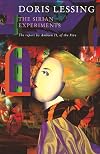
The Sirian Experiments: The Report by Ambien II, of the Five
by Doris Lessing
Canopus in Argos: Archives (3)
On This Page
Description
Relates the story of the education of a woman, Ambien II, who is one of the extremely long-lived administrators of the Sirian Empire.Tags
Recommendations

































Member Reviews
I'm struggling with this series. Lessing seems to trying to comment on earthly matters via a scifi tale using a fictional planet and competing alien empires. I'm not convinced it works.
I also struggle with the authors flaky grasp of evolution - a central part of the tale. Culture and race regualrly get mixed up with genuine evolutionary changes. I also wrestle with the author's focus on skin and hair colour and other superficialities such as height. I'm pretty sure she's not a bigot, but a long term colonial resident of Rhodesia/Zimbabwe could show more clarity here.
And there's the narrative style - the reader spends too much time wondering what is going on; who are these people; what are they trying to say . . .
Two more volumes to go show more in the series. I'll be a doubtful starter. show less
I also struggle with the authors flaky grasp of evolution - a central part of the tale. Culture and race regualrly get mixed up with genuine evolutionary changes. I also wrestle with the author's focus on skin and hair colour and other superficialities such as height. I'm pretty sure she's not a bigot, but a long term colonial resident of Rhodesia/Zimbabwe could show more clarity here.
And there's the narrative style - the reader spends too much time wondering what is going on; who are these people; what are they trying to say . . .
Two more volumes to go show more in the series. I'll be a doubtful starter. show less
This novel retells the history of Earth from the perspective of the Sirian Empire, a long-standing rival of Canopus, though they don't ever seem to be involved in all-out war. It's primarily narrated by Ambien II, a member of the Five that rule Sirius, and shows an alternate perspective to the events depicted in Shikasta... sort of. It's not exactly an alternate perspective, for though Ambien starts out antagonistic to Canopus, the novel details her slow conversion (over vast eons of time!) to Canopean beliefs, and it's written at a point where she has been converted, so the whole book is very heavily in favor of Canopean ideology. I liked it more than I did Shikasta, mostly because there were more moments where I connected to Ambien show more than there had been with Johor. She's put in an unfortunate position of no longer being accepted by her people in Sirius, but she's not (and never will be) one of the people of Canopus, either. (Now that I think about it, she's a lot like Al•Ith in The Marriages Between Zones Three, Four, and Five.) I especially liked the parts where Ambien went undercover on Earth, and encountered the agents of Canopus. Like Shikasta, however, the long fictional history eventually grew too repetitive to be interesting, though in this case the ending was absolutely killer.
I did continue to wonder whether or not the books were being written with the level of self-consciousness that Canopus might not really be "all that." You have a protagonist who is so enthralled by them that it is often difficult to tell. show less
I did continue to wonder whether or not the books were being written with the level of self-consciousness that Canopus might not really be "all that." You have a protagonist who is so enthralled by them that it is often difficult to tell. show less
This is in some ways quite a light hearted book, with moments of comedy as well as the more dominant didactic tone that characterises Lessing's science fiction. The lead character here is a female bureaucrat from the planet Sirius and the book tells her story of her interactions with the planet Canopus and, amongst other things, the evolution of our planet in which both more evolved societies have an interest. As ever, the chronological sweep and consistency of imagination is impressive - Lessing's science fiction universe is intellectually and rigorously coherent, and holds a mirror up to our understanding of our realities. But at the same time, this is a novel about growth and about the mistakes made along the way and as such has show more freshness, light and humour as well as pathos and tragedy. show less
if we wanted to, we could have crammed our planets with billions of genera, species, races—as they once had been. When we wanted, they could be left empty. We could—and did—maintain some planets, for special purposes, at high levels of population, and leave others virtually unpopulated. While all these variations on our basic problem were attempted, our space drive had been stabilised. We had discovered that no matter how forcefully we swept out into space, gathering in suitable planets as we found them, incorporating them into our general plan, we took our problems—or rather, our problem—with us. What did we need all these new colonies for? What was their purpose? If they had special conditions of climate, then we could tell show more ourselves they were useful—for something or other; if they had new minerals, or large deposits of those already known to us—they were used. But suppose we went on acquiring colonies and reached the number of a hundred . . . a thousand . . . what then?
As our philosophers asked, and argued.
We, the administrators, had been watching Canopus: she was not acquiring ever more colonies. She was stabilised on what she had. She had far fewer than we . . . she was developing and advancing them . . . But that was not how we saw it then: I have to record that we despised Canopus, that great neighbour of ours, our competitor, our rival, for being satisfied with such a low level of material development and acquisition.
In the first book in this series, agents from Canopus told the story of the planet known first as Rohanda the beautiful and then as Shikasta the broken. This book tells the story from the point of view of the Sirians, who shared the planet with the Canopeans, having been allocated the southern parts of the planet for their experiments. Ambien II, an administrator from Sirius whose contacts with Rohanda and Canopus span hundreds of thousands of years, and she writes this book at a time when she has finally come to understand Canopus. The Sirians have never understood the way that Canopus manages their planets and develop the races that live there, and have always resentfully believed that Canopus is being needlessly obscure and deceitful, when the refused to explain the nature of the Link, and answer every question about why they are acting in a particular way by saying that it was because of the Necessity.
Although this book takes place in prehistoric times and does not go deeply into the stories of individual humans as in the latter part of "Shikasta", I think I preferred "The Sirian Experiments" in some ways. Ambien II may be a colonial administrator to her very core, who refers to the less highly-developed races in her change as animals, but the story she tells is a personal one, looking back regretfully at her struggle to understand Canopus and come to terms with her betrayal of her original Sirian beliefs. show less
As our philosophers asked, and argued.
We, the administrators, had been watching Canopus: she was not acquiring ever more colonies. She was stabilised on what she had. She had far fewer than we . . . she was developing and advancing them . . . But that was not how we saw it then: I have to record that we despised Canopus, that great neighbour of ours, our competitor, our rival, for being satisfied with such a low level of material development and acquisition.
In the first book in this series, agents from Canopus told the story of the planet known first as Rohanda the beautiful and then as Shikasta the broken. This book tells the story from the point of view of the Sirians, who shared the planet with the Canopeans, having been allocated the southern parts of the planet for their experiments. Ambien II, an administrator from Sirius whose contacts with Rohanda and Canopus span hundreds of thousands of years, and she writes this book at a time when she has finally come to understand Canopus. The Sirians have never understood the way that Canopus manages their planets and develop the races that live there, and have always resentfully believed that Canopus is being needlessly obscure and deceitful, when the refused to explain the nature of the Link, and answer every question about why they are acting in a particular way by saying that it was because of the Necessity.
Although this book takes place in prehistoric times and does not go deeply into the stories of individual humans as in the latter part of "Shikasta", I think I preferred "The Sirian Experiments" in some ways. Ambien II may be a colonial administrator to her very core, who refers to the less highly-developed races in her change as animals, but the story she tells is a personal one, looking back regretfully at her struggle to understand Canopus and come to terms with her betrayal of her original Sirian beliefs. show less
This is my second reading of this book, and this time I read it immediately after 'Shikasta', to which it is a companion piece. It's fair to say that this book does not stand on its own and would even be baffling if one had not read Shikasta first. Unlike the other books in the Canopus in Argos Archives series, this one is closely coupled to the first. However it provides an interesting second perspective on that work. Where Shikasta was from the points of view firstly of Canopus and later various people of the stricken Shikasta, 'The Sirian Experiments' is told by a single narrator: Ambien II of Sirius, Canopus' galactic rival and neighbour.
Sirius is a materialistic empire. Its technology has conquered transport, communication, ageing, show more mortality, physical labour. But its immortal citizens have nothing to do: there is an existential crisis in the empire. Ambien II is one of the Five, immortal technocrats who semi-secretly run the Sirian Empire. Her interest in and envy of Canopus draws her to Rohanda, where she encounters the Canopean agent Klorathy. Klorathy shows her things on Rohanda/Shikasta which makes her begin to question herself and her Empire.
Ambien II is quite a dry and at times obtuse narrator (think of an immortal university bureaucrat and you might get the idea), so parts of this book can be heavy going at times. The structure is not innovative like Shikasta's. It is interesting to regard it as a very long companion document to Shikasta. It tells a somewhat long-winded tale of galactic evolution. show less
Sirius is a materialistic empire. Its technology has conquered transport, communication, ageing, show more mortality, physical labour. But its immortal citizens have nothing to do: there is an existential crisis in the empire. Ambien II is one of the Five, immortal technocrats who semi-secretly run the Sirian Empire. Her interest in and envy of Canopus draws her to Rohanda, where she encounters the Canopean agent Klorathy. Klorathy shows her things on Rohanda/Shikasta which makes her begin to question herself and her Empire.
Ambien II is quite a dry and at times obtuse narrator (think of an immortal university bureaucrat and you might get the idea), so parts of this book can be heavy going at times. The structure is not innovative like Shikasta's. It is interesting to regard it as a very long companion document to Shikasta. It tells a somewhat long-winded tale of galactic evolution. show less
I read this one as part of my occasional project to read as many Booker shortlisted books as possible. This is part of Lessing's Canopus in Argos sci-fi series, and I have not read the earlier parts. I don't know how much I missed, but this one seems to work pretty well as a stand-alone novel.
I approached it as a work of imagination - its central premise that the history of man on earth is largely a result of experimentation from alien civilisations from distant stars seems a little far-fetched and rather runs counter to Darwin and evolution, but I don't generally criticise sci-fi on plausibility grounds.
The two civilisations in Lessing's story are both utopian, but very different. This book's narrator is one of the five administrators show more that control Sirius's planetary empire, but she increasingly comes to favour the more idealistic methods of the rival civilisation from Canopus. She is effectively immortal. At the start of the book we hear that after a war between the two civilisations they have agreed to share control of the planet Sirius calls Rohinda and Canopus calls Shikasta, but is more familiar as our earth. Sirius favours experments in which populations are moved between planets as colonists, whereas Canopus believes in working with whatever indigenous species they find. A third rogue civilisation, regarded by both Sirius and Canopus as pirates, is also increasingly influential on the planet.
Doris Lessing is capable of writing in a wide variety of styles, and always has interesting ideas, and I found the book quite an enjoyable read, but I rather doubt that I will ever read the rest of the series. show less
I approached it as a work of imagination - its central premise that the history of man on earth is largely a result of experimentation from alien civilisations from distant stars seems a little far-fetched and rather runs counter to Darwin and evolution, but I don't generally criticise sci-fi on plausibility grounds.
The two civilisations in Lessing's story are both utopian, but very different. This book's narrator is one of the five administrators show more that control Sirius's planetary empire, but she increasingly comes to favour the more idealistic methods of the rival civilisation from Canopus. She is effectively immortal. At the start of the book we hear that after a war between the two civilisations they have agreed to share control of the planet Sirius calls Rohinda and Canopus calls Shikasta, but is more familiar as our earth. Sirius favours experments in which populations are moved between planets as colonists, whereas Canopus believes in working with whatever indigenous species they find. A third rogue civilisation, regarded by both Sirius and Canopus as pirates, is also increasingly influential on the planet.
Doris Lessing is capable of writing in a wide variety of styles, and always has interesting ideas, and I found the book quite an enjoyable read, but I rather doubt that I will ever read the rest of the series. show less
Not only one or the best scifi books I've ever read but probably one with the most profound social commentary.
Members
- Recently Added By
Lists

Booker Prize
491 works; 62 members

Booker Prize Shortlist: Titles Not Yet Read
161 works; 4 members

Man Booker Prize Longlist 1981
7 works; 2 members
Author Information

264+ Works 37,219 Members
Doris Lessing was born in Kermanshah, Persia (later Iran) on October 22, 1919 and grew up in Rhodesia (the present-day Zimbabwe). During her two marriages, she submitted short fiction and poetry for publication. After moving to London in 1949, she published her first novel, The Grass Is Singing, in 1950. She is best known for her 1954 Somerset show more Maugham Award-winning experimental novel The Golden Notebook. Her other works include This Was the Old Chief's Country, the Children of Violence series, the Canopus in Argos - Archives series, and Alfred and Emily. She has received numerous awards for her work including the 2001 Prince of Asturias Prize in Literature, the David Cohen British Literature Prize, and the 2007 Nobel Prize for Literature. She died on November 17, 2013 at the age of 94. (Bowker Author Biography) show less
All Editions
Some Editions
Awards and Honors
Awards
Series

Work Relationships
Is contained in
Common Knowledge
- Canonical title
- The Sirian Experiments: The Report by Ambien II, of the Five
- Original publication date
- 1981
- People/Characters
- Ambien II; Klorathy; Nasar; Tafta; Ambien I
- Important places
- Rohanda; Shikasta
- First words
- This is Ambien II, of the Five.
I have undertaken to write an account of our experiments on Rohanda, known to Canopus in this epoch as Shikasta.
The reception of Shikasta and, to a lesser extent, or The Marriages Between Zones Three, Four, and Five suggests that I should say something in way of clarification...if I created a cosmology, then it is only fo... (show all)r literary purposes! (Preface) - Last words
- (Click to show. Warning: May contain spoilers.)I reflect, too, that this rapport between us old colleagues may stand us all in good stead yet when - as you will, I am sure, agree seems more and more likely to happen - we all find ourselves together in "corrective exile" on this this quite pleasant though tedious Planet 13.
(Click to show. Warning: May contain spoilers.)But we can't all be physicists. (Preface)
Classifications
Statistics
- Members
- 696
- Popularity
- 41,238
- Reviews
- 13
- Rating
- (3.74)
- Languages
- 11 — Danish, Dutch, English, Finnish, French, German, Italian, Norwegian (Bokmål), Spanish, Swedish, Turkish
- Media
- Paper, Ebook
- ISBNs
- 22
- ASINs
- 11